11B vs 11C: Which Infantry MOS Is Right for You
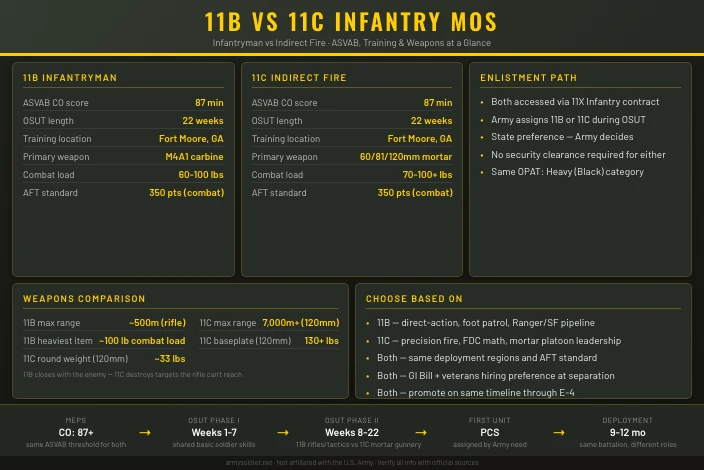
Both jobs will get you into the fight. The 11B Infantryman closes with the enemy on foot, rifle in hand. The 11C Indirect Fire Infantryman destroys targets from behind cover, dropping mortar rounds on positions the rifle can’t reach. They share the same ASVAB requirement, the same 22-week OSUT at Fort Moore, and the same combat MOS designation – but the day-to-day work is different enough that the choice matters. Here’s what separates them.
ASVAB and Enlistment Requirements
Both MOS require a minimum Combat (CO) composite score of 87 on the ASVAB. The CO score combines Verbal Expression (VE), Auto and Shop Information (AS), and Mechanical Comprehension (MC). That’s the same threshold, so your test scores alone won’t decide which job you get.
| Requirement | 11B Infantryman | 11C Indirect Fire |
|---|---|---|
| ASVAB CO score | 87 minimum | 87 minimum |
| AFQT minimum | 31 (diploma) / 50 (GED) | 31 (diploma) / 50 (GED) |
| OPAT category | Heavy (Black) | Heavy (Black) |
| Security clearance | Not required | Not required |
| Vision | Correctable to 20/20 | Correctable to 20/20 |
Both MOS are accessed through the 11X Infantry enlistment contract. You state a preference for 11B or 11C, but the Army makes the final call based on its needs at the time you complete training. That assignment happens during OSUT, not at the recruiting station.
The one area where 11C has a slight edge: the FDC (Fire Direction Center) side of the job rewards strong math skills. Soldiers who score well on Arithmetic Reasoning and Mechanical Comprehension tend to excel there. The ASVAB minimum is the same, but your actual subtest breakdown matters more for 11C.
Training: One Pipeline, Two Jobs
Both MOS share the same 22-week One Station Unit Training (OSUT) at Fort Moore, Georgia. The first seven weeks are identical – basic soldier skills, rifle marksmanship, land navigation, first aid, and physical conditioning. After that, the courses split.
11B training (weeks 8-22) focuses on close combat. You master crew-served weapons like the M249 SAW and M240B machine gun, practice urban operations and room clearing, run platoon live-fire exercises, and conduct multi-day field problems. The final weeks simulate large-scale combat at the platoon level.
11C training (weeks 8-22) centers on the mortar. You learn to operate all three systems – the 60mm M224A1, the 81mm M252A1, and the 120mm M120/M121. Classroom instruction covers ballistics, the mil-relation formula, and manual gunnery calculations. You also train on Fire Direction Center (FDC) procedures: receiving calls for fire, computing deflection and elevation data, and transmitting commands to the gun line. Field exercises include live-fire qualifications with all three calibers.
Both tracks are physically demanding. The difference is that 11C adds a technical layer – you need to be accurate under pressure and handle math while under fire.
Weapons and Equipment
The weapons are where the two jobs diverge most clearly.
11B primary weapons:
- M4A1 carbine (primary weapon)
- M249 Squad Automatic Weapon or XM250 (automatic rifle)
- M240B medium machine gun
- M320 grenade launcher
- AT-4 anti-armor rocket
- Javelin anti-tank missile system
11C mortar systems:
- M224A1 (60mm) – man-portable, up to 3,500-meter range
- M252A1 (81mm) – medium mortar, up to 5,600-meter range
- M120/M121 (120mm) – heavy mortar, exceeds 7,000-meter range; mounted on M1064 or Stryker carriers
The 11B’s world is rifles, machine guns, and anti-armor at distances measured in hundreds of meters. The 11C’s world is indirect fire measured in kilometers – you rarely see what you’re shooting at. A single 120mm round can level a vehicle or destroy a fighting position. That kind of firepower means the 11C carries a heavier physical load: a 120mm baseplate alone weighs over 130 lbs, and a single round weighs about 33 lbs.
Daily Work: Garrison vs Field
In garrison, the two jobs look different right away.
An 11B in garrison spends time on weapons maintenance, battle drills, vehicle maintenance, and range qualifications. The infantry fire team structure – four soldiers, two teams per squad – means constant small-unit training. Your team leader drives your schedule.
An 11C in garrison drills mortar crew procedures: setting up the gun, bore-sighting, computing firing data on the plotting board, and tearing down before counter-fire can locate your position. FDC personnel practice manual calculations that back up digital systems. Speed and precision get rehearsed until both are automatic.
In the field, the 11B moves on foot or in vehicles toward the enemy. The 11C occupies a firing position behind the forward line, receives calls for fire over the radio, and puts rounds on target. Then the crew displaces before the enemy can respond. A well-drilled 11C crew can set up, fire, and move in under a minute.
Physical Demands
Both carry the combat standard for the Army Fitness Test: 350 total points minimum, with at least 60 per event. The five AFT events are the 3-Rep Max Deadlift, Hand-Release Push-Up, Sprint-Drag-Carry, Plank, and Two-Mile Run.
The physical workload in the field differs meaningfully.
| Task | 11B | 11C |
|---|---|---|
| Typical combat load | 60-100 lbs | 70-100+ lbs |
| Heaviest single item | M4 + kit | 120mm baseplate (130+ lbs) |
| Primary movement | Foot patrols, assaults | Crew displacement with equipment |
| Unique hazard | Direct enemy fire exposure | Blast overpressure, hearing damage |
The 11B takes more physical risk from direct fire. The 11C deals with cumulative wear from lifting and carrying extremely heavy equipment repeatedly – mortar components, ammunition cans (40-50 lbs each), and crew gear. The Army tracks hearing loss in mortar crews through annual audiograms because repeated blast exposure causes measurable damage over time.
Deployment and Unit Assignment
Both MOS deploy wherever their infantry battalion goes. Deployment regions for active-duty infantry units span the Middle East, Europe (NATO rotations), the Pacific, and Africa. A standard rotation runs 9-12 months deployed followed by 18-24 months at home station.
The difference is how they’re used on deployment. The 11B walks patrols, clears buildings, and runs checkpoints in direct contact with threats. The 11C supports those same operations from a protected position, responding to calls for fire from forward observers. When the rifle platoon makes contact, the mortar platoon puts suppressive fire on the enemy to break contact or allow maneuver.
High-readiness units with the fastest deployment cycles:
- 82nd Airborne Division at Fort Liberty – maintains a Global Response Force brigade on 18-hour recall
- 101st Airborne Division at Fort Campbell – air assault infantry with frequent rotations
- 10th Mountain Division at Fort Drum – one of the most deployed divisions since 2001
- 4th Infantry Division at Fort Carson – regular CENTCOM and EUCOM rotations
One practical note: the 11C has fewer billets in the Army Reserve. Most part-time infantry slots – for either MOS – are in the Army National Guard, which maintains mortar sections within infantry battalions across most states.
Promotion and Career Progression
The promotion path is identical through the junior ranks. Both MOS promote automatically through E-4 based on time-in-service requirements, then go to the board at E-5.
Where the paths diverge is specialization. The career schools and leadership roles split along very different lines after E-5.
| Rank | 11B Path | 11C Path |
|---|---|---|
| E-5 (SGT) | Fire team leader; Ranger, Airborne, Sniper schools | Section member; Infantry Mortar Leader Course (IMLC) |
| E-6 (SSG) | Squad leader (9 soldiers) | Mortar section leader (3-5 crews) |
| E-7 (SFC) | Platoon sergeant | Mortar platoon sergeant; FDC operations chief |
| E-8+ | First sergeant; senior infantry advisor | First sergeant; battalion mortar advisor |
An 11B Sergeant pursues schools like Ranger (61 days), Airborne (3 weeks), Sniper (7 weeks), or Special Forces Assessment and Selection after two years. The career ladder leads toward fire team leader at E-5 and squad leader at E-6, commanding 9 soldiers.
An 11C Sergeant pursues the Infantry Mortar Leader Course (IMLC) at Fort Moore, which earns the ASI B1 identifier and makes you competitive for section leader and platoon sergeant roles. Senior 11C NCOs run sections of 3-5 mortar crews and manage the FDC. At the E-7 level, you are the mortar platoon sergeant – the technical and tactical expert for the most powerful organic weapon in the battalion.
Both MOS feed strong performers toward Ranger qualification and airborne units. The 75th Ranger Regiment accepts both 11B and 11C soldiers who pass Ranger Assessment and Selection Program (RASP).
Civilian Career Paths
Neither MOS comes with a license or certification at the end of service. What they offer is leadership experience, operational discipline, and a track record that resonates with specific civilian employers.
| Civilian Path | 11B Fit | 11C Fit |
|---|---|---|
| Law enforcement / federal agencies | Strong | Strong |
| Emergency management | Good | Good |
| Private security / contractor | Strong | Moderate |
| Logistics / operations management | Moderate | Strong (FDC experience) |
| Construction / trades | Moderate | Moderate |
The FDC side of the 11C role – managing complex calculations, coordinating with multiple radio nets, and tracking friendly and enemy positions – maps more directly to operations management and logistics roles than pure infantry experience does. The Bureau of Labor Statistics shows a 17% growth outlook for logisticians through 2034, and infantry veterans who can demonstrate precision work under pressure have a real case for those roles.
The GI Bill covers up to 36 months of tuition at a public university for either path, plus a monthly housing allowance. Both MOS qualify veterans for hiring preference at federal agencies including CBP, the Secret Service, and DEA.
Which One Should You Choose?
The Army assigns you to one through the 11X contract, but you can state a preference. Here’s how to think about it.
Choose 11B if you:
- Want direct-action combat experience on foot
- Plan to pursue Ranger School, Special Forces, or Airborne units early
- Prefer a physical, kinetic role over a technical one
- Are less interested in math-heavy tasks
Choose 11C if you:
- Have strong math and spatial reasoning skills
- Want to operate the battalion’s most powerful weapons system
- Are interested in leadership roles that blend technical expertise with combat
- Want post-service credentials that support logistics or operations careers
Both paths lead to the same combat deployments, the same physical grind, and the same promotional timeline. The question is whether you want to be the one pulling the trigger at close range or the one dropping rounds from a kilometer away.
For full details on each role, the 11B Infantryman and 11C Indirect Fire Infantryman profiles cover pay, training phases, duty stations, and post-service options in depth.
You may also find Army Combat Arms Jobs: Infantry, Armor, Artillery and Best ASVAB Scores for Combat Arms MOS helpful for comparing how infantry fits into the broader combat arms picture.
This site is not affiliated with the U.S. Army or any government agency. Verify all information with official Army sources before making enlistment or career decisions.