12B Combat Engineer: What It's Really Like
Most people hear “combat engineer” and picture someone blowing up a bridge. That’s part of it. But a 12B also digs fighting positions by hand in the dark, drives a bulldozer through wire obstacles, and spends half their garrison life doing equipment maintenance. If you want to know what the job actually looks like from Monday to Friday – and what it looks like downrange – this post breaks it down.
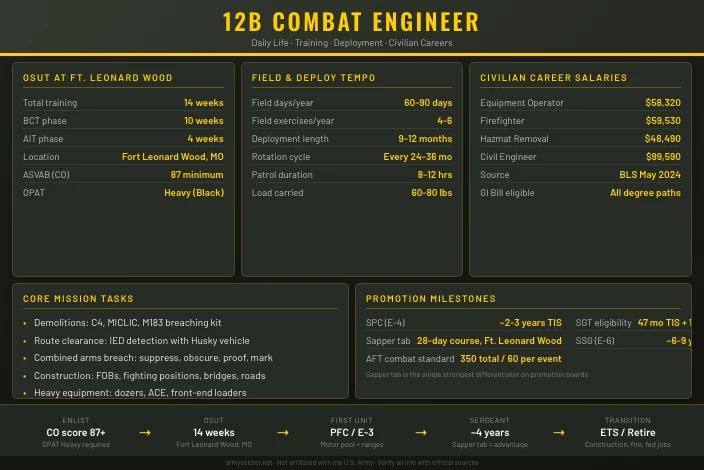
OSUT at Fort Leonard Wood
Training happens at Fort Leonard Wood, Missouri, home of the U.S. Army Engineer School. The 12B uses One Station Unit Training, which means Basic Combat Training and Advanced Individual Training run back-to-back under the same cadre, for a total of 14 weeks.
The first ten weeks cover the same material every Army soldier goes through: rifle qualification, land navigation, first aid, tactical movement, and the Army Fitness Test. You share that phase with other trainees going into Military Police and Chemical Corps MOSs, all of whom train at Fort Leonard Wood.
The last four weeks are combat engineer specific. The pace changes noticeably.
What AIT covers:
- Demolitions: C4, TNT, cratering charges, detonation cord, and how to calculate the charge needed for a specific task (cutting a steel beam vs. breaching a concrete wall takes very different math)
- Minefield operations: emplacing and detecting anti-tank and anti-personnel mines using hand tools and mine detectors
- Obstacle construction: building wire obstacles, tank ditches, abatis, and fighting positions
- Bridge and crossing operations: basic tactical bridging
- Heavy equipment: orientation on bulldozers, front-end loaders, and the Armored Combat Earthmover (ACE)
Fort Leonard Wood’s training regiment also added water survival drills to OSUT in recent years. Trainees practice removing boots and trousers while treading water and improvising flotation devices from their ACUs. It sounds unusual, but engineer missions often involve water crossing, and the Army wants soldiers who don’t panic near water.
Graduation leaves you as a Private First Class (most of the time) and sends you to your first unit.
Garrison Life: What a Normal Week Looks Like
Your first duty station sets the tone. Combat engineer units run a tighter operational tempo than most support MOSs.
A typical garrison week:
| Time | Activity |
|---|---|
| 0600-0700 | Physical training (PT) |
| 0700-0900 | Recovery, hygiene, breakfast formation |
| 0900-1700 | Mission: maintenance, range prep, training |
| 1700+ | Personal time (unless a field exercise is coming) |
The afternoon block is where the job shows up. On a maintenance day, you’re in the motor pool checking fluid levels, tracking vehicle faults, and fixing what broke during the last field exercise. Combat engineers operate equipment worth millions of dollars, and that equipment has to be ready when the unit needs it.
Range days are different. You draw explosives from the ammunition supply point, brief the safety plan, set the range, and spend the day running live demolition tasks. These are the days people remember.
Field exercises break the garrison routine 4 to 6 times per year, typically running one to three weeks each. You live in the field, run combat engineer tasks around the clock, and come back needing a real shower. Expect to spend roughly 60 to 90 days per year in the field outside of deployments.
Training days fill the gaps between ranges and field exercises. These cover tactics refreshers, new equipment familiarization, and mandatory Army training. Squad leaders run land navigation refreshers, junior NCOs lead pre-combat checks, and every soldier cycles through first aid sustainment at some point during the year. The pace is rarely slow in a combat engineer unit. Even the weeks with nothing special scheduled stay busy with maintenance, physical training, and the administrative overhead of a high-readiness unit.
Demolitions: The Part That Draws Everyone In
Demolitions training starts in AIT and never stops. Combat engineers are required to maintain demolition qualifications, which means hands-on live work at least once a year throughout your career. Annual qualification is not optional – units schedule demolition ranges to keep every 12B current, and soldiers who fall out of qualification get flagged.
The core explosive is C4 (Composition C-4), a plastic explosive that is stable to handle but detonates reliably with a blasting cap. You learn to calculate shaped charges (for cutting steel), general demolition charges (for destroying equipment or structures), and breaching charges (for blowing holes through walls). The math is not complicated, but the stakes of getting it wrong are high, and the Army treats each step as a procedural requirement, not a suggestion.
Beyond C4, you train on:
- M183 demolition charge assembly – the standard breaching kit, designed for door and wall entry
- M58 MICLIC (Mine Clearing Line Charge) – a rocket-propelled line charge that blasts a lane through a minefield
- Cratering charges – for destroying airfields or roads
- Bangalore torpedoes – metal tubes packed with explosive, pushed through wire obstacles
- Time fuse and detonating cord – used to sequence multiple charges or create standoff between the soldier and the blast
Every demolition operation runs under strict two-person control and formal safety procedures. Range control approves every shot. Blast radius calculations go on paper before anything gets rigged. The Army takes mishandling explosives seriously, and so does your unit. Soldiers who cut corners on demolition safety procedures face serious disciplinary consequences, and those consequences are enforced consistently because the alternative is catastrophic.
Route Clearance Operations
If you deploy with a route clearance company or platoon, your primary mission is finding and neutralizing IEDs before they kill the people driving the roads behind you.
A clearance patrol typically runs 8 to 12 hours. The lead element uses the Husky Mine Detection Vehicle and RG-31 or Buffalo armored vehicles fitted with cameras and manipulation arms. Dismounted soldiers check culverts, bridges, and suspected emplacements on foot. The team behind them maintains security.
The work is methodical and physically grinding. Body armor in 100-degree heat, constant scanning, and the knowledge that the ground you’re walking might be rigged. Experienced engineers say route clearance is less about bravery and more about discipline – the same careful procedure executed the same way every single time.
Key equipment used on route clearance patrols:
- Husky – a blast-resistant vehicle with ground-penetrating radar that detects buried pressure plates and IED components
- Buffalo – a mine-protected vehicle with a 30-foot robotic arm used to probe suspect areas and recover IED components for intelligence exploitation
- RG-31 – a mine-resistant ambush-protected vehicle carrying the dismounted team
- Portable metal detectors – carried by dismounted engineers for hand-scanning culverts and roadside areas
Injury risk is real. IED exposure is the primary hazard. Back problems and knee injuries accumulate from years of dismounted patrols under load. Hearing damage from blasts and equipment noise is common enough that the Army runs mandatory hearing checks throughout your career. Soldiers who complete multiple route clearance deployments frequently apply for EOD or Sapper training, where the technical skills gained in clearance operations carry direct credit toward qualification.
Breaching and Combat Operations
In a combined arms breach, the combat engineer’s job is to punch a lane through a minefield or obstacle belt so tanks and infantry can pass through. It is one of the most choreographed and dangerous tasks in ground combat. Engineers rehearse breach operations more than almost any other task because the sequence has to run correctly the first time, under fire, with zero tolerance for miscommunication between the engineer, infantry, and armor elements.
The sequence:
- Suppress enemy defenders covering the obstacle
- Obscure the breach point with smoke
- Secure the near side of the obstacle
- Proof the lane with a MICLIC or manual breaching
- Mark the lane for following forces
- Maintain the breach under fire
In training, you rehearse each step separately and then run them together at speed. In live exercises at places like the National Training Center at Fort Irwin, the entire combined arms sequence runs against an opposing force that actively disrupts the operation. Rotations at NTC are considered the most realistic training combat engineers receive short of actual combat – the opposing force is experienced, aggressive, and designed to expose every weakness in the breach plan.
Few Army jobs put a junior soldier in a more operationally consequential role than breach operations. An E-4 running a breaching charge is directly responsible for whether the next unit gets through. That accountability is one reason combat engineers tend to develop strong attention to detail early in their careers – the consequences of skipping a step are immediate and visible to everyone in the formation.
Construction Work: The Other Half of the Job
Combat engineers build things when they’re not blowing them up. In garrison and on deployments, you construct:
- Fighting positions and defensive perimeters
- Forward operating base infrastructure (barriers, guard towers, bunkers)
- Temporary and semi-permanent bridges
- Roads and grading in austere environments
- HESCO barrier systems and blast wall installations around protected areas
Heavy equipment operation is a real career track inside the 12B. Soldiers with formal operator certification on bulldozers, excavators, and motor graders are valuable both in the unit and after separation. Some 12Bs spend most of their career in construction-focused engineer units and build a civilian-ready operator skill set. The Army certifies operators through a formal licensing process that mirrors civilian standards, so the paperwork you earn in uniform carries real weight when you get out.
Bridging operations are a separate skill set within construction work. 12Bs learn to emplace and displace tactical bridges, including the Improved Ribbon Bridge used for wet gap crossings. Bridging exercises require precise coordination because the structure has to support tank traffic and be recoverable under pressure. Units that specialize in mobility support to heavy forces spend a significant portion of their training on bridging.
The Army also responds to natural disasters with combat engineer units. After major floods or hurricanes, engineers clear debris, restore road access, and repair infrastructure. These domestic response missions are distinct from combat but use the same equipment and techniques. Engineers who have participated in disaster response missions report that the work builds problem-solving skills that don’t come from any training scenario – the conditions are uncontrolled, the timeline is compressed, and the results matter to real people immediately.
Promotion Timeline
Promotion through the junior ranks moves at a pace that depends partly on Army needs and partly on your performance.
| Rank | Pay Grade | Typical Time in Service |
|---|---|---|
| Private First Class (PFC) | E-3 | 1-2 years |
| Specialist (SPC) | E-4 | 2-3 years |
| Sergeant (SGT) | E-5 | ~4 years (eligible at 47 months TIS) |
| Staff Sergeant (SSG) | E-6 | 6-9 years |
| Sergeant First Class (SFC) | E-7 | 9-14 years |
E-4 to E-5 is the first competitive gate. Soldiers need 47 months of total time in service and 11 months time in rank as an E-4 to be eligible for the promotion board. After that, your score on the Promotion Point Worksheet determines how fast you actually pin sergeant. Points come from military education, civilian education, awards, weapons qualification, and physical fitness scores.
Earning the Sapper tab changes the calculus. Sapper-qualified soldiers stand out on promotion boards. The 28-day Sapper Leader Course at Fort Leonard Wood is physically and mentally demanding, but graduates report faster promotion and better assignment options.
The Ranger tab is also attainable for combat engineers, and units actively encourage soldiers to attend. Rangers are assigned to engineer units throughout the Army, and the tab carries weight at every promotion board. Air Assault and Airborne school add additional qualification badges that contribute both to promotion points and to assignment options at units like the 82nd Airborne Division and 101st Airborne Division. Engineers who stack qualifications early in their career tend to hit E-6 faster than peers who wait to pursue additional schooling.
Physical Demands and Wear on the Body
This is not a desk job, and the physical cost accumulates.
You carry 60 to 80 pounds of equipment on dismounted patrols. Digging fighting positions by hand – 6 feet long, 18 inches wide, deep enough to stand in – is a recurring task. Operating heavy equipment in jarring conditions stresses the lower back. Route clearance patrols in full kit over rough terrain punish knees and ankles.
Long-serving combat engineers commonly deal with:
- Lower back injuries (from equipment operation and load-bearing)
- Knee and ankle problems (from years of dismounted movement under weight)
- Hearing damage (from demolitions, heavy equipment, and weapons fire)
- Shoulder injuries (from manual labor and load-carrying)
This doesn’t mean everyone gets hurt. It means the job has a physical cost, and the Army’s health system tracks it. Engineers who take recovery and maintenance seriously – lifting technique, sleep, nutrition – do better over a full career than those who ignore it.
The Army Fitness Test (AFT) measures combat readiness five ways: three-rep max deadlift, hand-release push-up, sprint-drag-carry, plank, and two-mile run. Combat engineers need a minimum total score of 350 (with at least 60 per event) to meet the combat arms standard.
What Deployment Actually Looks Like
Active-duty combat engineers deploy on a 9 to 12 month rotation every 24 to 36 months, tied to their parent brigade’s schedule. Engineer platoons attach to infantry and armor units, so you go where the maneuver force goes.
Deployment missions vary more than most people expect:
- Route clearance: systematic IED clearance on main supply routes
- FOB construction: building and improving the infrastructure of forward operating bases
- Airfield repair and improvement: maintaining airstrips in austere environments
- Barrier and perimeter operations: blast walls, HESCO barriers, guard towers
- Breaching support: for deliberate assault operations
- Theater opening: preparing entry points, ports of debarkation, and logistics infrastructure in the early phase of an operation
Not every deployment involves direct contact with the enemy. Many combat engineers spend deployments doing construction missions in relatively secure areas. Others run clearance operations in actively contested territory for months at a stretch. Assignment varies by unit and operational demand.
Reserve and National Guard engineers deploy on a different schedule. Guard units typically mobilize for 9 to 12 months when federally activated, but activations happen less frequently than the active-duty rotation cycle. Guard engineers who are not on federal orders often support state emergency responses – flood relief, wildfire support, hurricane recovery – which provides real-world experience using the same equipment they would deploy with. For a soldier who wants engineer experience without a full active-duty commitment, the Guard offers more hands-on field time than most other reserve career options.
Civilian Career Options After Service
The skills you build as a 12B have direct civilian value. The question is which direction you want to go.
Construction and heavy equipment: Operator certification on dozers, loaders, and excavators transfers directly. Construction equipment operators earn a median salary of $58,320 annually, with strong demand in infrastructure and energy sectors. Veterans with formal military operator training frequently bypass entry-level licensing requirements.
Demolition and hazmat: Commercial demolition companies actively recruit veterans with demolition qualifications. Hazardous materials removal workers earn a median of $48,490, and the security clearance many 12Bs hold adds value in government contracting.
Law enforcement and firefighting: The discipline, physical conditioning, and decision-making under stress that combat engineers develop translate cleanly to fire service and law enforcement. Firefighter median pay sits at $59,530. Many departments give veterans hiring preference and count military service toward time-in-grade requirements.
Civil engineering (with degree): The GI Bill covers full in-state tuition at a public university. Civil engineers with a degree earn a median of $99,590. Construction management programs often credit military experience toward degree requirements.
Federal agencies are another strong path. The Army Corps of Engineers, FEMA, and DHS specifically recruit veterans with engineer backgrounds for civilian positions in infrastructure, emergency management, and construction oversight.
Explore the full 12B Combat Engineer MOS profile for detailed pay figures, ASVAB score requirements, and duty station options.
For a comparison of every engineer MOS by civilian career value, see Army Engineer MOS Jobs: Combat and Construction. You may also find the Army engineer career field overview and ASVAB line scores for every engineer MOS useful as you research your options.
This site is not affiliated with the U.S. Army or any government agency. Verify all information with official Army sources before making enlistment or career decisions.