13B vs 13F: Cannon Crew vs Fire Support Specialist
Both jobs put artillery rounds on target. The difference is where you stand when those rounds leave the gun. The 13B Cannon Crewmember loads, aims, and fires the howitzer from a gun line miles behind the action. The 13F Fire Support Specialist stands at the front edge with infantry, picking the targets and calling the fire in. Same battlefield, opposite ends of the kill chain.
If you are weighing these two MOSs, the choice comes down to what kind of soldier you want to be: crew-served weapon operator or forward combat observer.
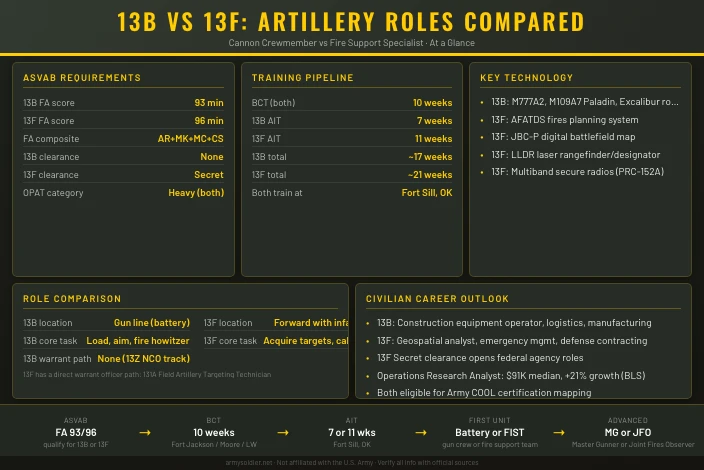
What Each Job Actually Does
The most important difference between these two MOSs is physical location on the battlefield.
13B Cannon Crewmembers work at the gun line inside a field artillery battery. Your section of six soldiers operates a single howitzer, whether that is the towed M777A2, the lightweight M119A3, or the self-propelled M109A7 Paladin. When a fire mission comes in, the section chief calls out the data and the crew executes: set the deflection, set the elevation, prepare the round, load it, fire it. A trained crew can fire multiple rounds per minute and displace to a new position before counter-battery fire arrives at the old one.
13F Fire Support Specialists are attached to infantry and armor companies, not artillery batteries. You move, fight, and live with those maneuver units. Your job is to find targets and bring fire onto them from whatever asset is available: howitzers, mortars, attack helicopters, or fast-mover jets. You send the call-for-fire mission. The 13B at the gun line executes it.
| Factor | 13B Cannon Crewmember | 13F Fire Support Specialist |
|---|---|---|
| Primary location | Gun line (battery) | Forward with infantry/armor |
| Core skill | Howitzer operations | Target acquisition and fire control |
| Crew vs solo | Six-person crew | 2-4 person FIST, often solo at OP |
| FA line score | 93 minimum | 96 minimum |
| Security clearance | None | Secret required |
| AIT length | 7 weeks | 11 weeks |
| Warrant path | 13Z (FA Senior NCO) | 131A Targeting Technician |
ASVAB Requirements
Both MOSs use the Field Artillery (FA) composite score. The FA composite combines Arithmetic Reasoning (AR), Mathematics Knowledge (MK), Mechanical Comprehension (MC), and Coding Speed (CS). You need solid math and mechanical aptitude to hit either threshold.
| Requirement | 13B Cannon Crewmember | 13F Fire Support Specialist |
|---|---|---|
| FA composite | 93 minimum | 96 minimum |
| Security clearance | None required | Secret required |
| Color vision | Not disqualifying | Normal color vision required |
| Visual acuity | Correctable to 20/20 | Correctable to 20/20, depth perception required |
| OPAT category | Heavy (Black) | Heavy (Black) |
The three-point gap between the FA scores looks small, but the 13F adds a Secret security clearance requirement that the 13B does not have. Your recruiter submits the clearance investigation at MEPS, and the process typically takes two to six months. Any serious criminal history, significant debt, or drug use can disqualify you from 13F even if your ASVAB score is fine.
The 13F’s vision requirements are more restrictive because accurate target location depends on being able to read terrain features, identify military equipment by color and shape, and operate laser rangefinders at extended distances. A 13B who later wants to reclassify to 13F must meet the vision and clearance standards at that time.
If you are not sure whether your ASVAB subscores will meet the FA composite threshold, the ASVAB study guide covers the four component subtests in detail. Arithmetic Reasoning and Mathematics Knowledge are the highest-weighted components and the best place to focus preparation time.
Training Pipelines
Training for both MOSs starts with the same 10-week Basic Combat Training at Fort Jackson, Fort Moore, or Fort Leonard Wood. After that, the paths split at Fort Sill, Oklahoma, home of the Fires Center of Excellence.
13B AIT runs 7 weeks. You learn howitzer operations from the ground up: loading procedures, fuse and charge preparation, manual firing data computation, digital fire control systems, and vehicle operations for the trucks and tracked equipment that move the gun. Safety training for high-explosive munitions is drilled until it is automatic. You graduate knowing how to operate the gun, maintain it, and move your section under field conditions.
13F AIT runs 11 weeks. The longer pipeline reflects the broader skill set required. You cover observed fire procedures, target location with GPS and laser equipment, fire support planning, radio communication across multiple nets, and the full range of fire assets you can call: howitzers, mortars, HIMARS rockets, attack aviation, and close air support. A significant portion of training is field-based, putting you in simulated combat scenarios where you set up observation posts and execute live-fire call-for-fire missions under pressure.
After AIT, 13F soldiers commonly pursue the Joint Fires Observer (JFO) course, which adds the ability to control close air support and direct aircraft onto targets. JFO certification is a major career milestone. 13B soldiers pursue the Field Artillery Master Gunner course at E-6 and above, which makes you the battery’s technical gunnery expert.
Technology and Systems
The two MOSs use different tools for the same network.
13B technology focuses on the howitzer and its fire control systems:
- M109A7 Paladin digital fire control system – processes firing data and automates gun laying
- M777A2 digital sight – integrates GPS and ballistic data for precision fires
- Modular Artillery Charge System (MACS) – propellant charge system for modern 155mm ammunition
- Excalibur GPS-guided rounds – precision munitions extending effective range beyond 40 kilometers
13F technology focuses on target location, data routing, and communication:
- AFATDS (Advanced Field Artillery Tactical Data System) – the digital fires hub that routes missions from observer to firing unit, tracking all indirect fire assets in the area
- JBC-P (Joint Battle Command-Platform) – tracks friendly and enemy positions on a digital battlefield map, shared across ground units
- LLDR (Lightweight Laser Designator Rangefinder) – locates targets with GPS precision using integrated laser and thermal optics
- Vector 21 binoculars – day and night observation at long range
- AN/PRC-152A and AN/PRC-117G radios – secure multiband radios for coordinating across the maneuver, fire support, and air nets simultaneously
AFATDS and JBC-P sit at the intersection of both jobs. The 13F plans and routes fire missions through AFATDS. The 13B’s fire direction center receives and processes those missions on the same system. Learning to work one side of that digital network makes the other side easier to understand if you ever cross-train or transfer.
Daily Life and Work Environment
In garrison, the two jobs look very different.
A typical day for a 13B starts with physical training, moves to motor pool maintenance, and fills afternoons with crew drills, ammunition inspections, and gunnery training. The howitzer is a complex piece of equipment that requires constant upkeep. Much of garrison life revolves around keeping the gun qualified and the crew sharp. You work and live within your artillery battery, a tight community of 80 to 150 soldiers.
A 13F in garrison splits time between the fire support office and training with the maneuver unit. You sit through fire support planning classes, run radio drills with the infantry or armor company you are attached to, and maintain your targeting equipment. Your daily schedule mirrors the maneuver unit’s, not the artillery battery’s. That means running with the infantry platoon’s PT, attending their training events, and learning their tactics so you can integrate fires accurately when they contact the enemy.
Garrison life at a glance:
- 13B: Motor pool, howitzer maintenance, crew gunnery drills, ammunition accountability, section-level training
- 13F: Fire support planning, radio drills, targeting equipment checks, joint training with infantry or armor company, terrain analysis exercises
In the field, both MOSs work long hours under physical stress. The 13B handles heavy ammunition (a 155mm round weighs about 95 pounds) during sustained fire missions in any weather. The 13F humps equipment comparable to an infantry soldier: weapon, radio, LLDR, batteries, water, and food across rough terrain.
Deployed, the contrast sharpens. The 13B operates from a fire base or forward operating base, which offers some measure of structure. The 13F lives at the forward edge with whichever company they support, which may mean a small patrol base or an observation post with no overhead cover.
Physical Demands
Both are combat arms MOSs held to the Army Fitness Test (AFT) combat standard. Every 13B and 13F must score at least 60 on each of the five AFT events and 350 total, under a sex-neutral, age-normed standard. There is no substitute event and no partial credit for a failed event.
The physical stresses differ by nature. 13B soldiers face the repeated loading of heavy rounds: a gun section can move over 3,000 pounds of ammunition in 15 minutes during a fire mission. Hearing loss from muzzle blast is an occupational hazard even with double ear protection. Back and shoulder injuries from ammunition handling are common over a multi-year career.
13F soldiers face the infantry’s physical environment: long movements on foot under load, extended observation post duty requiring sustained alertness, and the psychological weight of being responsible for accurate fire near friendly troops. The 13F carries less raw weight per lift but sustains physical output across longer periods in harder terrain.
Primary physical stressors by MOS:
| Stressor | 13B Cannon Crewmember | 13F Fire Support Specialist |
|---|---|---|
| Lift weight | Up to 95 lbs per 155mm round | 60–80 lbs fighting load with radios and optics |
| Repetitive motion injury risk | Back and shoulders (ammunition handling) | Knees and hips (terrain movement under load) |
| Occupational hazard | Hearing damage from muzzle blast | Mental load of directing fires near friendlies |
| Sustained output required | Sprint bursts during fire missions, then displacement | Extended patrols and multi-day observation post occupation |
Both MOSs require the OPAT Heavy (Black) category, which represents the Army’s highest physical demand tier. Candidates must demonstrate the ability to lift and carry heavy loads and perform manual labor tasks before a recruiter can submit you for either MOS.
Deployment Profile
Both MOSs deploy with brigade combat teams and see comparable operational tempos. The key difference is proximity to contact.
A 13B section deploys to a fire base or established position. Counter-battery fire is a real threat: once you fire, the enemy can track the round back to your position. But the gun line sits several kilometers behind the infantry, which means a different risk profile than the front edge.
A 13F deploys with the maneuver unit and operates wherever that unit operates. In past operations, fire support specialists have been on small patrol bases, forward outposts, and attached to special operations elements. You face direct fire, IEDs, and the same exposure as the infantry soldiers around you.
Common deployment regions for both MOSs:
- Middle East: Iraq, Syria, Kuwait, Jordan — primarily in support of counter-terrorism and advise-and-assist missions
- Europe: Poland, Romania, Germany — NATO rotational force deployments under the European Deterrence Initiative
- Pacific: South Korea — sustained presence as part of Combined Forces Command alongside the Republic of Korea Army
- Africa: Small-scale rotations in support of U.S. Africa Command operations and security cooperation missions
Deployment length is typically nine months for active duty brigade combat teams, though specific unit timelines vary. Both MOSs are assigned to the same brigade structure, so unit deployment history is the most reliable predictor of where you will serve.
Career Progression and Advancement
13B career progression runs through the gun crew hierarchy: Cannon Crewmember, Senior Crewmember, Section Chief, Platoon Sergeant, First Sergeant, then the 13Z Senior Field Artillery NCO designation at the senior NCO level. The Field Artillery Master Gunner (ASI A7) course at E-6 produces the battery’s gunnery expert and is the primary technical credential in the MOS.
13F career progression follows the fire support team structure: FIST member, senior observer, Company Fire Support NCO, Battalion Fire Support NCO, Brigade Fire Support NCO. The JFO course is the equivalent milestone to the 13B’s Master Gunner, and schools like Ranger, Airborne, and Air Assault are more accessible from the 13F because of the close relationship with light infantry units.
| Career Milestone | 13B Path | 13F Path |
|---|---|---|
| Primary technical course | Field Artillery Master Gunner (ASI A7), E-6 | Joint Fires Observer (JFO), available at E-4+ |
| Key additional schools | BNCOC, ANCOC, Fires Center courses | Ranger, Airborne, Air Assault, JFO, JFOC |
| Senior NCO designation | 13Z Field Artillery Senior NCO | No MOS change; stays 13F through career |
| Warrant officer path | No direct track | 131A Targeting Technician |
| Commission path | OCS or ROTC (retrain to FA branch) | OCS or ROTC (retrain to FA branch) |
The clearest long-term difference is the warrant officer path. 13F soldiers have a direct route to the 131A Field Artillery Targeting Technician warrant officer track, which puts you at the targeting and fires integration level for brigades and divisions. The 13B does not have an equivalent warrant officer track; senior 13Bs who want a warrant path typically retrain or transfer.
Civilian Career Paths
Neither MOS translates cleanly to a single civilian job, but the transferable skills differ meaningfully.
13B experience in operating and maintaining complex mechanical systems applies to construction equipment operation, heavy industrial work, manufacturing quality control, and logistics management. Formal training for civilian credentials in equipment operation or transportation is relatively straightforward to obtain through community college programs or the Army COOL program.
13F experience in target location, digital systems, and fire support planning maps to geospatial analysis, emergency management, operations coordination, and defense contracting. A Secret clearance and tactical planning experience are marketable to federal agencies like DHS and FEMA, as well as to defense firms that build targeting and communications systems. Operations Research Analyst roles carry a median annual salary above $91,000 per the Bureau of Labor Statistics, and demand is growing at 21 percent over the next decade.
Common civilian career paths by MOS:
- 13B: Heavy equipment operator, logistics coordinator, industrial manufacturing technician, ammunition specialist (DoD civilian), transportation manager
- 13F: Geospatial analyst, emergency management specialist, defense contractor (targeting and C2 systems), federal law enforcement, intelligence analyst, operations coordinator
If civilian career transferability is a priority, the 13F’s digital skills and active Secret clearance give you a stronger starting position after separation. The clearance alone saves a federal employer months of background investigation time, which translates directly into job offers.
Which One Is Right for You
The honest answer depends on what kind of soldier you want to be.
Choose 13B if you want to master a weapon system, work within a tight gun crew, and find satisfaction in the technical precision of howitzer operations. You will work hard physically, develop deep expertise on one of the most powerful weapon systems in the Army’s inventory, and build leadership skills managing a crew that has to function as a single unit under fire. The path is clear and the community is strong.
Choose 13F if you want to be at the front of the fight, work independently under pressure, and develop the kind of tactical awareness that comes from living with maneuver units in combat. The job demands more from your math skills, your map reading, and your ability to stay calm when mistakes have lethal consequences. The civilian skillset is broader and the warrant officer path is more defined.
Quick decision guide:
- You want to operate a crew-served weapon system → 13B
- You want to work alongside infantry in direct combat zones → 13F
- You prefer a clearly defined six-person team structure → 13B
- You want access to Ranger, Airborne, and Air Assault schools → 13F
- You plan to pursue a warrant officer career → 13F (131A track)
- You want the lowest ASVAB requirement of the two → 13B (FA 93 vs 96)
- You want broader civilian career options after service → 13F
Both MOSs are available in the Army Reserve and National Guard, giving you a part-time option if full-time active duty is not the right fit right now.
Explore the full range of Army artillery and air defense careers to see the other roles in CMF 13 alongside these two. You may also find Army combat arms jobs: infantry, armor, and artillery and Best ASVAB Scores for Combat Arms MOS helpful for comparing options across the broader combat arms field.
This site is not affiliated with the U.S. Army or any government agency. Verify all information with official Army sources before making enlistment or career decisions.