15T vs 15R vs 15U: Which Helicopter Repairer MOS
Three MOSs. Three helicopters. One ASVAB composite that qualifies you for all of them. If you want to be an Army helicopter mechanic, you’ll choose between the 15T UH-60 Black Hawk Repairer, the 15R AH-64 Apache Repairer, and the 15U CH-47 Chinook Repairer. Each requires the Mechanical Maintenance (MM) composite on the ASVAB. But the score cutoffs, training lengths, aircraft complexity, deployment frequency, and civilian job markets differ – sometimes significantly. Here’s how they stack up.
ASVAB Score Requirements
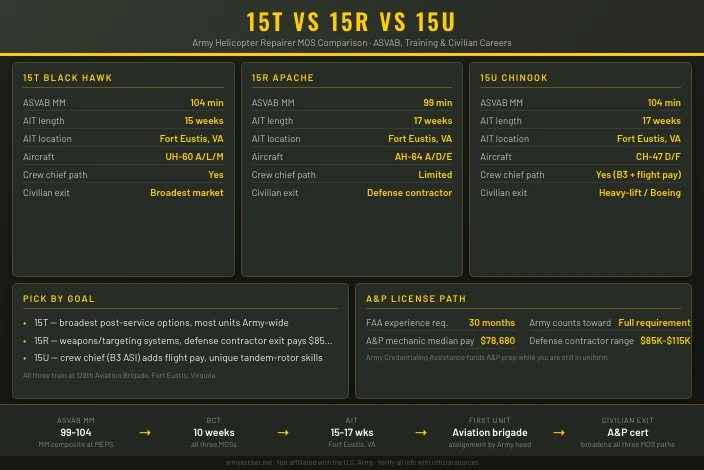
All three MOSs use the MM composite: Numerical Operations + Auto and Shop Information + Mechanical Comprehension + Electronics Information. The required minimums are close but not identical.
| MOS | Aircraft | MM Minimum |
|---|---|---|
| 15T | UH-60 Black Hawk | 104 |
| 15R | AH-64 Apache | 99 |
| 15U | CH-47 Chinook | 104 |
The 15R has the lowest threshold at MM 99 – five points below the other two. That might sound like good news for borderline scorers, but the Apache is arguably the most technically demanding of the three to maintain. The lower cutoff reflects the Army’s historical recruiting math, not the job’s complexity.
For all three, the MC (Mechanical Comprehension) and AS (Auto and Shop Information) subtests drive your MM score more than anything else. If your practice scores are close to the minimums, focus your study time on those two sections first.
AIT Length and Location
All three train at the 128th Aviation Brigade, Fort Eustis, Virginia (Joint Base Langley-Eustis), home of the Army Aviation Logistics School. That means the same instructors, the same facilities, and significant curriculum overlap – especially in the foundational weeks covering aviation safety, tool control, technical manuals, and general maintenance procedures.
Where they split is platform-specific training.
| MOS | AIT Length | Platform Focus |
|---|---|---|
| 15T | 15 weeks | UH-60A/L/M variants, turboshaft engines, rotor systems |
| 15R | 17 weeks | AH-64A/D/E variants, weapons integration, targeting systems |
| 15U | 17 weeks | CH-47D/F variants, tandem rotor drivetrain, heavy-lift systems |
The 15T course runs two weeks shorter than the other two. The Apache and Chinook have more complex systems – the Apache adds weapons and targeting maintenance to the standard airframe workload, and the Chinook’s tandem-rotor drivetrain requires extra instruction that pushes the course longer.
What You Actually Work On
The three platforms have distinct maintenance personalities. Understanding what fills your workday is as important as knowing the score cutoffs.
15T – Black Hawk
The UH-60 Black Hawk Repairer works on the Army’s most widely operated helicopter. Black Hawk maintainers cover turboshaft engines (T700-GE-701C/D), composite rotor blades, hydraulic flight controls, and digital health monitoring systems. The ASI system splits into B4 (A/L variants) and B7 (M variant), so experienced 15T soldiers often specialize on the newer glass-cockpit M model.
Because Black Hawks are everywhere, the 15T sees the widest variety of unit types: medevac, air assault, special operations aviation support, and VIP transport. Your maintenance work can look different depending on which unit you land in.
15R – Apache
The AH-64 Apache Repairer works on a weapons system first and a helicopter second. That distinction shapes maintenance work. Apache maintainers handle everything a standard rotary-wing mechanic does – engines, hydraulics, rotor systems, airframe – plus the M230 chain gun, Hellfire missile stations, Hydra 70 rocket pods, and the Target Acquisition Designation Sight/FLIR system. Weapons maintenance adds a layer of technical complexity and documentation requirements that the other two don’t share.
The Apache also operates on the 1553B digital data bus, which runs weapon system integration. Troubleshooting avionics faults on an Apache requires the 15Y (AH-64D Armament/Electrical/Avionics Repairer) for the deepest electrical work, but 15R soldiers need enough familiarity to identify faults and hand off correctly.
15U – Chinook
The CH-47 Chinook Repairer works on a tandem-rotor system that is mechanically unique. Two rotor heads, two transmissions, a combining gearbox, and the T55-GA-714A engines create a drivetrain unlike any single-rotor helicopter. Chinook mechanics learn how torque and rotor sync interact in a way that has no direct civilian equivalent – you’re learning systems that only exist on a CH-47.
The B3 ASI (Flight Engineer/Crew Chief) is the most sought-after qualification in the 15U world. Earning it puts you on the aircraft during missions, operating the rescue hoist and directing sling-load operations from the cargo door. Flight pay comes with it.
Deployment Tempo
Platform assignment largely determines how often you deploy.
Apache units (15R) tend to deploy with high-readiness division combat aviation brigades. The 101st Airborne at Fort Campbell and the 1st Cavalry Division at Fort Cavazos maintain active deployment schedules in support of theater security operations. Combat deployments historically run six to twelve months; European and Korean rotations run closer to nine.
Black Hawk units (15T) vary more by mission type. Air assault units follow high-tempo schedules similar to Apache brigades. MEDEVAC units may have shorter but more frequent rotations. SOAR (Special Operations Aviation Regiment) assignments carry their own unique tempo and selection requirements.
Chinook units (15U) deploy somewhat less frequently than Apache brigades but still maintain regular rotation schedules. The Chinook’s heavy-lift mission brings it in for specific operations – resupply, humanitarian response, mountain warfare – rather than sustained combat attack missions. Soldiers at Fort Campbell (101st) and Fort Wainwright (Alaska) see more operational cycles than those at training installations.
No MOS is “safe” from deployment. All three will put you in austere environments during exercises and rotations. The differences are in timing, duration, and intensity – not whether you’ll go.
Civilian Job Market
This is where the three MOS choices meaningfully diverge post-service.
15T (Black Hawk) offers the broadest civilian runway. The UH-60 is operated globally by dozens of military and paramilitary forces, law enforcement agencies, and emergency services organizations. Sikorsky (now a Lockheed Martin company) maintains large contractor workforces supporting active-duty and Foreign Military Sales fleets. Black Hawk experience transfers well to other medium-lift helicopters because the platform’s systems are common in the commercial sector.
15R (Apache) transitions more narrowly but pays well. Boeing, L3Harris, and SAIC run large Apache sustainment programs that actively recruit veterans with platform-specific experience. Civilian Apache operators barely exist outside government and contractor channels. If you exit after one contract, the defense contractor path is your primary landing zone – civilian helicopter operator jobs won’t use Apache skills directly. Those contractor roles pay well, often in the $85,000-$115,000 range, but the market is smaller than for Black Hawk mechanics.
15U (Chinook) sits between the two. Boeing’s defense unit supports CH-47F programs worldwide. Commercial heavy-lift operators (firefighting, logging, offshore construction) use the Chinook and hire from the veteran pool. But the Chinook’s niche – heavy external lift – has fewer operators than the general commercial market for medium helicopters.
For all three MOS paths, the FAA Airframe and Powerplant (A&P) license is the gateway credential. The Army’s Credentialing Assistance program and Army COOL both support A&P prep while you’re still in uniform. Your military maintenance experience counts toward the FAA’s 30-month practical experience requirement, which means the Army is effectively paying you to earn the time you’d otherwise need in a civilian program. BLS data puts the median pay for aircraft mechanics and service technicians at $78,680 annually – a baseline that experienced veterans with A&P certification and platform-specific credentials regularly exceed.
Side-by-Side Comparison
This table consolidates the key differences across all six categories covered above. Use it as a quick reference when comparing the three MOSs.
| Factor | 15T (Black Hawk) | 15R (Apache) | 15U (Chinook) |
|---|---|---|---|
| MM minimum | 104 | 99 | 104 |
| AIT length | 15 weeks | 17 weeks | 17 weeks |
| Unique skill | Multi-mission versatility | Weapons/targeting systems | Tandem rotor, heavy-lift |
| Deployment tempo | Moderate to high | High | Moderate |
| Crew chief path | Yes (standardized) | Limited (15Y overlap) | Yes (B3 ASI, flight pay) |
| Contractor demand | High | Moderate (niche) | Moderate |
| Civilian broadness | Widest | Narrowest | Mid-range |
Which One Should You Choose
If your goal is the broadest post-service options, the 15T wins. The Black Hawk is everywhere, the skills transfer widely, and contractor demand is deep.
If you want to work on the most technically sophisticated aircraft in the Army’s inventory and are comfortable with a tighter civilian market, the 15R fits. The Apache is the only platform in the world with that combination of weapons integration and targeting systems. It’s a specialized skill set, and the defense contractor market pays for it.
If you want to fly as a crew member and work on a mechanically unique system, the 15U with the B3 ASI qualification is the path. The Chinook crew chief role is one of the few enlisted aviation jobs that puts you in the aircraft during real missions and adds flight pay to your monthly earnings.
One factor all three share: the Army pays you a salary from day one of AIT. You’re earning military pay while learning skills that a civilian A&P program charges $30,000-$60,000 to teach. The specific platform matters less than the fact that you leave service with real turbine experience, a head start on A&P certification, and GI Bill benefits for whatever comes next.
For the full picture of all Army aviation paths from mechanic to pilot, see Army Aviation Jobs: Enlisted, Warrant, and Officer. You may also find Army Aviation ASVAB scores and the full Army aviation careers overview helpful for comparing every 15-series role side by side.
This site is not affiliated with the U.S. Army or any government agency. Verify all information with official Army sources before making enlistment or career decisions.