19D Cavalry Scout vs 19K Tanker: Which Armor MOS to Choose
Both the 19D and 19K require the same ASVAB score, train at the same installation, and wear the same crossed-sabers branch insignia. But ask a Cavalry Scout what they think of tankers, or a tanker what they think of scouts, and the differences come fast. One job puts you out front, alone, gathering intelligence before anyone else knows a fight is coming. The other puts 70 tons of steel between you and the enemy and asks you to close with it at full speed. Same career field. Completely different missions.
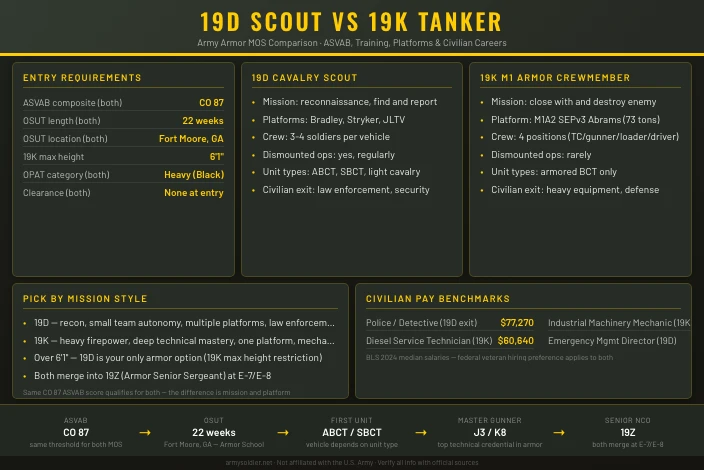
ASVAB Scores and Entry Requirements
The score threshold is identical for both MOSs. You need a minimum Combat (CO) composite of 87 to qualify for either 19D or 19K. The CO composite combines Verbal Expression (VE), Auto and Shop Information (AS), and Mechanical Comprehension (MC). It tests reading ability, mechanical reasoning, and hands-on aptitude.
| Requirement | 19D Cavalry Scout | 19K M1 Armor Crewmember |
|---|---|---|
| ASVAB Composite | CO (Combat) | CO (Combat) |
| Minimum Score | 87 | 87 |
| Formula | VE + AS + MC | VE + AS + MC |
| Max Height | None specified | 6'1" (185 cm) |
| Color Vision | Red/green distinction | Normal color vision required |
| Security Clearance | None required | None required |
| OPAT Category | Heavy (Black) | Heavy (Black) |
The 19K has one hard physical restriction the 19D does not: a maximum height of 6 feet 1 inch. The M1 Abrams turret and driver’s hull compartment are built around that limit. If you’re 6'2" or taller, the 19K is off the table. Check this at MEPS before you count on the job.
Color vision requirements also differ slightly. The 19K requires normal color vision because ammunition types use color-coded markings and the thermal sight system requires color discrimination. The 19D requires only red/green distinction. If you have partial color vision deficiency, confirm your specific condition at MEPS.
Both jobs require passing the ASVAB and the Heavy (Black) OPAT physical assessment before shipping.
Training: 22 Weeks at Fort Moore
Both MOSs use One Station Unit Training (OSUT), and both run 22 weeks at Fort Moore, Georgia under the Armor School. The first 10 weeks cover Basic Combat Training fundamentals shared across all combat arms. The back half diverges.
19D OSUT phases:
| Phase | Duration | Focus |
|---|---|---|
| Basic Soldier Skills | ~10 weeks | Rifle marksmanship, land nav, first aid, CBRN, PT |
| Scout Skills | ~12 weeks | Recon operations, Bradley/Stryker/HMMWV operations, crew-served weapons, call for fire, comms |
19K OSUT phases:
| Phase | Duration | Focus |
|---|---|---|
| Red / White / Blue | Weeks 1-10 | BCT fundamentals, rifle qual, squad tactics, live fire |
| Black Phase | Weeks 11-16 | M1 Abrams introduction, crew positions, turret operations, gunnery basics |
| Gold Phase | Weeks 17-22 | Advanced gunnery, maneuver training, tactical exercises |
Scout OSUT covers a broader set of platforms and weapons. You train on the Bradley, Stryker, HMMWV, and eventually the JLTV. You also learn dismounted reconnaissance, meaning you practice the mission on foot. Tanker OSUT goes deep on a single platform. By graduation, a 19K can operate every crew position on the M1 Abrams and understands the gunnery system well enough to fire live rounds.
The time investment is the same. The skill sets that come out are not.
Daily Work: Recon vs. Armor Maneuver
This is where the two jobs separate most sharply.
The 19D Cavalry Scout is a reconnaissance soldier. Your job is to find the enemy, not fight them unless you have to. You move ahead of the main force with a small crew – usually 3 to 4 soldiers in one vehicle – and gather information about enemy positions, terrain, routes, obstacles, and bridges. You report everything back. Commanders use your reports to decide where and when to commit the tanks and infantry.
In garrison, scouts split time between vehicle maintenance, weapons training, and tactical planning. In the field, the work centers on observation posts, route reconnaissance, and mounted and dismounted patrols. The Bradley or Stryker is your platform, but you also get off it regularly. Dismounted reconnaissance is a core scout skill.
The 19K M1 Armor Crewmember is a heavy-firepower role. Your crew of four closes with and destroys enemy armor, fortifications, and personnel using the 120mm main gun, .50-caliber machine gun, and coaxial 7.62mm. You do not go looking for the enemy quietly. You go to destroy what the scouts found.
In garrison, tankers spend most of their day in the motor pool. Track replacement on an M1 can take an entire crew a full day. Maintenance is not occasional – it’s the job when you’re not in the field. In the field, gunnery qualifications drive the training calendar. Table IV through Table XII certify your crew at increasingly complex firing scenarios, day and night, stationary and moving.
A useful way to think about it: scouts gather the intelligence, tankers act on it.
Vehicle Platforms
The platforms you operate define the day-to-day reality of each MOS.
19D operates:
- M3A3 Bradley Cavalry Fighting Vehicle – 25mm chain gun, TOW anti-tank missiles, thermal sights, digital battle tracking. In armored brigade combat teams (ABCTs).
- M1127 Stryker Reconnaissance Vehicle – mast-mounted Long-Range Advanced Scout Surveillance System (LRAS3) with thermal cameras capable of detecting targets beyond 10 kilometers. In Stryker brigade combat teams (SBCTs).
- JLTV (Joint Light Tactical Vehicle) – replacing the Humvee, with integrated armor, weapons mounts, and a 470-horsepower diesel engine.
19K operates:
- M1A2 SEPv3 Abrams – the only platform. 120mm smoothbore cannon, third-generation FLIR sensors, Commander’s Independent Thermal Viewer (CITV), Trophy Active Protection System to intercept incoming anti-tank missiles. 73 tons.
Scouts train on multiple platforms and switch between them depending on their unit type. An ABCT scout crews Bradleys. An SBCT scout crews Strykers. A light cavalry unit scout drives a JLTV. Your vehicle depends on where you’re assigned.
Tankers train on one platform and become experts on it. The M1A2 SEPv3 is one of the most capable ground combat vehicles in any military. Mastering it takes the full 22-week OSUT and then years of gunnery qualifications after. The tradeoff is narrow specialization for enormous firepower.
Deployment Tempo and Duty Stations
Both MOSs deploy regularly. Active-duty armor soldiers should expect roughly one deployment every 24 to 36 months, typically 9 to 12 months in length. Units on high-readiness rotations deploy more frequently with less notice.
The geographic spread is similar. Europe (Germany, Poland), the Middle East (Kuwait, Iraq), and the Pacific (South Korea) are the most common destinations for both 19D and 19K soldiers.
Common 19D duty stations: Fort Cavazos (TX), Fort Carson (CO), Fort Campbell (KY), Fort Stewart (GA), Fort Riley (KS), Fort Liberty (NC), Fort Drum (NY), Fort Irwin (CA), Germany, South Korea
Common 19K duty stations: Fort Cavazos (TX), Fort Stewart (GA), Fort Carson (CO), Fort Riley (KS), Fort Bliss (TX), Fort Moore (GA), Fort Irwin (CA), USAG Humphreys (South Korea)
There is significant overlap. Fort Cavazos (1st Cavalry Division) and Fort Stewart (3rd Infantry Division) are major hubs for both. Fort Irwin hosts both as part of the 11th Armored Cavalry Regiment, which plays OPFOR for rotating training units.
One difference worth noting: the 19D serves in a broader range of unit types. Scouts serve in armored, Stryker, and light cavalry units, which spreads assignment options to installations that don’t host heavy armor. Fort Liberty (82nd Airborne) and Fort Campbell (101st Air Assault) have cavalry scout assignments in light and air assault units where 19K soldiers are not typically assigned.
Physical Demands
Both fall in the Heavy (Black) OPAT category, meaning the physical standards at entry are identical. In the field, the jobs differ.
Scout dismounted operations mean carrying 60 to 80 pounds of gear on foot patrols. Loading a TOW missile launcher during a vehicle engagement requires strength and speed under pressure. The job mixes mounted and foot operations in ways tankers rarely experience.
Tanker maintenance demands raw strength in a confined space. A 120mm round weighs 40 to 50 pounds. Loading it means pivoting in a cramped turret while the tank is moving. Track pads weigh 70 pounds. Engine pack pulls require a full crew on wrenches for hours. The physical grind is different from scouting – less aerobic, more brute-force mechanical.
Both soldiers take the Army Fitness Test (AFT) at least once a year under the combat MOS standard: a minimum of 350 total points with at least 60 in each of the five events.
Advanced Training and Career Development
Both MOSs offer schools that shape long-term career trajectory.
19D career schools:
- Scout Leader Course (SLC) – for E-5s, advanced tactics and small-unit leadership
- Bradley Master Gunner Course – earns ASI J3, the top technical credential in scout units
- Advanced Reconnaissance Course (ARC) – earns ASI R7
- Ranger School and Airborne School – open to combat arms, expand assignment options
19K career schools:
- Abrams Master Gunner Course – earns ASI K8, the gold standard for tank NCOs
- Tank Commander Certification Course – certifies E-5s and above to lead a crew
- Battle Staff NCO Course – operations planning at battalion and brigade level
At the senior NCO level, both MOSs converge. At E-7, the 19K reclassifies to 19Z (Armor Senior Sergeant). The 19D merges into 19Z at E-8. From that point, the career field is shared – First Sergeant and Sergeant Major positions draw from soldiers of both backgrounds.
The Master Gunner credential (J3 for scouts, K8 for tankers) is the most respected technical qualification in the armor community. Soldiers who earn it early get promoted faster and are assigned to positions that shape their unit’s entire gunnery program.
Civilian Career Paths
The skills built in each MOS diverge more clearly at separation than they do in uniform.
19D veterans most often transition into law enforcement, private security, emergency management, and federal protective services. Surveillance skills, route reconnaissance experience, and leadership under pressure translate directly to police work and federal law enforcement (CBP, DEA, FBI). The BLS median for police and detectives is $77,270, with a 3% growth outlook.
19K veterans carry strong mechanical credentials. Operating and maintaining a 73-ton turbine-powered vehicle maps to heavy equipment operation, diesel mechanics, and industrial machinery maintenance. Defense contractors like General Dynamics and BAE Systems hire former tankers for vehicle testing, maintenance management, and training roles. The BLS median for industrial machinery mechanics is $63,510 with a 13% growth outlook.
Both groups benefit from the Army COOL program, which funds civilian certifications before separation. Scouts can pursue private investigator licenses and security management credentials. Tankers can earn CDL, OSHA certifications, and heavy equipment operator licenses. Federal veteran hiring preferences give both groups a scoring advantage on competitive civil service exams.
Head-to-Head Comparison
The table below consolidates every major difference between the two MOSs. Use it as a quick reference after reading the detailed sections above.
| Factor | 19D Cavalry Scout | 19K M1 Armor Crewmember |
|---|---|---|
| ASVAB minimum | CO 87 | CO 87 |
| OSUT length | 22 weeks | 22 weeks |
| OSUT location | Fort Moore, GA | Fort Moore, GA |
| Primary mission | Reconnaissance | Armor maneuver / fire and movement |
| Primary platform | Bradley / Stryker / JLTV | M1A2 SEPv3 Abrams |
| Crew size | 3-4 soldiers | 4 soldiers (fixed positions) |
| Dismounted operations | Yes, regularly | Rarely |
| Height restriction | None | Max 6'1" |
| Unit types | ABCT, SBCT, light cavalry | Armored BCT only |
| Top technical cert | J3 Bradley Master Gunner | K8 Abrams Master Gunner |
| Senior MOS (E-7+) | 19Z (merges at E-8) | 19Z (merges at E-7) |
| Civilian exit | Law enforcement, security | Heavy equipment, diesel, defense |
Which One Is Right for You
Choose the 19D if you want variety across platforms and missions, prefer operating in small autonomous teams, or are drawn to the intelligence-gathering side of ground combat. Scouts work across multiple vehicle types and unit structures. The job mixes mounted and dismounted operations in ways that keep the mission unpredictable. Law enforcement and federal security careers are natural exits.
Choose the 19K if you want to operate the most capable ground combat platform in the U.S. inventory, if you’re mechanically oriented and thrive mastering one system deeply, or if heavy industry careers after service appeal to you. Tankers become genuine experts on the Abrams and the gunnery system that drives it. The career field rewards technical precision and crew cohesion.
If you’re over 6'1", the choice is already made for you – the 19D is your only armor option.
Both jobs share the same entry score, the same training pipeline, and the same physical standards. The decision comes down to what kind of work you want to do every day and where you want those skills to take you after the Army.
This site is not affiliated with the U.S. Army or any government agency. Verify all information with official Army sources before making enlistment or career decisions.
Browse the full Army armor careers section for complete profiles on both MOSs. For a broader comparison of all combat arms families, see Army Combat Arms Jobs: Infantry, Armor, Artillery, and check ASVAB scores for combat arms MOS for line score details.