35F vs 35G vs 35L: Which Intel MOS Is Right for You
Three Army intelligence jobs. All require a Top Secret clearance. All train at Fort Huachuca. All feed into the same defense contractor and federal agency hiring pipeline after service. But the work itself is completely different – and picking the wrong one is an easy mistake to make when the job titles all sound like variations of “spy.”
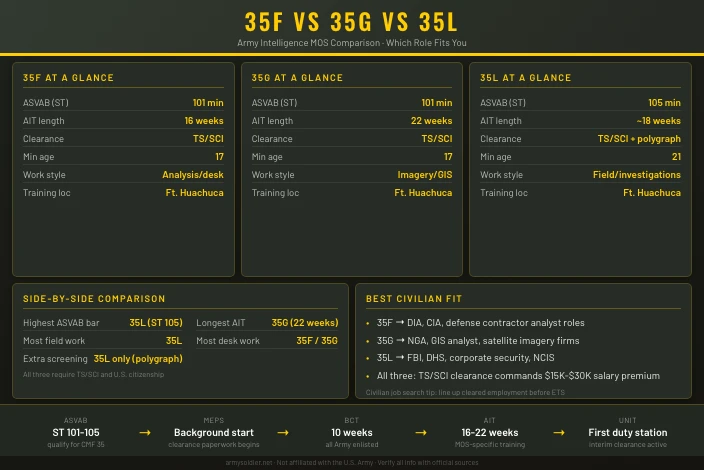
The 35F analyzes all-source intelligence and briefs commanders. The 35G interprets satellite and drone imagery. The 35L runs counterintelligence investigations and develops human sources. Those aren’t variations of the same job. They attract different people, demand different aptitudes, and lead to different civilian careers.
Here’s what actually separates them.
What Each MOS Does Day to Day
35F Intelligence Analyst
The 35F Intelligence Analyst is the Army’s generalist intelligence role. Analysts collect and fuse information from multiple sources – human intelligence, signals, imagery, open-source reporting – and turn it into products commanders use to make decisions. On a garrison day, that means updating threat databases, building situation maps, and preparing briefings. On deployment, it means running the Intelligence Preparation of the Battlefield (IPB) and telling leadership where the enemy is and what they’ll likely do next.
This job is mostly desk and screen work, with a heavy writing and briefing component. If you can read dense information, distill it quickly, and present findings to a room of officers without hesitating, the 35F is in your range.
35G Geospatial Intelligence Imagery Analyst
The 35G Geospatial Intelligence Imagery Analyst focuses on one specific type of intelligence: imagery. Analysts exploit satellite photographs, drone feeds, and airborne sensor data to identify targets, facilities, and terrain features. They produce maps, overlays, and battle damage assessments used by everyone from brigade planners to national agencies.
The work is technical and spatial. You’re measuring distances between structures, identifying vehicle types from overhead angles, and tracking pattern-of-life changes on imagery collected over weeks or months. Strong spatial reasoning and patience for precise, systematic work matter here more than broad analytical range.
The 35G also has the longest AIT of the three – 22 weeks – because the imagery exploitation systems and analytical techniques require more specialized training time.
35L Counterintelligence Agent
The 35L Counterintelligence Agent is the most distinct of the three. Where the 35F and 35G are primarily analytical jobs done inside a SCIF, the 35L involves active fieldwork. Agents conduct national security criminal investigations, develop human sources with access to hostile networks, brief commanders on local threats, and coordinate cases with the FBI and DIA.
This job requires genuine interpersonal skills. You’ll interview reluctant witnesses, cultivate sources who may not want to be found, and build cases that have to hold up to legal and command scrutiny. Every investigation produces written reports reviewed by senior leadership. Weak writing kills careers in this MOS faster than almost any other factor.
The 35L also carries more autonomy than most enlisted jobs. Agents regularly work cases with minimal supervision, sometimes as the sole CI agent for an entire tactical unit.
Requirements Side by Side
All three MOSs share the same ASVAB composite – the Skilled Technical (ST) score – which combines General Science, Verbal Expression, Math Knowledge, and Mechanical Comprehension subtests.
| Requirement | 35F | 35G | 35L |
|---|---|---|---|
| ST (ASVAB) | 101 minimum | 101 minimum | 105 minimum |
| Security Clearance | TS/SCI | TS/SCI | TS with SCI eligibility |
| Polygraph | No | No | Yes (CI polygraph) |
| Minimum Age | 17 | 17 | 21 (for accreditation) |
| Citizenship | U.S. only | U.S. only | U.S. only |
| Color Vision | Required | Required | Required |
| OPAT Category | Moderate (Gold) | Moderate (Gold) | Medium |
The 35L’s ST minimum is 4 points higher than the other two – not a dramatic gap, but it filters out candidates who pass the 101 cutoff by a narrow margin. More importantly, the CI polygraph is a separate layer of screening that eliminates candidates the background investigation alone would have cleared. The 35L also has the only minimum age requirement above 17; you must be 21 before you can receive full accreditation as a CI Special Agent.
Training Pipeline
All three MOSs start with the same 10-week Basic Combat Training. The paths diverge at Advanced Individual Training.
| MOS | AIT Location | AIT Length | Focus |
|---|---|---|---|
| 35F | Fort Huachuca, AZ | ~16 weeks | All-source fusion, IPB, DCGS-A, threat briefings |
| 35G | Fort Huachuca, AZ | ~22 weeks | Imagery exploitation, GEOINT analysis, target reporting |
| 35L | Fort Huachuca, AZ (CISAC) | ~18 weeks | CI investigations, source operations, interviewing, report writing |
The 35G’s longer AIT reflects the complexity of imagery exploitation systems and the spatial analysis techniques that take time to learn properly. The 35F course is the shortest because the all-source analysis framework builds on a broader base of common intelligence concepts. CISAC – the Counterintelligence Special Agent Course – runs a pace closer to a professional school than a standard AIT, with instruction in legal authorities, interviewing techniques, and case management that requires more time to absorb.
After CISAC, 35L soldiers don’t immediately become accredited agents. There’s a one-year CI Probationary Program at the first duty station, with supervised case work before full accreditation.
Work Environment and Lifestyle
The 35F and 35G spend most of their careers inside SCIFs – Sensitive Compartmented Information Facilities. The physical environment is controlled and screen-intensive. Garrison assignments run roughly standard business hours, with shift work during exercises and 12-hour rotations on deployment. Neither MOS involves significant fieldwork outside secure facilities on a typical day.
The 35L is different. While CI agents do work in SCIFs, they also spend time outside them – conducting interviews, meeting sources, and coordinating with partner agencies. Field office assignments at 902nd Military Intelligence Group resident agencies feel more like a law enforcement environment than a military intelligence section. Deployed assignments put agents closer to the operational environment than the average analyst.
A few lifestyle factors apply to all three:
- You can’t discuss work with family or non-cleared friends
- Family members undergo background checks during clearance processing
- Foreign-born spouses or significant ties to other countries require disclosure and can slow the investigation
- Duty stations cluster near intelligence commands (Fort Meade, Fort Belvoir, Fort Liberty, Fort Campbell)
That last point matters for planning. Intelligence assignments don’t scatter you across the country the way some MOSs do – you’re more likely to cycle through the same handful of installations over a career.
Civilian Career Potential
The TS/SCI clearance is valuable regardless of which of these three MOSs you hold. Cleared professionals with military intelligence backgrounds consistently earn $15,000 to $30,000 more annually than equivalent positions without clearance access.
But the destination matters too.
35F veterans transition into defense contractor analytical roles, federal intelligence agency positions (DIA, CIA, NSA, DHS), and threat analysis work in the private sector. Management analyst, operations research analyst, and information security analyst roles are common paths. The 35F’s all-source background makes it one of the most versatile in terms of where you can land.
35G veterans move into geospatial intelligence and GIS analysis positions at NGA, defense contractors, commercial satellite companies, and energy firms that use spatial data. GISP (GIS Professional) certification – fundable through Army COOL – translates directly to private-sector GIS analyst roles. Starting salaries at defense contractors for cleared imagery analysts range from $80,000 to $120,000.
35L veterans are positioned for federal law enforcement (FBI Special Agent, DHS Homeland Security Investigations, NCIS) and CI-specific contractor roles. The investigative skills and legal knowledge built in this MOS align with both the 0132 Intelligence and 1811 Criminal Investigator federal job series. Corporate security firms also recruit heavily from this background.
All three MOSs pair well with a degree if you use the Post-9/11 GI Bill after separation. Intelligence studies, cybersecurity, data science, and criminal justice are common choices. Full MOS listings for the career field are at Army intelligence careers.
Which One Fits You
The right choice depends on what you actually want to do every day, not just what sounds impressive.
Choose 35F if:
- You want broad analytical work across multiple intelligence disciplines
- You’re comfortable writing, briefing, and presenting to senior leaders
- You’re curious about military history, geopolitics, and threat analysis
- You want the most versatile post-service career options in the intelligence field
Choose 35G if:
- You have strong spatial reasoning and like precise, methodical work
- You’re genuinely interested in mapping, remote sensing, or geography
- You want the longest AIT – 22 weeks of focused technical training
- You’d consider a post-service career in GIS, satellite imagery, or federal geospatial agencies
Choose 35L if:
- You’re 21 or willing to wait until then, or already serving in another MOS
- You want fieldwork, autonomy, and investigative work rather than desk analysis
- You’re a strong writer and comfortable building relationships with strangers
- You’re interested in a post-service path in federal law enforcement
- Your background is clean enough to pass a CI polygraph
If you’re under 21 and drawn to the 35L, one path is to enlist in the 35F first, prove your aptitude, and reclassify to 35L once you hit the age requirement. That isn’t the only path, but it keeps you in the intelligence field while you wait.
For a broader look at what intelligence and cyber jobs look like across the whole career field, the Army intelligence and cyber MOS overview covers every MOS in CMF 35 and CMF 17. You may also find best ASVAB scores for Army intelligence MOS jobs helpful if you’re still figuring out which line scores you need to target.
This site is not affiliated with the U.S. Army or any government agency. Verify all information with official Army sources before making enlistment or career decisions.