37F PSYOP vs 38B Civil Affairs: Which Special Operations MOS
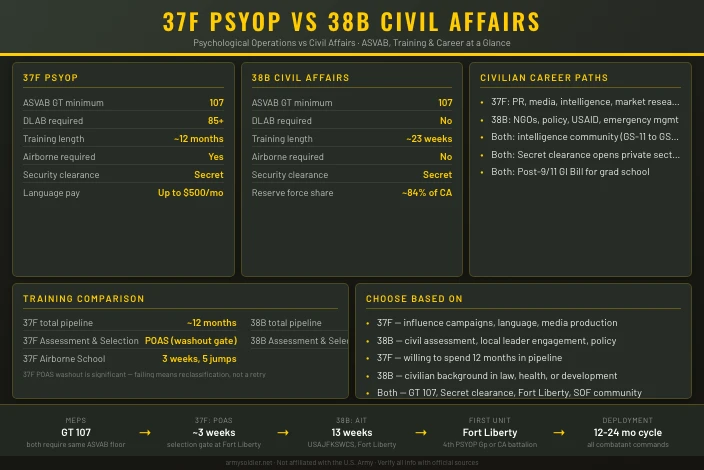
Both MOSs carry a GT score of 107, both require a Secret clearance, and both are housed at Fort Liberty under Army Special Operations Command. But the 37F Psychological Operations Specialist and the 38B Civil Affairs Specialist do fundamentally different things in the field. One shapes what people believe. The other shapes the conditions people live in. Choosing between them comes down to what kind of work actually interests you.
What Each Job Does
The core distinction is simple but easy to blur: PSYOP targets the mind, Civil Affairs targets the environment.
A 37F Psychological Operations Specialist plans, develops, and distributes influence campaigns. The job involves analyzing a foreign population, identifying what drives their decisions, and creating messages designed to change how they think or act. Media products range from printed leaflets to radio broadcasts to social media content. In a deployed environment, a PSYOP team might advise a battalion commander on how local attitudes are shifting, then develop messaging to counter enemy propaganda.
A 38B Civil Affairs Specialist works the civil terrain. The job involves meeting with local government officials, assessing infrastructure damage, and writing reports that feed the commanding general’s planning cycle. A 38B’s output is a civil affairs assessment: what the population needs, how local governance functions, and what civil conditions could affect the mission.
Both roles require soldiers who read fast, write clearly, and can operate in ambiguous environments. The difference is whether you’d rather craft a message or conduct an assessment.
ASVAB Scores and Entry Requirements
| Requirement | 37F PSYOP | 38B Civil Affairs |
|---|---|---|
| GT minimum | 107 | 107 |
| DLAB | 85 minimum | Not required |
| Citizenship | U.S. citizen only | U.S. citizen only |
| Security clearance | Secret | Secret |
| Physical demand | Significant (Gray) | Moderately Heavy |
| Airborne | Required | Not required |
The GT composite of 107 is the same for both. Where they split is the Defense Language Aptitude Battery. The DLAB is not an ASVAB subtest. It’s a separate exam that measures how quickly you can absorb a new language’s grammar rules and patterns. A score of 85 is the floor for 37F, and many candidates find it harder to prepare for than the ASVAB itself.
Not every recruiter schedules the DLAB automatically. If you’re targeting 37F, ask for it specifically when you go to MEPS.
The physical demand difference is real. The PSYOP Significant (Gray) OPAT category applies because the 37F pipeline includes Airborne School and Assessment and Selection. Civil Affairs carries a Moderately Heavy standard with no Airborne requirement at entry. That said, both MOSs deploy to the same high-threat environments and require sustained physical fitness.
Training Pipelines
This is where the two jobs diverge most sharply in time and difficulty.
37F PSYOP Pipeline
| Phase | Location | Length | What Happens |
|---|---|---|---|
| 31B OSUT | Fort Leonard Wood, MO | 20 weeks | Military Police one-station training |
| Airborne School | Fort Moore, GA | 3 weeks | 5 static-line parachute jumps |
| POAS | Fort Liberty, NC | ~3 weeks | Psychological Operations Assessment and Selection |
| PSYOP Qualification Course | Fort Liberty, NC | ~17-20 weeks | Language/culture, media production, culminating exercise |
Total time from enlistment to MOS: roughly 12 months. The PSYOP pipeline is one of the longest in the Army. It starts with 31B (Military Police) OSUT, which combines Basic Combat Training and MP-specific training into 20 weeks. Then Airborne School. Then comes the real filter.
Psychological Operations Assessment and Selection (POAS) is a multi-week course at Fort Liberty that screens candidates on physical endurance, problem-solving, and mental resilience under stress. Candidates who fail POAS get reclassified to a different MOS. There is no second attempt. The washout rate is significant, and the cadre are specifically looking for soldiers who think clearly when exhausted and work well in small teams.
Survivors enter the PSYOP Qualification Course at the JFK Special Warfare Center and School. Five phases: in-processing, language and culture, PSYOP core skills, a culmination exercise, and graduation. You’ll learn audience analysis, propaganda analysis, media production, and tactical planning.
38B Civil Affairs Pipeline
| Phase | Location | Length | What Happens |
|---|---|---|---|
| BCT | Various | 10 weeks | Basic Combat Training |
| AIT | Fort Liberty, NC | 13 weeks | Civil affairs doctrine, functional specialties, cultural engagement, report writing |
Total time: roughly 23 weeks. No Assessment and Selection. No Airborne requirement. The 13-week AIT at USAJFKSWCS covers civil affairs doctrine, functional specialty areas (governance, infrastructure, rule of law, public health), civil reconnaissance, and writing assessments to staff-level standards.
The lower barrier to entry reflects a design choice, not lower quality standards. The Army deliberately structured most of its Civil Affairs force in the Reserve, specifically to recruit people who bring real-world expertise: lawyers, engineers, public health workers, policy professionals. Active-duty 38B billets are fewer than 37F slots, which can make them more competitive to land.
Daily Work: Garrison and Deployed
In garrison, both MOSs spend significant time on research and area studies. A 37F at Fort Liberty builds media products and reviews intelligence reports on target audiences. A 38B studies the governance structures, economic conditions, and infrastructure in their unit’s area of responsibility.
Deployed, the jobs look different on the ground.
A PSYOP Tactical Detachment is a small team of 4 to 8 soldiers. They embed with a supported unit and run influence operations in parallel with combat operations. That might mean broadcasting a radio message to a contested village at 0300, distributing printed materials at a checkpoint, or briefing a colonel on how local attitudes shifted after a kinetic strike. A junior 37F sergeant can find themselves advising senior officers far earlier in their career than almost any other enlisted MOS.
A Civil Affairs Team-Alpha (CAT-A) is similarly small. They conduct civil reconnaissance by visiting local officials, assessing water treatment facilities, and documenting the civilian conditions commanders need to understand. A 38B on the ground might spend a day meeting with a provincial council, then spend the evening writing an assessment that will inform the division’s next decision. The work is relationship-intensive and requires political awareness alongside military judgment.
Both jobs require communication skills that most combat arms soldiers never develop. The difference: PSYOP communication is outbound (you craft the message and push it). Civil Affairs communication is inbound and relational (you listen, assess, and report what you learn).
Language Requirements
The 37F requires a DLAB score of 85, which means language training is built into the career from the start. After earning the MOS, most PSYOP soldiers attend the Defense Language Institute for a course ranging from 26 to 64 weeks depending on the assigned language. Arabic, Mandarin, Russian, Korean, and Spanish are common. Language proficiency pay can add up to $500/month for qualified linguists.
The 38B does not require the DLAB. Language training is available through DLI and cultural awareness programs, and senior NCOs with regional expertise often pursue language study. But it isn’t a pipeline requirement and doesn’t carry the same mandatory emphasis as in PSYOP.
If you already speak a foreign language, it’s a significant asset in both fields. For PSYOP, it accelerates your career. For Civil Affairs, it makes you a stronger candidate for regional assignments.
Security Clearances
Both start with a Secret clearance at entry. Both can progress to Top Secret or TS/SCI based on assignment.
The investigation covers the same ground: finances, criminal history, foreign contacts, foreign travel, mental health treatment, and drug use. Losing a clearance in either MOS ends your career in that field. Given that Civil Affairs soldiers frequently interact with foreign nationals and partner nation organizations, the clearance investigation will look carefully at international ties.
The path to TS/SCI is more common in PSYOP, where access to classified intelligence is baked into the audience analysis mission. Some 38B assignments, particularly those in joint or interagency billets, also require upgraded access. Both MOSs treat the clearance as a career asset, and both feed pipelines into the intelligence community post-service.
Physical Demands
The two MOSs sit in different physical demand categories, but both require sustained fitness.
37F (Significant/Gray OPAT):
- Airborne School requires 5 qualifying parachute jumps and physical readiness well above Army minimums
- POAS involves long ruck marches, limited sleep, and physical stress over multiple days
- Ongoing Airborne status after earning the MOS means regular jump currency
38B (Moderately Heavy):
- No Airborne requirement
- Civil reconnaissance may involve dismounted movement through rural and urban terrain in full kit
- Same AFT standard applies: 60 points per event, 300 total minimum
Both MOSs deploy to the same environments as conventional Army units and sometimes combat units. Being fit to Army minimums is not enough in either field. You need to be fit enough to operate effectively when things get hard.
Deployment and Operational Tempo
Active-duty 37F soldiers deploy roughly every 18 to 24 months for 6- to 9-month rotations across every combatant command. Reserve PSYOP units have one of the highest mobilization rates in the Army Reserve. Expect at least one 9- to 12-month deployment in a six-year contract, and many soldiers deploy more than once.
Active-duty 38B soldiers see similar cycles, with deployments every 12 to 24 months. The Reserve picture is comparable in tempo: Civil Affairs has one of the highest mobilization rates in the Army Reserve, with the Army deliberately sizing about 84% of its Civil Affairs force in the Reserve component to draw on civilian expertise.
Both jobs take you across the same geographic combatant commands: CENTCOM, EUCOM, INDOPACOM, AFRICOM, SOUTHCOM. Neither is a low-deployment MOS.
Civilian Career Paths
Where these two MOSs diverge most clearly at separation is in the type of civilian work they prepare you for.
From 37F, the strongest paths are:
- Public relations and strategic communications: audience analysis and media production translate directly into corporate or agency communications roles
- Market research and analytics: the intelligence analysis and behavioral research skills apply to private sector consumer research
- Intelligence community: CIA, DIA, NSA, and defense contractors actively recruit former PSYOP soldiers with language skills and regional expertise
- Political consulting and influence: understanding what moves populations is genuinely valuable in commercial and political contexts
From 38B, the strongest paths are:
- International development and NGOs: USAID, World Bank, and major NGOs value soldiers who have managed civil-military coordination in fragile states
- Government affairs and policy: the assessment and advisory work maps directly to policy analyst and program manager roles
- Emergency management: civil reconnaissance and infrastructure assessment experience fits FEMA and state emergency management agencies
- Intelligence community: the clearance, analytical writing, and cross-cultural expertise are equally valued here
| Civilian Role | Median Annual Pay (BLS, May 2024) | Outlook (2024-2034) |
|---|---|---|
| Public Relations Specialist | $69,780 | +5% |
| Market Research Analyst | $76,950 | +7% |
| Policy Analyst / Political Scientist | $125,350 | +6% |
| Emergency Management Director | $79,510 | +5% |
| Intelligence Analyst (GS-11 to GS-13) | $75,000-$110,000 | Stable demand |
Both MOSs leave you with a Secret clearance, analytical writing skills, cross-cultural experience, and a network in the special operations community. Those assets have real market value. PSYOP experience tends to translate more readily into private sector communications and media roles. Civil Affairs experience tends to translate more readily into international development, public administration, and policy roles.
Quick Comparison
| Factor | 37F PSYOP | 38B Civil Affairs |
|---|---|---|
| Core mission | Influence foreign populations | Engage civilian terrain |
| Training length | ~12 months | ~23 weeks |
| Assessment & Selection | Yes (POAS, significant washout) | No |
| Airborne required | Yes | No |
| DLAB required | Yes (85+) | No |
| Language training | Mandatory, DLI pipeline | Available, not required |
| Language pay | Up to $500/month | Available if earned |
| Reserve force structure | 2nd, 7th PSYOP Groups | ~84% of total CA force |
| Post-service: strongest path | PR, intelligence, media | Development, policy, NGOs |
Which MOS Fits You
Pick 37F if you want to dig into what drives a foreign population’s behavior, you’re willing to commit to a year-long pipeline with a real washout gate, and language learning sounds interesting rather than daunting. Airborne training is part of the deal, and you’ll jump out of aircraft as a routine part of the job.
Pick 38B if the civil-military coordination angle fits you better: assessing infrastructure, building relationships with local officials, and advising commanders on human terrain. The pipeline is shorter. The entry barrier is lower. And if you have a civilian background in law, public health, engineering, or international affairs, you’ll have context most of your peers won’t.
Both are strong careers for people who want more than direct combat. Both reward intellectual curiosity, cultural awareness, and the ability to write clearly under pressure. Both will take you to places most Army soldiers never see.
For a broader look at the full SOF career field, Army special operations careers: SF, PSYOP, and Civil Affairs covers every path from Green Berets to PSYOP to CA. The best ASVAB scores for special operations MOS breaks down exactly which line scores and composites each SOF job requires.
This site is not affiliated with the U.S. Army or any government agency. Verify all information with official Army sources before making enlistment or career decisions.