68W vs 68C vs 68D: Which Medical MOS Is Right for You
Three Army medical jobs. Three completely different careers. The 68W treats casualties under fire in the field. The 68C works shifts in Army hospitals providing direct patient care. The 68D runs the operating room, managing instruments and sterilization for every surgery. All three fall under CMF 68, all three require a solid ASVAB score – and that’s about where the similarities end.
If you’re trying to figure out which one fits, the fastest path is to understand what each job actually looks like day to day, what it costs you to qualify, and where it takes you when you get out.
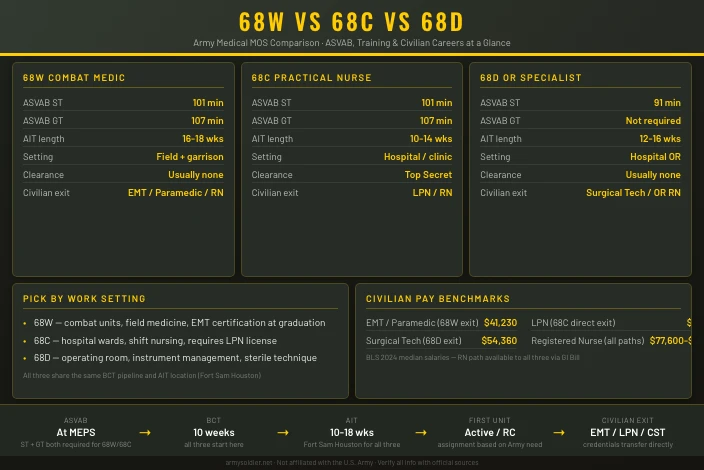
At a Glance: Key Differences
Before going deep on each MOS, here’s the side-by-side view.
| 68W | 68C | 68D | |
|---|---|---|---|
| Title | Combat Medic | Practical Nursing Specialist | Operating Room Specialist |
| ASVAB (ST) | 101 | 101 | 91 |
| ASVAB (GT) | 107 | 107 | Not required |
| Extra requirement | None | LPN license | None |
| Security clearance | Usually none | Top Secret | Usually none |
| AIT length | 16-18 weeks | 10-14 weeks | 12-16 weeks |
| Work setting | Field + garrison | Hospital/clinic | Hospital OR |
| Civilian parallel | EMT / Paramedic | LPN / RN | Surgical Technologist |
The 68W and 68C share the same ASVAB bar – both require ST 101 and GT 107. The 68D asks for less: ST 91, no GT minimum. But the 68C adds a requirement the others don’t have: a state LPN license, either before you enlist or obtained through Army training.
68W Combat Medic: The Field Medicine Role
The 68W is the Army’s most widely recognized medical job, and it’s also the one with the widest gap between garrison life and deployment life. In garrison, you run sick call, give immunizations, and handle routine primary care in a battalion aid station.
On deployment or during field training, you move with your unit, carry a rifle alongside your aid bag, and make medical decisions alone when the situation demands it.
This job demands two things simultaneously: solid clinical knowledge and the ability to function in tactical environments. Most soldiers can do one or the other. The 68W has to do both.
What a day looks like in garrison:
- Morning sick call, triaging walk-in patients
- Updating medical records and unit readiness reports
- Conducting Combat Lifesaver (CLS) training for non-medical soldiers
- Inspecting and inventorying medical equipment
In the field, the structure disappears. You respond to casualties, manage evacuation routes, and use improvised solutions when the textbook ones aren’t available. That combination is why the 68W has a longer AIT than either 68C or 68D.
ASVAB and Qualification
You need ST 101 and GT 107. Both composites matter. The ST pulls from General Science, Mechanical Comprehension, Verbal Expression, and Math Knowledge. The GT combines Verbal Expression and Arithmetic Reasoning. Missing either composite disqualifies you from the 68W regardless of how high the other is.
The Army also requires normal or near-normal color vision. Severe red-green color blindness may be waiverable, but it complicates your candidacy.
Training Pipeline
| Phase | Location | Duration |
|---|---|---|
| Basic Combat Training | Fort Jackson, Fort Moore, or Fort Leonard Wood | 10 weeks |
| AIT | Fort Sam Houston, TX | 16-18 weeks |
AIT at Brooke Army Medical Center is academically demanding. You cover anatomy, pharmacology, trauma care, hemorrhage control, airway management, and field medicine protocols. Expect written exams, hands-on skills checks, and simulated casualty scenarios.
You graduate with Emergency Medical Technician (EMT) certification from the National Registry (NREMT).
Post-Service Path
The civilian pipeline from 68W is one of the strongest in the Army. Your NREMT certification transfers directly. Common paths after service:
- EMT or paramedic in fire or private EMS
- Emergency room technician or trauma tech
- Nursing program (with GI Bill covering tuition)
- Physician assistant school
Median salaries for direct-exit jobs run from $41,230 for EMT/paramedic to $77,600 for RN. The 10-year job outlook for RNs is +6%, and physician assistant demand is growing at +27%.
68C Practical Nursing Specialist: The Hospital Role
The 68C is the closest Army enlisted medical job to a civilian nursing career. You provide direct patient care – administering medications, checking vitals, dressing wounds, monitoring patients through a shift, and documenting everything in electronic health records. You work under physician and RN supervision in Army hospitals and clinics, following established care plans while keeping a close eye on anything that looks off.
This is a structured, protocol-driven role. Your autonomy grows with experience and certification, but early in your career you’re executing care plans, not making them.
The LPN License Requirement
The 68C has a prerequisite the others don’t: a valid state LPN or LVN license. You can get licensed before you enlist through a community college or vocational program, or the Army can put you through licensed practical nurse training as part of your enlistment. Either way, you need to hold that license to serve in this MOS.
If you already have an LPN license when you enlist, you may skip Basic Combat Training and attend a shorter two- to four-week Army orientation course instead. That’s a significant time advantage. The Army also tends to prioritize licensed candidates and may offer better enlistment options.
ASVAB and Clearance
The ASVAB bar matches the 68W exactly: ST 101 and GT 107. What’s different is the security clearance. The 68C requires a Top Secret clearance because of access to sensitive medical records.
The clearance process takes two to six months and involves a full background investigation covering finances, criminal history, drug use, and foreign contacts.
If you have significant derogatory information in any of those areas, the 68C may not be the right path.
Work Environment
In garrison, a 68C shift looks a lot like civilian hospital nursing. You work 12-hour rotating shifts – days and nights, including weekends and holidays. Field and deployed settings change the pace. Casualty volumes spike, resources shrink, and the documentation burden doesn’t let up. You keep doing the same core tasks under much harder conditions.
Post-service, 68C graduates move into civilian nursing directly. You leave with an LPN license, real patient care experience, and eligibility to enter LPN-to-RN bridge programs. Median RN salary is $82,750, and RN job growth is running at +9%.
68D Operating Room Specialist: The Surgical Support Role
The 68D never touches a patient the way a medic or nurse does. Your job is to make surgery possible. You set up the OR before each case, manage every instrument during the procedure under sterile protocol, run sterilization between cases, and inspect equipment. When something breaks, you troubleshoot it. When a surgical team needs a specific instrument tray, you have it ready.
If you miss something – a contaminated instrument, an uncounted sponge – a patient pays for it. That accountability runs through every part of the job.
ASVAB and Entry Requirements
The 68D has a lower ASVAB bar than the other two: ST 91 minimum, no GT requirement. No special license is needed before enlistment. There’s also no security clearance requirement for standard assignments (specialized units may require a Secret clearance, but that’s not the norm).
That lower entry bar doesn’t mean the job is easier. It reflects what the role actually tests. The 68D is a precision technical job, not a verbal reasoning or advanced math job. The ST composite – which pulls from science, mechanical reasoning, and math – aligns well with what OR work actually demands.
Training Pipeline
| Phase | Location | Duration |
|---|---|---|
| Basic Combat Training | Fort Jackson, Fort Moore, or Fort Leonard Wood | 10 weeks |
| AIT | Fort Sam Houston, TX | 12-16 weeks |
AIT covers surgical instrument identification, sterilization methods, OR safety protocols, infection control, electrosurgical unit operation, and surgical team dynamics. You run simulated OR scenarios and practice instrument preparation under supervision before you ever step into a real operating room.
Post-Service Path
The 68D civilian exit is clean and direct. Your training maps closely to the Certified Surgical Technologist (CST) credential through the Association of Surgical Technologists. Military training covers most of what the exam tests, though additional study is typically required.
Civilian surgical technologist median salary is $54,360 with a +7% ten-year outlook. OR specialists with further schooling move into OR nursing ($92,000+) or biomedical equipment tech roles ($63,000+).
Comparing the Three: What Actually Matters for Your Decision
The table at the top covered the mechanics. Here’s how to think through the choice.
Pick the 68W if:
- You want to serve in a combat or tactical unit alongside infantry soldiers
- You’re interested in emergency medicine, paramedicine, or trauma nursing after service
- You’re prepared for physical and psychological demands that hospital work doesn’t have
- You can hit both the ST 101 and GT 107 thresholds
Pick the 68C if:
- You’re already on a nursing track in civilian life or planning to be
- You have or can get an LPN license before enlisting
- Hospital-based care and shift work fit your lifestyle better than field assignments
- You want the fastest path to an RN career using Army training and the GI Bill
Pick the 68D if:
- You’re drawn to the technical precision of surgical environments
- You prefer a well-defined protocol role over improvised field medicine
- Your ASVAB scores are in the 91-100 ST range and you don’t want to wait to retest
- A surgical technologist or OR nursing career is your civilian target
None of these is the wrong answer if it matches how you want to spend your service time. The 68W gets more exposure to austere conditions. The 68C gets more patient contact time. The 68D gets more technical depth in a specialized environment.
Reserve and National Guard Availability
All three MOSs are available in the Reserve and Guard. The 68W has the broadest availability – nearly every combat unit carries 68W slots. The 68C and 68D are more concentrated in medical units that maintain hospital or surgical capability. If geographic stability matters to you and you’re considering part-time service, confirm that a unit near you actually has an open slot in the MOS you want before committing.
A Note on ASVAB Preparation
The 68W and 68C both require two separate composites above 100. That’s a meaningful study target. The ST composite pulls from General Science, Mechanical Comprehension, Verbal Expression, and Math Knowledge. The GT composite combines Verbal Expression and Arithmetic Reasoning. You can’t offset a weak GT with a strong ST – both thresholds must be met independently.
The 68D only requires ST 91, which most well-prepared candidates can hit with focused study on the science and mechanical reasoning sections.
This site is not affiliated with the U.S. Army or any government agency. Verify all information with official Army sources before making enlistment or career decisions.
You may also find the Best ASVAB Scores for Army Medical MOS Jobs and the full Army medical careers directory helpful for your next step.