Active Duty vs Army Reserve vs National Guard
Most people know the Army has a Reserve and a National Guard, but few understand what that actually means for their daily life before they sign a contract. The three components look similar on paper – same rank structure, same pay tables, same basic training. In practice, they shape your schedule, your paycheck, your healthcare, and your civilian career in completely different ways.
This guide breaks down every major factor side by side so you can make an informed decision before talking to a recruiter.
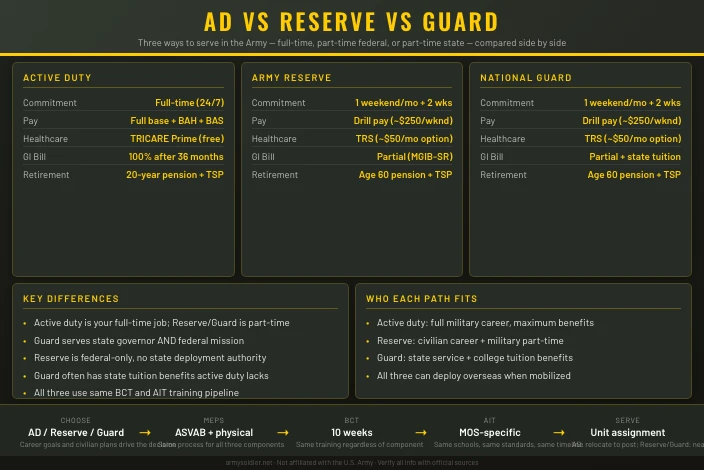
Time Commitment
Active Duty is full-time military service. You live on or near a military installation, work a standard duty day (roughly 0630 to 1700 with physical training), and are available for deployment, training exercises, and unit duties around the clock. It is a career, not a side obligation.
Army Reserve and Army National Guard share the same baseline schedule: one weekend per month plus two weeks of annual training (AT). That weekend counts as four Unit Training Assemblies (UTAs), so drilling members earn 48 UTAs per year plus 14 days of AT, totaling 62 paid training days annually.
The standard schedule looks simple, but it has real limits:
- Some MOSs require additional training beyond the baseline weekend
- Annual training can extend beyond two weeks for certain specialties
- Schools, certifications, and leadership courses add days throughout the year
- Mobilization can convert part-time service into full-time active duty without much warning
The difference between Reserve and Guard on time commitment is minimal at the baseline level. Both run the same weekend-plus-AT model. The divergence shows up in how and why they get called up beyond that baseline, which the deployment section covers in detail.
Pay Structure
Pay during drills is calculated as: (monthly base pay ÷ 30) × number of drill periods. A standard weekend equals four drill periods.
Sample Weekend Drill Pay (4 UTAs)
| Grade | Years of Service | Weekend Pay |
|---|---|---|
| E-3 | Less than 2 | $378 |
| E-4 | Less than 2 | $419 |
| E-5 | Less than 2 | $446 |
| E-6 | 6 years | $565 |
| O-1 | Less than 2 | $553 |
| O-3 | 3 years | $903 |
| W-1 | Less than 2 | $541 |
Active Duty soldiers receive that same base pay every month as a salary, plus full allowances. An E-4 with less than two years earns $3,142 per month in base pay, plus Basic Allowance for Subsistence ($476.95/month for enlisted) and BAH based on duty location.
When Reserve or Guard soldiers mobilize to active duty, they shift off drill pay entirely and onto full active-duty pay – same base pay, same BAH at their duty location, same BAS. The pay difference between components disappears the moment orders are cut.
Annual training pay works the same way: you earn one day of active-duty base pay for each day you’re on orders during AT.
Benefits Comparison
This is where the three components diverge most sharply.
Healthcare
| Component | Plan | Monthly Premium | Copays |
|---|---|---|---|
| Active Duty | TRICARE Prime | $0 | $0 |
| Active Duty Families | TRICARE Prime | $0 | $0 (in-network) |
| Reserve / Guard (drilling) | TRICARE Reserve Select | $57.88 (member only) | Standard cost-sharing |
| Reserve / Guard + Family | TRICARE Reserve Select | $286.66 | Standard cost-sharing |
| Reserve / Guard (mobilized) | TRICARE Prime | $0 | $0 |
TRICARE Reserve Select (TRS) is a premium-based plan available to drilling Reserve and Guard members not on active-duty orders. At $57.88 per month for member-only coverage, it costs far less than most civilian employer plans, but it is not free. Coverage flips to full TRICARE Prime the moment a soldier activates on orders over 30 days.
Education Benefits
Active Duty soldiers have access to two education programs simultaneously:
- Tuition Assistance (TA): $250 per semester hour, up to $4,500 per year, usable while serving
- Post-9/11 GI Bill: 36 months of full benefit after 36 months of aggregate active duty
Reserve and Guard soldiers can use the same federal TA program ($250/semester hour, $4,500/year cap) while in drilling status. The GI Bill picture is different:
- Montgomery GI Bill – Selected Reserve (MGIB-SR, Chapter 1606): $493/month for up to 36 months. Available without activation, but stops if you leave drilling status.
- Post-9/11 GI Bill (Chapter 33): Requires 90+ days of aggregate Title 10 active-duty service after September 10, 2001. Initial Entry Training (basic training + AIT) does not count. Most Reserve/Guard soldiers earn this through deployments.
The Post-9/11 GI Bill benefit scales with cumulative active duty time: 90 days earns 40%, six months earns 50%, up to 100% at 36+ months. A soldier who deploys twice can reach full benefit eligibility without ever going Active Duty.
National Guard state benefits add another layer. Many states offer tuition waivers at public universities, state bonuses, and state income tax exemptions on military pay. These vary widely – some states cover full in-state tuition at public schools, others offer partial waivers or nothing at all. Contact your state’s Adjutant General office to find out exactly what your state provides.
Retirement
Active Duty retirement under the Blended Retirement System (BRS) pays 40% of your high-36 average basic pay after 20 years, beginning immediately at retirement. The TSP match begins in year three: 100% on the first 3% you contribute, 50% on the next 2%, for a maximum government contribution of 5% of base pay.
Reserve and Guard retirement uses a points-based system under the same BRS framework. You earn:
- 1 point per drill period (up to 130 inactive duty points per year)
- 1 point per day of active duty
- 15 gratuitous membership points per year
A “good year” requires 50+ retirement points. You need 20 good years to qualify. The pension does not start at age 60 for most Reserve/Guard retirees – but every 90 consecutive days of active duty under qualifying mobilization orders reduces that age by 90 days, down to a minimum of age 50.
The practical gap: an Active Duty soldier who retires at 20 years starts collecting a pension immediately, often in their late thirties. A Reserve/Guard soldier with the same 20 good years waits until 60. The monthly payment is also smaller because fewer annual points mean fewer equivalent years of service in the pension formula.
Deployment Frequency
Active Duty soldiers deploy based on unit assignment, operational tempo, and Army needs. Infantry and special operations units have historically seen the most frequent rotations. Deployments typically run 9-12 months with a dwell period between them.
Reserve and Guard soldiers mobilize less frequently in peacetime, but mobilization has become more common since 2001. Both components now deploy regularly through several authorities:
- Title 10 (federal): The president activates soldiers for federal military operations, including overseas deployments. Both Reserve and Guard are subject to Title 10 mobilization.
- Title 32 (state, Guard only): The governor activates Guard soldiers for domestic missions – disaster response, civil emergencies – under state control with federal pay and benefits.
- State Active Duty (Guard only): The governor calls up Guard soldiers as state employees with state pay and benefits. Federal protections like USERRA still apply, but federal benefits do not.
The Army Reserve has no state mission and no Title 32 or State Active Duty authority. Reserve soldiers can only mobilize under federal orders.
In practice, Guard soldiers often face more varied activation scenarios because of this dual state-federal mission. A hurricane, wildfire, or civil emergency can call up Guard units with little notice under orders that have nothing to do with overseas operations.
USERRA protections cover both components. Your civilian employer must hold your job for up to five cumulative years of military service, cannot deny you promotions or seniority due to military obligations, and must offer continued health insurance during your absence.
MOS Availability by Component
Not every MOS exists in every component. Active Duty has the broadest selection – all 150+ MOSs are available somewhere. Reserve and Guard units are organized around specific mission requirements, which means some specialties are heavily represented and others are rare or nonexistent at the part-time level.
Generally well-represented in Reserve/Guard:
- Medical (CMF 68)
- Transportation and logistics (CMF 88, 92)
- Engineers (CMF 12)
- Military police (CMF 31)
- Signal and cyber (CMF 25, 17)
- Finance and HR (CMF 36, 42)
Less common or limited in Reserve/Guard:
- Special Forces (18-series)
- Some aviation specialties
- Certain intelligence MOSs with high clearance requirements
- Combat arms (11B, 19K) exist but fewer units compared to Active Duty
The National Guard tends to have more combat arms and aviation units than the Reserve, because Guard units are organized to support state defense and disaster response missions that require those capabilities. The Reserve leans more heavily toward support and sustainment functions.
If a specific MOS is critical to your decision, verify unit availability in your area before committing. Your recruiter can show you what units have openings within reasonable commuting distance.
Civilian Career Impact
Active Duty service and a civilian career are mutually exclusive while you’re serving. The trade-off is that Active Duty provides substantial career training, security clearances, and professional experience that translate directly to civilian jobs when you separate. Many veterans move directly into federal government, defense contracting, healthcare, law enforcement, and technical fields because their military training maps to civilian hiring requirements.
Reserve and Guard service is specifically designed to coexist with a civilian career. You keep your civilian job, your civilian paycheck, and your civilian career progression. The challenge is managing the friction between both:
- Monthly drill weekends pull you away from work, family events, and weekend plans
- Annual training takes two or more weeks of leave every year
- Mobilization can take you away for months or years with limited notice
- Security clearances obtained through Reserve/Guard service can boost your civilian salary in cleared fields
The civilian career advantage of Reserve/Guard service is often underestimated. Military leadership experience, technical skills, and clearances are marketable. A 68W (Combat Medic) in the Reserve who works as a paramedic or nurse in their civilian job builds parallel skills in both roles. A 25U (Signal Support Specialist) in the Guard with an active TS/SCI clearance often commands a salary premium in IT contracting work.
Serving as a 68W in the Army Reserve is one common example of how part-time service and a civilian healthcare career reinforce each other. For a broader look at which MOSs translate best to civilian employment, see Best Army Reserve MOS Jobs for Civilian Careers.
Family Considerations
Active Duty family life centers on the installation. Spouses and children live on or near post, access on-post schools, medical care, commissary, and community programs. The trade-off is frequent moves (PCS orders) and deployment separations that can span a year or more.
Reserve and Guard family life looks more like civilian life most of the time. Your family stays rooted in one community, kids stay in the same school, and your household income stays stable through your civilian job. The disruption is periodic rather than constant – but mobilization can feel more abrupt precisely because it is unexpected.
A few practical realities for Reserve/Guard families:
- TRICARE Reserve Select covers the family while the soldier is in drilling status, but they must enroll and pay the premium
- Family members lose access to on-post services that Active Duty families use daily
- Mobilization triggers SCRA and USERRA protections, but navigating them with an employer or landlord still takes effort
- State Active Duty (Guard) pay from the state may be lower than federal active-duty pay, depending on the state
The Reserve and National Guard each run Family Readiness Groups (FRGs) that connect families during mobilizations and provide support resources, but these operate with fewer full-time staff than Active Duty FRGs.
For a detailed breakdown of what Reserve benefits actually look like in practice, Army Reserve Benefits: What You Actually Get covers the full picture. To understand how the Reserve and Guard differ beyond the basics covered here, see Army National Guard vs Reserve: Key Differences.
Which Component Fits You
No component is objectively better. The right choice depends on what you want your daily life to look like.
| Factor | Active Duty | Army Reserve | Army National Guard |
|---|---|---|---|
| Time commitment | Full-time | ~62 days/year + mobilization | ~62 days/year + mobilization |
| Steady income | Military salary | Civilian salary + drill pay | Civilian salary + drill pay |
| Healthcare | TRICARE Prime (free) | TRS ($57.88 to $286.66/mo) | TRS ($57.88 to $286.66/mo) |
| Housing | BAH or on-post | Civilian housing (no BAH) | Civilian housing (no BAH) |
| GI Bill | 100% after 36 months | Earns through deployment | Earns through deployment |
| Retirement | Starts at separation (20+ yrs) | Starts at age 60 (20 good years) | Starts at age 60 (20 good years) |
| State mission | None | None | Yes (governor activation) |
| State education benefits | No | No | Yes (varies by state) |
| Civilian career | Paused | Maintained | Maintained |
| Deployment frequency | Higher in operational units | Moderate | Moderate + state activations |
Choose Active Duty if you want to focus entirely on a military career, live on post, access the full benefits package daily, and build toward a 20-year pension you can start collecting in your 30s or 40s.
Choose the Army Reserve if you want to keep your civilian career, you live in an area with Reserve units that have your MOS, and you want federal part-time service without a state mission.
Choose the Army National Guard if you want to keep your civilian career and your state offers tuition benefits or bonuses that make the Guard financially attractive, or if you want the option to respond to local disasters and emergencies in your community.
Explore the full range of Army career options to see which jobs are available in each component before making your decision.
This site is not affiliated with the U.S. Army or any government agency. Verify all information with official Army sources before making enlistment or career decisions.