Army AMEDD Direct Commission Guide
Most officers earn their commission by spending years in ROTC or fighting through a competitive OCS board. Healthcare professionals skip that queue. If you hold a medical license, a clinical degree, or a graduate credential in an approved health field, the Army Medical Department (AMEDD) can commission you directly – bypassing the standard enlisted or OCS pipeline entirely.
Direct commission is not a shortcut to a soft assignment. You will deploy, lead soldiers, and operate under the same Army standards as any other officer. But the entry path is designed for working professionals, and the package – loan repayment, officer pay, housing allowance, and TRICARE – is competitive in a way that changes the calculus for a lot of clinicians.
The Six AMEDD Corps
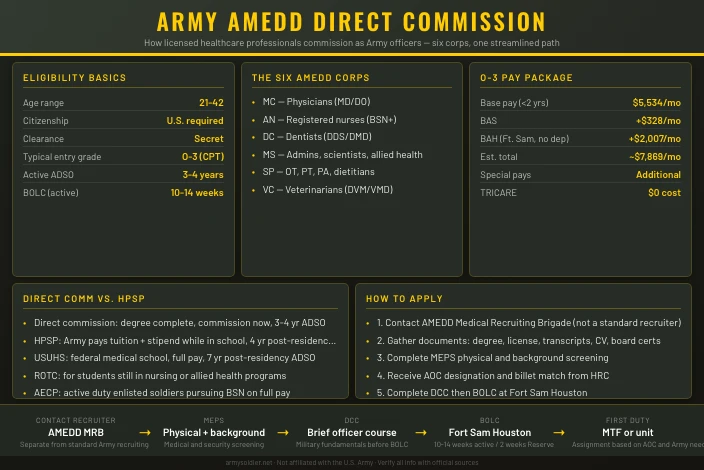
AMEDD spans six officer corps, each requiring a specific credential. The direct commission path is available across all six, though the degree and licensure requirements differ.
| Corps | Code | Who It’s For | Minimum Credential |
|---|---|---|---|
| Medical Corps | MC | Physicians | MD or DO + state medical license |
| Army Nurse Corps | AN | Registered nurses | BSN + active RN license |
| Dental Corps | DC | Dentists | DDS or DMD + state dental license |
| Medical Service Corps | MS | Administrators, scientists, allied health | Bachelor’s to doctorate depending on AOC |
| Medical Specialist Corps | SP | OTs, PTs, PAs, dietitians | Professional degree + active license |
| Veterinary Corps | VC | Veterinarians | DVM or VMD + state license |
The MS Corps is the most varied – it covers everything from health services administrators (70B) with a bachelor’s degree to clinical psychologists (73B) who need a doctorate and an APA-approved internship. If your profession doesn’t fit neatly into MC, AN, DC, SP, or VC, MS is where you belong.
Eligibility Requirements
All AMEDD direct commission applicants must meet a standard baseline before corps-specific requirements apply.
Universal requirements:
- U.S. citizenship (required before commissioning, not just at application)
- Age between 21 and 42 at commissioning (waivers exist; prior military service earns age credit)
- A qualifying military physical through MEPS
- Eligibility for a Secret security clearance
- Degree and active licensure appropriate to the target corps
- No prior conviction for a felony or serious offense (waiver-dependent)
The age limit matters most for physicians. An MD finishing a five-year surgical residency at age 32, plus a two-year fellowship, may be 34 before seriously considering military service. That leaves a shrinking window but not a closed one – AMEDD recruiters handle age waiver requests regularly, and applicants with prior military service get credit applied to their age calculation.
The security clearance requirement is straightforward for most healthcare professionals. Eligibility for a Secret clearance means no unresolved felony charges, no active drug use, no significant unmanaged debt, and no foreign allegiance issues. The investigation covers your financial history, criminal record, and foreign contacts. Dual citizenship does not automatically disqualify you, but renunciation of the other citizenship may be required before commissioning. Most AMEDD applicants clear this step without difficulty.
What “Direct Commission” Actually Means
The term gets used loosely. In AMEDD context, it means you commission as an officer without attending Officer Candidate School (OCS) or completing four years of ROTC. Instead, you complete a condensed entry course and then report directly to your first duty assignment.
The entry course is the AMEDD Direct Commission Course (DCC), a brief military officer fundamentals program that covers land navigation, weapons qualification, Army customs and courtesies, physical training standards, and leadership basics. After DCC, all AMEDD officers – direct commission and ROTC alike – attend the AMEDD Basic Officer Leader Course (BOLC) at Fort Sam Houston, Texas.
BOLC runs 10 to 14 weeks for active duty officers and two weeks for Reserve officers. It is divided into three phases:
BOLC teaches you to function as an officer. Clinical competence is assumed. The course does not retrain your specialty skills – it gives you the military knowledge to apply them in a deployed or garrison setting.
Pay Grade Entry and Longevity Credit
This is where direct commission frequently surprises applicants. You do not enter as a Second Lieutenant (O-1) simply because you’re new to the Army. Graduate education years count toward pay longevity, and most AMEDD direct commission officers enter as O-3 (Captain) or higher.
Typical entry grades:
| Corps | Common Entry Grade | Notes |
|---|---|---|
| MC (Physicians) | O-3 (Captain) | Medical degree + residency years count as service credit |
| AN (Nurses, BSN) | O-1 to O-2 | BSN-entry; graduate degree bumps entry grade |
| DC (Dentists) | O-3 (Captain) | Similar to MC; dental degree + clinical training credited |
| MS (Varies by AOC) | O-1 to O-3 | Master’s/doctorate holders typically enter at O-3 |
| SP (OT, PT, RD) | O-1 to O-3 | Doctoral degree holders (DPT, OTD) often enter at O-3 |
| VC (Veterinarians) | O-3 (Captain) | DVM/VMD + clinical training credited |
A Captain with less than two years of credited service earns $5,534 per month in base pay, per 2026 DFAS military pay tables. Add $328.48 per month BAS, plus tax-free BAH based on duty station – an O-3 at Fort Sam Houston receives $2,007 per month without dependents, or $2,127 with dependents. Total monthly compensation before specialty pays easily clears $7,800.
Physicians and dentists also qualify for substantial special pays on top of base pay: Variable Special Pay, Incentive Special Pay, Board Certified Pay, and accession or retention bonuses that can total tens of thousands of dollars annually. The exact amounts change each fiscal year based on specialty shortage designations. An AMEDD recruiter can give you current figures for your specific credential.
Service Obligations
The Army calls the post-training service commitment the ADSO – Active Duty Service Obligation. For direct commission officers, it typically runs three to four years of active duty service after completing BOLC. HPSP scholarship recipients and USUHS graduates carry longer obligations (four years post-residency for HPSP; seven years post-residency for USUHS), but those paths involve the Army funding your professional degree, not direct commission of an already-licensed professional. The AMEDD scholarship programs page covers both options in detail.
A three-year active duty commitment is a genuine trade-off worth calculating clearly:
- Three years of officer pay, housing, and TRICARE
- Loan repayment programs for qualifying student debt
- Post-9/11 GI Bill eligibility (36 months of education benefits transferable to dependents after six years)
- Deployment potential – operational medicine experience that most civilian clinicians never access
The Reserve component is also an option. Reserve AMEDD direct commission carries a drilling commitment of one weekend per month plus two weeks of Annual Training. Reserve officers receive the same daily pay rate as active duty during AT and mobilizations. Many civilian clinicians find the Reserve path fits their career without forcing a full-time transition.
The Application Process
AMEDD medical recruiting operates on a separate track from standard Army recruiting. Do not walk into a general recruiting station expecting them to process a physician or PA application – you need a medical recruiter.
The application sequence:
Contact the Medical Recruiting Brigade – go to the relevant corps page on the AMEDD recruiting site (physicians, nurses, dentists, or medical specialists). A recruiter will review your credentials and confirm your eligibility before any paperwork begins.
Gather your documents: Degree transcripts, current professional license, DEA registration if applicable (physicians), USMLE or COMLEX scores (physicians), board certification documentation, CV with clinical experience, and any prior military records.
Complete MEPS processing: The Military Entrance Processing Station conducts a physical examination and background screening. This step confirms medical eligibility for service.
Receive a branch designation and initial assignment: AMEDD recruiters work with HRC (Human Resources Command) to identify open billets that match your credential. Your AOC within a corps depends on your specific degree and training.
Complete DCC and BOLC: Once commissioned, you attend the Direct Commission Course then BOLC at Fort Sam Houston. Reserve officers attend an accelerated two-week BOLC.
Report to first duty assignment: Active duty officers receive orders to their initial installation. Reserve officers return to their drilling unit.
Which Corps Fits Your Credential
Physicians (MD or DO) commission into the Medical Corps. Direct commission is the fastest path once residency is complete and an active license is in hand. HPSP remains available for students still in medical school who want the Army to fund the degree.
The Army Nurse Corps takes BSN-and-above nurses through direct commission. Nurses still in school are better served by ROTC with the Nurse Summer Training Program. Active duty enlisted soldiers can pursue a commission through AECP.
Dentists commission into the Dental Corps, following the same direct commission framework as the Medical Corps. Oral surgeons and general dentists are consistently in demand.
Physical therapists (65B), occupational therapists (65A), and dietitians (65C) commission into the Medical Specialist Corps. As of early 2026, 65A carries an accession bonus up to $250,000 and 65B up to $30,000 – among the largest in AMEDD. Confirm current figures with a recruiter since amounts shift each fiscal year.
Veterinarians (DVM or VMD) commission into the Veterinary Corps, which covers food safety inspection, working dog care, and zoonotic disease surveillance alongside clinical veterinary work.
If your credential is a master’s or doctorate in a health science, the Medical Service Corps has an AOC for you – clinical psychology (73B), social work (73A), environmental science (72D), audiology (72C), and health administration (70B) are among the most common.
Commissioning vs. Other Paths
Direct commission is not the only way into AMEDD. Understanding where it sits relative to other paths helps clarify whether it’s the right move for you.
| Path | Best For | Degree Status | Army Pays For |
|---|---|---|---|
| Direct Commission | Licensed professionals with degree in hand | Degree complete | DCC + BOLC training only |
| HPSP | Medical/dental/other students currently in school | Degree in progress | Full tuition + stipend + bonus |
| USUHS | Medical school candidates willing to attend federal school | Pre-medical school | Full MD at federal institution |
| ROTC (NSTP for nurses) | Undergrad/graduate students at participating programs | Degree in progress | Scholarship (competitive) |
| AECP | Active duty enlisted soldiers pursuing BSN on duty | Degree in progress | Full pay + benefits during schooling |
If your degree is funded and complete, direct commission is the clean path. If you’re still in professional school and want the Army to pay for it, HPSP is worth a hard look instead. The deciding factor is usually debt: a physician with $250,000 in loans may benefit more from HPSP’s full tuition coverage and stipend, even with the longer service obligation. A nurse or PA who graduated with manageable debt and an active license in hand gets to their first assignment faster through direct commission.
What to Expect After Commissioning
Your first assignment after BOLC depends on your corps and the Army’s billet needs. Physicians typically report to a military treatment facility as a clinic physician or GMO (General Medical Officer) with a maneuver unit. Nurses report to one of 13 approved MTF locations and complete the Clinical Nurse Transition Program. Physical therapists and occupational therapists often report to a brigade support battalion or MTF clinic.
Every AMEDD officer operates inside the military command structure. You have a chain of command, you deploy when your unit deploys, and you meet the same Army Fitness Test standards as any other officer. The AFT has five events:
- 3-rep max deadlift
- Hand release push-up
- Sprint-drag-carry
- Plank
- Two-mile run
Operational medicine assignments change the clinical picture. A physician with a maneuver battalion goes to the field whenever the battalion trains. That means field exercises, tactical medicine settings, and everything that comes with being a junior officer in an infantry environment – not a hospital desk. Many clinicians find that transition the most valuable part of their service.
Contact the Army Medical Recruiting Brigade with your specific credential to get current billet availability, bonus figures, and a realistic timeline for your commissioning process.
This site is not affiliated with the U.S. Army or any government agency. Verify all information with official Army sources before making enlistment or career decisions.
Explore the full breakdown of Army medical career options in Army medical MOS and officer jobs and learn more about the officer path choices at Army officer paths to serve.