Army ASVAB Retesting Rules and Timeline
Your ASVAB score sits at 47 and you need a 50 to qualify for the MOS you want. Or your AFQT landed below 31 and you can’t enlist at all. Either way, the question is the same: how soon can you test again, and what does the timeline look like from here? The wait periods are more lenient early on and tighten up fast, so knowing the exact rules before you schedule anything can save you months.
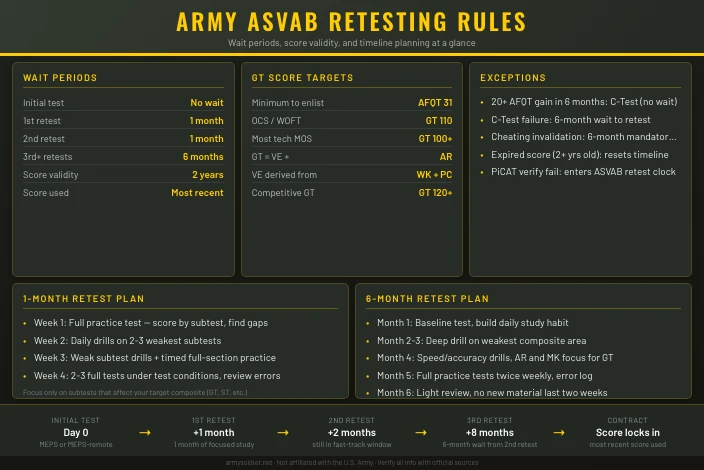
The Retest Wait Periods, Exactly
The Army follows the Department of Defense testing policy, which sets mandatory wait times that increase with each attempt.
| Attempt | Wait Required |
|---|---|
| Initial test | None – take when scheduled |
| First retest | 1 calendar month after initial test |
| Second retest | 1 calendar month after first retest |
| Third retest and beyond | 6 calendar months after previous retest |
There is no cap on how many times you can retest. But the six-month gap after your second retest makes a third attempt a significant commitment of time.
One rule catches a lot of applicants off guard: the Army uses your most recent score, not your highest. If you score 55, retest and score 48, your score of record is 48. That’s not hypothetical – it happens, and it can cost you a job you already qualified for.
Score Validity and When You Must Retest
ASVAB scores are valid for 2 years from the date you took the test. After that window closes, the scores expire for enlistment purposes and you must retest from scratch, regardless of what you previously scored.
If your scores expire, the standard retest wait periods reset. You are not penalized for an expired score – the slate simply clears.
A few scenarios where the two-year clock matters most:
- You tested in high school for a student ASVAB, scored well, then delayed enlisting
- You scored and spoke with a recruiter but didn’t sign a contract within two years
- You enlisted, separated, and want to use an old ASVAB score for reentry
In all three cases, check the test date with your recruiter before building a timeline. An expired score means starting over, which can shift your entry date by months.
Exceptions to the Standard Wait Periods
The wait periods have two notable exceptions worth knowing.
Large AFQT jump (20+ points in 6 months). If your AFQT score increases by 20 or more points within a six-month period, the military requires you to take a Confirmation Test (C-Test) to verify the gain is legitimate. The C-Test is administered immediately – no one-month wait applies for that specific test. If you pass the C-Test, the higher score stands. If you fail, your previous score remains your score of record, and you must wait six months before a standard retest.
Cheating or test invalidation. A test invalidated for misconduct carries an automatic six-month wait before you can retest. Administrative invalidations (power outage at the test center, fire drill mid-test) don’t count against you and you can retest based on normal scheduling.
How PiCAT Fits Into This
The PiCAT (Pending Internet Computerized Adaptive Test) is an at-home version of the ASVAB. You take it online, then complete a short in-person Verification Test at MEPS to confirm your results. If you pass the Verification Test, your PiCAT scores serve as your official ASVAB scores.
The complication: a failed Verification Test sends you back to the standard ASVAB timeline. You don’t get to simply retake the PiCAT. Your recruiter will schedule a standard ASVAB retest, and the one-month wait period for a first retest applies.
This matters for planning. If you attempt the PiCAT and fail verification, you’ve effectively used your “no-wait” window. The next attempt requires a full calendar month.
Recommended study resource: An ASVAB study course with full-length practice tests and section-specific drills can help you identify exactly which subtests are pulling your composite scores down before you commit to a retest date.
When you purchase through links on our site, we may receive compensation at no extra cost to you.
Planning Your Retest Calendar
The difference between a one-month wait and a six-month wait is significant enough to plan around. Here’s how to think about it depending on where you are in the sequence.
If you haven’t taken the ASVAB yet, you have the most flexibility. Your first two retests each require only a one-month gap. That means within three months of your initial test, you can have completed three attempts total.
If you’re on your first or second retest, you’re still in the fast lane. One month between tests gives you a real shot at improving with focused study.
If you’ve already done two retests, you’re looking at a six-month commitment before you can test again. Use that time deliberately. A six-month study window with a structured plan can move scores significantly, but only if you’re working on the right subtests.
One-Month Retest Calendar (First or Second Retest)
| Week | Focus |
|---|---|
| Week 1 | Take a full practice test. Score by subtest. Find the gaps. |
| Week 2 | Drill the 2-3 weakest subtests daily. |
| Week 3 | Mix weak subtest drills with timed full-section practice. |
| Week 4 | Two or three full practice tests under test conditions. Review errors. |
Six-Month Retest Calendar (Third Retest and Beyond)
| Month | Focus |
|---|---|
| Month 1 | Baseline practice test. Build daily study habit. Cover all subtests. |
| Month 2 | Deep drill on weakest composite area (GT, ST, or other target). |
| Month 3 | Build up the secondary weak area. Take a full practice test mid-month. |
| Month 4 | Speed and accuracy drills. Focus on Math Knowledge and Arithmetic Reasoning if GT is the target. |
| Month 5 | Full practice tests twice weekly. Start error log to track repeat mistakes. |
| Month 6 | Final two weeks: rest, light review, no new material. Test-day prep. |
Worked Examples: Mapping Your Timeline
Abstract rules are easier to apply with specific scenarios attached.
Scenario 1: AFQT of 29, want to enlist, need 31 minimum. You took your initial test in January. You can retest in February (one month later). With four weeks of focused Word Knowledge and Paragraph Comprehension study, moving two percentile points is very achievable. If February’s retest hits 31+, you’re eligible to enlist. Total delay: one month.
Scenario 2: GT score of 95, want GT 110 for warrant officer. GT is calculated as Verbal Expression (VE) plus Arithmetic Reasoning (AR). A 15-point gap in the GT composite is real but closeable. If you took your initial test in March and your first retest in April, and still land at 105, your second retest is May. Three attempts, three months total, still within the one-month window. If May’s score still misses 110, you’re now in six-month territory – next attempt is November at earliest.
Scenario 3: Scored 45 AFQT in January, want GT 110 by September. Working backward from September: a third retest in September requires the second retest no later than March (six-month gap). That means the first retest had to happen no later than February. Initial test: January. First retest: February. Second retest: March. Third retest: September. This works – but only if you started studying before that January test. By March’s second retest, you’ve had two months to improve. If GT 110 isn’t there by March, the September target requires the full six months of structured preparation.
Scenario 4: Scores expire next month. Your test is from two years ago and expires in 30 days. Even if you scored high enough, you’ll need to retest. The good news: an expired score is a clean slate. No prior retest count carries forward. Your next test is treated as an initial test, giving you two one-month windows before the six-month rule kicks in.
Raising GT Score Specifically
GT is the line score that opens the most doors in the Army: warrant officer programs, OCS, Green to Gold, and many technical MOS jobs. It’s calculated from two subtests – Verbal Expression (VE) and Arithmetic Reasoning (AR).
VE itself is derived from Word Knowledge (WK) and Paragraph Comprehension (PC). So the four subtests that directly move your GT score are WK, PC, and AR, plus the standardization that produces VE.
If GT is your target, concentrate study time here:
- Arithmetic Reasoning: Word problems requiring multi-step math. Practice translating language into equations.
- Word Knowledge: Vocabulary in context. Read broadly, use flashcards, learn common prefixes and roots.
- Paragraph Comprehension: Main idea, inference, author tone. Practice with timed reading passages.
Spreading study time across all nine ASVAB subtests when only three are dragging your GT score down wastes the limited time you have between retests.
An ASVAB study guide with practice tests lets you target GT-specific subtests without covering material that won’t move the score you need.
When you purchase through links on our site, we may receive compensation at no extra cost to you.
Army vs. Other Branches
The Army’s retest policy follows the DoD standard, meaning the wait periods are the same across all branches for the ASVAB itself. What differs is the minimum AFQT score required to enlist:
| Branch | Minimum AFQT (diploma) | Minimum AFQT (GED) |
|---|---|---|
| Army | 31 | 50 |
| Navy | 35 | 50 |
| Marine Corps | 32 | 50 |
| Air Force | 36 | 65 |
| Coast Guard | 40 | 50 |
The Army’s 31 minimum is among the lowest across all branches. For applicants right at the margin, the Army is often the most accessible path. But MOS-specific line score requirements are separate from the AFQT floor – qualifying to enlist doesn’t automatically qualify you for every job.
You may also find Army officer selection tests and Army ASVAB test prep helpful for planning your next steps.