Army Aviation Jobs: Enlisted, Warrant, and Officer Paths
Army aviation is one of the few career fields where a high school graduate with no military experience can walk in as a civilian and, two years later, be flying a Black Hawk. The enlisted side puts you inside helicopters with wrenches. The warrant officer path puts you in the cockpit. The commissioned officer path adds command responsibility on top of flying. Each track has its own entry requirements, training pipeline, and long-term trajectory, and they are genuinely different careers, not just different ranks doing the same work.
This guide covers all three, with specific scores, timelines, and what daily life actually looks like in each one.
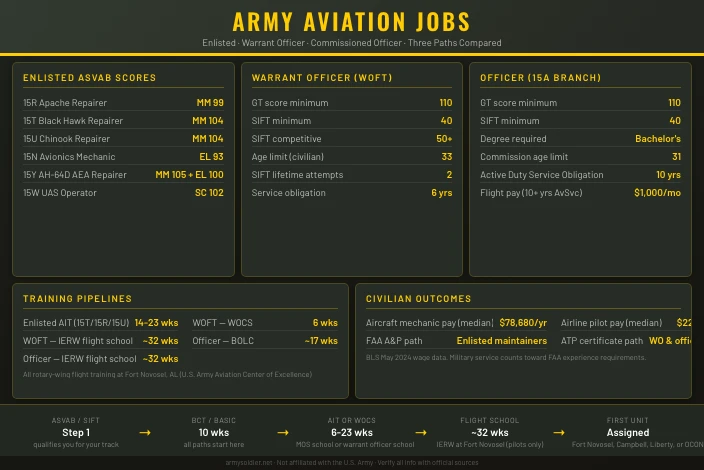
Three Tracks Into Army Aviation
Army aviation runs on three distinct populations. Enlisted soldiers in Career Management Field 15 (CMF 15) are the maintainers: the mechanics, crew chiefs, and operations specialists who keep the aircraft ready to fly. Warrant officers, primarily in MOS 153A, are the primary pilots. Commissioned officers in Branch AV (Aviation) fly and lead at the platoon, company, and battalion level.
Each track does different work and requires a different entry path:
| Track | Primary Role | Entry Requirement |
|---|---|---|
| Enlisted (CMF 15) | Maintenance, operations, UAS | ASVAB line scores |
| Warrant Officer (153A) | Rotary-wing pilot | GT 110 + SIFT 40 |
| Commissioned Officer (15A) | Pilot and commander | Degree + commission + SIFT 40 |
The misconception is that enlisted maintainers are just support. Aviation units are combat formations. A 15R AH-64 Apache Repairer deployed to the Middle East works under the same threat environment as the pilots. The difference is job function, not risk level.
Enlisted Aviation: CMF 15
CMF 15 aviation jobs cover 15 MOSs split between aircraft maintenance, UAS operations, and aviation operations. Most soldiers in this career field train at Fort Novosel, Alabama, home of the U.S. Army Aviation Center of Excellence (USAACE).
ASVAB Requirements by MOS
Every CMF 15 job requires specific ASVAB line score composites. Most maintenance MOSs require the Mechanical Maintenance (MM) score, which combines Numerical Operations, Auto and Shop Information, Mechanical Comprehension, and Electronics Information.
| MOS | Title | Line Score |
|---|---|---|
| 15B | Aircraft Powerplant Repairer | MM 104 |
| 15D | Aircraft Powertrain Repairer | MM 104 |
| 15E | UAS Repairer | EL 93 + MM 104 |
| 15F | Aircraft Electrician | MM 104 |
| 15G | Aircraft Structural Repairer | MM 104 |
| 15H | Aircraft Pneudraulics Repairer | MM 104 |
| 15N | Avionic Mechanic | EL 93 |
| 15P | Aviation Operations Specialist | ST 91 |
| 15Q | Air Traffic Control Operator | ST 101 |
| 15R | AH-64 Attack Helicopter Repairer | MM 99 |
| 15T | UH-60 Helicopter Repairer | MM 104 |
| 15U | CH-47 Helicopter Repairer | MM 104 |
| 15W | UAS Operator | SC 102 |
| 15Y | AH-64D Armament/Electrical/Avionics Repairer | MM 105 + EL 100 |
The 15Y has the highest combined threshold in the field, requiring both MM 105 and EL 100. The 15R has a slightly lower MM requirement than the other platform repairers because Apache-specific training at AIT compensates for entry-level gaps in general mechanic knowledge.
What Enlisted Aviation Work Looks Like
The 15T (UH-60 Helicopter Repairer) and 15U (CH-47 Helicopter Repairer) are the two highest-volume platform jobs. Crew chiefs in these MOSs do more than fix aircraft. They fly as non-rated crewmembers on missions, operating the hoist, managing load calculations, and calling out obstacles during approaches. The 15R works exclusively on the Apache and does not typically fly missions as crew.
A garrison day in aviation maintenance follows a predictable rhythm: pre-flight inspections before first light, scheduled maintenance during the duty day, and post-flight checks after the last sortie lands. Field exercises and deployments break that schedule. When operations tempo is high, maintenance teams work until the fleet is ready, period.
The 15P (Aviation Operations Specialist) and 15Q (Air Traffic Control Operator) are the non-maintenance tracks. 15P soldiers run the operations center, scheduling crews, tracking missions, and managing airspace coordination. 15Q directs aircraft in Army airspace and at tactical airfields. Both require Skilled Technical (ST) scores rather than MM.
Training Pipeline
Enlisted aviation training follows Basic Combat Training and then AIT at Fort Novosel. Training lengths vary by MOS complexity:
- 15P: approximately 7 weeks
- 15Q: approximately 16 weeks
- 15R, 15T, 15U: 14 to 23 weeks depending on platform
After AIT, soldiers receive their first duty station assignment based on Army needs. Major enlisted aviation installations include Fort Novosel (training and some operational units), Fort Campbell, Kentucky (101st Combat Aviation Brigade and 160th Special Operations Aviation Regiment), and Fort Liberty, North Carolina (XVIII Airborne Corps aviation assets).
Civilian Career Path
Enlisted aviation maintenance experience translates directly to FAA Airframe and Powerplant (A&P) certification. The median annual wage for civilian aircraft mechanics and service technicians was $78,680 in May 2024 (Bureau of Labor Statistics). The industry faces a projected shortage of 30,000 unfilled positions by 2028, which strengthens the job market for veterans leaving with hands-on turbine engine and avionics experience.
Warrant Officer Path: WOFT
The Warrant Officer Flight Training (WOFT) program is the Army’s primary pilot-production pipeline. Most Army helicopter pilots are warrant officers, not commissioned officers. The 153A Rotary Wing Aviator MOS covers Black Hawks, Apaches, Chinooks, and other rotary-wing platforms.
Eligibility Requirements
WOFT has firm requirements, and several are non-waivable:
- Age: 18 minimum, 33 maximum at time of enlistment (must not have passed 33rd birthday)
- GT score: minimum 110 on the ASVAB (non-waivable)
- SIFT: minimum passing score of 40 (non-waivable; no retake after a passing score)
- Education: high school diploma minimum; civilian applicants do not need a college degree
- Physical: Class 1A flight physical required
- Prior service limit: must not exceed 8 years of Active Federal Service when the application is signed
The GT 110 is the critical ASVAB threshold. GT combines Verbal Expression and Arithmetic Reasoning subtests. Candidates who fall short can retest, but the GT score must hit 110 before any WOFT application moves forward.
The SIFT is a separate test from the ASVAB, taken at a Military Entrance Processing Station or test center. It has seven subtests covering math, reading comprehension, spatial perception, and Army aviation knowledge. You get two lifetime attempts. A competitive SIFT score is 50 or above, and scores of 60 or higher significantly strengthen a selection board packet. Because a passing score cannot be retaken, preparing before the first attempt matters.
Training Pipeline
WOFT candidates who enter as civilians enlist, complete Basic Combat Training, and then attend the Warrant Officer Candidate School (WOCS) at Fort Novosel, which runs approximately 6 weeks. After commissioning as a WO1, students enter Initial Entry Rotary Wing (IERW) flight training.
Traditional IERW runs approximately 32 weeks in four phases. The Army’s Flight School Next program is transitioning training to a model that includes private pilot and instrument rating phases before the tactical military phase, designed to increase flight hours and produce more proficient graduates.
After completing IERW, pilots attend an aircraft-specific qualification course before reporting to their first operational unit.
Pay as a Warrant Officer Pilot
Warrant officer pilots receive both base pay and Aviation Career Incentive Pay (ACIP). All figures from 2026 DFAS pay tables:
| Grade | Typical YOS | Monthly Base Pay | ACIP (approx.) |
|---|---|---|---|
| WO1 (no prior service) | Under 2 | $4,057 | $125-$250 |
| WO1 (prior enlisted, ~6 YOS) | 6 | $5,152 | $125-$250 |
| CW2 | 8-10 | $6,051-$6,283 | up to $600 |
| CW3 | 14 | $7,398 | up to $850 |
| CW4 | 20 | $9,229 | up to $1,000 |
| CW5 | 26 | $11,495 | up to $1,000 |
BAH at Fort Novosel for a W-1 without dependents is $1,407/month, and with dependents $1,761/month (2026 verified rates). BAS adds $476.95/month for food, tax-free.
Civilian Transition for Pilots
Army helicopter pilots hold thousands of flight hours by the end of their service obligation. Many transition to commercial aviation. The median annual wage for airline pilots was $226,600 in May 2024 (Bureau of Labor Statistics). Warrant officers typically qualify for the FAA’s Airline Transport Pilot (ATP) certificate before separation, and airlines hire veterans with military rotary-wing hours, using bridging programs to convert them to fixed-wing transport operations.
Commissioned Officer Path: 15A Aviation Branch
Aviation officers fly and lead. Unlike warrant officers, who are single-track technical pilots throughout their career, commissioned officers rotate between flying duties and staff and command positions. The path is longer, the commitment is greater, and the ceiling is higher.
Entry Requirements
Commissioned aviation officers must:
- Hold a bachelor’s degree (any field of study)
- Commission through ROTC, West Point, or OCS before age 31
- Score GT 110 on the ASVAB
- Pass the SIFT with a minimum of 40
- Complete a Class 1A flight physical
The SIFT requirement is identical to WOFT, and the same competitive benchmarks apply: 50+ is competitive, 60+ strengthens the packet. The key difference is that officers must commission first, then compete for aviation branch through the ROTC or OCS branch selection process.
Career Progression
The 15A designation is the initial Aviation Officer AOC. At the captain level, after completing the Captain’s Career Course, HRC re-designates officers based on aircraft qualification:
| AOC | Aircraft Track |
|---|---|
| 15B | UH-60 Black Hawk / CH-47 Chinook |
| 15C | AH-64 Apache |
| 15D | AH-64 Apache (alternate track) |
Early career (lieutenant through captain) is primarily flying. At major, officers shift into battalion staff roles: S3 (operations), S4 (logistics), XO. Lieutenant colonels command aviation battalions of 400 to 600 soldiers. The career arc is fundamentally different from a warrant officer who stays in the cockpit for 20 years.
Active Duty Service Obligation
Aviation officers carry a 10-year Active Duty Service Obligation (ADSO), the longest in the Army officer corps. That clock starts at flight school completion. Officers who enter flight school at 22 may not reach their initial separation window until their mid-30s. The ADSO reflects the Army’s investment in flight training, which costs several hundred thousand dollars per pilot.
Officer Pay
Monthly base pay for aviation officers from the 2026 DFAS officer pay tables:
| Grade | Title | Under 2 YOS | 4 YOS | 8 YOS | 12 YOS |
|---|---|---|---|---|---|
| O-1 | 2LT | $4,150 | $5,222 | n/a | n/a |
| O-2 | 1LT | $4,782 | $6,485 | n/a | n/a |
| O-3 | CPT | $5,534 | $7,383 | $8,126 | $8,788 |
| O-4 | MAJ | $6,295 | $7,881 | $8,816 | $9,888 |
Aviation Career Incentive Pay (AvIP) adds to base pay, scaling with years of aviation service:
| Years of Aviation Service | Monthly AvIP |
|---|---|
| 2 or fewer | $125 |
| Over 2 | $200 |
| Over 6 | $700 |
| Over 10 | $1,000 |
A captain at 10 years of aviation service earns $8,126 in base pay plus $1,000 in AvIP before allowances.
How the Three Tracks Compare
The right track depends on what you want from your time in and from your career after.
Enlisted maintainers get the fastest path to operational aviation, strong hands-on technical skills, and a direct road to FAA certification after separation. If you want to work on aircraft and build a civilian maintenance career, CMF 15 is the cleanest route.
Warrant officer pilots get the most flying time of any Army aviator. Warrants stay in the cockpit throughout their career rather than rotating out to staff. The WOFT program is open to civilians without degrees, and the 6-year initial service obligation (after flight school) is significantly shorter than the officer ADSO.
Commissioned officers take on leadership and command responsibility alongside flying. The 10-year ADSO is a real constraint, but it comes with a career arc that can reach battalion and brigade command, plus civilian leadership opportunities that go beyond aviation.
| Factor | Enlisted | Warrant Officer | Commissioned Officer |
|---|---|---|---|
| Degree required | No | No | Yes |
| Primary role | Maintenance/ops | Flying | Flying + command |
| Entry test | ASVAB MM/EL/ST/SC | GT 110 + SIFT 40 | GT 110 + SIFT 40 |
| Time to first unit | 14-23 wks AIT | ~38 wks (WOCS + IERW) | ~49 wks (BOLC + IERW) |
| Service obligation | Per contract | 6 yrs post-flight school | 10 yrs post-flight school |
| Civilian outcome | FAA A&P, crew chief | Airline pilot (ATP) | Airlines, corporate aviation, senior leadership |
Duty Stations
Aviation units concentrate at a handful of major installations. Fort Novosel, Alabama is the training center, where nearly all Army pilots and many enlisted aviation soldiers train before moving to operational units. Fort Campbell, Kentucky hosts the 101st Combat Aviation Brigade (the Army’s only air assault division) and the 160th Special Operations Aviation Regiment, known as the Night Stalkers. Fort Liberty, North Carolina supports XVIII Airborne Corps aviation units. Overseas assignments include installations in Germany, South Korea, and Hawaii.
Aviation units also deploy. The rotary-wing mission set covers air assault, attack, medevac, and special operations support across every major combat theater. Soldiers and officers in aviation can expect multiple deployments across a career.
You may also find how to become an Army helicopter pilot, best enlisted aviation MOS for civilian careers, Army aviation officer vs warrant officer pilot, and 15T vs 15R vs 15U: which helicopter repairer MOS helpful.
This site is not affiliated with the U.S. Army or any government agency. Verify all information with official Army sources before making enlistment or career decisions.