Army Aviation Officer vs Warrant Officer Pilot
Two different people can both call themselves Army pilots. One is a commissioned officer who spent four years earning a degree, competed for aviation branch through ROTC or OCS, and accepted a 10-year active duty service obligation after flight school. The other is a warrant officer who may have had no military experience at all before walking into a recruiter’s office, passing a test, and earning wings through the Warrant Officer Flight Training program. Both fly Army helicopters. The day-to-day reality, and the long-term career math, diverges sharply from there.
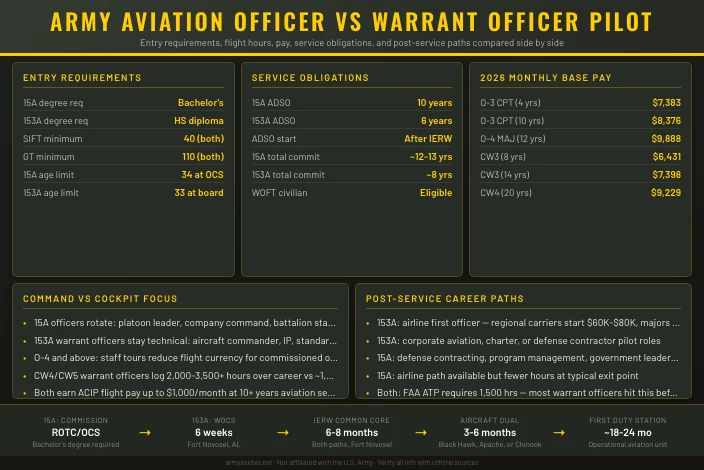
Two Paths Into the Same Cockpit
The Army trains commissioned aviation officers (15A) and warrant officer aviators (153A) at the same flight school: Fort Novosel, Alabama. They sit in the same simulators and train on the same aircraft. What separates them is almost everything else.
Commissioned officers enter through ROTC, OCS, or the United States Military Academy. They branch aviation competitively, which means they must finish in roughly the top half of their commissioning class and submit a separate board package that includes their SIFT score and a Class 1A flight physical. A bachelor’s degree is required before commissioning.
Warrant officers enter through the Warrant Officer Flight Training (WOFT) program. Civilians can apply directly, no enlisted time required. The minimum is a high school diploma, an ASVAB GT score of 110, a passing SIFT score of 40, and a clean flight physical. Age is the hard gate: candidates must be selected for flight school before their 33rd birthday.
| Requirement | 15A (Commissioned) | 153A (Warrant Officer) |
|---|---|---|
| Education | Bachelor’s degree | High school diploma minimum |
| ASVAB GT | 110 (OCS/ROTC paths) | 110 (non-waivable) |
| SIFT | 40 minimum | 40 minimum |
| Age limit | 34 at OCS commission | 33 at board selection |
| Entry grade | O-1 (2LT) | W-1 (WO1) |
| ADSO after flight school | 10 years | 6 years |
The degree requirement is the most decisive filter. If you have a bachelor’s degree and want to lead soldiers, the commissioned path opens more doors. If you want to fly as soon as possible and are willing to build a career as a technical expert, WOFT gets you there faster and with fewer years of obligation.
Training Pipeline: How Long Before You’re Flying Operationally
Both paths flow through Fort Novosel, but they arrive there through different timelines.
A commissioned aviation officer spends four-plus years in college, then completes commissioning training (ROTC Advanced Camp or 12 weeks of OCS), then reports to Aviation BOLC at Fort Novosel. From BOLC arrival to earning an aeronautical rating takes roughly 18 to 24 months:
- BOLC Phase I: 4-6 weeks (officer leadership, land navigation)
- SERE-C: approximately 3 weeks (survival and resistance training)
- IERW Common Core: 6-8 months (instruments, night flying, solo flight)
- Advanced aircraft qualification: 3-6 months (Black Hawk, Apache, or Chinook)
A WOFT candidate who comes in with no prior service moves faster from application to wings. Warrant Officer Candidate School (WOCS) at Fort Novosel runs about 6 weeks. The flight school pipeline after WOCS mirrors the officer pipeline: the same IERW Common Core and advanced aircraft courses. Total time from WOCS entry to first operational assignment typically runs 18 to 24 months as well.
The practical gap is at the front end. A direct-entry WOFT candidate can go from civilian to warrant officer aviator in under three years. A commissioned officer’s path, including a four-year degree, usually runs six to seven years before they reach an operational unit.
Command Versus Cockpit: The Core Career Trade-off
This is where the two paths diverge most.
Warrant officers are technical experts first. The 153A career track stays rooted in flying proficiency. Warrant officers progress from aircraft commander to instructor pilot to standardization instructor to maintenance test pilot. As a CW4 or CW5, a warrant officer aviator is one of the most experienced tactical pilots in the Army, logging thousands of flight hours across multiple deployments. Command of soldiers is not part of the warrant officer career model in aviation.
Commissioned officers rotate between flying and leading. A lieutenant leads a platoon of four to six aircraft and the crew chiefs who maintain them. A captain commands a company of 60 to 120 soldiers. By the time a commissioned officer reaches major, staff work (S3 operations, S4 logistics, battalion XO) competes directly with flight currency. Senior aviation officers may spend the majority of their time in command and staff roles rather than at the controls.
Officers who genuinely want to command and see the cockpit as one part of a broader leadership career should commission. Officers who primarily want to fly missions and accumulate aircraft expertise should think carefully about the warrant officer track instead. This is not a knock on either path. It is a direct description of what each career actually looks like at year 10 and year 20.
Flight Hours Over a Career
Warrant officers generally log more total flight hours over a career than commissioned officers of the same vintage, because the job stays focused on flying rather than rotating through staff tours.
| Career Point | Commissioned Officer (15A) | Warrant Officer (153A) |
|---|---|---|
| 5 years of service | 500-800 hours | 800-1,200 hours |
| 10 years of service | 1,000-1,500 hours | 1,800-2,500 hours |
| 15 years of service | 1,200-2,000 hours | 2,500-3,500 hours |
| 20 years of service | 1,500-2,500 hours | 3,000-4,500 hours |
A commissioned aviation officer at the O-3/CPT level with roughly eight years of service might have accumulated 1,000 to 1,500 flight hours, including training sorties and deployment missions. Staff tours at major commands and ILE residency at Fort Leavenworth take significant time away from flight operations. Officers at the O-4 level and above may fly as little as the minimum required for currency depending on assignment.
A CW3 or CW4 at the equivalent career point has typically logged 2,000 to 3,000 or more hours, because the warrant officer career structure keeps them at the controls. Standardization pilots and instructor pilots log hours continuously. This flight-hour advantage is a major factor in post-service airline hiring, where hours are a primary qualification metric.
Pay Comparison
Both officer categories receive flight pay on top of base pay. Base pay figures are from 2026 DFAS tables.
Commissioned aviation officers:
| Grade | Typical Career Point | Monthly Base Pay |
|---|---|---|
| O-2 (1LT) | Years 2-4 | $4,782-$6,485 |
| O-3 (CPT) | Years 4-10 | $5,534-$8,788 |
| O-4 (MAJ) | Years 10-16 | $6,295-$10,214 |
Warrant officer aviators:
| Grade | Typical Career Point | Monthly Base Pay |
|---|---|---|
| W-1 (WO1) | Years 1-3 | $4,057-$4,611 |
| W-2 (CW2) | Years 3-8 | $4,622-$6,051 |
| W-3 (CW3) | Years 8-16 | $5,223-$7,666 |
| W-4 (CW4) | Years 16-24 | $5,720-$10,032 |
Both tracks receive Aviation Career Incentive Pay (ACIP), also called flight pay, which adds up to $1,000 per month at peak rates for aviators with more than ten years of aviation service. At the O-3 level with ten years of service, a commissioned officer earns $8,126 in base pay plus $1,000 in flight pay, totaling $9,126 per month before allowances. A CW3 at 14 years earns $7,398 in base pay plus flight pay on top.
The base pay advantage sits with commissioned officers at equivalent career years, since O grades run higher than W grades at the same time-in-service bracket. But warrant officers often reach senior grades faster in pure flying proficiency terms, and CW4/CW5 rates catch up substantially. Both paths also receive BAH, BAS ($328.48 per month at officer rates), and full TRICARE Prime coverage.
Service Obligations
The active duty service obligation for each path matters when you are calculating your exit timeline.
Commissioned officers accept a 10-year ADSO that begins when they complete IERW Common Core and earn their aeronautical rating, not at graduation from advanced aircraft training. The clock starts earlier than most candidates expect. Combined with the standard commissioning ADSO (four years for ROTC scholarship recipients), many aviation officers are committed to 12 or 13 years of total service before they are free to leave without penalty.
Warrant officer aviators carry a 6-year ADSO after earning their aeronautical rating. A WOFT candidate who enters with no prior service and earns wings in year two of service is obligated to approximately year eight of service total. That is a substantially shorter commitment than the commissioned track.
Key obligation differences at a glance:
- Earliest realistic separation (commissioned): Year 12-13 from commissioning, factoring ROTC/OCS ADSO plus 10-year aviation ADSO
- Earliest realistic separation (warrant): Year 8 from enlistment, factoring WOCS/flight school time plus 6-year ADSO
- Retention bonuses: Both tracks receive Aviation Bonus (AvB) offers at the ADSO expiration point, with bonus amounts varying by year group and platform demand
- Penalty for early separation: Breaking an ADSO requires repayment of a prorated share of flight training costs, which the Army values at over $500,000
The shorter WOFT obligation is part of why warrant officer aviators are a large share of the Army’s airline recruiting pipeline. They complete their commitment earlier, carry more flight hours, and hit the FAA ATP minimums faster.
Post-Service Career Paths
Both paths lead to strong civilian opportunities, but the nature of those opportunities differs.
For commissioned officers, the options split between aviation and leadership. Officers who leave at the 10 to 13-year mark with a bachelor’s degree, management experience, and a combat record can move into corporate leadership, defense contracting, program management, or federal government roles. Aviation career paths for post-service commissioned officers include airline first officer positions, corporate aviation, or government aviation programs. The degree and command experience open doors that pure flight-hour credentials do not.
For warrant officers, the airline pipeline is the primary post-service destination for many. Major and regional airlines actively recruit military aviators. FAA Airline Transport Pilot certification requires 1,500 hours (reduced to 750 for graduates of certain programs), and most warrant officer aviators hit those totals well before their ADSO ends. CW3s and CW4s leaving at 10 to 15 years of service often arrive at regional carriers with 2,000 to 3,500 hours and multi-engine instrument experience that accelerates their upgrade to captain. Corporate aviation and defense contractors also hire warrant officer pilots directly.
The post-service compensation in commercial aviation is substantial. First officers at major regional carriers start around $60,000 to $80,000 per year, climbing to $100,000 or more with seniority. Wide-body captains at the major carriers earn $200,000 to $400,000 depending on aircraft and seniority. Both commissioned and warrant officer aviators are well-positioned for this track, but the flight-hour advantage held by warrant officers typically translates to faster progression after leaving the Army.
Which Path Fits Your Goals
Neither path is objectively better. They are designed for different people with different priorities.
| Priority | Better Path |
|---|---|
| Lead soldiers, command units | Commissioned officer (15A) |
| Maximize flight hours and flying tenure | Warrant officer (153A) |
| Shortest path to the cockpit | Warrant officer (WOFT) |
| Degree already in hand or in progress | Commissioned officer |
| No college degree, want to fly | Warrant officer (WOFT) |
| Fastest exit timeline | Warrant officer (6-yr ADSO vs 10-yr) |
| Airline career after service | Warrant officer (flight hours) |
| Post-service management/leadership roles | Commissioned officer |
The Army aviation community depends on both. Commissioned officers plan, integrate, and command aviation operations at every level from platoon to brigade. Warrant officers execute those missions with exceptional tactical proficiency and fly the bulk of the Army’s total sorties. If you are deciding between the two, start with an honest answer to one question: do you want to lead people as your primary mission with flying as part of that, or do you want flying to be the career?
For a broader look at all Army aviation roles from crew chief to pilot, see the Army aviation jobs overview. For the specific SIFT and ASVAB requirements both paths share, SIFT vs ASVAB for Army Officers and Warrant Officers covers exactly what scores you need and how to prepare.
This site is not affiliated with the U.S. Army or any government agency. Verify all information with official Army sources before making enlistment or career decisions.