Army BAH Rates: How Housing Allowance Works
BAH is the single biggest variable in an Army paycheck – and most Soldiers don’t fully understand it until they’re standing at a housing office with a PCS order in hand. The number on your LES depends on three things: where you’re stationed, your rank, and whether you have dependents. Change any one of those, and the amount changes too.
Here’s how the system actually works, what to expect when your situation shifts, and how to figure out whether living on or off post makes financial sense.
What BAH Is – and What It Isn’t
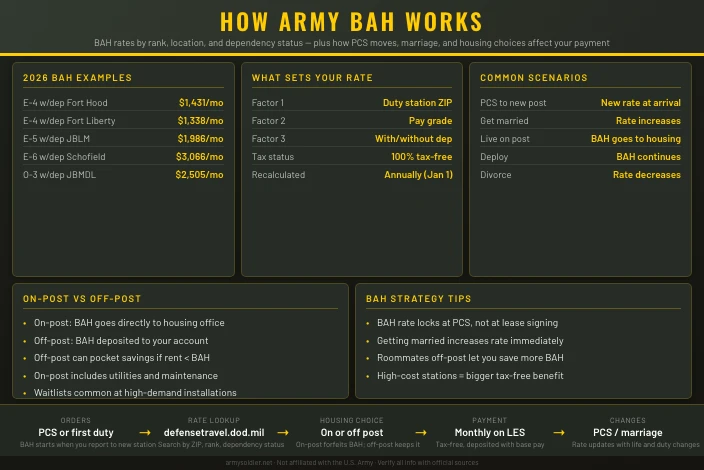
Basic Allowance for Housing is a monthly tax-free payment that covers the civilian housing market near your duty station. It’s not meant to cover 100% of your rent. The DoD builds in a roughly 5% out-of-pocket cost – meaning an E-4 or E-5 should expect to contribute between $93 and $212 per month toward housing regardless of rank or location.
BAH is not basic pay. It doesn’t count toward retirement calculations, and it’s not subject to federal income tax. That tax-free status is worth real money – a Soldier receiving $1,800/month in BAH is effectively getting more than $1,800 in after-tax value compared to a civilian earning the same amount as taxable wages.
The three factors that determine your rate:
- Duty station location – BAH is set per Military Housing Area (MHA), not per installation. There are 299 MHAs covering the continental U.S., plus Alaska and Hawaii. Each MHA has its own rate based on local rental market data.
- Pay grade – A staff sergeant (E-6) gets a higher BAH than a specialist (E-4) at the same installation because the DoD assumes a more senior Soldier rents a larger or higher-quality unit.
- Dependency status – Soldiers with at least one qualifying dependent receive a higher “with dependents” rate. The gap is typically $200-$400 per month at most installations.
How Much BAH Varies by Location
The difference between a high-cost and low-cost duty station can be dramatic. An E-5 at Fort Wainwright in Alaska or any Hawaii installation pulls significantly more BAH than the same rank at an installation in rural Kentucky or Alabama. That gap exists because the DoD is tracking actual rental prices in each local market.
To put real numbers on it: at Fort Sam Houston in San Antonio, an E-5 without dependents receives $1,500/month and an E-5 with dependents receives $1,869/month. Those figures come from the verified 2026 BAH tables. San Antonio is a mid-cost market. High-cost installations – particularly in California, Hawaii, the Washington D.C. metro, and coastal Alaska – run considerably higher.
A rough breakdown by cost tier:
| Market Type | Example Installations | E-5 With Dependents (Approx.) |
|---|---|---|
| High cost | Honolulu, San Diego, Northern Virginia | $3,000+ |
| Mid cost | Fort Sam Houston TX, Fort Campbell KY | $1,800-$2,200 |
| Lower cost | Fort Novosel AL, Fort Sill OK | $1,500-$1,800 |
These figures are directional. Use the official BAH rate lookup to get the exact number for your specific pay grade and installation.
BAH rates are updated every January 1st. The 2026 increase averaged 4.2% nationally, following a 5.4% increase in both 2024 and 2025. The increases in recent years reflect the broader civilian rental market – when rents rise nationally, BAH typically follows.
Rate Protection: Your BAH Won’t Go Down (With Exceptions)
One of the less-publicized features of BAH is individual rate protection. If the BAH rate for your MHA drops – say, because local rents fell – your personal rate stays the same as long as your situation doesn’t change. You only lose that protection in three specific cases:
- You PCS – you get the rate at your new duty station on your report date, not your old rate
- You get demoted – your BAH adjusts to the lower pay grade’s current rate
- Your dependency status changes – moving from “with dependents” to “without dependents” adjusts your rate on the effective date
Promotions work in your favor. You immediately start receiving the higher pay grade’s BAH rate. There’s no waiting period.
What Happens When You PCS
A permanent change of station resets your BAH. You stop receiving your old station’s rate when you check out, and you start receiving the new station’s rate when you check in. In between – while you’re in transit – you receive BAH Type II, which is a lower transitional rate, not your previous full rate.
A few things catch Soldiers off guard at PCS:
- High-to-low market moves hurt. Going from a high-cost installation to a lower-cost one means a pay cut in housing allowance. Your new rate will reflect the cheaper local market.
- Low-to-high market moves help. Moving to a high-cost area increases your BAH to match local rental prices.
- The new rate starts on report date, not travel date. Days in transit are covered at Type II, so the gap between your old and new rates is short but real.
- You receive your old station’s rate up through your check-out date. Not your last day of work – your official check-out date from the gaining or losing unit.
Plan your housing search around what BAH will actually be at the new station, not what you’re currently receiving.
Getting Married – or Adding Any Dependent
Marriage bumps your BAH from the single rate to the with-dependents rate. The increase takes effect on the date you update your records in DEERS (Defense Enrollment Eligibility Reporting System) and submit the documentation to your unit’s finance office. The paperwork is straightforward – marriage certificate plus updated dependency forms – but Soldiers sometimes delay it. Every day you wait is money left on the table.
The same logic applies to other qualifying dependents:
- A first child (biological or adopted) triggers the with-dependents rate if you’re not already claiming it
- A dependent parent can also qualify under certain circumstances
One important rule: the with-dependents rate is not cumulative. You don’t get more money for a second or third child. BAH switches once from without-dependents to with-dependents, and that’s the only jump the system recognizes.
For dual-military couples where both spouses are active duty, each person receives their own BAH at the single rate unless they have dependent children. When children are involved, one parent claims the with-dependents rate – typically the higher-ranking spouse – and the other continues receiving the single rate.
On-Post vs. Off-Post: The Real Math
Living on post is not free – it’s an exchange. You sign over your BAH to the housing management company (most on-post housing is privatized), and they provide the unit. The rent they charge is designed to match your BAH, so you typically pay nothing additional out of pocket. But you also keep nothing.
Off post, you keep the difference between your BAH and your actual rent. At a lower-cost installation where apartments are well below the BAH rate, that spread can be meaningful. At a high-cost installation like Fort Wainwright or a Hawaii post, affordable off-post housing may not actually exist near BAH levels.
Factors that favor on-post housing:
- No first/last month’s deposit or credit check required
- 24-hour maintenance included
- Utilities often bundled or subsidized
- Shorter commute to post facilities
- No lease negotiation
Factors that favor off-post:
- You keep any gap between BAH and actual rent
- More flexibility in choosing neighborhood and home size
- No housing management company managing your unit
- Better for families wanting separation from the installation environment
The honest answer is that neither option is universally better. An E-4 at Fort Campbell might pocket a few hundred dollars monthly living off post in Clarksville. An E-4 at Fort Belvoir near Washington D.C. might struggle to find anything near BAH rates. The math is installation-specific.
One thing that rarely gets discussed: on-post housing quality varies significantly by installation and housing management company. An on-post unit at a well-maintained installation with a responsive management company is a very different experience from one with deferred maintenance and a slow work order system. Check reviews from other Soldiers at your specific installation before deciding.
BAH for Reservists and National Guard
Reserve and National Guard Soldiers receive BAH differently from active duty. You don’t automatically receive BAH just because you’re in the Reserve. BAH kicks in during periods of active duty orders.
Specifically:
- 90+ days of consecutive active duty orders – you receive full BAH at the rate for the duty location, same as active component
- Less than 90 days – you receive BAH Reserve Component/Transit (RC/T), a national flat rate that is substantially lower than most MHA rates
- Weekend drills (IDT) – no BAH entitlement
If you’re a Reservist on extended orders near a major metro area, the RC/T rate may not cover your actual housing costs. This is something to plan for before accepting extended orders if you rent in a high-cost city.
Learn more about how Army benefits compare across components at the Army benefits guide.
You may also find the Complete Guide to Army Pay and Benefits and Army Healthcare: TRICARE Explained for New Soldiers helpful if you’re working through your full compensation picture as a new Soldier.
This site is not affiliated with the U.S. Army or any government agency. Verify all information with official Army sources before making enlistment or career decisions.