Army Bonus for High ASVAB Scores
A lot of recruits walk into MEPS expecting their ASVAB score alone to trigger a cash bonus. That’s not how it works. The Army does not pay you a bonus for scoring high on the ASVAB. What a high score does is open the door to high-demand MOS jobs – and those jobs carry the biggest enlistment bonuses on the current contract list.
The difference matters because how you study for the test should change based on what you’re trying to qualify for. If you want the best possible bonus, you need a target MOS first. Then you work backward to the line score that qualifies you for it.
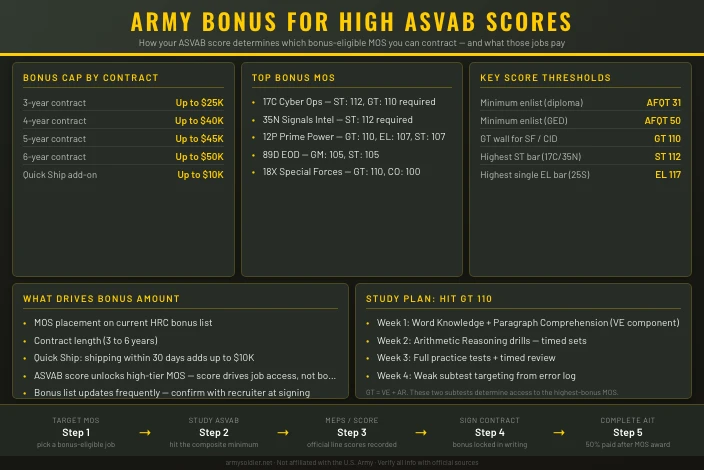
How Bonuses Actually Connect to ASVAB Scores
The Army’s enlistment bonus structure rewards MOS selection and contract length, not raw test performance. Every few months, Army Human Resources Command publishes an updated bonus chart listing which MOS jobs are on the incentive list and how much each pays by contract length.
To collect a bonus, you must:
- Qualify for a bonus-eligible MOS (which requires meeting its ASVAB line score minimums)
- Sign a contract for that specific MOS
- Complete Basic Combat Training and Advanced Individual Training
- Receive your official MOS award
Your ASVAB score is the gatekeeper – not the paymaster. Hit the line score minimum and you’re eligible. Score 30 points higher and your bonus does not go up. But scoring high enough to reach the most technical, high-demand MOS jobs does put more money within reach.
Study resource: An ASVAB prep course with section-specific drills targets the exact subtests that feed each composite score, so you’re not studying blindly.
When you purchase through links on our site, we may receive compensation at no extra cost to you.
The Bonus Cap by Contract Length
The Army caps total combined bonuses at $50,000 for a 6-year active duty contract. Shorter contracts carry lower caps.
| Contract Length | Maximum Bonus |
|---|---|
| 3 years | $25,000 |
| 4 years | $40,000 |
| 5 years | $45,000 |
| 6 years | $50,000 |
A Quick Ship bonus of up to $10,000 can stack on top of a job signing bonus if you report to Basic Training within 30 days of enlistment. That stacking is how recruits reach the $50,000 combined ceiling. The Quick Ship window is tight – 30 days from signing means you need to be ready.
These figures are from the Army’s enlistment bonus program at HRC, effective September 2025. Bonus amounts and eligible MOS shift frequently. The chart your recruiter shows you at MEPS is the only number that matters – what’s on your signed contract is what you get paid.
High-Score MOS Jobs With the Biggest Bonuses
The jobs that require the highest ASVAB composites are also the jobs the Army most needs to fill. That overlap is where the real money sits.
Cyber and Signal (CMF 17/25)
17C Cyber Operations Specialist sits at the top of the enlisted ASVAB ladder. You need both GT: 110 and ST: 112 – the highest combined threshold of any enlisted MOS. The Army struggles to fill this job because so few candidates clear both composites simultaneously. That shortage drives the incentive.
25S Satellite Communication Systems Operator-Maintainer requires EL: 117, the single highest individual composite on the entire MOS list. Signal jobs in this tier routinely appear on the HRC bonus chart.
Intelligence (CMF 35)
35N Signals Intelligence Analyst matches the 17C at ST: 112. 35T Military Intelligence Systems Maintainer also hits that ceiling. Both carry Top Secret clearance requirements, which add another filter – and another reason the Army pays well to recruit qualified candidates.
35P Cryptologic Linguist requires ST: 91 plus a Defense Language Aptitude Battery score of 107 or better. Foreign language proficiency can layer an additional bonus on top of the standard enlistment incentive.
Engineers (CMF 12)
12P Prime Power Production Specialist demands three composites simultaneously: GT: 110, EL: 107, and ST: 107. It’s one of the hardest ASVAB bars in the Army and qualifies for bonuses accordingly.
Explosive Ordnance Disposal (CMF 89)
89D EOD Specialist requires GM: 105 and ST: 105. EOD operators work with live explosives and face a rigorous selection pipeline that keeps the field perpetually short-staffed. The bonus reflects that.
Special Forces (CMF 18)
The 18X Special Forces Candidate contract requires GT: 110 and CO: 100. Special Forces bonuses run separately from the standard enlistment chart – the Ranger bonus (up to $20,000 after completing Ranger training) and related special operations incentives can combine with the base signing bonus.
The table below summarizes the highest-composite MOS jobs that regularly appear on the bonus list:
| MOS | Composite Requirement(s) | Why It Matters |
|---|---|---|
| 17C | GT: 110, ST: 112 | Highest combined bar; cyber shortage |
| 35N | ST: 112 | Signals intelligence; TS clearance needed |
| 35T | ST: 112 | MI systems; same bar as 35N |
| 12P | GT: 110, EL: 107, ST: 107 | Three-composite requirement |
| 89D | GM: 105, ST: 105 | EOD; consistently short-staffed |
| 25S | EL: 117 | Highest single EL score on the list |
| 18X | GT: 110, CO: 100 | Special Forces candidate contract |
What You’re Actually Studying For
The ASVAB composites that qualify you for the highest-bonus MOS jobs come down to a small number of key subtests.
GT (General Technical) is the most important composite for high-bonus jobs. GT = Verbal Expression (VE) + Arithmetic Reasoning (AR). Every SF MOS, 17C, 12P, and CID requires GT: 110. VE is itself derived from Word Knowledge and Paragraph Comprehension. Strong reading skills and solid mental math are what move this number.
ST (Skilled Technical) = GS + VE + MK + MC. The ST: 112 threshold for 17C and 35N requires strong performance across all four subtests – General Science, Verbal Expression, Mathematics Knowledge, and Mechanical Comprehension. No single subtest compensates for a weak one.
EL (Electronics) = GS + AR + MK + EI. Electronics Information is the subtest most people underprep. It feeds directly into EL, which gates signal and aviation maintenance jobs.
The practical implication: if you want GT: 110, your study time belongs on AR and the WK/PC sections that build VE. If you want ST: 112, you need solid scores on all four of its components – that’s a broader prep challenge.
Study resource: An ASVAB study guide with full-length practice tests covers each composite’s component subtests so you can identify and fix your weakest areas before test day.
When you purchase through links on our site, we may receive compensation at no extra cost to you.
How Bonuses Are Paid
Understanding the payment schedule matters before you sign. The Army does not hand you a check at MEPS.
The standard split for most job signing bonuses:
- 50% paid after completing AIT and receiving your MOS award
- 25% paid at the two-year contract anniversary
- 25% paid at the four-year contract anniversary
The Quick Ship bonus, if you earn it, typically pays out separately after BCT completion. Verify the exact schedule in your written contract – the schedule can vary by bonus type.
If you leave early, the Army recoupts the unearned portion. Say you signed for six years, collected 50% after AIT, and separate at year three. You’ll owe back a prorated share of what was paid. The Army calculates recoupment on time remaining, not a flat forfeit of everything.
What the Bonus List Doesn’t Cover
The HRC bonus chart changes every few months based on Army recruiting priorities. A MOS that paid $40,000 last quarter might drop off the list entirely by the time you sign. Two things are worth knowing:
- The bonus is locked at signing. If you sign a contract listing a $40,000 bonus for your MOS, you keep that amount even if the list changes the next week.
- The list at MEPS is the only list that counts. Anything a recruiter quotes verbally before your contract is signed is a preview, not a promise.
Some MOS jobs consistently appear on the bonus list because the Army always needs them and always struggles to fill them. The cyber, signals intelligence, EOD, and prime power jobs described above fall into that category. Jobs with lower ASVAB requirements tend to cycle on and off the list more erratically.
The Civilian Acquired Skills Program
One additional path worth knowing: the Army’s Civilian Acquired Skills Program (CASP) allows recruits with verified prior civilian training or certifications in a relevant field to enlist at a higher pay grade rather than starting at E-1. This isn’t a cash bonus – it’s rank acceleration that compounds with a signing bonus over a full contract.
CASP at a glance:
- Pay grade entry up to E-4 (vs. standard E-1 start)
- Available for roughly 60 MOS jobs, including technical fields that also carry bonuses
- Eligible backgrounds include IT, healthcare, and skilled trades
- Must be written into your enlistment contract – ask your recruiter before signing
Putting It Together
The path to the largest enlistment bonus runs through your ASVAB score – but indirectly. The sequence looks like this:
- Identify a high-demand MOS with a current bonus
- Find the line score(s) required for that MOS
- Break those composites down to their component subtests
- Study those subtests specifically
- Meet the threshold at MEPS
- Sign a contract with the bonus in writing
Scoring a 99 AFQT with no MOS target earns you nothing extra. Scoring GT: 110 and locking a 17C or 18X contract on a 6-year term puts up to $50,000 on the table.
For a deeper look at how enlistment bonuses work, including payment schedules and recoupment rules, see the Army enlistment bonuses guide. If you’re deciding which MOS to target, ASVAB scores for every Army MOS maps the line score requirements across all 19 career families.
This site is not affiliated with the U.S. Army or any government agency. Verify all information with official Army sources before making enlistment or career decisions.