Army Combat Arms Jobs: Infantry, Armor, Artillery
Combat arms is the part of the Army that closes with and destroys the enemy. Three career families do this work: Infantry (CMF 11), Armor (CMF 19), and Artillery and Air Defense (CMF 13/14). Each one has different weapons, different training, different daily life, and different paths after service. If you are trying to pick between them, this guide lays out what you actually need to know.
What Combat Arms Means in the Army
Combat arms MOS codes put soldiers at the front of the fight. These are not support jobs. You do not maintain equipment for someone else’s mission or manage a supply chain. You are the mission. Every other branch in the Army exists to put you in position to win.
That designation comes with real consequences:
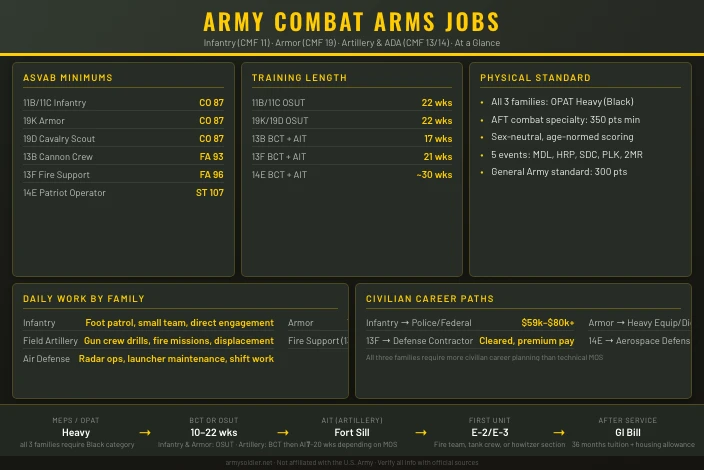
- Physical standards are higher than most MOS, measured by the Army Fitness Test (AFT) combat specialty standard: a minimum total of 350 points with sex-neutral, age-normed scoring across five events
- Deployment tempo runs higher than the Army average, with many units cycling through 9 to 12 month deployments
- Occupational Physical Assessment Test (OPAT) requirements are Heavy (Black) across all three families
- Re-enlistment rates are lower than technical MOS, with roughly 30 to 40 percent of combat arms soldiers staying past their first term
- Women in combat arms have been eligible for all MOS since 2016; all three families are fully open
Combat arms also comes with advantages: faster leadership responsibility, close unit cohesion, and access to elite schools (Ranger, Airborne, Air Assault). Federal agencies, law enforcement, and defense contractors treat a combat arms background as evidence of performance under real pressure — something no resume course can replicate.
The three combat arms career families each develop different skills and open different doors. Infantry builds small-unit leaders who make rapid decisions on foot. Armor builds vehicle crew operators who manage complex weapons systems as a tight team. Artillery builds technical fire support professionals who understand the math, electronics, and coordination behind indirect fire. The question is which of those skill sets fits what you want from your service and what you want to do afterward.
Infantry (CMF 11)
Infantry is the decisive arm. When the Army talks about closing with and destroying the enemy through fire and maneuver, it means infantry. Every other branch sets the conditions for what infantry does on foot.
The Jobs
CMF 11 has two enlisted MOS at entry level:
11B Infantryman is the standard infantry career. You operate in a fire team of four soldiers, carrying rifles, machine guns, anti-armor rockets, and grenade launchers. Your job is to find enemy forces, close the distance, and eliminate them. You clear buildings, conduct patrols, set ambushes, and secure terrain.
11C Indirect Fire Infantryman is the mortar specialist. You operate 60mm, 81mm, and 120mm mortar systems from within an infantry company, providing close-range indirect fire in support of your own platoon. Both MOS train under the same 11X enlistment contract. The Army assigns you to 11B or 11C based on its needs at the time you complete training.
ASVAB Requirements
Both 11B and 11C require a minimum Combat (CO) composite score of 87. The CO composite combines Arithmetic Reasoning, Coding Speed, Auto and Shop Information, and Mechanical Comprehension. A 87 CO is one of the lowest MOS thresholds in the Army.
| MOS | Composite | Minimum Score |
|---|---|---|
| 11B Infantryman | CO (AR + CS + AS + MC) | 87 |
| 11C Indirect Fire Infantryman | CO (AR + CS + AS + MC) | 87 |
The ASVAB is not the filter for infantry. The physical standards are. You must pass the OPAT Heavy category before you ship: 160 cm standing long jump, 450 cm seated power throw, 160 lbs strength deadlift, and 43 shuttles on the interval aerobic run.
Training Pipeline
Both infantry MOS use One Station Unit Training (OSUT) at Fort Moore, Georgia. BCT and AIT are combined into a single 22-week block. There is no separate AIT at a different location.
| Phase | Weeks | Focus |
|---|---|---|
| Red / White / Blue | 1-10 | Soldier basics, M4 marksmanship, land navigation, first aid |
| Black / Gold | 11-19 | Advanced weapons, urban operations, platoon live-fire, combined arms |
| Graduation | 20-22 | Final field exercise, evaluations |
Twenty-two weeks is long. By the end, you can operate the M4, M249, M240B, M320 grenade launcher, and AT-4. The final weeks involve live-fire platoon attacks and large-scale field exercises. Attrition is real, primarily from physical injury and inability to meet standards.
Daily Life
Garrison days run 0630 to 1700. Physical training, weapons maintenance, battle drills, and classroom instruction fill the schedule. Field rotations at the National Training Center (Fort Irwin, CA) or Joint Readiness Training Center (Fort Johnson, LA) run 3 to 4 weeks and eat that schedule entirely. Sixteen-hour days are standard during those rotations.
Infantry units deploy at a high tempo. The general target is 2 years at home for every 1 year deployed, but operational demands compress that ratio in practice.
Specialization
After 11B OSUT, strong performers can pursue follow-on schools that separate ordinary infantry from elite assignments:
- Airborne School (3 weeks, Fort Moore) for the 82nd Airborne Division
- Air Assault School (10 days, Fort Campbell) for 101st Airborne assignments
- Ranger School (62 days, multiple phases) for the Ranger tab and competitive promotions
- Sniper School (7 weeks, Fort Moore)
- Special Forces Assessment and Selection after 2 years of service
The Expert Infantryman Badge (EIB) and Combat Infantryman Badge (CIB) are the most visible career credentials within the branch.
Post-Service Outlook
Infantry does not map to a specific civilian job. What it transfers is leadership under pressure, team management, and a profile that law enforcement and federal security agencies recognize immediately. Former infantrymen commonly move into:
- Police officer / detective: $77,270 median annual salary
- Firefighter: $59,530 median
- Emergency management specialist: $80,110 median
- Federal agent / border patrol: salaries vary by agency and GS level
The GI Bill covers up to 36 months of college after service, which many infantry veterans use to earn degrees in criminal justice, business, or emergency management before entering those fields at a higher starting point.
Armor (CMF 19)
Armor combines the lethality of tanks with the reconnaissance capability of cavalry. CMF 19 has two distinct jobs that attract very different personalities.
The Jobs
19K M1 Armor Crewmember puts you inside a 70-ton M1A2 Abrams main battle tank. You operate as one of four crew: driver, loader, gunner, or tank commander. Your job is to destroy enemy armor, fortifications, and personnel using the 120mm main gun and three mounted machine guns. You join an armored brigade combat team and train alongside mechanized infantry.
Explore the full profile on the 19K Armor Crewmember page.
19D Cavalry Scout is different in character. You move ahead of the main force, find the enemy, and report what you see. Scouts operate Bradleys, Strykers, and JLTVs in small teams of 4 to 6 soldiers. You conduct mounted and dismounted reconnaissance, run observation post operations, and provide flank security for larger formations. The cavalry scout role demands more individual judgment than most combat arms jobs.
See the full 19D Cavalry Scout profile for details.
ASVAB Requirements
Both 19K and 19D require the same composite, with one notable physical restriction for 19K.
| MOS | Composite | Minimum Score | Physical Note |
|---|---|---|---|
| 19K M1 Armor Crewmember | CO (AR + CS + AS + MC) | 87 | Maximum height 6'1" |
| 19D Cavalry Scout | CO (AR + CS + AS + MC) | 87 | No height restriction |
The height limit for 19K is real and enforced. The Abrams turret and driver’s compartment have hard physical constraints. If you are taller than 6'1", the 19D is your path into the armor career field.
Training Pipeline
Both jobs use OSUT at Fort Moore, Georgia – 22 weeks total.
| MOS | Location | Duration | Phase 2 Focus |
|---|---|---|---|
| 19K | Fort Moore, GA | 22 weeks OSUT | Tank gunnery, Abrams crew operations, maintenance |
| 19D | Fort Moore, GA | 22 weeks OSUT | Reconnaissance, vehicle ops (Bradley/Stryker), call-for-fire |
The first 10 weeks are identical to 11B: basic soldier skills. Weeks 11 through 22 diverge based on MOS. A 19K trainee spends hundreds of hours on crew drills, gunnery tables, and Abrams maintenance. A 19D trainee learns reconnaissance procedures, observation post operations, and how to operate and fight from multiple vehicle platforms.
Daily Life
A 19K day in garrison is dominated by motor pool work. The Abrams requires daily maintenance: track inspection, fluid checks, engine diagnostics, weapon system function checks. Live-fire gunnery qualifications (Table IV through Table XII) are the defining events of the training year. A crew that cannot hit its gunnery tables is a problem. You spend months preparing for them.
The 19D day in garrison mixes vehicle maintenance with reconnaissance training, radio procedures, and land navigation. Scouts operate in smaller teams than tank crews and carry more individual responsibility for planning and reporting.
Deployment cycles for both MOS run approximately 9 to 12 months deployed, 24 to 36 months at home. Armor units have deployed to Europe for NATO deterrence rotations (typically 9 months) and historically to combat theaters in Iraq and Afghanistan.
Post-Service Outlook
The 19K’s strongest civilian crossover is mechanical and industrial:
- Construction equipment operator: $58,320 median
- Diesel service technician: $60,640 median
- Industrial machinery mechanic: $63,510 median, with 13% job growth over the next decade
The 19D translates more toward intelligence, law enforcement, and contract security roles. Cavalry scouts develop observation skills, reporting habits, and situational awareness that private security, federal law enforcement, and government contractors value.
Artillery and Air Defense (CMF 13/14)
Artillery and Air Defense cover two distinct functions that share a career family. Field artillery (CMF 13) delivers fires against enemy ground targets. Air defense artillery (CMF 14) shoots down enemy aircraft and missiles. The daily work is fundamentally different between them.
Field Artillery (CMF 13)
Field artillery is indirect fire. You do not see the enemy when you pull the trigger. You receive a fire mission, compute data, set the gun, and put a round on a grid coordinate miles away. Speed and accuracy define the difference between effective artillery and wasted ammunition.
13B Cannon Crewmember operates howitzers: the M119A3 (105mm towed), M777A2 (155mm towed), and M109A7 Paladin (155mm self-propelled). Your crew handles loading, aiming, firing, ammunition preparation, and displacement to new positions after each fire mission. Counter-battery radar tracks the trajectory of outgoing rounds back to the origin point, so staying in one place too long makes you a target.
See the 13B Cannon Crewmember profile.
13F Fire Support Specialist is the forward observer. You embed with infantry or armor units and serve as the link between the maneuver force and every indirect fire asset available: howitzers, mortars, rockets, attack aviation, and close air support. You locate targets, send call-for-fire requests, and adjust rounds onto the target. The 13F is the only enlisted MOS that regularly controls all of those asset types simultaneously.
Full details on the 13F Fire Support Specialist page.
Other CMF 13 MOS include 13J Fire Control Specialist, 13M MLRS/HIMARS Crewmember, and 13R Firefinder Radar Operator – each covering a specific piece of the fires mission.
Air Defense Artillery (CMF 14)
Air defense artillery operates missile and radar systems to protect ground forces from aerial threats. The work is more technical than field artillery: you monitor radar displays, track incoming threats, operate launchers, and maintain complex electronic systems.
14E Patriot Fire Control Enhanced Operator and 14T Patriot Launching Station Operator both work on the Patriot missile system, the Army’s primary long-range air and missile defense platform. 14G Air and Missile Defense Crewmember covers short-range systems. 14H Air Defense Enhanced Early Warning System Operator focuses on radar operations and air picture management.
CMF 14 attracts soldiers with stronger math and electronics aptitude. The ASVAB requirements reflect that.
ASVAB Requirements
| MOS | Composite | Minimum Score |
|---|---|---|
| 13B Cannon Crewmember | FA (AR + CS + MK + MC) | 93 |
| 13F Fire Support Specialist | FA (AR + CS + MK + MC) | 96 |
| 13J Fire Control Specialist | FA (AR + CS + MK + MC) | 93 |
| 13M MLRS/HIMARS Crewmember | FA (AR + CS + MK + MC) | 93 |
| 14E Patriot Fire Control Operator | ST (GS + VE + MK + MC) | 107 |
| 14T Patriot Launching Station Operator | MM (NO + AS + MC + EI) | 98 |
The FA composite weights math and mechanical reasoning heavier than the CO composite used by infantry and armor. A score of 93 FA is achievable with solid preparation, but you need to focus on Arithmetic Reasoning and Mathematics Knowledge specifically. The 13F requires 96 FA and adds a Secret security clearance requirement, which is the most demanding standard in CMF 13.
Air defense MOS like 14E require the Skilled Technical (ST) composite with a minimum of 107, which is significantly higher than any field artillery or infantry requirement. If your ASVAB strengths are in math and science rather than mechanical aptitude, CMF 14 may be a better fit.
Training Pipeline
Field artillery and air defense use separate AIT locations after BCT.
| MOS | BCT Location | AIT Location | AIT Duration |
|---|---|---|---|
| 13B | Varies | Fort Sill, OK | 7 weeks |
| 13F | Varies | Fort Sill, OK | 11 weeks |
| 14E | Varies | Fort Sill, OK | ~20 weeks |
| 14T | Varies | Fort Sill, OK | ~12 weeks |
BCT runs 10 weeks at Fort Jackson, Fort Moore, or Fort Leonard Wood. AIT at Fort Sill (Fires Center of Excellence) is where you become an artilleryman. The 13B AIT is the shortest in the artillery family at 7 weeks. The 13F AIT runs 11 weeks because it covers call-for-fire procedures, digital targeting systems, and fire support planning. Air defense AIT runs longer still because of the electronics complexity.
Daily Life
A 13B day in garrison rotates through motor pool, maintenance, physical training, and gunnery drills. The howitzer section of six soldiers works as a unit. Each person has a specific job in the firing sequence, and any breakdown in the chain delays the mission. Live-fire qualification tables are the measuring stick.
A 13F day looks more like an infantry soldier’s day because 13Fs live with the maneuver units they support, not with the artillery battery. You run with infantry, attend their planning sessions, and deploy forward with their companies and platoons. When the unit goes to the field, you go first.
Air defense MOS work in operations centers and at launcher sites, often at fixed installations or forward operating bases. The schedule is shift-based rather than mission-cycled, which produces a more predictable daily routine than field artillery or infantry.
Post-Service Outlook
Field artillery translates to civilian careers in a few directions. The leadership and planning skills carry into management and operations roles. The technical skills are more specific: howitzer operation has no direct civilian equivalent, but the teamwork and maintenance discipline apply to industrial settings.
The 13F’s strongest asset is the Joint Fires Observer (JFO) qualification. JFO-certified 13Fs can control aircraft, which translates to roles in defense contracting, aviation coordination, and federal law enforcement with DOD or DHS agencies.
Air defense MOS have stronger direct civilian crossover. The electronics, radar systems, and missile maintenance skills map to aerospace defense contractors (Raytheon, Lockheed Martin, Northrop Grumman), where cleared veterans with hands-on Patriot experience command significant hiring interest.
Comparing the Three Families
The right choice depends on what you want from service and what you want after it. Here is a direct comparison across the key factors.
| Factor | Infantry (11) | Armor (19) | Artillery/ADA (13/14) |
|---|---|---|---|
| ASVAB Composite | CO: 87 | CO: 87 | FA: 93-96 / ST: 107 |
| Training Length | 22 weeks OSUT | 22 weeks OSUT | 17-30 weeks (BCT + AIT) |
| Training Location | Fort Moore, GA | Fort Moore, GA | BCT varies + Fort Sill, OK |
| Height Restriction | None | 19K: max 6'1" | None |
| Security Clearance | None (entry) | None (entry) | 13F: Secret required |
| Physical Demand | Heavy (Black) | Heavy (Black) | Heavy (Black) |
| Daily Work Style | Foot patrol, small team | Vehicle crew, maintenance | Crew drills or obs post |
| Civilian Crossover | Law enforcement, leadership | Heavy machinery, mechanics | Defense contracting, electronics |
A few things stand out. All three require the same physical standard. Infantry and armor share the same CO composite minimum, so your ASVAB score does not differentiate them. If you are on the margin, infantry and armor are equally achievable. Artillery requires the FA composite, which weights math harder. Air defense artillery requires a higher bar still.
The strongest differentiator is what you want to do every day. Infantry puts you on foot, in small teams, making independent decisions at the lowest level. Armor puts you in a vehicle, working as a tight crew on a complex weapons system. Artillery divides between the gun line (crew-centric, physical, loud) and the forward observer role (embedded with infantry, high responsibility, Secret clearance required).
What each family offers in terms of post-service credentials also differs. Infantry produces leaders, not technical specialists — the credential is proven performance under pressure, which law enforcement and federal agencies value but which requires more translation work for corporate employers. Armor produces mechanics and vehicle operators with hands-on experience on the most complex ground combat platform in the Army. Artillery, particularly CMF 14 and the 13F MOS, produces cleared technical specialists with skills that defense contractors will pay to hire on day one after separation.
Physical Demands Across All Three
Combat arms physical standards are uniform in one way and variable in another. Every MOS in all three families requires the OPAT Heavy category at MEPS. That is the gate before you ever ship to training.
Once you are in, the AFT applies. The combat specialty standard requires a minimum of 350 total points across five events using sex-neutral, age-normed scoring. These 21 designated combat MOS face a higher bar than the general Army standard of 300. The events are:
- 3-Rep Max Deadlift (MDL)
- Hand Release Push-Up (HRP)
- Sprint-Drag-Carry (SDC)
- Plank (PLK)
- Two-Mile Run (2MR)
The physical demands differ in character across the three families even though the AFT standard is the same:
| Family | Primary Physical Stress | Key Demand |
|---|---|---|
| Infantry (11) | Load carriage, prolonged movement on foot | 60-100 lb combat load over rough terrain; 12-mile ruck marches |
| Armor (19) | Crew compartment confinement, heat stress | Tank interior temperatures up to 130°F in summer; loading 40-lb rounds |
| Artillery (13) | Repetitive heavy lifting, crew tempo | 155mm rounds weigh 95-100 lbs each; sustained fire missions demand endurance |
| Air Defense (14) | Sustained ops tempo, equipment handling | Shift-based work; missile system components require teamwork and coordination |
Infantry soldiers carry the heaviest loads. Tankers deal with extreme heat and confined spaces. Artillery crews repeatedly lift and load heavy ammunition through fire missions that can last hours. Air defense MOS work long operational shifts managing radar and launcher systems.
If you are starting your fitness preparation now, focus on the deadlift and the two-mile run. Those two events separate candidates more than any other combination. Build a base of functional strength with compound lifts, then add ruck marching progressively as your ship date approaches.
Reserve and National Guard Options
All three families have reserve component options, but the reality varies significantly. Combat arms part-time service is more demanding than most reserve jobs, and equipment availability drives where the billets actually exist.
| Family | Army Reserve | Army National Guard | Notes |
|---|---|---|---|
| Infantry 11B/11C | Widely available | Widely available | High mobilization rates post-2001; most accessible combat arms reserve option |
| Armor 19K | Very limited | Available in most states | Tank infrastructure limits Reserve billets; Guard maintains M1 Abrams battalions |
| Armor 19D | Available | Available | Broader access via Stryker and light cavalry units |
| Field Artillery 13 | Available | Available in most states | Guard field artillery units exist across most states |
| Air Defense 14 | Very limited | Available (Patriot units) | Equipment complexity limits Reserve management; primarily active or Guard |
Infantry (11B/11C) is widely available in both the Army Reserve and Army National Guard. Guard infantry units have seen high mobilization rates since 2001, including combat deployments and domestic activations. This is the most accessible combat arms option for part-time service.
Armor (19K/19D): The Army Reserve has very few tank billets because armored units require heavy equipment infrastructure that Reserve installations typically cannot support. Several states maintain M1 Abrams battalions in their National Guard. The 19D Cavalry Scout has broader Reserve availability across Stryker and light cavalry units.
Artillery and Air Defense (13/14): Field artillery units appear in Guard formations across most states. Air defense units, especially Patriot batteries, are primarily active-duty or National Guard, as the equipment and crew proficiency requirements make Reserve unit management difficult.
The key difference for any reserve component combat arms soldier: the training commitment is heavier than most people expect. “One weekend a month” describes the schedule but not the intensity. Combat arms drill weekends involve physical training, weapons qualification, and field exercises. Annual Training for infantry and armor often means multi-day live-fire exercises at a Combat Training Center.
Which Family Fits You
There is no objectively best combat arms branch. Each one rewards a different set of strengths. The right answer comes down to what kind of daily work you want, what your ASVAB scores support, and what you want to do after you separate.
Choose infantry if you want maximum physical challenge, small-team autonomy, and the broadest access to elite schools and special operations pathways. You will lead a fire team sooner than any other branch. The civilian exit requires more planning than technical MOS, but the leadership experience and law enforcement demand are real. Infantry also gives you the widest path to Ranger School, Special Forces Assessment, and Airborne assignments — if those are goals, infantry is where you start.
Choose armor if you are drawn to combined arms warfare, vehicle operations, and technical weapons systems. The ASVAB requirement is the same as infantry, so the choice here is about role and temperament. The 19D is the better fit if you want more individual discretion and reconnaissance work. The 19K is right if you want to be part of a tight four-person crew on a weapon that can stop most things it encounters.
Choose artillery or ADA if your ASVAB math scores are stronger than average or you want better direct civilian career translation. The 13F is a particularly strong MOS for soldiers who want joint operations experience, security clearance credentials, and a path toward defense contracting after service. Air defense MOS offer the clearest transition to defense industry jobs. If you score well on the ST composite and want a technical career with real hiring demand on day one after separation, CMF 14 is worth serious consideration.
You may also find 11B vs 11C: Which Infantry MOS, 13B vs 13F: Cannon Crew vs Fire Support, 19D Cavalry Scout vs. 19K Tanker, Best Combat Arms MOS for a Civilian Career, and Best ASVAB Scores for Combat Arms MOS helpful for deeper comparisons within each family.
This site is not affiliated with the U.S. Army or any government agency. Verify all information with official Army sources before making enlistment or career decisions.