Army Cyber vs Signal MOS: What's the Difference
Recruiters group Army Cyber and Signal jobs under the same career hub, and the ASVAB scores overlap enough that many applicants get offered both. But the two fields have almost nothing in common once you’re actually doing the work. One field builds and maintains the Army’s communications infrastructure. The other attacks and defends computer networks as a primary combat mission. Choosing the wrong one based on a vague description can mean years in a job that doesn’t match what you had in mind.
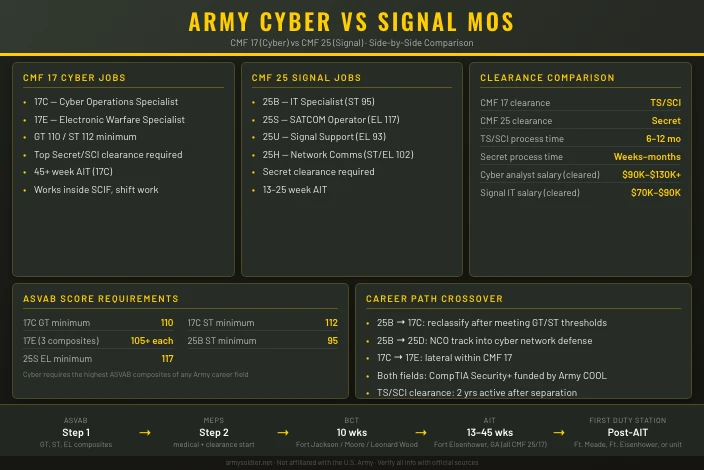
Two Fields, One Hub Page
The Army organizes Cyber under Career Management Field 17 (CMF 17) and Signal under Career Management Field 25 (CMF 25). They share a single career hub because both fields involve computers and networks, and historically Signal soldiers were the Army’s primary IT workforce. That’s changed significantly over the last decade.
CMF 17 was established as its own cyber branch in 2014, when U.S. Cyber Command stood up and the Army recognized that offensive and defensive cyberspace operations were a distinct warfighting function. Signal remained focused on building and running the communications networks that cyber missions – and all other Army missions – depend on.
Think of it this way: Signal is the infrastructure layer. Cyber is the operations layer that runs on top of it.
What Cyber MOS Soldiers Do (CMF 17)
CMF 17 has two enlisted jobs:
- 17C Cyber Operations Specialist – conducts offensive and defensive cyberspace operations, digital forensics, and malware analysis from a Sensitive Compartmented Information Facility (SCIF)
- 17E Electronic Warfare Specialist – controls the electromagnetic spectrum by jamming enemy communications, protecting friendly systems, and hunting electronic signatures in real time
Both are warfighting roles. The 17C writes code, hunts network intrusions, and in some cases runs authorized offensive operations against adversary systems. The 17E uses specialized jamming platforms mounted on vehicles, controlling who can and can’t communicate on a given frequency in a given area of operations.
Neither job spends much time maintaining servers or running cable.
What Signal MOS Soldiers Do (CMF 25)
CMF 25 currently has seven enlisted positions:
- 25B Information Technology Specialist – manages Army IT systems, servers, and networks at the unit level
- 25D Cyber Network Defender – NCO-only reclassification; monitors and defends Army networks from intrusion
- 25H Network Communications Systems Specialist – installs and operates fiber, IP nodal, satellite, and multichannel radio systems
- 25N Nodal Network Systems Operator – builds and operates the tactical network nodes connecting combat units (being consolidated into 25H for new accessions)
- 25S Satellite Communication Systems Operator – operates satellite ground terminals and manages wideband SATCOM links
- 25U Signal Support Systems Specialist – maintains tactical radios and data distribution systems at the battalion level
- 25E Electromagnetic Spectrum Manager – coordinates electromagnetic spectrum use across the force
Signal is broader and more infrastructure-focused. Signal soldiers build the network. They keep it running. When it breaks during an operation, they fix it. The mission is communications availability, not threat exploitation.
ASVAB Score Requirements
The score gap between Cyber and Signal reflects the difference in technical depth. Cyber MOS jobs carry some of the highest ASVAB thresholds in the entire Army.
| MOS | Composite | Minimum Score | Clearance |
|---|---|---|---|
| 17C Cyber Operations | GT + ST | GT 110 / ST 112 | TS/SCI |
| 17E Electronic Warfare | EL + GT + ST | All three 105+ | TS/SCI |
| 25B IT Specialist | ST | 95 | Secret |
| 25D Cyber Network Defender | ST | 112 (NCO only) | Top Secret |
| 25H Network Comms Specialist | ST + EL | ST 102 / EL 102 | Secret |
| 25N Nodal Network | ST | 102 | Secret |
| 25S SATCOM Operator | EL | 117 | Secret |
| 25U Signal Support | EL + SC | EL 93 / SC 92 | Secret |
The 17C requires a GT score of 110 and an ST score of 112. The 17E demands three composites at 105 or higher. No Signal entry-level MOS comes close to those thresholds except the 25S, and that’s a single composite.
The GT composite measures verbal and arithmetic reasoning. The ST composite adds General Science and Mechanical Comprehension. Both predict success in technical AIT courses, which is why cyber jobs require them at such high minimums.
If your scores land between Signal and Cyber thresholds – say an ST of 105 and a GT of 105 – Signal MOS jobs are open to you immediately. That doesn’t mean Cyber is closed forever. Some soldiers enlist in a 25-series MOS, build IT experience and certifications, then reclassify into 17C or 25D after retaking the ASVAB or meeting the score on a later attempt.
Training Pipelines
Training length alone reveals how different these jobs are.
| MOS | BCT | AIT Length | AIT Location |
|---|---|---|---|
| 17C | 10 weeks | 45+ weeks (two phases) | Pensacola, FL then Fort Eisenhower, GA |
| 17E | 10 weeks | 28 weeks | Fort Eisenhower, GA |
| 25S | 10 weeks | 25 weeks | Fort Eisenhower, GA |
| 25B | 10 weeks | 20 weeks | Fort Eisenhower, GA |
| 25N / 25H | 10 weeks | 19 weeks | Fort Eisenhower, GA |
| 25U | 10 weeks | 13 weeks | Fort Eisenhower, GA |
The 17C pipeline is the longest in both fields. Phase 1 runs 25 weeks at the Navy’s Information Warfare Training Command in Pensacola, Florida, where Cyber, Navy, Air Force, and Marine students attend the Joint Cyber Analysis Course together. Phase 2 moves to the Army Cyber Center of Excellence at Fort Eisenhower, Georgia, for 20 more weeks of Army-specific offensive and defensive cyber training.
Signal AIT is entirely at Fort Eisenhower and runs 13 to 25 weeks depending on the MOS. You come out of training with networking certifications and unit-level technical skills, not classified cyber operator credentials.
Security Clearance: The Biggest Practical Difference
Both fields require a security clearance, but not the same one.
| Clearance | Level | Investigation Depth | Typical Timeline |
|---|---|---|---|
| CMF 25 Signal | Secret | 7-10 year background check | Weeks to a few months |
| CMF 17 Cyber | Top Secret/SCI | Full reinvestigation, reference interviews, SF-86 | 6-12 months |
The clearance level has real downstream effects. SCI access is required to enter a SCIF, so a 17C without an adjudicated clearance cannot start their assigned work. Defense contractors seeking cleared cyber analysts routinely post salaries of $90,000 to $130,000+ for former 17C soldiers – a significant premium over Secret-cleared IT candidates.
The SCI investigation looks hard at your financial history, foreign contacts, and past drug use. If your background includes serious financial problems, close foreign family ties, or prior drug use, you may qualify for a Secret but not a TS/SCI. That makes Signal the realistic path for some applicants – and not a consolation prize.
The investigation itself starts with the SF-86 questionnaire, which covers every address, employer, and foreign contact from the past 10 years. Investigators will interview your references and neighbors. Expect the TS/SCI process to run 6 to 12 months from submission to final adjudication. Most soldiers receive an interim clearance that allows them to begin BCT and AIT while the full investigation runs in the background.
Daily Work and Duty Environment
Where you spend your time on the job differs sharply between the two fields.
CMF 17 – Cyber:
Most 17C work happens inside a SCIF. You leave your phone in a locker outside the door, badge into a windowless room, and sit at a classified workstation. Operations centers run 24/7, so shift schedules include nights and weekends. Some missions surge to 12-hour days for weeks at a stretch. The work is analytical and technical, with periods of intense focus followed by waiting for the next incident or operation.
CMF 25 – Signal:
The environment varies widely by MOS. A 25B in a battalion S-6 shop spends most days in a server room or office, troubleshooting user issues and managing network infrastructure. A 25U moves constantly during field exercises, setting up radios and communication nodes under field conditions. A 25S operates satellite terminals in any weather, aligning dishes and managing link budgets. Signal puts you more frequently in garrison offices and field environments, less frequently behind a classified workstation.
Both fields deploy, but the mission changes. A 17C team may project cyber effects entirely from a stateside facility without ever leaving the country. Signal soldiers generally deploy with their assigned units and maintain communications in theater.
Which Path Fits Your Goals
The right choice depends on what you want from the job and where you’re going afterward.
Choose CMF 17 if:
- You want to work directly in offensive or defensive cyber operations
- Your GT and ST scores are above 110
- You can pass a TS/SCI background investigation
- You’re drawn to a cybersecurity career, and the civilian salary ceiling matters to you
- You’re comfortable in classified environments with strict security restrictions
Choose CMF 25 if:
- You want to build, operate, and maintain communications networks
- Your ASVAB scores clear Signal thresholds but fall short of 17C requirements
- A Secret clearance is more realistic for your background than a TS/SCI
- You want broad duty station options – Signal billets exist at virtually every Army installation and unit type
- You’re interested in IT operations, satellite systems, or infrastructure work rather than threat hunting
There’s also a progression path worth knowing. Some 25B soldiers reclassify into 17C after meeting the higher ASVAB and clearance requirements. Others move into the 25D Cyber Network Defender track, which pulls experienced Signal NCOs into cyber defense work without leaving CMF 25. Neither path is automatic – both require time in grade, command approval, and an available training slot.
Civilian Career Comparison
Both fields produce strong post-service prospects, but at different salary levels.
| Field | Clearance | Typical Starting Salary | Key Civilian Roles |
|---|---|---|---|
| CMF 17 Cyber | TS/SCI | $90,000-$130,000+ | SOC analyst, penetration tester, red team operator |
| CMF 25 Signal | Secret | $70,000-$90,000 | IT administrator, network engineer, systems analyst |
A 17C separating with an active TS/SCI and CompTIA Security+ sits at the top of the entry-level cybersecurity candidate pool. Defense contractors and intelligence agencies actively recruit separating cyber operators, and many soldiers line up offers before they finish processing out. Information security analysts earn a national median of $124,910, and cleared analysts in the D.C. corridor or San Antonio defense market often earn significantly more.
A 25B with Security+ and an active Secret clearance targets civilian IT roles starting at $70,000 to $90,000 in defense contracting corridors. Network and systems administrators earn a median of $96,800 nationally. The job outlook for basic IT support is declining slightly as cloud migration reduces headcount, but cleared IT professionals with hands-on infrastructure experience remain in demand.
The clearance level is the biggest single driver of the salary gap. A TS/SCI holder earns a measurable premium over a Secret-cleared candidate for equivalent technical roles in the defense sector.
For a deeper look at the ASVAB scores you need across both fields, Army Cyber and Signal ASVAB Scores breaks down every composite and subtest by MOS. You can also browse the full list of profiles at Army Cyber and Signal careers.
This site is not affiliated with the U.S. Army or any government agency. Verify all information with official Army sources before making enlistment or career decisions.