Army Direct Commission Programs Explained
OCS takes 12 weeks of high-attrition training. ROTC takes four years of college-level military coursework. Direct commission skips both. If you already hold a professional credential the Army needs (a law degree, a theology master’s, a cyber background, a medical license), you can receive an officer commission based on that qualification alone and report to training rather than competing for a slot.
This path exists across multiple branches, not just medicine. The Army runs separate direct commission programs for lawyers, chaplains, cyber professionals, and a broad portfolio of technical branches. Each has different degree requirements, different entry ranks, and different training pipelines. Here is how each one works.
What Direct Commission Actually Means
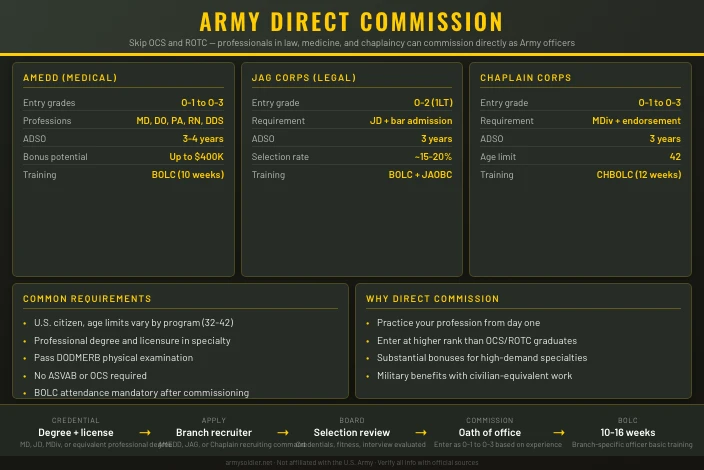
A direct commission means the Army appoints you as an officer because of a specific credential, bypassing Officer Candidate School (OCS) and ROTC entirely. You don’t compete in a traditional officer board. You apply to a specific program, meet its professional requirements, and commission based on those qualifications.
The tradeoff is this: OCS and ROTC produce generalist officers with extensive military acculturation. Direct commission produces specialist officers who need to learn military basics quickly. So every direct commission path runs through a condensed training course before branch-specific schooling.
What you skip:
- Officer Candidate School (12 weeks)
- ROTC (4-year program)
- Basic Combat Training (in most cases)
What you still complete:
- The Direct Commission Course (DCC): 5 to 8 weeks depending on program
- A branch-specific Basic Officer Leader Course (BOLC)
All direct commissioned officers, regardless of prior military experience, complete DCC. The course covers land navigation, weapons qualification, physical fitness standards, Army customs, and leadership fundamentals. Think of it as a condensed version of the basics OCS candidates spend months on.
After DCC, you attend your branch’s BOLC, a longer and more specialized course that prepares you to function as an officer in your specific field. Total pre-assignment training ranges from about 3 months for some programs to over 6 months for others.
The standard active duty service obligation across Army direct commission programs is 3 years. Some programs carry longer obligations tied to training investments or loan repayment.
JAG Corps: Direct Commission for Lawyers
The Army’s Judge Advocate General’s Corps offers direct commissions to licensed attorneys. It is one of the most structured direct commission paths, with a dedicated recruiting office and a dedicated training pipeline.
Eligibility requirements:
| Requirement | Active Duty | Army Reserve |
|---|---|---|
| Degree | JD from ABA-accredited law school | Same |
| Bar admission | Active member, any U.S. state bar | Same |
| Age | Under 42 at commissioning | Under 33 at commissioning |
| Citizenship | U.S. only | U.S. (dual citizenship case-by-case) |
Age waivers are available. Prior military service credits toward the age calculation, with each year of prior service adding a year to your limit.
Entry rank and training:
New JAG officers commission as First Lieutenants (O-2) and typically promote to Captain (O-3) within 6 to 12 months of commissioning. That quick promotion reflects the Army’s recognition that licensed attorneys enter with professional experience most O-1s lack.
The training pipeline has two phases:
- Direct Commission Course (DCC): 6 to 8 weeks at Fort Jackson, South Carolina, covering basic soldiering skills: physical fitness, weapons qualification, land navigation, and Army customs.
- Judge Advocate Officer Basic Course (JAOBC): 12 weeks at The Judge Advocate General’s Legal Center and School in Charlottesville, Virginia, covering military law, contracts, international law, administrative law, and criminal procedure.
After JAOBC, you report to your first duty station as a practicing Army attorney. Assignments span criminal prosecution, legal assistance for soldiers and families, contracts and fiscal law, administrative hearings, and international law at overseas commands.
Law students may apply during their final fall semester. The application-to-commissioning timeline runs roughly 6 months.
Chaplain Corps: Direct Commission for Clergy
The Chaplain Corps commissions ordained clergy directly. No OCS, no ROTC. The entry requirements are more specific than most people expect: a graduate theological degree, ordination, and an endorsement from a recognized faith organization are all required.
Eligibility requirements:
- U.S. citizenship
- Bachelor’s degree (minimum 120 semester hours from an accredited institution)
- Master of Divinity (M.Div.) or equivalent Master of Theology, at least 72 credit hours from an accredited seminary
- Ordination or ecclesiastical recognition from your faith community
- Ecclesiastical endorsement from a faith group recognized by the Armed Forces Chaplains Board (mandatory, non-waiverable)
- Minimum 2 years of post-seminary professional ministry experience (active duty); under 42 at commissioning for active duty, under 47 for Reserve and National Guard
The ecclesiastical endorsement is the step that trips up applicants. Your denomination, diocese, or sponsoring organization must formally certify you as one of their endorsed clergy for military service. Not all faith groups participate. Check the Armed Forces Chaplains Board recognized endorser list before starting the application process.
Entry rank and training:
Chaplains commission as First Lieutenants (O-2). Training runs through the Chaplain Basic Officer Leader Course (CHBOLC) at Fort Jackson, South Carolina, approximately 8 to 12 weeks covering military common core tasks alongside chaplain-specific ministry doctrine and ethics.
Chaplains serve all soldiers regardless of religion. They do not carry weapons. They work alongside chaplain assistants (68M) who handle security. The role spans combat deployments, garrison pastoral care, crisis counseling, and family readiness programs.
Cyber Direct Commissioning Program
The Army’s Cyber Direct Commissioning Program targets working civilian cyber professionals with technical credentials that would take years to develop through a traditional military path. This program falls under Army Cyber Command (ARCYBER) and commissions officers directly into the Cyber (CY) branch.
Eligibility requirements:
- U.S. citizenship: dual citizenship disqualifies applicants at point of commissioning
- Bachelor’s degree minimum; STEM degrees preferred and sometimes required
- Documented years of relevant professional cyber experience (the specific amount varies by position; experience is weighted more heavily than the degree in most cases)
- Ability to obtain and maintain a Top Secret/SCI security clearance
- Some positions require a counterintelligence-scope polygraph and eligibility for access to NSA and USCYBERCOM facilities
- Pass Army medical screening and basic fitness standards
- Age waiver up to 54; must commission before age 55
Entry rank depends on a constructive service credit calculation that accounts for your post-degree professional experience. Officers can commission anywhere from Second Lieutenant (O-1) to Colonel (O-6), though most cyber professionals enter at Captain (O-3) or Major (O-4) based on their years of experience.
Training:
Cyber officers attend DCC followed by the Cyber Basic Officer Leader Course at Fort Eisenhower, Georgia. Branch schooling focuses on offensive and defensive cyber operations, network exploitation, and signals intelligence.
The Army overhauled this program’s timeline. What was once an 18-to-24-month process now takes approximately 6 months from application to commissioning following recent reforms. FY26 selection boards run on a quarterly schedule.
Both active duty and Army Reserve positions are available. The Reserve path lets professionals maintain civilian cyber careers while serving part-time.
Army Direct Commission Program: Technical Branches
Beyond cyber, the Army’s broader Direct Commission Program covers a wide range of technical branches and functional areas. This is the program most often called simply “the Army DCP.”
Branches currently accepting applications (FY26):
| Branch | Code | Notes |
|---|---|---|
| Cyber | CY | Covered separately above |
| Signal Corps | SC | Communications and IT |
| Engineers | EN | Combat and construction engineering |
| Military Intelligence | MI | Analysis and collection |
| Military Police | MP | Law enforcement and corrections |
| Finance | FI | Accounting and fiscal management |
| Adjutant General | AG | Human resources |
| Chemical Corps | CM | CBRN defense |
| Logistics | LG | Supply chain and sustainment |
Functional Areas (FA) open to O-3 and above include Space Operations (FA 40), Public Affairs (FA 46), Foreign Affairs (FA 48), Operations Research (FA 49), and Strategic Intelligence (FA 34), among others.
Eligibility baseline:
- U.S. citizenship (dual citizenship disqualifies applicants)
- Bachelor’s degree from an accredited institution
- Relevant education and technical expertise aligned to the target branch
- Secret clearance eligibility (some positions require Top Secret)
- Age waiver available up to 54; must commission before 55
- Pass Army medical and fitness standards
Entry rank is determined by constructive service credit. The Army reviews your post-degree professional experience, certifications, and relevant training, then assigns a pay grade. Officers can enter from O-1 through O-6 depending on this calculation.
Training pipeline varies by branch. An Engineer officer (O-1 through O-2) completes DCC (5 weeks) followed by the Engineer BOLC at Fort Leonard Wood, Missouri (19 weeks), about 24 weeks total before the first duty assignment. Officers entering at O-3 add a Captains Career Course (6 weeks). O-4 and above may also complete Intermediate Level Education.
FY26 selection boards are scheduled in November 2025, February 2026, June 2026, and August 2026.
AMEDD: Direct Commission for Healthcare Professionals
The Army Medical Department (AMEDD) runs the largest and most established direct commission program. Because it covers six separate officer corps (Medical, Nurse, Dental, Veterinary, Medical Service, and Medical Specialist), each with distinct credential requirements, it warrants its own deep-dive.
For a full breakdown of AMEDD corps requirements, entry ranks, loan repayment programs, and the DCC-to-BOLC training pipeline at Fort Sam Houston, see the Army AMEDD direct commission guide.
The short version: AMEDD commissions range from O-1 (new nursing graduates) to O-3 (physicians and dentists with several years of post-residency experience). Healthcare officers attend the AMEDD DCC at Fort Sam Houston, Texas, followed by the AMEDD Basic Officer Leader Course, which runs 10 to 14 weeks for active duty.
| AMEDD Corps | Credential Required | Typical Entry Rank |
|---|---|---|
| Medical Corps | MD or DO | O-3 (CPT) |
| Nurse Corps | BSN + RN license | O-1 to O-2 |
| Dental Corps | DDS or DMD | O-3 (CPT) |
| Veterinary Corps | DVM | O-3 (CPT) |
| Medical Service | Healthcare admin degree | O-1 to O-2 |
| Medical Specialist | PT, OT, PA, dietitian | O-1 to O-3 |
How Direct Commission Compares to OCS and ROTC
All three paths produce commissioned officers. The differences are in who they’re designed for and what the commitment looks like before you pin on gold bars.
| Path | Who It’s For | Time Before Commission | Min. Commitment |
|---|---|---|---|
| ROTC | College students | 2-4 years concurrent with degree | 4-8 years active duty |
| OCS | College graduates, enlisted soldiers | 12 weeks after BCT | 3 years active duty |
| Direct Commission | Licensed/credentialed professionals | DCC (5-8 weeks) + BOLC | 3 years active duty (program-dependent) |
OCS has a competitive selection board with limited seats. Direct commission selection is based on your professional credentials. The Army needs your specialty, and either you qualify or you don’t.
One key difference: OCS graduates commission with no predetermined branch assignment locked to a credential. Direct commission officers are always branched to match their professional field. A licensed attorney goes to JAG. A credentialed nurse goes to the Nurse Corps. The credential determines the branch, with no choice involved.
Neither path is easier. OCS is physically and mentally demanding in ways direct commission is not. Direct commission carries professional credential requirements that take years to earn. The right path depends on where you are in your career.
Choosing the Right Program
The program that fits you depends on one thing: what credential you already hold.
- Law degree + bar admission: JAG Corps
- Seminary degree + ordination + endorsement: Chaplain Corps
- Cyber/IT professional experience + TS/SCI eligibility: Cyber Direct Commission
- Engineering, signals, intelligence, or other technical degree + experience: Army DCP (broad program)
- Medical license, nursing degree, dental license, or allied health credential: AMEDD (see linked guide above)
If your background fits more than one program, contact Army recruiters for each. They operate independently and can walk through the specifics of their selection boards.
For a broader comparison of officer versus enlisted paths and how direct commission fits into the larger Army structure, Army officer vs enlisted covers the pay, advancement, and lifestyle differences between both tracks.
The paths to serve guide covers all entry routes (enlisted, officer, warrant officer, and direct commission) in one place if you’re still weighing your options. You may also find Army officer selection tests useful for understanding what testing requirements apply to each commissioning path.
This site is not affiliated with the U.S. Army or any government agency. Verify all information with official Army sources before making enlistment or career decisions.