Army Diver (12D): Requirements and Career Path
Fewer than 200 active-duty soldiers hold the 12D Army Diver MOS at any given time. The training pipeline washes out roughly 75 to 80 percent of candidates before they ever reach advanced instruction. And the ASVAB requirement is among the highest of any combat engineer job in the Army’s 12-series.
If that ratio hasn’t scared you off, keep reading. This covers what it actually takes to qualify, what the training looks like from Phase 1 through Panama City, and where the job leads after service.
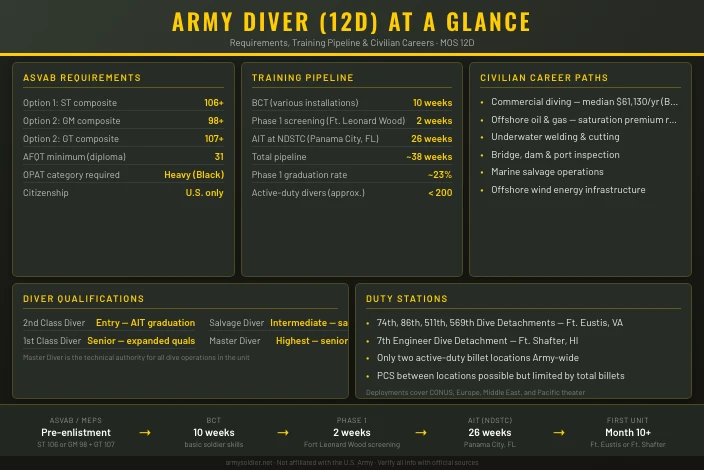
ASVAB Requirements for 12D
The 12D has the most demanding ASVAB threshold in the Army engineer career field. You must hit one of two qualifying combinations:
| Option | Composites | Minimum Scores |
|---|---|---|
| Option 1 | Skilled Technical (ST) | ST: 106 |
| Option 2 | General Maintenance (GM) + General Technical (GT) | GM: 98 and GT: 107 (both required) |
For Option 2, both scores must clear their minimums at the same time. Hitting GM 98 while scoring GT 106 does not qualify you.
ST (Skilled Technical) draws from four ASVAB subtests: General Science (GS), Verbal Expression (VE), Mathematics Knowledge (MK), and Mechanical Comprehension (MC). GM (General Maintenance) uses GS, Auto and Shop Information (AS), MK, and Electronics Information (EI). GT (General Technical) is simply VE plus Arithmetic Reasoning (AR).
The shared subtest across all three composites is Mathematics Knowledge. If your math is weak, that one gap costs you on every path to qualifying. Target MK and GS first – those two subtests move the most composites simultaneously.
Beyond ASVAB, the medical bar is strict. The 12D follows AR 40-501, Section 5-11 – diver medical standards that go well beyond the general Army physical. Any history of pressure-related ear, sinus, or lung conditions is typically disqualifying. Medical waivers route through the Chief of Hyperbaric Medicine at Dwight David Eisenhower Army Medical Center.
You also need to be a U.S. citizen (no permanent residents), demonstrate basic water competency before shipping, and qualify in the Heavy (Black) OPAT category at MEPS. That means a standing long jump of at least 160 cm, seated power throw of 450 cm, strength deadlift of 160 lbs, and 43 intervals on the aerobic run. The 12D is one of the few MOS jobs that requires the highest OPAT category, which reflects what Phase 1 will actually demand of your body.
Physical Screening: What Happens Before Training Starts
Phase 1 isn’t where the screening begins. Screening starts before you sign anything.
Recruiter water competency check. Your recruiter will arrange a basic swim test before submitting a 12D contract. The standard is functional – you need to demonstrate that you can stay afloat, manage yourself in open water, and complete basic strokes without distress. This isn’t a timed 500-yard swim, but candidates who struggle visibly will not get a 12D contract approved. Showing up unable to manage yourself in a pool ends the process before it starts.
MEPS physical for 12D. The standard Army physical at MEPS isn’t sufficient for the 12D. You’ll be evaluated against diver medical standards under AR 40-501, Section 5-11, which the examining physician will apply in addition to the normal entrance physical. Key disqualifiers include: any history of spontaneous pneumothorax, chronic ear or sinus conditions, asthma or reactive airway disease, claustrophobia documented in medical history, and conditions affecting pressure equalization. These are not waiverable through the normal process – medical waivers for dive-specific conditions route through the Chief of Hyperbaric Medicine at Dwight David Eisenhower Army Medical Center at Fort Gordon.
OPAT at MEPS. You must qualify in the Heavy (Black) category on the Occupational Physical Assessment Test. That means clearing all four events: standing long jump (160 cm), seated power throw (450 cm), strength deadlift (160 lbs), and 43 intervals on the aerobic run. The Army uses this to filter out candidates whose baseline physical capability won’t hold up in a physical training environment as demanding as Phase 1.
Timeline from first contact to shipping. Expect 3 to 6 months from initial recruiter contact to shipping to BCT, factoring in MEPS scheduling, the swim test, contract approval, and open training seats. 12D seats are scarce – the Army trains fewer than 50 new divers per year – so shipping dates can push out even after a contract is signed.
Once you pass MEPS and ship to Basic Combat Training, the clock starts on one of the longer enlisted pipelines in the Army.
The 12D Training Pipeline
Plan on roughly 10 months from the start of BCT to arrival at your first unit – if you make it through.
| Phase | Location | Length | What Gets Tested |
|---|---|---|---|
| BCT | Various installations | 10 weeks | Basic soldiering: marksmanship, fitness, land navigation |
| Phase 1 Screening | Fort Leonard Wood, MO | 2 weeks | Pool conditioning, diving physics, stress inoculation |
| Phases 2 and 3 (AIT) | Naval Diving and Salvage Training Center, Panama City, FL | 26 weeks | SCUBA, surface-supplied systems, welding, demolition, salvage |
Phase 1: The Gate Most People Don’t Get Through
Phase 1 is where roughly 75 to 80 percent of 12D candidates wash out. It runs two weeks at Fort Leonard Wood and covers diving physics, basic dive medicine, and an escalating series of pool drills designed to identify candidates who cannot stay calm underwater.
The pool sessions start immediately. You’ll complete 1,000-yard timed swims, breath-hold drills, underwater gear removal, and mask-clearing exercises while instructors introduce deliberate distractions. Candidates who freeze or panic don’t continue. This is not remedial – it’s a filter. The Army isn’t trying to help you pass Phase 1. It’s finding out whether you can handle what comes next.
Soldiers who fail Phase 1 do not become Army divers. They get reclassified to a different MOS.
Phases 2 and 3: Panama City
Candidates who clear Phase 1 move to the Naval Diving and Salvage Training Center (NDSTC) in Panama City, Florida – the largest diving facility in the world. Army students train alongside Navy divers and meet the same standards.
The 26-week AIT covers:
- Open-circuit SCUBA operations from the ground up
- Surface-supplied diving with hard-hat helmets and full-face masks connected to umbilical air lines
- Underwater welding and burning using hydraulic and pneumatic tools
- Demolition techniques for obstacle clearance and structure removal
- Salvage rigging for recovering submerged equipment and structures
- Dive planning and safety procedures – every student learns to plan and supervise a dive operation, not just execute one
The surface-supplied system is harder to learn than SCUBA. It allows deeper and longer dives but ties the diver to the surface with an umbilical. Staying oriented in low-visibility water while managing that tether is a skill that takes real practice to develop.
Day-to-Day Work as an Army Diver
The 12D is not a normal Army unit experience. Dive detachments are small – typically a handful of divers – which means every soldier carries significant individual responsibility.
Typical duties include:
- Bottom surveys and hydrographic mapping of waterways
- Underwater inspection of bridge foundations, piers, and harbor infrastructure
- Search-and-recovery operations for submerged equipment or personnel
- Rehearsing underwater demolition and mine-clearing procedures
- Equipment maintenance: helmets, umbilicals, manifolds, regulators, SCUBA rigs
Garrison rhythm. In garrison, a typical week follows a predictable structure: physical training in the morning (with a heavy emphasis on swimming), equipment inspection and maintenance during mid-morning, dive planning and academic instruction in the afternoon. Actual in-water time is not daily – dive schedules depend on mission requirements, water conditions, and available personnel. But maintenance cycles are constant. Surface-supplied dive gear involves umbilicals, manifolds, communication systems, and helmets that require routine inspection logs and pre-dive checks before any operation. A dive detachment that skips maintenance discipline is a dive detachment that gets people hurt.
Field operations. Deployable missions are called up on short notice. A 12D unit can be tasked to survey a river crossing site ahead of a maneuver element, assess bridge damage after flooding, or clear a port facility of underwater obstructions. Army divers have also operated in direct support of EOD – locating and identifying underwater threats (mines, IEDs attached to infrastructure) so Explosive Ordnance Disposal teams can act.
Deployment history includes Iraq, Afghanistan, Somalia, Haiti, and Pacific theater locations. The nature of the work shifts by theater: port reconstruction and harbor clearing in some locations, river crossing reconnaissance and bridge inspection in others. Surge events – natural disasters, combat engineering missions – can push a small detachment to high operational tempo with very little warning.
Duty Stations
The 12D has fewer billet options than almost any other Army MOS. All active-duty Army divers fall under one of six engineer dive detachments at two installations:
Joint Base Langley-Eustis (Fort Eustis), Virginia The 74th, 86th, 511th, and 569th Engineer Dive Detachments are based here. Fort Eustis sits in Newport News, Virginia, inside the Hampton Roads metro area. The area is densely military – Langley Air Force Base is a short drive away, and Norfolk Naval Station is nearby – which means base housing competition is real and off-post rental prices reflect a high-demand military market. That said, Hampton Roads offers a large civilian labor market for spouses, proximity to Virginia Beach, and reasonable cost of living relative to other East Coast metro areas. Divers at Fort Eustis operate throughout CONUS, Europe, and the Middle East. The geographic reach means TDY (temporary duty) travel is a regular part of this assignment.
Joint Base Pearl Harbor-Hickam (Fort Shafter), Hawaii The 7th Engineer Dive Detachment operates from Fort Shafter, located about 5 miles from downtown Honolulu. Hawaii assignments carry a higher BAH rate to offset the cost of living, but out-of-pocket housing costs still run high if you live off-post. The Pacific assignment covers a massive area – missions span the Pacific Ocean, Far East, and Australia. PCS to Hawaii typically runs 2 to 3 years, and the isolation from the continental U.S. is a real consideration for families with support networks stateside.
Those are your options. There is no third installation, no rotating assignment list, and no OCONUS posting outside of Hawaii for the 12D. If the geography doesn’t work for your family situation, the 12D may not be the right fit. With only two locations, PCS flexibility is essentially zero – every reassignment moves you between these two posts.
Diver Qualification Levels
Entry as a 2nd Class Diver is just the beginning. Army divers advance through a tiered qualification structure based on accumulated experience, demonstrated competency, and completion of formal courses:
| Badge | Level | How It’s Earned |
|---|---|---|
| 2nd Class Diver | Entry | Awarded at NDSTC AIT graduation; qualifies for SCUBA and surface-supplied operations to standard depths |
| Salvage Diver | Intermediate | Additional course focused on rigging, lift bag operations, and complex recovery procedures; typically pursued 1 to 2 years post-AIT |
| 1st Class Diver | Senior | Expanded operational qualifications including deeper saturation operations and dive supervisor responsibilities; requires documented dive hours and supervisor endorsement |
| Master Diver | Highest enlisted | Requires years of operational experience, a formal Master Diver course, and a comprehensive board evaluation; held by senior NCOs who serve as the technical authority for all detachment dive operations |
2nd Class to Salvage Diver is the first progression most soldiers pursue after arriving at their unit. The salvage course is not automatic – soldiers must accumulate minimum logged dive hours and receive a commander’s recommendation before attending. Timeline varies, but most soldiers are competitive for Salvage after 12 to 18 months of operational experience.
1st Class Diver is a significant career milestone. At this level, a diver can supervise operations independently. The qualification requires documented performance across a range of dive types and conditions, not just a single course completion.
Master Diver is the peak of the enlisted technical progression. The course is conducted at the Naval Diving and Salvage Training Center – the same facility where AIT takes place – and tests candidates on advanced physics, dive medicine, equipment failure scenarios, and supervisory decision-making under pressure. A detachment typically has one or two Master Divers, and they are the ones making go/no-go calls on dive plans.
Beyond dive badges, many 12D soldiers pursue Airborne School (3 weeks at Fort Moore) for units requiring parachute-qualified divers, the Sapper Leader Course (28 days at Fort Leonard Wood), and hydrographic survey training. The Army also sends divers to civilian-equivalent programs for specialized underwater inspection certifications.
Civilian Career Paths
The training at NDSTC meets or exceeds the standards set by the Association of Diving Contractors International (ADCI) – the body that governs commercial diving certifications. Former Army divers qualify for commercial credentials faster than civilians who train at private dive schools.
Commercial diving employers in the following industries actively recruit veterans with military dive training:
- Offshore oil and gas – Gulf of Mexico saturation divers can earn well above the median salary, particularly on deep saturation contracts
- Marine salvage – ship and cargo recovery operations worldwide
- Underwater welding and cutting – infrastructure repair and fabrication
- Bridge, dam, and port inspection – federal and state infrastructure programs
- Offshore wind energy – a growing sector requiring certified commercial divers for foundation and cable work
The Bureau of Labor Statistics puts median annual pay for commercial divers at roughly $61,130. That’s the median. Experienced offshore divers routinely earn more, especially those willing to work rotation schedules in the Gulf.
The GI Bill can fund additional education if you want to move into a supervisory or engineering role – civil engineering, marine science, and offshore project management are natural progressions for someone who spent years doing underwater construction and salvage.
Is the 12D Right for You
The 12D is not a job you stumble into. It selects for specific traits.
The profile that succeeds:
- Comfortable in the water, not just capable – you need to enjoy being underwater
- Calm under physical stress; the ability to slow your breathing and think clearly when things get uncomfortable
- Mechanically inclined and willing to maintain complex equipment
- Comfortable in a small, high-accountability unit with nowhere to hide
- Realistic about a 75 to 80 percent chance of not completing Phase 1
Prior competitive swimming, recreational SCUBA, or boating experience doesn’t guarantee success – but it dramatically narrows the gap between you and what Phase 1 demands. Candidates with genuine water confidence arrive at Fort Leonard Wood with an advantage the Army can’t give them in two weeks.
Preparation that actually moves the needle. If you have time before shipping, focus on three things: swimming volume (not just laps – get comfortable with breath-hold work, treading water for extended periods, and underwater swimming), cold and murky water exposure (pool clarity doesn’t match what operational diving looks like), and physical fitness with an emphasis on pull-ups and swimming endurance rather than just running. Candidates who arrive physically prepared but water-anxious are more likely to fail Phase 1 than candidates who arrive less fit but genuinely at home in the water.
ASVAB prep timeline. The ST 106 / GM+GT combined threshold is demanding. If you’re starting from a mid-range score, give yourself 3 to 6 months of focused study on Math Knowledge, General Science, and Mechanical Comprehension. These three subtests collectively determine whether you qualify under either option. A practice test at the start of your prep gives you a baseline – candidates often find GS is the fastest score to raise with targeted study.
The honest question to answer. Before signing a 12D contract, ask yourself whether you’ve ever been in a situation where you were physically stressed underwater – out of air, disoriented, or fighting panic – and whether you handled it well. Not whether you enjoy swimming on a nice day, but whether you’ve experienced actual stress in the water and stayed functional. That self-knowledge matters more than swim times when Phase 1 instructors start introducing distractions.
The Phase 1 attrition rate is not a scare statistic. Most people who sign a 12D contract do not become Army divers. Go into it with eyes open.
For a broader look at how 12D fits within the Army’s combat engineering jobs, see the Army engineer MOS overview. For the line score breakdown across every 12-series MOS, ASVAB scores for Army engineer MOS jobs shows exactly where 12D sits relative to the rest of the field.
To dig into the full career details – pay, benefits, Reserve options, and post-service policies – the 12D Diver MOS profile covers everything from enlistment through separation.
This site is not affiliated with the U.S. Army or any government agency. Verify all information with official Army sources before making enlistment or career decisions.