Army Duty Stations: Where Will You Live
Where you live in the Army isn’t entirely your choice. The Army has positions to fill across dozens of installations in the US and overseas, and your assignment depends first on what the Army needs, then on what you want. That said, the system does give you a voice. Understanding how it works – and which posts are known for what – helps you make smarter choices when your preferences actually count.
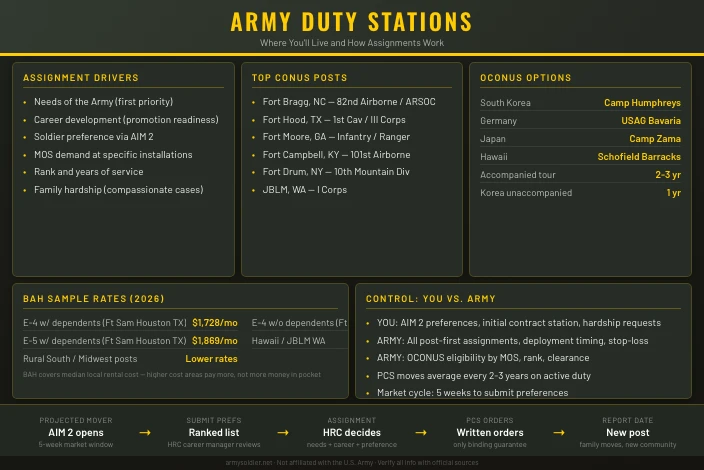
How Army Assignments Work
Every active-duty Soldier goes through the assignment process at least once every two to four years. The Army calls a Soldier who is due for reassignment a “projected mover” and opens a window for them to shop available positions.
The tool that runs this process is AIM 2 (Assignment Interactive Model 2.0), a web-based marketplace where Soldiers can browse open billets and rank their preferences. Enlisted Soldiers submit their preferences through their branch career manager at HRC (Human Resources Command). The market cycle runs for roughly five weeks.
Three things drive the final decision:
- Needs of the Army – unit manning levels and deployment cycles come first
- Career development – HRC considers whether an assignment develops the Soldier’s skills and prepares them for promotion
- Soldier preference – your ranked list from AIM 2 carries weight, but isn’t a guarantee
The traditional term for the preference list is a dream sheet, and the name is only half-joking. Many Soldiers get one of their top picks. Many don’t. First-term enlisted Soldiers have the least pull; senior NCOs and officers have more. Your MOS matters too – a high-demand job in short supply at a specific installation can eliminate any real choice.
PCS moves (Permanent Change of Station) happen roughly every two to three years on average, though some assignments run longer. Each move comes with orders, a moving allowance, and a reporting date. Families follow. Kids change schools. Spouses restart job searches. This is the single biggest quality-of-life factor that recruiter conversations tend to underemphasize.
Major CONUS Installations
The continental US has roughly 30 active Army installations of meaningful size. These ten account for the largest concentrations of active-duty Soldiers.
| Installation | State | Major Unit | Key MOS Fields |
|---|---|---|---|
| Fort Liberty | NC | XVIII Airborne Corps, 82nd Airborne, USASOC | Infantry, Special Operations |
| Fort Cavazos | TX | III Armored Corps, 1st Cavalry Division | Armor, Cavalry, MP |
| Fort Moore | GA | Maneuver Center of Excellence | Infantry, Armor (training) |
| Fort Campbell | KY | 101st Airborne Division | Infantry, Aviation |
| Fort Drum | NY | 10th Mountain Division | Infantry, Light Forces |
| JBLM | WA | I Corps | Mixed (all branches) |
| Fort Stewart | GA | 3rd Infantry Division | Combat Arms, Logistics |
| Fort Riley | KS | 1st Infantry Division | Infantry, Combined Arms |
| Fort Carson | CO | 4th Infantry Division | Infantry, Armor |
| Fort Novosel | AL | Aviation Center of Excellence | Aviation (training) |
Fort Liberty, NC
Home to the XVIII Airborne Corps, the 82nd Airborne Division, and Army Special Operations Command. Fort Liberty is one of the most populated military installations in the world, with roughly 50,000 Soldiers and over 250,000 people including families and civilian workers. It sits near Fayetteville, North Carolina.
Special operations MOS fields – 18-series Special Forces, 37F PSYOP, 38B Civil Affairs – and airborne infantry (11B) are heavily represented here. The surrounding Fayetteville area is deeply accustomed to military life, with a large off-post rental market.
Fort Cavazos, TX
The largest active-duty post in the US Army by number of Soldiers, Fort Cavazos hosts the III Armored Corps, the 1st Cavalry Division, and the 3rd Cavalry Regiment. It covers over 330 square miles outside Killeen, Texas, about 60 miles north of Austin.
Armor and cavalry MOS fields are the core of Fort Cavazos’s mission. The post also stations the 89th Military Police Brigade and 13th Sustainment Command. Living costs near Fort Cavazos are relatively low, and off-post housing is plentiful.
Fort Moore, GA
Fort Moore is the Army’s Maneuver Center of Excellence, hosting the Infantry School, the Armor School, and the 75th Ranger Regiment. Located on the Georgia-Alabama border near Columbus, it is where every infantry Soldier and armor crewmember completes their initial skills training.
A large number of MOS 11B and 19K Soldiers receive their first duty station assignment here after AIT. The base itself is expansive and the surrounding Columbus area is a well-established military community.
Fort Campbell, KY
Straddling the Kentucky-Tennessee state line, Fort Campbell is home to the 101st Airborne Division (Air Assault) and the 160th Special Operations Aviation Regiment (SOAR). The post is closely associated with the air assault mission – think rope lines and helicopters, not static-line parachutes.
Aviation MOS fields and air assault infantry are the dominant career fields. Fort Campbell is near Clarksville, Tennessee, which has a large off-post residential community and a lower cost of living than most major metros.
Fort Drum, NY
Fort Drum hosts the 10th Mountain Division, one of the most deployed divisions in Army history. It sits near Watertown in northern New York, close to the Canadian border. Winters are severe – Watertown consistently ranks among the snowiest cities in the country.
The 10th Mountain is a light infantry division, so 11B is the dominant MOS. Fort Drum is a relatively remote post, which affects off-post housing options and spouse employment.
Joint Base Lewis-McChord, WA
JBLM is home to I Corps and sits between Tacoma and Olympia in western Washington. The Pacific Northwest location makes it one of the more popular posts among Soldiers who submit preferences, and competition for JBLM assignments reflects that.
I Corps includes elements from multiple division-level units and supports Pacific theater operations. The Tacoma-Seattle metro area offers broad civilian employment for military spouses.
Fort Stewart, GA
Fort Stewart houses the 3rd Infantry Division and is the largest Army installation east of the Mississippi by land area. It sits about 40 miles southwest of Savannah, Georgia. The post is known for frequent deployments – the 3rd ID has rotated to the Middle East multiple times in recent decades.
Combat arms and transportation and logistics MOS fields make up a large share of the force here.
Fort Riley, KS
The 1st Infantry Division (the “Big Red One”) is headquartered at Fort Riley, outside Junction City, Kansas. The post is one of the older active installations and has a well-developed on-post community. The surrounding area is rural, which can be a significant lifestyle adjustment for Soldiers from large urban areas.
Fort Carson, CO
Fort Carson sits at the base of Pikes Peak near Colorado Springs and hosts the 4th Infantry Division. The Colorado Springs area is one of the more desirable duty station locations among Soldiers who rank preferences, owing to outdoor recreation, a strong military-friendly community, and reasonable cost of living relative to coastal areas.
Fort Novosel, AL
Fort Novosel (formerly Fort Rucker) is the Army’s primary aviation training center and home of the Army Aviation Center of Excellence. Almost every Army aviator – warrant officer and officer alike – trains here. Aviation warrant officers going through WOFT (Warrant Officer Flight Training) spend at least a year at Fort Novosel before moving to an operational assignment.
The surrounding Daleville and Dothan area is small and rural. Most Soldiers at Fort Novosel are in a training status rather than permanently assigned.
OCONUS Assignments
Overseas assignments come in two general forms: accompanied (family can join you) and unaccompanied (family stays in the US on a separate BAH rate). Most OCONUS assignments are 2-3 years accompanied or 1 year unaccompanied.
| Installation | Country | Notable Units | Tour Length |
|---|---|---|---|
| Camp Humphreys | South Korea | 2nd Infantry Division, 8th Army HQ | 2 yr accompanied / 1 yr unaccompanied |
| USAG Bavaria / Grafenwoehr | Germany | 7th Army Training Command, V Corps | 2-3 yr |
| Camp Zama | Japan | U.S. Army Japan HQ | 2-3 yr |
| Schofield Barracks | Hawaii | 25th Infantry Division | 2-3 yr |
Camp Humphreys in South Korea is the largest overseas US military installation in the world. The base houses 8th Army headquarters and the 2nd Infantry Division’s Combat Aviation Brigade, among other units. Unaccompanied one-year tours are common and carry a higher BAH rate for the stateside location where the family resides.
USAG Bavaria encompasses Grafenwoehr, Vilseck, and several smaller communities in Bavaria, Germany. The 7th Army Training Command runs one of Europe’s largest training areas here. Germany assignments are accompanied and typically 2-3 years. V Corps headquarters also operates in the region.
Schofield Barracks in Hawaii hosts the 25th Infantry Division and is one of the most requested assignments by preference. The high cost of living in Hawaii means BAH rates there are among the highest in the country, but local housing markets are tight.
BAH and the Cost of Where You Live
Basic Allowance for Housing rates vary dramatically by installation. A Soldier stationed in Hawaii or the Washington DC area will draw significantly more BAH than the same rank at a rural post in Kansas. The allowance is set to cover median rental costs for the local market – it doesn’t follow your rank alone.
Here’s how BAH compares across a few installations at two common enlisted ranks:
| Rank | Installation | BAH w/ Dependents | BAH w/o Dependents |
|---|---|---|---|
| E-4 | Fort Sam Houston, TX | $1,728 | $1,359 |
| E-5 | Fort Sam Houston, TX | $1,869 | $1,500 |
| E-4 | Fort Liberty, NC | $1,500+ | $1,200+ |
| E-5 | Schofield Barracks, HI | $2,700+ | $2,200+ |
Rates shift every January. The exact figures for your rank and location are available through the DoD BAH calculator.
The gap matters when you’re comparing assignments. A duty station with higher BAH in a high-cost area often leaves you no better off financially than a low-BAH post where rent is cheap. Running the numbers for each specific location before submitting preferences is worth the time.
On-post housing is available at most installations through privatized housing providers. On-post units are convenient and the rent equals your BAH, but availability can be limited, waitlists run 6-12 months at popular posts, and the quality varies significantly by installation and neighborhood.
What You Can and Can’t Control
Here’s a direct accounting:
What you can influence:
- Submitting preferences through AIM 2 during your assignment window
- Negotiating a specific duty station into your initial enlistment contract (first assignment only, not guaranteed after that)
- Requesting a compassionate reassignment for documented family hardship
- Volunteering for specific assignments or deployments that match your preference
What the Army controls:
- All assignments after your first, subject to AIM 2 preferences but not bound by them
- Unit deployments and their timing
- Retention at a post beyond your normal rotation date (“stop-loss” in surge periods)
- OCONUS assignment eligibility based on MOS, rank, and security clearance
Most career fields have predictable assignment patterns – if you’re 11B infantry you will very likely spend time at a heavy-rotation post like Fort Liberty, Fort Drum, or Fort Cavazos. Knowing that going in is better than learning it after you sign.
For a broader look at daily life across all of these locations, What Army Life Is Really Like covers the on-post garrison routine, field time, and the parts that shape your day-to-day far more than which state you’re in. Before you ship to any of these posts, you’ll go through Army Basic Training first. How your total compensation stacks up at different duty stations depends on BAH rates and tax-free allowances, which Army vs Civilian Pay breaks down in detail. To explore which MOS fields are available and where they tend to be stationed, start with the enlisted career directory.
This site is not affiliated with the U.S. Army or any government agency. Verify all information with official Army sources before making enlistment or career decisions.