Army Engineer MOS Jobs: Combat and Construction
The Army’s Corps of Engineers does two very different things. One part blows up bridges, clears minefields, and breaches fortified walls while infantry units are fighting. The other part builds roads, installs power grids, and constructs base camps in locations where commercial contractors won’t go. CMF 12 (the 12-series Military Occupational Specialties) covers both. Twelve MOS codes. One career field. Completely different daily realities depending on which path you pick.
If you’re deciding between combat and construction, or trying to figure out which MOS fits your ASVAB scores and civilian goals, this guide breaks down the full field.
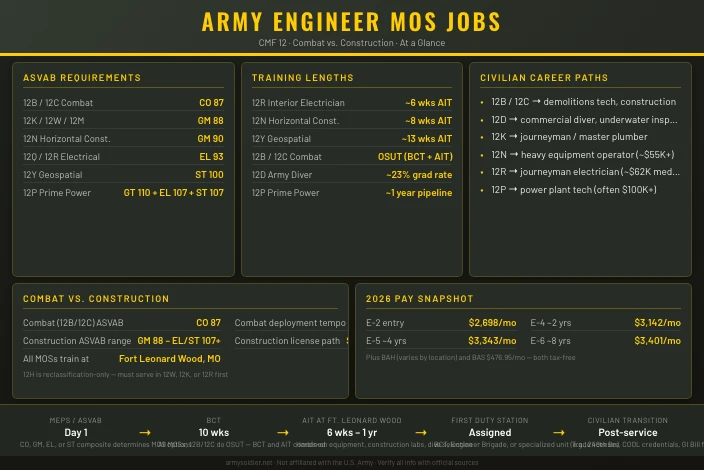
The Two Sides of CMF 12
Army engineers split into two broad groups based on their primary mission. The distinction matters for daily life, deployment tempo, physical requirements, and career outcomes.
Combat engineers support maneuver units in close contact with the enemy. They breach obstacles, clear routes of improvised explosive devices, emplace and remove mines, and build fighting positions under fire. These jobs carry combat arms classification and train alongside infantry.
Construction and utilities engineers build and maintain infrastructure. Roads, airfields, bridges, power systems, electrical wiring, plumbing, and diving operations all fall here. These soldiers deploy frequently but spend more time on project-based work than direct combat support.
The MOS breakdown:
| Category | MOS | Job Title |
|---|---|---|
| Combat | 12B | Combat Engineer |
| Combat | 12C | Bridge Crewmember |
| Combat / Technical | 12D | Diver |
| Construction | 12H | Construction Engineering Supervisor |
| Construction | 12K | Plumber |
| Construction | 12N | Horizontal Construction Engineer |
| Construction | 12P | Prime Power Production Specialist |
| Construction | 12Q | Power Distribution Specialist |
| Construction | 12R | Interior Electrician |
| Construction | 12W | Carpentry and Masonry Specialist |
| Technical | 12Y | Geospatial Engineer |
Note: 12H is a reclassification-only MOS. You cannot enlist directly into it. Soldiers must first serve in a feeder MOS such as 12W, 12K, or 12R before reclassifying.
Combat Engineers: 12B, 12C, and 12D
These three MOSs carry the most physical risk in the career field. Two of them require a CO (Combat) composite score on the ASVAB, and all three can put you in direct contact with enemy forces on deployment.
12B Combat Engineer
The 12B Combat Engineer is the centerpiece of the career field. You clear minefields, demolish obstacles with C4 and other explosives, construct defensive fighting positions, and operate heavy earthmoving equipment in combat. Route clearance teams in 12B units use mine detectors, ground-penetrating radar, and the Husky Mine Detection Vehicle to find IEDs buried in roads before they kill a convoy.
ASVAB requirement: CO 87, the same floor as infantry.
Training is One Station Unit Training (OSUT) at Fort Leonard Wood, Missouri, where basic combat training and MOS training happen in the same location without a break. Combat engineers earn the Expert Infantryman Badge opportunity and frequently attend the Sapper Leader Course, a 28-day course covering advanced demolitions and small-unit tactics. Some pick up airborne or air assault qualifications depending on unit assignment.
Daily garrison work is a mix of equipment maintenance, demolitions range time, and physical training. Field exercises are demanding. Deployment frequency is high, particularly for units attached to infantry brigades.
12C Bridge Crewmember
The 12C Bridge Crewmember builds floating bridges that carry 70-ton tanks across rivers and gaps. You operate bridge erection boats in moving water, connect ribbon bridge bays under fire, and assemble the infrastructure that keeps an entire division moving.
ASVAB requirement: CO 87, same as 12B.
This MOS trains at Fort Leonard Wood and works with the Improved Ribbon Bridge (IRB), the Dry Support Bridge (DSB), and Bailey-type panel bridges. Night crossings are standard because real-world gap crossings happen under cover of darkness. The physical demands are severe. You’re lifting heavy bridge bays, working in cold water, and operating boats in current while the rest of the unit is waiting on you.
Deployment work has included gap crossings in support of offensive operations, disaster response after floods, and humanitarian missions where washed-out infrastructure cut off civilian populations.
12D Army Diver
The 12D Army Diver is the most selective MOS in CMF 12. The training pipeline has roughly a 23% graduation rate. If you make it through, you join a small community of underwater engineers who conduct reconnaissance, demolition, and salvage in some of the most dangerous conditions the Army operates in.
ASVAB requirement: Either ST 106 or both GM 98 and GT 107 simultaneously. The dual-composite option means both must clear their minimums at the same time. Hitting one and missing the other doesn’t qualify.
Army divers use surface-supplied diving (hard-hat helmet connected to a surface air source) for deep or long operations, and SCUBA for shallower work requiring mobility. Missions include bridge and pier inspections, waterway reconnaissance before river crossings, underwater demolition, and salvage of equipment that goes into rivers or harbors.
The MOS has deployed to Iraq, Afghanistan, Somalia, and Haiti. Divers have inspected port infrastructure, cleared waterways, and recovered sensitive equipment in all of those environments.
Construction and Technical Engineers
This group covers the MOSs that build, wire, plumb, and power the infrastructure the Army operates from. Most require General Maintenance (GM) or Electronics (EL) composites on the ASVAB, reflecting the hands-on technical aptitude the work demands.
ASVAB Requirements at a Glance
| MOS | Composite | Minimum Score |
|---|---|---|
| 12K Plumber | GM | 88 |
| 12M Firefighter | GM | 88 |
| 12N Horizontal Construction Engineer | GM | 90 |
| 12W Carpentry and Masonry | GM | 88 |
| 12H Construction Engineering Supervisor | GM | 93 (at reclassification) |
| 12Q Power Distribution Specialist | EL | 93 |
| 12R Interior Electrician | EL | 93 |
| 12P Prime Power Production Specialist | GT + EL + ST | 110 / 107 / 107 (all three) |
| 12Y Geospatial Engineer | ST | 100 |
See ASVAB scores for every Army engineer MOS for the full breakdown of which composites to target and how to prepare.
12N Horizontal Construction Engineer
The 12N Horizontal Construction Engineer operates the Army’s heaviest construction equipment: D7R bulldozers, 140M graders, 621G scrapers, and GPS-enabled grade control systems that cut precise road elevations without manual survey stakes. You build roads, airfields, helicopter landing zones, and fighting positions. All of that earthwork is what combat units and logistics convoys depend on.
ASVAB requirement: GM 90.
AIT runs approximately 8 weeks at Fort Leonard Wood. Most of it is seat time on equipment. You switch machines frequently so you can operate across the full heavy equipment inventory. On deployments, 12N soldiers have cut main supply routes through mountainous terrain, graded helicopter landing zones under time pressure, and built forward operating base perimeters in weeks that would take civilian contractors months.
The civilian payoff is direct. Heavy equipment operators with commercial licenses work on highway construction, mining, and infrastructure projects at a median salary of around $55,000 per year, with experienced operators in high-demand markets earning considerably more.
12K Plumber
The 12K Plumber installs and repairs water supply, drainage, sanitation, and fire suppression systems on Army installations and in the field. Garrison work covers standard commercial plumbing repairs on post facilities. Field work means setting up water purification points and waste management systems in austere conditions without a parts warehouse nearby.
ASVAB requirement: GM 88.
Plumbers are in high demand in civilian life. The Bureau of Labor Statistics projects tens of thousands of plumber job openings annually for the foreseeable future, driven by aging infrastructure and a shortage of skilled tradespeople entering the profession. Army training, combined with apprenticeship hours logged during service, puts soldiers on the path to journeyman and master plumber licensure.
12R Interior Electrician
The 12R Interior Electrician installs and maintains interior electrical systems up to 600 volts: wiring, panels, breakers, transformers, and generators inside buildings and facilities. When a hospital wing or communications center on post loses power, a 12R finds the fault and fixes it.
ASVAB requirement: EL 93.
AIT is approximately 6 weeks at Fort Leonard Wood. The civilian transition is one of the most direct in the entire Army: the median annual wage for electricians is around $62,350, and the field is growing at roughly three times the national employment average. Apprenticeship hours logged during service count toward state licensing requirements.
12Q Power Distribution Specialist
The 12Q works outdoors, installing and maintaining the electrical distribution lines and equipment that run power from generation sources to buildings and systems across an installation. Think line workers: climbing poles, stringing cable, and keeping the grid connected. The civilian equivalent is an electrical power-line installer, a licensed trade with strong wages and consistent demand.
ASVAB requirement: EL 93.
12W Carpentry and Masonry Specialist
The 12W Carpentry and Masonry Specialist builds and repairs wood and masonry structures on Army installations and in field environments. You frame buildings, set concrete block, install roofing, and construct temporary structures that keep units sheltered. On humanitarian deployments, 12W soldiers have built schools, clinics, and community infrastructure as part of civil affairs missions.
ASVAB requirement: GM 88.
This MOS feeds into the 12H Construction Engineering Supervisor role after soldiers gain experience. Civilian construction and carpentry trades offer strong wage growth, especially for workers who pursue contractor licensing.
12P Prime Power Production Specialist
The 12P Prime Power Production Specialist designs, installs, and operates high-capacity power generation systems from 30-kilowatt generator sets up to megawatt-scale prime power plants. Every medical facility, communications node, and surveillance system at a forward operating base runs off systems a 12P built.
ASVAB requirement: GT 110, EL 107, and ST 107. All three composites must clear their minimums at the same time. This is the most demanding ASVAB threshold in CMF 12.
The training pipeline takes close to one year. New soldiers enlist as 12B first, complete OSUT at Fort Leonard Wood, then transition to 12P specialization. Every 12P exits training with one of three Additional Skill Identifiers: Mechanical (S2), Electrical (S3), or Instrumentation (E5).
The 249th Engineer Battalion (Prime Power) at Fort Belvoir, Virginia is the Army’s primary unit for this mission and has supported operations on every continent. Civilians with medium-voltage electrical experience earn well above $100,000 annually in the power generation and utility sectors.
12Y Geospatial Engineer
The 12Y Geospatial Engineer processes satellite and aerial imagery into maps, terrain databases, and 3D battlefield visualizations that commanders use for mission planning. This is one of the most technically specialized enlisted jobs in the Army, and one of the most desk-heavy. You’ll work with ArcGIS, ENVI, and military imagery exploitation systems, often on classified networks.
ASVAB requirement: ST 100.
The 12Y has historically qualified for enlistment bonuses of up to $15,000 for qualified recruits. Civilian GIS analysts and remote sensing technicians work in defense contracting, urban planning, environmental monitoring, and infrastructure management. The skill set transfers broadly.
Training Pipeline: What to Expect
Almost every engineer MOS trains at Fort Leonard Wood, Missouri, home of the U.S. Army Engineer School. BCT (Basic Combat Training) is 10 weeks for all branches. What follows depends on your MOS:
- 12B and 12C: OSUT combines BCT and AIT at Fort Leonard Wood. You stay in the same location and move from basic into MOS training without transferring.
- 12D: The diver training pipeline is one of the longest and most selective in the career field. Candidates must pass a physically demanding selection course before formal dive school begins.
- 12N: Approximately 8 weeks of AIT focused on heavy equipment operations.
- 12R: Approximately 6 weeks of AIT covering interior electrical systems.
- 12P: Close to one year total: 12B OSUT followed by prime power specialization. This is the longest training pipeline in CMF 12.
- 12Y: AIT runs approximately 13 weeks covering geographic information systems and imagery analysis.
All construction MOS training includes hands-on practical work, not just classroom time. Fort Leonard Wood has active construction training areas, equipment yards, and electrical labs where soldiers complete projects before they leave for their first duty station.
Where Engineers Serve
Most engineer units are assigned to one of three types of formations:
Brigade Combat Teams (BCTs) have an organic engineer battalion. Combat engineers (12B, 12C) assigned here support infantry, armor, and Stryker brigades directly. Deployment frequency is high, and the work is combat-focused.
Engineer Brigades and Battalions are corps- or division-level units with a mix of combat and construction engineers. These organizations handle large-scale route clearance, bridge operations, and construction projects during sustained operations.
The 249th Engineer Battalion (Prime Power) at Fort Belvoir is the dedicated unit for 12P soldiers. Detachments deploy independently to wherever power generation is needed, which makes this one of the most globally active units in the Army.
Reserve and National Guard engineer units exist across every state. 12-series soldiers in the Reserve or Guard perform the same training and deploy for both federal missions and state emergencies such as hurricanes and floods. Guard engineers have been among the first military units on the ground during major natural disasters.
Civilian Career Paths by MOS
One of the strongest arguments for a CMF 12 enlistment is the direct line from military training to civilian licensure and employment. The Army funds the training. You accrue the experience hours. The credentials come from that combination.
| MOS | Civilian Role | Typical Path |
|---|---|---|
| 12B / 12C | Construction site work, demolitions tech | Military experience + certifications |
| 12D | Commercial diver, underwater inspection | Coast Guard certification after service |
| 12K | Journeyman / master plumber | Apprenticeship hours + state exam |
| 12N | Heavy equipment operator | CDL / operator license + experience |
| 12P | Power plant technician, utility electrician | Commercial licenses, often six figures |
| 12Q | Line installer, power distribution tech | IBEW apprenticeship credit |
| 12R | Journeyman electrician | State apprenticeship hours + exam |
| 12W | Carpenter, masonry contractor | Portfolio + contractor license |
| 12Y | GIS analyst, defense contractor | Bachelor’s degree via GI Bill + clearance |
The Army COOL (Credentialing Opportunities On-Line) program helps soldiers map their MOS experience to civilian certifications and identifies which certifications the Army will pay for while you serve.
Choosing the Right Engineer MOS
The split between combat and construction is a genuine lifestyle difference, not just a job title. Here’s a direct comparison across the factors that matter most:
| Factor | Combat (12B, 12C) | Construction / Technical |
|---|---|---|
| Physical demand | Very high | Moderate to high |
| Combat exposure | High | Lower (but still deploys) |
| ASVAB entry bar | CO 87 | GM 88 to EL/ST 107+ |
| Training length | OSUT (longer) | AIT 6 weeks to 1 year |
| Civilian license path | Limited | Strong (trades, engineering) |
| Deployment frequency | Very high | Moderate to high |
If you want to be in the fight and aren’t prioritizing a direct civilian credential, 12B or 12C is the choice. If you want trade credentials, strong post-service earning potential, and work that’s physically demanding but not combat-focused, the construction MOSs deliver more direct civilian value.
The Army Engineer career hub has full profiles for every MOS listed here, including ASVAB score breakdowns, complete training pipelines, pay tables, and post-service career details.
You may also find what it’s really like to be a 12B Combat Engineer, Army engineer MOS civilian construction jobs, Army Diver 12D requirements and career path, and Army engineer vs. Navy Seabee helpful.
This site is not affiliated with the U.S. Army or any government agency. Verify all information with official Army sources before making enlistment or career decisions.