Army Engineer vs Navy Seabee
The Army and the Navy both run military construction forces. Both build under fire. Both send tradespeople to austere locations most civilian contractors won’t touch. But the daily reality of serving in each is different in ways that matter if you’re trying to choose between them.
Army engineers in CMF 12 split between two missions – combat support and construction – and the split changes everything about daily life, training length, and the civilian career you exit with. Navy Seabees focus almost entirely on expeditionary construction. They build rapidly, in contested environments, under the Naval Mobile Construction Battalion (NMCB) structure. One force is organized to fight and build. The other is organized to build, fast, anywhere in the world.
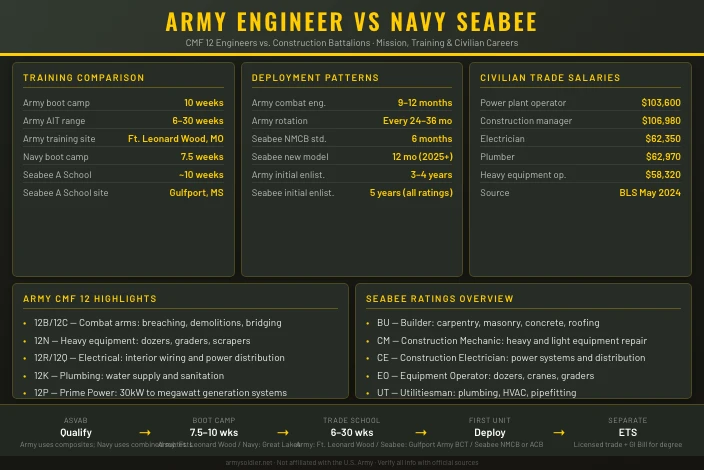
Mission: How Each Force Is Used
The Army’s engineer mission has two distinct tracks. Combat engineers (12B, 12C) work directly with maneuver forces – infantry, armor, Stryker brigades – doing breaching, route clearance, demolitions, and obstacle construction in close proximity to the enemy. They are combat arms soldiers. Construction engineers (12N, 12K, 12R, 12P, 12W, and others) build the infrastructure that sustains an operation: roads, airfields, power grids, base camps, and facilities. Both groups deploy. Only one routinely operates under direct fire.
Navy Seabees operate exclusively under the expeditionary construction mission. An NMCB deploys with a full complement of trades – builders, electricians, plumbers, equipment operators, steelworkers, and mechanics – and builds everything from airfields to pier facilities in forward locations. The Seabee motto, “We Build, We Fight,” reflects their ability to defend what they construct, but the primary mission is construction. You carry a rifle and receive combat training, but you are not a combat arms force.
The practical difference: an Army 12B attached to an infantry brigade may spend a deployment doing route clearance for months at a stretch. A Seabee builder deploying with an NMCB will spend most of that time on construction projects, with weapons qualification and security tasks as secondary duties.
Where each force operates:
- Army engineers: embedded in Brigade Combat Teams, corps-level engineer brigades, and independent engineer battalions worldwide
- Navy Seabees: Naval Mobile Construction Battalions (NMCBs), Amphibious Construction Battalions (ACBs), Naval Construction Regiment command structure – homeports at Port Hueneme, CA and Gulfport, MS
- Both: contingency operations, disaster response, and humanitarian construction globally
Structure: MOS vs. Rating
Army engineers enlist into a specific MOS within CMF 12. You pick your job – or your recruiter and ASVAB scores narrow it down – and you train for that specific function from the start.
| Army MOS | Function |
|---|---|
| 12B Combat Engineer | Breaching, demolitions, route clearance |
| 12C Bridge Crewmember | Tactical bridging, gap crossing |
| 12N Horizontal Construction | Heavy earthmoving equipment |
| 12K Plumber | Water supply, drainage, sanitation |
| 12R Interior Electrician | Wiring, panels, up to 600V |
| 12Q Power Distribution | Outdoor power lines and distribution |
| 12W Carpentry and Masonry | Structural work, concrete, framing |
| 12P Prime Power | High-capacity generation, 30kW to megawatt scale |
| 12Y Geospatial Engineer | Mapping, GIS, terrain analysis |
Navy Seabees enlist into a rating – the Navy’s equivalent of a job specialty. Seven ratings cover the Seabee force.
| Seabee Rating | Function |
|---|---|
| BU (Builder) | Carpentry, masonry, concrete, roofing, painting |
| CM (Construction Mechanic) | Repair of heavy and light equipment |
| CE (Construction Electrician) | Electrical systems, power generation, distribution |
| EA (Engineering Aide) | Surveying, drafting, construction planning |
| EO (Equipment Operator) | Heavy equipment: dozers, graders, cranes, forklifts |
| SW (Steelworker) | Steel fabrication, welding, structural steel |
| UT (Utilitiesman) | Plumbing, pipefitting, HVAC, utilities |
Army MOSs and Seabee ratings cover roughly the same functional ground. The difference is organizational: Army construction engineers are part of a larger career field that also includes combat engineers. Seabees are all construction, all the time.
ASVAB and Entry Requirements
The Army and Navy both use the ASVAB, but they calculate qualification scores differently. Army CMF 12 uses composite line scores tied to specific skill areas. The Navy uses combined subtests that don’t always match Army composite names.
Army CMF 12 ASVAB requirements (composite minimums):
| MOS | Composite | Minimum |
|---|---|---|
| 12B, 12C | CO (Combat) | 87 |
| 12N, 12K, 12W | GM (General Maintenance) | 88-90 |
| 12R, 12Q | EL (Electronics) | 93 |
| 12P (Prime Power) | GT + EL + ST | 110 / 107 / 107 (all three simultaneously) |
| 12Y | ST (Skilled Technical) | 100 |
Navy Seabee ASVAB requirements (combined subtest scores):
| Rating | Formula | Minimum |
|---|---|---|
| BU (Builder) | AR+MC+AS or VE+AR+MK+AO | 136 or 197 |
| CM (Construction Mechanic) | AR+MC+AS | 162 |
| CE (Construction Electrician) | AR+MK+EI+GS | 200 |
| EA (Engineering Aide) | AR+2MK+GS | 207 |
| EO (Equipment Operator) | AR+MC+AS | 162 |
| SW (Steelworker) | GS+MC+EI or VE+MK+MC+CS | 170 or 220 |
| UT (Utilitiesman) | AR+MK+EI+GS | 200 |
The Army and Navy use different scoring systems, so these numbers aren’t directly comparable. What they show is that technical Seabee ratings (CE, EA, UT) and technical Army MOSs (12P, 12R, 12Q) both require strong math and electronics subtest scores. Construction-focused ratings and MOSs (BU, EO vs. 12N, 12W) are more accessible to candidates without a strong electronics background.
One enlistment difference: all Seabee ratings require a five-year initial enlistment. Army CMF 12 enlistments are typically three to four years depending on the MOS and available contracts.
Training Pipelines
Both services start with boot camp, but the training paths diverge afterward.
Army CMF 12 training:
Almost every Army engineer MOS trains at Fort Leonard Wood, Missouri, home of the U.S. Army Engineer School. Basic Combat Training runs 10 weeks. 12B and 12C combat engineers use One Station Unit Training (OSUT), combining BCT and AIT under the same cadre – 14 weeks total without relocating. Construction MOSs complete BCT, then move to AIT at Fort Leonard Wood ranging from 6 weeks (12R) to approximately 30 weeks (12P). The 12P pipeline is the longest in CMF 12 and involves enlisting as 12B first, completing OSUT, then transitioning to prime power specialization.
Navy Seabee training:
Navy boot camp runs 7.5 weeks at Recruit Training Command, Great Lakes, Illinois. After graduation, Seabee recruits report to A School at Gulfport, Mississippi, where construction rating schools run approximately 10 weeks for most ratings. The Center for Seabees and Facilities Engineering at both Gulfport and Port Hueneme provides the core instruction. After A School, sailors receive their first battalion assignment – an NMCB or ACB – where fleet-level training continues before deployment.
Side-by-side comparison:
| Factor | Army CMF 12 | Navy Seabees |
|---|---|---|
| Boot camp | 10 weeks, Fort Leonard Wood | 7.5 weeks, Great Lakes |
| Trade school | AIT 6-30 weeks, Fort Leonard Wood | A School ~10 weeks, Gulfport |
| Combat arms option | Yes (12B, 12C) | No |
| Initial enlistment | 3-4 years (most MOSs) | 5 years (all ratings) |
| Training location | Mostly Fort Leonard Wood | Boot camp + Gulfport or Port Hueneme |
Deployment: Pace, Pattern, and Location
Deployment patterns shape daily life more than almost any other factor in military service.
Army combat engineers (12B, 12C) deploy on the same rotation as their parent brigade – typically 9 to 12 months, repeating every 24 to 36 months. Construction MOSs in engineer brigades and battalions deploy on similar timelines, but the work looks different: project-based construction rather than combat support. The 249th Engineer Battalion (Prime Power) deploys its 12P detachments independently, often to locations outside normal brigade deployment cycles.
Seabees deploy by battalion. The traditional NMCB rotation is six months at the deployed site, with the battalion turning over to the next unit in the rotation. This is shorter per deployment but can repeat more frequently. In 2025, NMCB 133 piloted a 12-month deployment model with an internal turnover at the six-month mark – a format that may become more common as the Navy adjusts its operational tempo requirements.
Both forces deploy to every geographic combatant command. Seabees have a particularly strong presence in the Pacific and at forward operating bases where construction projects are continuous. Army engineer brigades typically follow the Army’s larger operational footprint in Europe, the Middle East, and the Pacific.
Where Seabees commonly work:
- Forward operating bases and expeditionary camps
- Naval air stations and airfield construction/repair
- Pacific theater infrastructure (Guam, Japan, South Korea, Australia)
- Disaster response and humanitarian construction
- Antarctic research station support (Operation Deep Freeze)
Daily Work: What the Job Actually Looks Like
The day-to-day experience depends on your specific specialty, but some patterns hold across each force.
Army construction engineers on a typical garrison week mix equipment maintenance, training ranges, and hands-on project work. A 12N equipment operator might spend two days in the motor pool running maintenance on bulldozers and graders, one day at a training range, and two days operating equipment on a post construction project. A 12R electrician handles facility maintenance requests – a broken breaker panel, a failed generator, wiring in a new building – alongside formal training.
Seabee builders and equipment operators in garrison train intensively between deployments. NMCBs cycle through pre-deployment training, deployment, and post-deployment stand-down. Between deployments, the battalion runs construction exercises and maintains certifications. On deployment, the work is project-based: you receive a project (a barracks building, a road section, a power substation), execute it from start to finish with your team, and move to the next. The pace is faster than most civilian construction sites because military schedules don’t flex for weather or supply delays the way commercial projects do.
One distinction worth noting: Army combat engineers (12B, 12C) spend significant garrison time on combat tasks – demolitions ranges, IED detection training, combined arms exercises, and physical training standards aligned with combat arms. A 12B’s week looks closer to an infantry soldier’s week than a construction worker’s week. Seabee garrison life is trade-focused throughout.
Physical Demands
Both forces require strong physical fitness, but the standards differ.
Army combat engineers must meet the Army Fitness Test (AFT) combat arms standard: a minimum total score of 350 (with at least 60 points per event) across five events – three-repetition max deadlift, hand-release push-up, sprint-drag-carry, plank, and two-mile run. Construction MOSs use a lower AFT threshold. The combat engineer physical load on deployment is severe: 60 to 80 pounds carried on dismounted patrols, manual digging of fighting positions, and continuous load-bearing movement in body armor.
The Navy PFA (Physical Fitness Assessment) tests push-ups, planks, and a 1.5-mile run. As of 2026, sailors take the PFA twice per year. There is no branch-specific higher standard for Seabees equivalent to the Army combat arms AFT floor. The physical demands of Seabee work are real – heavy equipment operation, manual construction labor, and carrying tools in hot and austere environments – but the formal fitness standard is the Navy-wide PFA, not a combat-specialized test.
If raw physical intensity is a meaningful factor in your decision, Army combat engineers operate at a significantly higher physical threshold than any Seabee rating.
Career Progression and Advancement
Army CMF 12 uses the standard Army promotion system: E-1 through E-9, with time-in-service and time-in-grade requirements for each step. Combat engineers can pursue the Sapper Leader Course – a 28-day program at Fort Leonard Wood covering advanced demolitions and small-unit tactics – which carries weight on promotion boards. Construction engineers can pursue the 12H (Construction Engineering Supervisor) reclassification after serving in a feeder trade MOS, typically reaching that at Staff Sergeant.
Seabees advance through Navy enlisted grades (E-1 through E-9). At the Master Chief level (E-9), all Seabee construction ratings converge into a single designator: Master Chief Seabee (CBCM). Advancement within ratings requires passing Navy advancement exams, accumulating service time, and building a performance record. The Seabee Combat Warfare (SCW) specialist designation – earned through a qualification process covering construction, combat, and demolitions knowledge – is the Seabee equivalent of a professional qualification badge and factors into advancement.
Both forces have officer and warrant officer paths. Army engineers commission as 12A (Engineer Officer) through ROTC, OCS, or West Point, then specialize in combat or construction roles. The Navy has Civil Engineer Corps (CEC) officers who lead Seabee operations. Warrant officer paths don’t exist in either force’s engineering community in the same way they do for Army aviation.
Post-Service Civilian Careers
This is where the decision gets concrete for many people. Both forces produce veterans with licensed trade experience. The question is which path fits your post-service goals.
Army CMF 12 civilians: The construction MOS paths (12P, 12R, 12K, 12W, 12N) offer strong licensed trade outcomes. The Army COOL program maps MOS experience to civilian certifications and funds credentialing during service. The USMAP apprenticeship program counts active-duty OJT hours toward state journeyman requirements.
Seabee civilians: Former Seabees are actively recruited by civilian construction firms. All seven Seabee ratings align to licensed civilian trades, and the Navy COOL program offers similar credentialing support. Seabee EOs exit with heavy equipment hours. BU builders have carpentry and masonry credentials. CEs and UTs can pursue electrical and plumbing journeyman paths.
Civilian salary reference (BLS data, construction trades):
| Trade | BLS Median Annual |
|---|---|
| Power plant operator (12P / CE) | $103,600 |
| Construction manager (12H / senior Seabee) | $106,980 |
| Electrician (12R / CE) | $62,350 |
| Plumber (12K / UT) | $62,970 |
| Heavy equipment operator (12N / EO) | $58,320 |
| Carpenter (12W / BU) | $59,310 |
The civilian outcomes are comparable across the two forces for equivalent trade specialties. The main edge Army engineers have is the 12P Prime Power pipeline – there is no direct Seabee equivalent at that power-generation scale, and the civilian ceiling for that specialty exceeds $100,000. On the Seabee side, Steelworkers (SW) have a civilian path in structural steel, welding, and ironworking that doesn’t have a close CMF 12 counterpart.
Which Is the Better Fit?
The honest answer depends on three things: whether you want a combat role, how long you’re willing to commit up front, and which service branch’s culture fits you.
Choose Army CMF 12 if:
- You want a combat arms role (only the Army offers this in the engineering space)
- You prefer a 3-4 year initial commitment over 5 years
- You want the 12P Prime Power pipeline or the Sapper qualification track
- You want to be embedded in Army maneuver units rather than a standalone construction battalion
Choose Navy Seabees if:
- Construction is your primary goal and you’re not seeking a combat arms role
- You want to work in a tightly integrated construction team across all trades
- You’re comfortable with a 5-year commitment in exchange for focused trade development
- The Navy’s global construction posture – Pacific focus, Antarctic deployments, maritime basing – aligns with where you want to work
Both paths produce veterans with real trade skills, documented hours, and GI Bill eligibility for a degree that multiplies civilian earning potential. The difference is mission emphasis, service culture, and the structure of your day.
The Army engineer career hub covers every CMF 12 MOS in detail, including ASVAB score requirements, training pipelines, and post-service career outcomes. For a deeper look at the Army side, Army engineer MOS jobs: combat and construction covers the full career field, and Army engineer MOS jobs for civilian construction careers ranks each MOS by post-service value.
This site is not affiliated with the U.S. Army or any government agency. Verify all information with official Army sources before making enlistment or career decisions.