Army Enlistment Bonuses: How They Work
The Army will pay qualified recruits up to $50,000 in combined enlistment bonuses – but that number only applies to specific jobs, specific contract lengths, and specific circumstances. Most recruits won’t see that ceiling. What you actually get depends on four things: the MOS you choose, how long you commit to serve, how fast you ship to Basic Training, and what the Army needs right now.
This guide explains how each bonus type works, when the money actually lands in your account, what happens to it if your situation changes, and what you need to do before you sign anything.
What Drives Your Bonus Amount
The Army doesn’t hand out bonuses based on what you want. It pays them based on what it needs. Jobs with short supply and high demand carry the biggest numbers. Jobs that are easy to fill carry nothing.
Three factors set your bonus amount:
- Your MOS. Only jobs on the Army’s current critical skills list are eligible. That list updates frequently – sometimes monthly – so a job that carries a $40,000 bonus today may carry nothing six months from now.
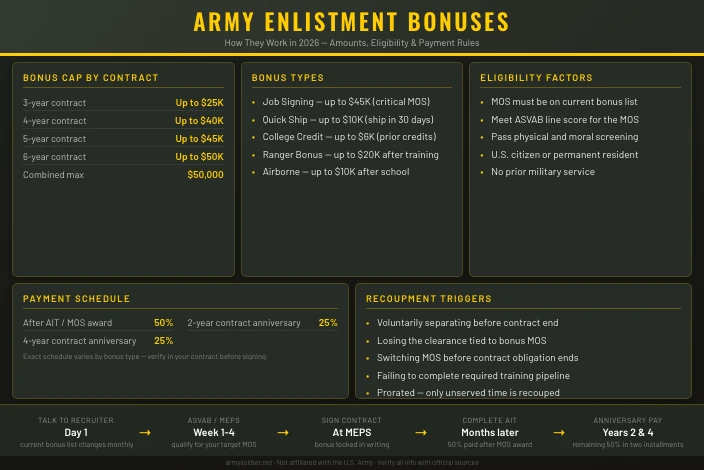
- Your contract length. Longer commitments raise the cap. A 3-year contract caps at $25,000. A 6-year contract caps at $50,000.
- Your ship date. If you can get to Basic Training within 30 days of signing, the Quick Ship Bonus adds up to $10,000 on top of your job bonus.
| Contract Length | Maximum Bonus |
|---|---|
| 3 years | $25,000 |
| 4 years | $40,000 |
| 5 years | $45,000 |
| 6 years | $50,000 |
Bonuses stack. A recruit who signs a 6-year contract for a critical MOS, has prior college credits, and ships within 30 days could stack a Job Signing Bonus, a College Credit Bonus, and a Quick Ship Bonus – up to the $50,000 combined ceiling.
The Main Bonus Types
Each bonus has its own eligibility rules. You won’t qualify for all of them, but understanding each one helps you build the best possible package when you sit down with your recruiter.
Job Signing Bonus
This is the biggest one. The Army pays up to $45,000 for enlisting in a job on its critical skills list. The specific amount depends on the MOS and contract length. In-demand fields like cyber, intelligence, and some medical specialties routinely appear on the list. Combat arms and logistics jobs sometimes do too, depending on the Army’s current needs.
To qualify, you must meet the ASVAB line score for the job and pass all physical and security screening requirements. The bonus is tied to the MOS in your contract – if you change jobs before completing your service obligation, the bonus can be recouped (more on that below).
Quick Ship Bonus
Speed has a dollar value. Recruits who can report to Basic Combat Training within 30 days of signing their enlistment contract may qualify for up to $10,000 extra. This bonus exists because the Army needs to fill training seats on short notice, and it pays a premium for flexibility.
The Quick Ship Bonus is only available when your target MOS also qualifies for a Job Signing Bonus. You won’t get it for a non-bonus job just by shipping fast.
College Credit Enlistment Bonus
If you completed college coursework or vocational training before enlisting, you may qualify for up to $6,000 based on the number of credits and the institution. This bonus is only available when you also select a job that qualifies for a Job Signing Bonus – it stacks on top, it doesn’t stand alone.
Ranger Bonus
Soldiers who enlist with an 18X (Special Forces Candidate) or Ranger contract and successfully complete the required training pipeline can receive up to $20,000. The bonus pays after you complete training and report to your duty station – not before. If you don’t make it through the pipeline, the bonus doesn’t pay.
Airborne Bonus
Enlisting with an Airborne contract and completing Airborne School at Fort Liberty can add up to $10,000. Like the Ranger Bonus, payment follows completion – the Army won’t pay for training you haven’t finished.
Your ASVAB score determines which bonus jobs you can qualify for. Higher line scores open more MOS options and more bonus opportunities. An ASVAB study course with practice tests can help you hit the scores that open up the highest-paying jobs.
When you purchase through links on our site, we may receive compensation at no extra cost to you.
When the Money Actually Arrives
This is where recruits get surprised. The Army does not hand you a check at MEPS. Bonus money follows a schedule tied to your service milestones.
The standard payment structure for most enlistment bonuses:
Payment timing varies by bonus type. Some bonuses pay differently than the standard 50/25/25 split. The Quick Ship bonus, if earned, typically pays separately after BCT completion. Ranger and Airborne bonuses pay after successful completion of their respective schools – not before.
Read every line of your bonus addendum at MEPS. Ask your recruiter to walk through the exact payment schedule before you sign. If the bonus is significant, have a JAG attorney or finance officer review the addendum. The schedule in your signed contract is the only schedule that matters.
Taxes on Your Bonus
Military enlistment bonuses are taxable income. The Army withholds federal income tax at the time of payment – typically at a flat supplemental withholding rate rather than your standard paycheck rate. This often means a larger-than-expected withholding on the day your bonus lands.
What to expect on a $40,000 bonus paid at the standard 50/25/25 split:
| Installment | Gross Amount | Federal Withholding (est. 22%) | Net Deposit |
|---|---|---|---|
| After AIT (50%) | $20,000 | ~$4,400 | ~$15,600 |
| Year 2 (25%) | $10,000 | ~$2,200 | ~$7,800 |
| Year 4 (25%) | $10,000 | ~$2,200 | ~$7,800 |
The 22% flat supplemental rate is the standard IRS withholding for bonus income. Your actual tax liability depends on your total annual income – some soldiers get a portion back at tax time, others don’t.
One exception: if you receive any bonus installment while deployed to a designated combat zone, that installment may be excluded from federal income tax under the Combat Zone Tax Exclusion. The exclusion applies to the month of deployment, not the full year.
State income tax treatment varies. Some states exempt military pay entirely. Others tax bonus income the same as regular wages. Check your state’s rules or contact your installation’s financial readiness office.
What Happens If You Leave Early
Signing a bonus contract is a two-way commitment. If you don’t hold up your end, the Army will recoup the unearned portion.
Recoupment is prorated. If you signed a 4-year contract and leave after 2 years, the Army only recoups the share of the bonus proportional to the time left on your contract – not the full amount. But the calculation happens from your separation date, not from when you last received an installment.
Specific situations that trigger recoupment:
- Voluntary separation before your contract end date
- MOS change before completing your service obligation – if you switch to a non-bonus job, you lose the bonus tied to the original MOS
- Lost clearance or qualification – jobs that require a security clearance or special skill qualification carry bonus conditions; losing that clearance ends the bonus and can trigger recoupment
- Failure to complete training – Ranger and Airborne bonuses won’t pay if you don’t finish, but there’s no recoupment for training you never completed
Medical separations and involuntary discharges for reasons outside your control are treated differently – the Army generally waives recoupment in those cases, but the specific outcome depends on the discharge characterization.
Army Reserve Bonuses
Reserve enlistment bonuses work on the same basic framework but carry lower caps. Qualified Army Reserve recruits may be eligible for up to $13,000 depending on the MOS and contract length.
Reserve bonuses are funded separately from active duty bonuses and are subject to annual appropriations. Availability changes based on the Reserve’s current manning needs, not the active Army’s list. A job that carries a big bonus on the active side may carry nothing in the Reserve, and vice versa.
The Reserve operates its own Selected Reserve Incentive Program (SRIP), which includes:
- Enlistment bonuses for initial enlistees in critical Reserve MOS jobs
- Affiliation bonuses for prior-service members who join a Reserve unit after leaving active duty
- Student loan repayment for qualifying members, up to set annual limits
- Reenlistment bonuses for current Reservists extending in critical skills
SRIP eligibility and amounts are set at the start of each fiscal year. The fiscal year runs October through September. If you’re considering the Reserve, ask the recruiter what the current SRIP table shows – not what it showed last year.
Payment rules for Reserve bonuses also differ. Some Reserve bonuses pay in a single installment after completing required training. Others pay annually over the contract period. The payment schedule is specific to the incentive type and will be documented in your contract.
Selective Reenlistment Bonuses
Enlistment bonuses go to new recruits. Reenlistment bonuses go to soldiers who are already in and want to stay. The Selective Reenlistment Bonus (SRB) is the Army’s main tool for keeping experienced soldiers in critical jobs.
The SRB formula: (monthly base pay) x (years of additional service) x (SRB multiplier). The multiplier varies by MOS and career stage. The maximum SRB payout is $180,000 over a career.
To qualify for an SRB, a soldier must:
- Hold a critical MOS currently authorized for SRB
- Have completed at least 17 months of active duty
- Agree to a 3-year or longer reenlistment or extension
- Be within the window before current service ends (usually 12 months out)
SRB multipliers are published by HRC and change when retention needs change. A job with a high multiplier this year could drop to zero if the Army fills its quota. Soldiers in high-demand technical fields – cyber, signals, aviation maintenance, intelligence – tend to see the most consistent SRB availability.
Here’s how the math works in practice: an E-5 Sergeant with 6 years of service earns $3,926 per month in base pay. With an SRB multiplier of 3.0 and a 4-year reenlistment, the bonus equals $3,926 x 4 x 3.0 = $47,112. Half pays at the reenlistment ceremony. The remainder pays in annual installments over the contract.
The SRB does not affect enlistment bonuses. A soldier who received an enlistment bonus and later reenlists for an SRB is eligible for both, subject to their respective terms.
How to Find Out What You Actually Qualify For
Bonus amounts change. The HRC bonus chart updates multiple times per year – sometimes every few months. The numbers published in any article (including this one) reflect the most recent available data, but your recruiter pulls from the live system at the time you sign.
Steps to get accurate numbers:
- Take the ASVAB to find out which MOS jobs you qualify for
- Ask your recruiter to pull the current bonus chart for every MOS you’re considering
- Compare contract length options for each job – longer contracts carry higher caps
- Get the exact bonus amount, payment schedule, and conditions in writing in your enlistment contract
- Have a finance officer or JAG attorney review any bonus addendum before you sign if the amounts are significant
A higher ASVAB score broadens your options. Many of the highest-bonus MOS jobs have demanding line score requirements – especially in cyber, intelligence, and electronics. Improving your scores before MEPS can directly increase your bonus eligibility.
One thing recruiters don’t always volunteer: the bonus list is public. HRC posts the current bonus chart on its website. You can look up which jobs are on the list and what the contract-length tiers look like before you ever set foot in a recruiting office. Knowing this beforehand puts you in a stronger position when you discuss your options.
National Guard Bonuses
The National Guard operates under state control, and bonus availability varies widely by state. Some states offer enlistment bonuses that match or exceed active duty levels for critical jobs. Others offer nothing at all.
Guard bonuses come from two funding sources:
- Federal bonuses – Funded through the National Guard Bureau, following similar SRIP rules as the Reserve. These appear in the same HRC bonus chart framework and apply uniformly across states.
- State bonuses – Funded by each state’s military department and set by the state legislature. These vary dramatically – some states offer $20,000+ for critical MOS jobs while others offer nothing.
Contact your state’s Guard recruiting office directly – not a federal Army recruiter – for current Guard bonus information. State-funded bonuses are separate from federal programs and are not reflected in the HRC bonus chart.
Guard members who are federally activated (Title 10 orders) for extended periods may become eligible for active duty bonus programs during that period of activation. The rules are complex and depend on the nature of the orders. A finance officer at the mobilization station can clarify eligibility before activation begins.
The Practical Bottom Line
A $50,000 bonus headline gets attention, but the actual picture is more specific. You need the right MOS, the right contract length, and the right timing. The bonus stacks help, but most recruits qualify for one or two components – not all five.
The biggest advantage you carry into MEPS is your ASVAB score. It determines which jobs you can select, and the jobs with the best bonuses tend to require the highest scores. If you’re targeting a specific MOS with a large signing bonus, score first and negotiate second.
A few other things worth knowing before you sign:
- Bonuses are negotiated at MEPS, not at the recruiting office. Your recruiter can show you what’s available, but the actual bonus contract gets written at MEPS. Read everything before you sign – changes after that point are difficult.
- The bonus list is a snapshot. Jobs rotate on and off based on fill rates. A job on the list today may come off it next month. If you see a job you want with a bonus you want, move fast.
- Your total compensation picture is bigger than the bonus. Base pay, BAH, BAS, TRICARE, and the GI Bill add up to well above what the signing bonus number suggests. The bonus is one component, not the whole deal.
For a full breakdown of how bonuses sit alongside the rest of your pay and benefits, the Army benefits guide covers every component of active duty compensation.
You may also find Army MOS jobs with the biggest signing bonuses, how a high ASVAB score increases your Army bonus, Army officer bonuses and incentive pay, and how to negotiate your Army enlistment contract helpful.
This site is not affiliated with the U.S. Army or any government agency. Verify all information with official Army sources before making enlistment or career decisions.