Army Intelligence and Cyber MOS Jobs
The Army runs on information. Before a commander moves a unit, calls in fires, or authorizes a raid, someone has already answered a chain of hard questions – Where is the threat? What is it capable of? Can our networks survive contact? Those answers come from two career fields: Military Intelligence (CMF 35) and Cyber/Signal (CMF 17/25). If you’re drawn to work that combines analytical skill, technology, and national security stakes, this is where you look first.
Both fields require high ASVAB scores and a security clearance. The biggest difference is what you’re doing with that clearance – and how close to the fight you want to be.
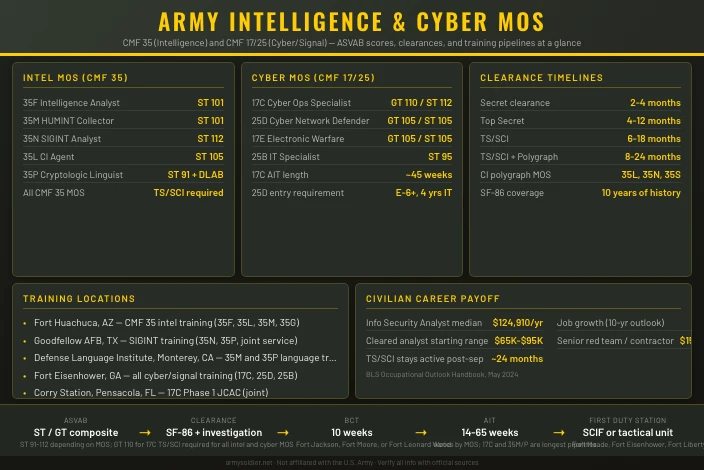
What Army Intelligence Jobs Actually Do
CMF 35 covers everything from sitting at a workstation processing intercepted signals to knocking on a door and interviewing a potential source. The common thread is intelligence: collecting, analyzing, and reporting information that commanders use to make decisions.
| MOS | Title | Core Function |
|---|---|---|
| 35F | Intelligence Analyst | All-source fusion and commander briefings |
| 35M | HUMINT Collector | Source operations and interrogation |
| 35N | SIGINT Analyst | Signals interception and analysis |
| 35L | CI Agent | Counterintelligence investigations |
| 35P | Cryptologic Linguist | Foreign voice intercept and translation |
The 35F Intelligence Analyst is the most common MI job. Your work is all-source fusion – pulling together human intelligence, signals, imagery, and open-source reporting into a single picture of the threat environment. You operate DCGS-A (Distributed Common Ground System – Army) on classified networks and brief your findings to commanders. AIT runs about 16 weeks at Fort Huachuca, Arizona.
35M Human Intelligence Collectors work directly with people. You conduct interrogations, debrief sources, and screen documents and personnel on the battlefield. If a Category IV language assignment comes with the job, expect up to 64 weeks at the Defense Language Institute in Monterey, California, before AIT even starts. Total pipeline for a language-assigned 35M can exceed two years from BCT to first duty station.
35N Signals Intelligence Analysts intercept and analyze foreign communications and electronic signals. The work happens in SCIFs and relies on classified collection systems. You maintain the Electronic Order of Battle, write technical intelligence reports, and brief commanders on what enemy signals reveal. AIT runs about 25 weeks at Goodfellow Air Force Base, Texas – a joint environment where you train alongside Air Force, Navy, and Marine SIGINT students.
35L Counterintelligence Agents flip the intelligence mission around. Instead of collecting on the enemy, you’re protecting Army personnel and systems from enemy collection efforts. You investigate suspected espionage cases, develop human sources connected to hostile networks, and advise commanders on insider threats. The minimum age is 21 for accreditation. The Counterintelligence Special Agent Course (CISAC) at Fort Huachuca runs about 18 weeks, followed by a one-year probationary period under supervision before you receive full agent status.
35P Cryptologic Linguists spend more time on language than any other Army MOS. You intercept foreign voice communications, translate them, and produce SIGINT summaries in near-real time. The DLAB (Defense Language Aptitude Battery) score matters as much as the ASVAB here – you need a 107 minimum. Enlistment bonuses reach up to $50,000 for critical language speakers.
All CMF 35 jobs share one hard requirement: U.S. citizenship. Every MI MOS requires a minimum TS/SCI security clearance. Some require a CI-scope polygraph on top of the standard background investigation.
Intelligence MOS ASVAB Requirements
Every CMF 35 job uses the Skilled Technical (ST) composite. The ST formula combines General Science (GS), Verbal Expression (VE), Math Knowledge (MK), and Mechanical Comprehension (MC).
| MOS | Title | ST Minimum | Additional Requirement |
|---|---|---|---|
| 35F | Intelligence Analyst | 101 | None |
| 35G | GEOINT Imagery Analyst | 101 | None |
| 35M | HUMINT Collector | 101 | DLAB 100+ |
| 35S | Signals Intelligence Analyst | 101 | Army Analyst Aptitude Test |
| 35P | Cryptologic Linguist | 91 | DLAB 107+ |
| 35L | Counterintelligence Agent | 105 | CI polygraph, age 21+ |
| 35N | SIGINT Analyst | 112 | CI-scope polygraph |
| 35T | MI Systems Maintainer | 112 | None |
A score of 112 ST is near the top of the enlisted range. If the 35N interests you, aim for 115+ to stay competitive. The ST subtest breakdown – science, verbal, math, and mechanical concepts – rewards broad preparation across subjects rather than specialization in one area.
The 35L and 35N both require a counterintelligence polygraph, which adds two to six months to clearance processing time beyond the standard TS/SCI investigation. That delay is worth planning for. Most soldiers receive an interim clearance to begin BCT and AIT, with full adjudication completing during or shortly after training.
What Army Cyber and Signal Jobs Do
CMF 17 and CMF 25 overlap in mission but sit in different lanes. CMF 17 is offensive and defensive operations in cyberspace. CMF 25 is building and protecting the communications infrastructure the Army runs on.
| MOS | Title | Core Function |
|---|---|---|
| 17C | Cyber Operations Specialist | Offensive/defensive cyber operations |
| 25D | Cyber Network Defender | Network intrusion detection and response |
| 17E | Electronic Warfare Specialist | Electromagnetic spectrum operations |
| 25B | IT Specialist | IT infrastructure and network administration |
The 17C Cyber Operations Specialist is the Army’s frontline cyber operator. You defend military networks against intrusion, conduct authorized offensive operations against adversary systems, and perform digital forensics and malware analysis. AIT for the 17C is one of the longest pipelines in the Army: 25 weeks of the Joint Cyber Analysis Course (JCAC) at Corry Station, Pensacola, followed by 20 weeks at the Cyber Center of Excellence at Fort Eisenhower, Georgia. That’s over 45 weeks of AIT alone. The failure rate is higher than most MOSs – come in with basic IT knowledge and strong study habits.
The 25D Cyber Network Defender is not an entry-level role. It requires reclassification at Staff Sergeant (E-6) or above, with at least four years of verified IT/IA experience and a battalion commander’s recommendation. If you’re a Signal NCO with a 25B or similar background and want to move into dedicated network defense work, the 14-week 25D course at Fort Eisenhower is the path. You’ll run intrusion detection systems, manage incident response, and conduct vulnerability assessments across Army networks.
17E Electronic Warfare Specialists operate in the electromagnetic spectrum – jamming enemy communications, protecting friendly signals, and supporting EW planning across an area of operations. The work sits at the intersection of signals intelligence and cyber operations.
25B Information Technology Specialists build and maintain the Army’s IT infrastructure. Servers, networks, help desk, user administration. It’s the foundation of the cyber career field and the most common entry point for soldiers who eventually reclassify to 25D.
The rest of CMF 25 – 25N, 25S, 25H, 25U, 25E – covers network systems, satellite communications, electromagnetic spectrum management, and tactical signal support. These roles require lower ASVAB thresholds than the cyber-focused jobs but still open strong civilian paths in telecom and network engineering.
Cyber and Signal ASVAB Requirements
| MOS | Title | GT Min | ST Min | Entry Type |
|---|---|---|---|---|
| 17C | Cyber Operations Specialist | 110 | 112 | Initial enlistment |
| 25D | Cyber Network Defender | 105 | 105 | Reclassification (E-6+) |
| 17E | Electronic Warfare Specialist | 105 | 105 | Initial enlistment |
| 25B | Information Technology Specialist | – | 95 | Initial enlistment |
| 25N | Nodal Network Systems Operator | – | 93 | Initial enlistment |
| 25S | Satellite Comms Operator | – | 93 | Initial enlistment |
The GT composite (Verbal Expression + Arithmetic Reasoning) and ST composite both appear in cyber requirements because the work draws on language reasoning and technical skills equally. A GT of 110 puts you in the top quartile of enlistees.
For the 17C specifically, both the GT and ST minimums are high, and the TS/SCI clearance requirement applies on top. The Army funds significant certifications for 17C soldiers – CompTIA Security+, CEH, CISSP, SANS/GIAC courses – because keeping these soldiers technically current is a national security priority.
Security Clearances: What to Expect
Every CMF 35 and CMF 17 job requires a Top Secret clearance. Most also require Sensitive Compartmented Information (SCI) access, which adds a separate layer of vetting beyond the standard investigation.
The background investigation covers 10 years of your life: every address, employer, foreign contact, financial account, and legal issue. Investigators interview your references. Financial problems, drug use, and significant foreign contacts are not automatic disqualifiers, but they add time and scrutiny. Lying on the SF-86 is a federal offense and guarantees denial.
| Clearance Level | Typical Timeline | Jobs That Require It |
|---|---|---|
| Secret | 2-4 months | Most CMF 25 signal jobs |
| Top Secret | 4-12 months | 25D, all CMF 35 and CMF 17 |
| TS/SCI | 6-18 months | All CMF 35, 17C |
| TS/SCI + Polygraph | 8-24 months | 35L, 35N, 35S, 35P (NSA-adjacent) |
Clearance timelines are estimates. High caseloads at DCSA (Defense Counterintelligence and Security Agency) can stretch processing. Most soldiers receive an interim clearance at MEPS that allows them to begin training while the full investigation runs.
A TS/SCI clearance has real civilian value. Defense contractors, federal agencies, and private cybersecurity firms pay a significant premium for cleared professionals. Sponsoring a new clearance from scratch costs $15,000 to $50,000 in investigative fees and processing time. When you leave active duty with an active clearance, that cost has already been paid on your behalf.
Training Pipelines by MOS
The intelligence and cyber fields have some of the longest AIT pipelines in the Army. That’s a feature, not a problem – the training is where you build the skills that pay off in service and after.
| MOS | BCT | AIT Location | AIT Length |
|---|---|---|---|
| 35F | 10 weeks | Fort Huachuca, AZ | ~16 weeks |
| 35M | 10 weeks | DLI (if language) + Fort Huachuca, AZ | 20 wks AIT + up to 64 wks DLI |
| 35N | 10 weeks | Goodfellow AFB, TX | ~25 weeks |
| 35L | 10 weeks | Fort Huachuca, AZ | ~18 weeks + 1-yr probation |
| 35P | 10 weeks | DLI + Goodfellow AFB, TX | 36-64 wks DLI + AIT |
| 17C | 10 weeks | Corry Station, FL + Fort Eisenhower, GA | ~45 weeks (2 phases) |
| 25D | N/A (reclassification) | Fort Eisenhower, GA | 14 weeks |
| 25B | 10 weeks | Fort Eisenhower, GA | ~16 weeks |
Soldiers who draw a Category IV language for a 35M or 35P assignment – Arabic, Chinese, Korean, Russian – spend 64 weeks at DLI before AIT even starts. That’s more than a year of training before your first duty assignment. The Army feeds you and pays you the whole time.
Fort Eisenhower (formerly Fort Gordon, Augusta, Georgia) is the home of Army cyber and signal training. Most CMF 17 and CMF 25 initial entry and advanced training happens here. Fort Huachuca in southern Arizona trains most CMF 35 soldiers. It houses the U.S. Army Intelligence Center of Excellence and the 111th Military Intelligence Brigade.
Duty Stations and Assignments
Intelligence and cyber jobs cluster at a smaller set of installations than most Army career fields. That’s because the specialized facilities – SCIFs, cyber operations centers, and signals collection platforms – can’t be replicated everywhere.
Key installations for intelligence and cyber soldiers:
- Fort Meade, MD – NSA, U.S. Cyber Command, DIA elements, 780th MI Brigade (Cyber). Strategic-level work with more bureaucracy and less deployment tempo.
- Fort Eisenhower, GA – Cyber Center of Excellence and multiple cyber operational units. Most 17C and 25D soldiers spend at least one tour here.
- Fort Liberty, NC – XVIII Airborne Corps. High-tempo tactical intelligence with frequent deployment cycles.
- Fort Campbell, KY – 101st Airborne Division. Same high-tempo profile as Fort Liberty.
- Overseas – Germany (USAREUR), South Korea, Japan, and Italy for most CMF 35 and CMF 17 MOSs. Germany tours typically run two to three years as accompanied assignments.
Fort Meade and Fort Eisenhower dominate the strategic and institutional assignments. Fort Liberty and Fort Campbell offer the operational experience that builds a stronger promotion file and faster career progression for soldiers willing to accept the pace.
Civilian Career Payoff
The clearance is the most portable benefit of serving in these fields, but the skills matter too.
| Career Path | Typical Starting Salary | Key Employers |
|---|---|---|
| Intelligence analyst (35F/35M) | $65,000 – $95,000 | CIA, DIA, NSA, FBI, DHS, defense contractors |
| SIGINT analyst (35N/35P) | $80,000 – $130,000 | NSA, defense SIGINT contractors |
| CI investigator (35L) | $80,000 – $120,000 | FBI, NCIS, DHS, corporate security |
| Cybersecurity analyst (17C) | $90,000 – $130,000+ | Defense contractors, intelligence agencies |
| IT/Network engineer (25B/25S) | $70,000 – $90,000 | Defense contractors, telecom, federal agencies |
Information security analysts earn a median of $124,910 per year, with a projected 29% growth rate over the next decade. Senior cleared penetration testers and red team operators with hands-on government experience regularly reach $150,000 to $200,000.
Civilian certifications earned during service carry forward too. 17C soldiers commonly graduate with CompTIA Security+, CEH, and CISSP. These cost thousands to obtain as a civilian. The Army funds them.
Who These Jobs Suit
Intelligence and cyber work attracts a specific type of person. These jobs are primarily office and SCIF work, with field intensity during exercises and deployments.
CMF 35 fits people who:
- Think in patterns and enjoy solving problems with incomplete information
- Can write clearly and present findings to a room of officers
- Are genuinely curious about geopolitics, foreign threats, or human behavior
- Have a clean background and no significant foreign ties that would complicate a clearance
CMF 17/25 fits people who:
- Have genuine interest in computers, networking, or systems – not just casual tech use
- Can learn and apply technical concepts quickly
- Are comfortable with strict security environments and limited ability to discuss their work
- Want a career path that leads directly into high-paying civilian tech jobs
Both fields reward patience. Intelligence analysis and cyber operations involve long stretches of methodical work interrupted by moments of high intensity. The soldier who performs best isn’t always the most technically gifted – it’s the one who stays disciplined through the tedious parts and sharp through the urgent ones.
Reserve and National Guard Options
Both CMF 35 and CMF 17/25 have Reserve and Guard billets, though they’re fewer than the active-duty force and the clearance requirements don’t change.
Reserve MI units include intelligence companies, brigade combat team intelligence sections, and theater analysis elements. Guard cyber units are growing fast – several states operate Cyber Protection Teams that have taken on real-world homeland defense missions, not just training exercises.
The 35F in the Reserve is one of the most common intelligence billets and the easiest to find across most states. A 35M with a language specialty or a 35L agent is harder to slot because fewer billets exist and clearance maintenance adds administrative complexity.
Key considerations for Reserve and Guard soldiers in these fields:
- Technical currency – Network defense techniques and offensive tools evolve faster than one drill weekend per month can track. Budget for additional training days or work a civilian cybersecurity job that keeps skills sharp.
- Clearance maintenance – Your TS/SCI must stay active. That requires continuous reporting of life changes (foreign contacts, financial problems, drug use) and periodic reinvestigation every five years.
- Billet availability – 35F and 25B billets exist in most states. 35L, 35M language slots, and 17C Reserve billets are harder to find and more competitive.
- Civilian-military synergy – Soldiers who hold cleared civilian analyst or cyber jobs during the week arrive at drill weekends with current technical skills, creating a reinforcing cycle.
This site is not affiliated with the U.S. Army or any government agency. Verify all information with official Army sources before making enlistment or career decisions.
Explore Army intelligence careers and Army cyber and signal careers for full MOS profiles, ASVAB requirements, pay tables, and training details. You may also find Army jobs that require a security clearance, 35F vs 35G vs 35L: which intel MOS to choose, Army cyber vs signal MOS differences, and how a TS/SCI clearance boosts your civilian salary helpful.