Army Jobs That Require a Security Clearance
A security clearance isn’t just a background check. It’s a years-long audit of your finances, personal relationships, foreign travel, and digital footprint. Dozens of Army jobs require one before you can even start training – and the level required varies from a basic Secret all the way to Top Secret with Sensitive Compartmented Information (TS/SCI) access and a polygraph. If you’re planning your MOS selection around clearance requirements, this guide covers what each level means, which jobs require one, and what the investigation actually examines.
What Security Clearance Levels Mean
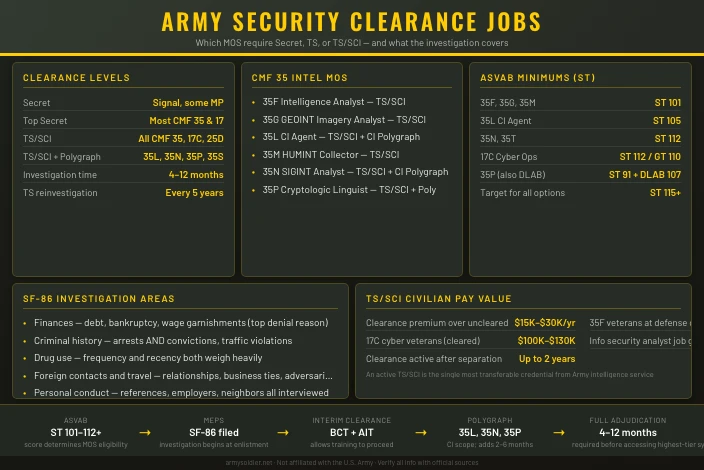
The federal government issues three main clearance tiers: Confidential, Secret, and Top Secret. Most Army jobs requiring a clearance fall into the Secret or Top Secret category. TS/SCI is a separate designation – it means you hold a Top Secret clearance and have been granted access to Sensitive Compartmented Information facilities and programs.
Here’s how the tiers compare in practice:
| Level | Investigation | Reinvestigation | Army MOS Examples |
|---|---|---|---|
| Secret | National Agency Check + Credit | Every 10 years | Signal, MP, some logistics roles |
| Top Secret | Single Scope Background Investigation | Every 5 years | 17C, 35G, 35F, 35M, 35N, 35P, 35T |
| TS/SCI | SSBI + access adjudication | Every 5 years | All CMF 35, 17C, 17E, 25D (NCOs) |
| TS/SCI + Polygraph | SSBI + CI or full-scope poly | Every 5 years | 35L, 35N, 35P, select cyber billets |
A polygraph adds another screening layer on top of the clearance investigation. The Counterintelligence Scope Polygraph (CSP) covers espionage, terrorism, and unauthorized disclosure. Some billets require a Full Scope Polygraph (FSP), which goes further into personal conduct and lifestyle.
One important clarification: the Army grants clearances – it does not simply accept civilian-held clearances. You start the investigation process at MEPS when you sign your contract. An interim clearance lets you begin BCT and AIT while the full investigation runs. Full adjudication must be complete before you can access the highest-tier systems.
Army MOS Jobs That Require TS/SCI
The Army’s intelligence and cyber career fields carry the heaviest clearance requirements. Every active MOS in Career Management Field 35 (Military Intelligence) requires at least a Top Secret clearance with SCI access.
CMF 35 – Military Intelligence
| MOS | Title | Clearance | Additional Screening |
|---|---|---|---|
| 35F | Intelligence Analyst | TS/SCI | None |
| 35G | Geospatial Intelligence Imagery Analyst | TS/SCI | None |
| 35L | Counterintelligence Agent | TS/SCI | CI Polygraph |
| 35M | Human Intelligence Collector | TS/SCI | None |
| 35N | Signals Intelligence Analyst | TS/SCI | CI Polygraph |
| 35P | Cryptologic Linguist | TS/SCI | CI Polygraph |
| 35S | Signals Intelligence Analyst (EW) | TS/SCI | CI Polygraph |
| 35T | MI Systems Maintainer/Integrator | TS/SCI | None |
The 35L also requires a minimum age of 21 for full accreditation – one of the few enlisted MOS with an age floor above 17. ASVAB thresholds vary across these jobs: 35N and 35T require a Skilled Technical (ST) score of at least 112, while most others start at 101. The 35P is the outlier – it requires an ST of 91 but adds the Defense Language Aptitude Battery (DLAB) with a minimum score of 107.
CMF 17 – Cyber
Cyber MOS jobs carry TS/SCI requirements that match or exceed the intelligence field. The 17C Cyber Operations Specialist needs a GT score of at least 110 and an ST of 112 – two of the highest composite thresholds in the enlisted force. Its training pipeline runs over 45 weeks across two installations.
The 17E Electronic Warfare Specialist and 25D Cyber Network Defender also require TS/SCI. The 25D is not an entry-level MOS – it’s a reclassification track for E-6 and above soldiers already serving in CMF 25 signal roles.
What the Investigation Actually Covers
The SF-86 (Standard Form 86) drives the background investigation. It covers the past 10 years of your life in detail, and plan to spend several hours completing it accurately. Errors or omissions are themselves disqualifying.
Areas the investigation examines:
- Finances – bankruptcies, unpaid collections, wage garnishments, delinquent accounts. Financial problems are the single most common reason for clearance denial because they suggest vulnerability to coercion.
- Criminal history – arrests (not just convictions), traffic violations, and civil judgments. A prior DUI won’t automatically disqualify you, but it adds scrutiny and time.
- Drug use – past marijuana use, prescription drug abuse, or illegal substances. Frequency and recency both matter. Experimental use years ago weighs differently than regular use in the past 12 months.
- Foreign contacts and travel – significant relationships with foreign nationals, foreign business dealings, or travel to adversarial countries. A foreign-born spouse does not disqualify you, but it adds documentation requirements and often extends the investigation timeline.
- Personal conduct – truthfulness, reliability, and judgment. Investigators interview references, former employers, neighbors, and coworkers.
- Social media – investigators review public-facing accounts. Posts glorifying drug use, expressing sympathy for adversarial governments, or showing poor judgment create problems.
The investigation timeline is 4 to 12 months for a typical TS/SCI case. Cases involving foreign contacts, financial complications, or prior drug use stretch longer. An interim clearance allows training to proceed in most cases.
MOS Jobs That Require a Secret Clearance
Not every clearance job is in intelligence or cyber. Signal, military police, and several other MOS carry Secret requirements – easier to obtain than TS/SCI but still requiring a full National Agency Check with Law and Credit (NACLC) investigation.
Common Secret-level MOS:
- 25B IT Specialist – manages Army networks and servers. Secret required at entry; many billets upgrade to TS/SCI once assigned to joint commands.
- 25U Signal Support Systems Specialist – maintains tactical communication systems. Secret required.
- 25S Satellite Communications Systems Operator – operates satellite networks supporting division-level and higher communications. Secret required.
- 25N Nodal Network Systems Operator – installs and maintains large-scale tactical network nodes. Secret required.
- 31B Military Police – some investigative and detainee-operations assignments carry Secret requirements at minimum.
How Clearance Level Affects Your Career
A clearance is a professional credential, and its value compounds after you leave the Army. Two effects are well-documented in defense contracting and federal employment.
Clearance holders command a salary premium in the civilian market. Analysts with an active TS/SCI earn roughly $15,000 to $30,000 more than uncleared peers in comparable analytical or IT roles. Veterans from the 35F MOS entering defense contracting typically see starting salaries from $65,000 to $95,000. Veterans from the 17C MOS with active clearances and operational cyber experience regularly land roles paying $100,000 to $130,000. These figures reflect demand at firms like Booz Allen Hamilton, CACI, and Leidos, where cleared veterans are actively recruited.
Cleared career fields are also growing fast. The Bureau of Labor Statistics projects a 29% ten-year growth rate for information security analysts – among the fastest of any occupation it tracks. Intelligence analyst roles at federal agencies show stable demand with consistent hiring from the veteran community.
Within the Army, clearance level determines which billets you can fill. Soldiers with TS/SCI access qualify for assignments at joint commands, NSA, DIA, and combatant-command intelligence cells that are closed to Secret-only holders. Duty stations near Fort Meade, MD, and Fort Belvoir, VA concentrate these opportunities.
There’s a flip side. Your clearance follows you. Arrests, new foreign contacts, financial changes, and any other reportable event must go to your security manager promptly after they occur. Soldiers who let problems accumulate before disclosing typically lose clearances they could have kept by reporting early.
Clearance and the ASVAB Connection
The two requirements work together. You can’t earn the MOS without the ASVAB score, and you can’t keep the MOS without the clearance. Scoring high enough for CMF 35 or CMF 17 jobs is harder than most applicants expect.
Minimum ASVAB scores for clearance-heavy MOS:
| MOS | ST Minimum | GT Minimum | Additional Test |
|---|---|---|---|
| 35F, 35G, 35M | 101 | – | None beyond ASVAB |
| 35L | 105 | – | CI Polygraph |
| 35N, 35T | 112 | – | CI Polygraph (35N only) |
| 35P | 91 | – | DLAB (107 minimum) |
| 17C | 112 | 110 | None |
| 25D | – | 107 | NCOs only (reclassification) |
The ST composite pulls from four ASVAB subtests: General Science, Verbal Expression, Math Knowledge, and Mechanical Comprehension. Targeting 115 or higher on ST gives you access to every CMF 35 option and most CMF 17 paths.
Maintaining Your Clearance Through Your Career
Earning a clearance is the beginning. A few rules that catch soldiers off guard:
Reportable events – any arrest, financial problem, foreign contact, or foreign travel outside of leave must be reported to your security manager. The threshold is lower than most people expect, and the reporting window is immediate, not “whenever it’s convenient.”
Periodic reinvestigation – TS/SCI clearances require reinvestigation every five years. The process is similar to the initial investigation. Changes in your financial situation, relationship status, or foreign contacts get scrutinized again.
Revocation consequences – losing a clearance almost always means losing the MOS. The Army will attempt to reclassify you, but your options narrow significantly. For billets at NSA or DIA, revocation ends the assignment immediately.
Post-service obligations – nondisclosure agreements signed during service remain in force after separation. Unauthorized disclosure of classified information is a federal crime regardless of whether you’re still in uniform.
This site is not affiliated with the U.S. Army or any government agency. Verify all information with official Army sources before making enlistment or career decisions.
For a broader look at intelligence and cyber career options, explore Army intelligence careers and visit Army intelligence ASVAB scores for line score details across every CMF 35 MOS.