Army Jobs That Don't See Combat
Most people picture infantry when they think about the Army. The reality is that combat arms soldiers make up a minority of the total force. Of the 140-plus enlisted MOS in the Army, only a fraction put soldiers in direct contact with the enemy. The rest exist to keep the machine running: treating casualties, moving supplies, maintaining equipment, managing personnel, and securing communications.
If a front-line role isn’t right for you, there’s no shortage of alternatives. Here’s where to look.
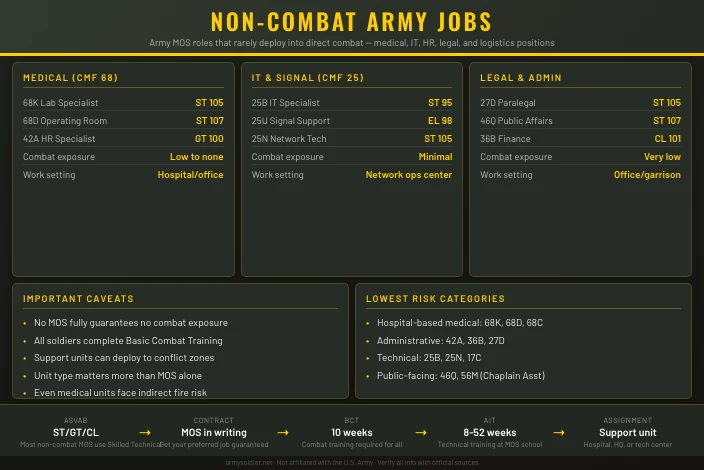
What “Non-Combat” Actually Means
The Army separates its occupational specialties into three broad functions: combat arms, combat support, and combat service support. Combat arms roles – infantry, armor, artillery, special forces – are designed to close with and engage the enemy directly. The other two categories exist to enable that mission from behind it.
Combat support includes roles like military police, signal, and intelligence. These soldiers work close to the action but aren’t typically the ones pulling triggers in a firefight. Combat service support covers medical, logistics, finance, human resources, and legal work – jobs that rarely put soldiers in direct-fire situations.
That said, no Army job carries a guarantee of zero risk. Any soldier can deploy to a contested area, and support troops have taken casualties in every conflict the Army has fought. What these roles offer is a significantly lower probability of direct combat, not a complete exemption from it.
Medical MOS Jobs
The Army’s medical career field (CMF 68) is one of the largest and most varied non-combat fields in the enlisted force. Most of these jobs are based at medical treatment facilities on installation, though some deploy with combat units.
68W (Combat Medic Specialist) is the one exception worth flagging. The 68W attaches to combat units and provides care under fire. The remaining 68-series specialties work in clinical and administrative settings with much lower exposure.
| MOS | Title | Typical Setting |
|---|---|---|
| 68C | Practical Nursing Specialist | Military hospital or clinic |
| 68R | Veterinary Food Inspection Specialist | Food safety labs, installations |
| 68A | Biomedical Equipment Specialist | Medical equipment repair shops |
| 68E | Dental Specialist | Dental clinics on installation |
| 68G | Patient Administration Specialist | Hospital admin offices |
The ASVAB requirement for most 68-series jobs centers on the Skilled Technical (ST) line score, typically in the 95-107 range. Nursing and administrative specialties lean more on clerical scores.
One practical advantage of these roles: clinical skills earned in the Army translate directly to civilian healthcare licensing. An LPN credential, radiology certification, or dental assistant license all carry real value on separation day.
IT and Signal MOS Jobs
Signal and cyber roles keep Army communications running and rarely place soldiers in direct-fire positions. They’re also among the highest-demand skills in the civilian job market.
25U (Signal Support Systems Specialist) installs and maintains communications equipment: radios, satellite terminals, tactical networks. The work is technical and equipment-intensive. The ASVAB requires EL: 95 and SC: 95.
25B (IT Specialist) manages servers, networks, and information systems across Army installations. Most 25B soldiers spend their careers in server rooms and network operations centers. The civilian analog is a systems administrator.
17C (Cyber Operations Specialist) is the Army’s offensive and defensive cyber role. It requires a security clearance, carries high ASVAB thresholds, and feeds directly into the civilian cybersecurity workforce after separation.
All three of these MOS qualify soldiers for DoD-sponsored certifications including CompTIA Security+, which is a baseline requirement for IT roles at most federal contractors. That credential alone strengthens a post-service job search considerably.
Intelligence MOS Jobs
Intelligence analysis work requires a security clearance and strong analytical thinking. The jobs themselves involve processing information – satellite imagery, signal intercepts, human reporting – rather than conducting raids or direct-action missions.
35F (Intelligence Analyst) is the core analysis role. Soldiers interpret collected intelligence and produce reports for commanders. The ASVAB line score requirement is ST: 101. Most 35F assignments are in intelligence cells on post, not forward operating bases.
35L (Counterintelligence Agent) investigates potential insider threats and foreign intelligence activity. This MOS requires a Top Secret clearance and an extensive background investigation. Assignments are typically office-based and stateside-heavy.
35P (Cryptologic Linguist) requires passing the Defense Language Aptitude Battery in addition to the ASVAB. Soldiers study a foreign language at the Defense Language Institute, then perform signals collection and translation at intelligence units. It’s one of the most specialized non-combat roles in the Army.
Human Resources and Administration
Every unit needs someone managing personnel records, assignments, awards, and pay. The HR career field (CMF 42) fills that function at every echelon from company to corps.
42A (Human Resources Specialist) handles the full range of personnel administration: processing promotions, maintaining records, coordinating reassignments, and managing casualty reporting. The ASVAB requires GT: 100 and CL: 90. Most assignments are at headquarters elements, not forward positions.
This MOS builds skills that map cleanly onto civilian HR roles. SHRM certifications and federal HR positions are realistic targets for soldiers separating after a 42A career. The work environment is office-based throughout a standard Army posting.
Legal and Finance
27D (Paralegal Specialist) supports Judge Advocate General Corps attorneys with legal research, document drafting, claims processing, and trial preparation. The ASVAB requires CL: 105. Soldiers gain hands-on legal experience that can credit toward paralegal certification in most states.
36B (Financial Management Technician) handles budgets, pay discrepancies, travel vouchers, and financial auditing at unit and installation level. This MOS requires GT: 101. Civilian finance roles – including federal government accountant and budget analyst positions – are realistic outcomes after separation.
Both fields pair well with college coursework completed through tuition assistance during the contract. A soldier finishing a 27D tour with 60 college credits and a paralegal certificate is in a strong position on the way out.
Logistics and Supply Chain
Logistics MOS jobs are among the most numerous in the Army. They cover a wide range of functions: supply distribution, fuel management, food service, and property accountability.
92A (Automated Logistical Specialist) manages inventory using Army supply systems, tracking everything from spare parts to ammunition. The ASVAB requires CL: 90. Most assignments are at supply rooms on post.
92G (Food Service Specialist) operates dining facilities and field kitchens. It’s one of the few Army jobs that rarely deploys to forward positions and offers a direct pathway into culinary or food service management careers after separation.
88M (Motor Transport Operator) drives and maintains military trucks and transport vehicles. This MOS does support forward logistics convoys, which historically carry more risk than purely rear-area jobs. Even so, it isn’t a combat arms role. The ASVAB requires OF: 85.
Of these three, 92A builds the most transferable skills for supply chain and warehouse management. Amazon, UPS, and major federal contractors actively recruit veterans with logistics experience in Army supply systems.
Other Support Roles Worth Knowing
A few smaller MOS sit almost entirely in rear areas by design.
46Q (Public Affairs Specialist) produces news stories, manages press relations, and supports Army communication efforts. The work involves cameras, interviews, and writing. This MOS often leads to journalism or communications credentials that hold real value outside the Army.
56M (Religious Affairs Specialist) supports Army chaplains with administrative and logistical functions. The role is noncombatant by doctrine, though these soldiers deploy wherever chaplains go. ASVAB requires CL: 90.
74D (CBRN Specialist) handles chemical, biological, radiological, and nuclear defense: training soldiers on protective equipment, conducting decontamination, and monitoring for hazardous materials. The ASVAB requires ST: 100. CBRN specialists rarely see direct combat and carry skills applicable in emergency management and industrial safety careers.
How to Lock In a Specific MOS
Your options depend on what training seats are open when you enlist. Getting the MOS you want requires some preparation on your end before you walk into a recruiter’s office.
- Score high on the ASVAB. Higher scores open more choices and give you real bargaining power with your recruiter.
- Complete medical and legal processing early. Delays shrink the available seat pool fast.
- Get your MOS written into the enlistment contract. A verbal promise from a recruiter isn’t binding.
- Ask about the Reserve or National Guard if active-duty seats for your preferred MOS are full. Reserve component soldiers train in the same technical specialties with a different deployment commitment.
No MOS guarantees you’ll stay out of a conflict zone. But selecting a role in medical, HR, IT, intelligence, logistics, or legal gives you the best odds of a career built around technical skills rather than direct engagement. Browse the Army enlisted career fields directory for full MOS profiles, current ASVAB requirements, and training pipeline details.
You may also find Best Army Jobs for 2026 and Best Army Jobs for Introverts helpful.
This site is not affiliated with the U.S. Army or any government agency. Verify all information with official Army sources before making enlistment or career decisions.