Army Jobs That Transfer to Civilian Careers
Most Army enlistment decisions focus on signing bonuses and available openings. The smarter question is: what does this job get you after the Army? A few MOS families hand you a near-direct path into a six-figure civilian career. Others require years of retraining to reach the same result. The gap between them can mean $30,000 or more in starting salary on day one after separation.
This post ranks the major Army MOS families by how directly their skills, certifications, and clearances translate to civilian employment. It also covers the transition programs that accelerate that process for every Soldier, regardless of MOS.
IT and Cyber: The Strongest Transfer in the Army
The Army’s IT and cyber workforce retains some of the highest civilian demand of any enlisted career field. Soldiers in 25B (IT Specialist) and 17C (Cyber Operations Specialist) spend their service maintaining enterprise networks, hardening systems, and in some cases running offensive cyber operations. Those skills are in demand at every major employer and federal contractor.
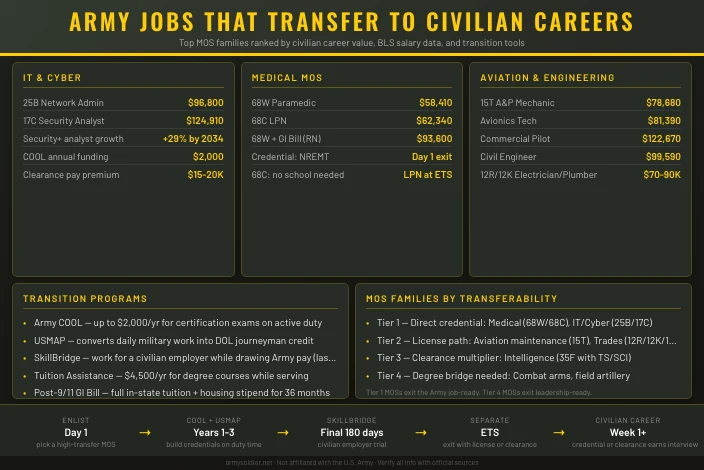
25B is the broader IT generalist role. Soldiers manage Active Directory environments, configure switches and routers, and troubleshoot end-user systems across the installation. The civilian equivalent is a network administrator or systems administrator. BLS data shows the median annual wage for network and computer systems administrators was $96,800 in May 2024.
17C is the more specialized path. Soldiers in this MOS conduct computer network exploitation and defense at the unit level. The civilian market calls this information security analysis, and it pays accordingly: the median annual wage for information security analysts was $124,910 in May 2024. Job growth in that field is projected at 29 percent through 2034, roughly four times the average for all occupations.
Both paths benefit from certifications earned during service:
- CompTIA Security+ (required for most IT roles at DOD installations)
- Certified Ethical Hacker (CEH)
- Cisco CCNA (common for 25B network tracks)
- GIAC certifications (common for 17C and cyber defense roles)
Army COOL funds most of these through Credentialing Assistance. Soldiers can apply up to $2,000 per fiscal year toward exam fees and study materials while still on active duty. The clearance attached to these jobs adds another layer of value – a Secret or TS/SCI clearance can increase starting salary at a defense contractor by $15,000 to $25,000 over an equivalent uncleared role.
If cyber and signal are on your list, Army cyber and signal MOS jobs covers the full breakdown of 25- and 17-series options by skill set and career ceiling.
Medical: Credentials With Immediate Civilian Value
Army medical MOS jobs are the most credential-dense career field in the enlisted Army. The training is equivalent to civilian programs, and credentials are recognized by state licensing boards in most cases.
68W (Combat Medic Specialist) produces a National Registry EMT at the Basic level. Many Soldiers earn their Advanced EMT during service, and combat deployment experience puts most 68W veterans well ahead of civilian EMT peers. Paramedics earned a median of $58,410 in May 2024, but experienced veterans commonly step into supervisory or flight medic roles that pay significantly more. The bigger play for most 68W veterans is using the GI Bill to bridge into nursing – clinical hours from service count toward RN licensing requirements in many states, and registered nurses earn a median of $93,600 annually.
68C (Practical Nursing Specialist) exits the Army as a licensed practical nurse (LPN). Median annual pay for LPNs was $62,340 in May 2024. The LPN credential opens doors at hospitals, long-term care facilities, and clinics immediately after separation, with no additional schooling required.
| MOS | Civilian Role | Median Annual Pay (May 2024) |
|---|---|---|
| 68W | EMT / Paramedic | $58,410 |
| 68C | Licensed Practical Nurse | $62,340 |
| 68W + GI Bill bridge | Registered Nurse | $93,600 |
For the full CMF 68 picture including surgical tech, dental, and mental health pathways, Best Army Medical Jobs for a Civilian Healthcare Career has the complete breakdown.
Aviation Maintenance: FAA Licenses and Airline Hiring Pipelines
The commercial aviation industry has a documented shortage of qualified mechanics. Army helicopter repairers are positioned to fill that gap, but only if they earn the right credentials before separating.
15T (UH-60 Black Hawk Repairer) is the highest-volume aviation maintenance MOS in the Army and the most direct path to an FAA Airframe and Powerplant (A&P) mechanic certificate. The A&P is the civilian gate-pass for aircraft maintenance work. Aircraft mechanics and service technicians earned a median of $78,680 in May 2024, and avionics technicians earned $81,390.
The path from Army service to FAA certification runs through 14 CFR Part 65. Most Army helicopter mechanics accumulate more than the required 30 months of hands-on experience during a standard enlistment. The FAA evaluates the military training documentation and issues the certificate.
Veterans who pursue warrant officer flight training after mechanical experience can eventually transition to commercial aviation. Commercial pilots earned a median of $122,670 in May 2024, and airline pilots earned $226,600.
Best Enlisted Aviation MOS for Civilian Jobs covers the CMF 15 lineup in detail, including which platforms carry the most weight with airline and defense contractor hiring teams.
Engineering: Construction Trades and Licensed Contractor Paths
Army engineers split into combat and construction tracks. The construction-focused MOS codes have the clearest civilian application.
12R (Interior Electrician) and 12K (Plumber) exit the Army with trade skills that map directly to licensed journeyman paths in the civilian sector. Both trades have persistent demand – electricians and plumbers in major metro areas regularly earn $70,000 to $90,000 before overtime. The key tool here is USMAP (United Services Military Apprenticeship Program), which documents on-the-job training hours completed during military service and submits them to the Department of Labor for formal apprenticeship credit. Soldiers who complete USMAP requirements exit with a DOL-issued journeyman card, which most state licensing boards accept toward licensed contractor status.
12P (Prime Power Production Specialist) trains Soldiers to install and operate military power generation systems. The civilian equivalent is an industrial electrician or power-line installer, with high demand in data center construction, utility infrastructure, and energy project work.
For Soldiers drawn to the management side of construction, civil engineers earned a median of $99,590 in May 2024 – a realistic ceiling for veterans who bridge Army engineer experience with a GI Bill-funded engineering degree. Construction equipment operators, another natural path for Soldiers with heavy equipment time, earned $58,320.
The full engineering MOS picture, including licensing paths, is at Best Army Engineer MOS for Civilian Construction Jobs.
Intelligence: The Clearance Multiplier
Army intelligence MOS jobs are not direct-credential fields the way medical or IT jobs are. The value comes from two things: analytic skills built over years of structured work, and the security clearance that comes with the job.
35F (All-Source Intelligence Analyst) is the core enlisted intelligence MOS. Soldiers synthesize signals, imagery, and human intelligence into finished products used by commanders. The civilian equivalent spans intelligence analyst, operations research analyst, and program management roles. Operations research analysts earned a median of $91,290 in May 2024, and the federal government is the largest employer of analytical professionals.
The TS/SCI clearance that most 35F Soldiers hold is the real career accelerant. Defense contractors and federal agencies routinely pay a $15,000 to $25,000 premium for cleared candidates in analytical and program management roles. That premium is harder to quantify than a nursing license or an A&P certificate, but for veterans in the right market, it opens doors no civilian applicant can walk through.
The full breakdown of how clearance levels affect civilian compensation is at Army TS/SCI Clearance and Civilian Pay.
Transition Tools Every Soldier Should Use
The MOS sets the ceiling. These programs determine how close to that ceiling you get on day one after separation.
Army COOL funds civilian credentials while you’re still on active duty. Eligible Soldiers request up to $2,000 per fiscal year through ArmyIgnitED for exam prep, testing fees, and recertification. The database covers hundreds of credentials across IT, healthcare, trades, and logistics – search by MOS to see which your training already qualifies you for.
USMAP converts daily military work into documented apprenticeship hours. Soldiers log on-the-job tasks with a supervisor over time, and the DOL issues a formal journeyman certificate upon completion. The program is most valuable for trades-oriented MOS codes, but it’s available across the force. It costs nothing and requires no off-duty time.
SkillBridge is the closest thing the military has to a paid civilian internship. Soldiers within 180 days of separation can work at a civilian employer full-time while still drawing military pay and benefits. Chain-of-command approval and TAP completion are required. Soldiers in grades E1 through E5 can participate for up to 120 days. Participating employers span technology, healthcare, logistics, and financial services – many use SkillBridge as a direct-to-hire pipeline.
Tuition Assistance and the GI Bill are the long-game tools for MOS codes that need a degree bridge to reach their civilian ceiling. Tuition Assistance covers up to $4,500 per year in tuition while on active duty. The Post-9/11 GI Bill covers full in-state tuition at public schools plus a monthly housing allowance for up to 36 months after separation. For intelligence analysts, engineers, and healthcare workers targeting RN or above, these benefits close the gap between what the Army trains and what the civilian market requires.
You’ll find profiles for every enlisted career field at Army Enlisted Careers.
This site is not affiliated with the U.S. Army or any government agency. Verify all information with official Army sources before making enlistment or career decisions.
You may also find Best Army Jobs for 2026 and Highest-Paying Army MOS Jobs helpful.