Army Medical MOS Jobs: Complete Guide
The Army’s medical career field has 23 active MOSs. They range from combat medics who treat casualties under fire to biomedical equipment specialists who keep ventilators running in forward surgical teams. Some of these jobs take six weeks of training. Others take a year. A few open doors to civilian healthcare careers that pay $80,000 to $120,000 after service. Most people never realize the full range of what’s available.
Career Management Field 68 (CMF 68) covers every enlisted medical occupation in the Army. If you want to serve in healthcare, this is the field. The right MOS inside CMF 68 depends on your ASVAB scores, your physical tolerance, and what you want to do after the Army.
What CMF 68 Actually Covers
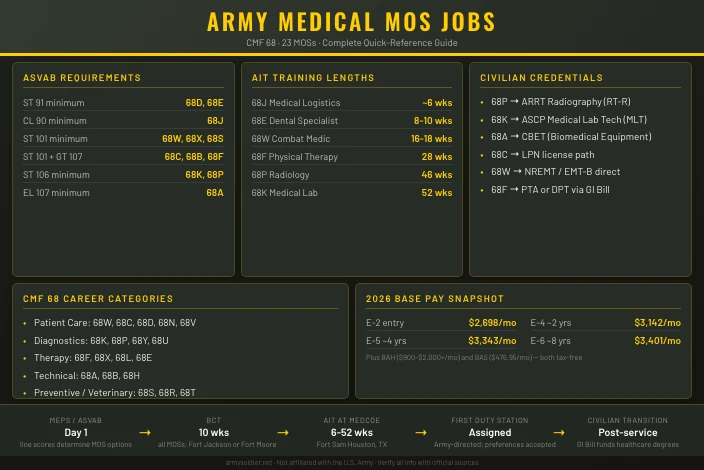
CMF 68 is not just combat medics. The field spans seven distinct categories, each focused on a different aspect of military healthcare.
Patient care sits at the center. The 68W Combat Medic is the most recognized job in the field – a dual-role soldier who treats casualties in the field and runs sick call in garrison. The 68C Practical Nursing Specialist works bedside in Army hospitals, managing medications and monitoring patients. The 68D Operating Room Specialist preps surgical suites, manages instruments, and stands beside surgeons during procedures.
Diagnostics and imaging includes the 68P Radiology Specialist, who operates X-ray, CT, and fluoroscopic equipment, and the 68K Medical Laboratory Specialist, who processes blood panels, cultures, and diagnostic tests.
Specialized therapy roles include the 68F Physical Therapy Specialist, who works under licensed PTs to rehabilitate injured soldiers, and the 68X Mental Health Specialist, who assists behavioral health providers with screenings, crisis intervention, and documentation.
Technical and equipment roles cover the 68A Biomedical Equipment Specialist, who maintains and repairs the machines that keep patients alive, and the 68B Orthopedic Specialist, who applies casts, traction, and assists in orthopedic surgery.
Preventive medicine and veterinary roles include the 68S Preventive Medicine Specialist, who protects the force through food and water safety inspections and disease surveillance.
Medical support rounds out the field with logistics (68J), patient administration (68G), dental (68E), pharmacy (68Q), and nutrition care (68M).
ASVAB Requirements Across CMF 68
All Army medical MOSs require specific ASVAB line scores. The Army doesn’t use your overall percentile – it uses composite scores that combine specific subtests. Most CMF 68 jobs pull from the Skilled Technical (ST) composite, which combines General Science, Verbal Expression, Mechanical Comprehension, and Math Knowledge.
A few specialties use other composites:
| Composite | Formula | Medical MOSs Using It |
|---|---|---|
| ST (Skilled Technical) | GS + VE + MC + MK | Most CMF 68 jobs |
| GT (General Technical) | VE + AR | Required alongside ST for higher-demand jobs |
| EL (Electronics) | GS + AR + MK + EI | 68A Biomedical Equipment |
| CL (Clerical) | VE + AR + MK | 68J Medical Logistics |
Here’s a breakdown of ASVAB requirements for the most common CMF 68 MOSs:
| MOS | Title | Score Required |
|---|---|---|
| 68W | Combat Medic | ST 101 + GT 107 |
| 68C | Practical Nursing Specialist | ST 101 + GT 107 |
| 68B | Orthopedic Specialist | ST 101 + GT 107 |
| 68F | Physical Therapy Specialist | ST 101 + GT 107 |
| 68X | Mental Health Specialist | ST 101 |
| 68S | Preventive Medicine Specialist | ST 101 |
| 68K | Medical Laboratory Specialist | ST 106 |
| 68P | Radiology Specialist | ST 106 |
| 68A | Biomedical Equipment Specialist | EL 107 |
| 68D | Operating Room Specialist | ST 91 |
| 68E | Dental Specialist | ST 91 |
| 68J | Medical Logistics Specialist | CL 90 |
The ST 101 threshold appears frequently because it’s the Army’s baseline filter for jobs that require clinical judgment. The dual ST 101 + GT 107 requirement shows up in the most demanding direct-care roles. If you score a 106 ST, you qualify for radiology and lab work – both strong career paths – but not for nursing or combat medic without improving your GT.
If you’re still building your ST score, the ASVAB study guide breaks down each subtest with targeted prep strategies.
Training Pipelines: How Long Each MOS Takes
After Basic Combat Training (10 weeks), each MOS has its own Advanced Individual Training (AIT). Medical AIT runs at the Medical Center of Excellence (MEDCoE) at Fort Sam Houston, Texas – the Army’s primary medical training campus. Here’s how the pipelines compare:
| MOS | AIT Length | Training Focus |
|---|---|---|
| 68J Medical Logistics | ~6 weeks | Supply systems, inventory, DMLSS software |
| 68E Dental Specialist | 8-10 weeks | Chair-side assist, radiography, infection control |
| 68C Practical Nursing | 10-14 weeks | Patient care, medication management, documentation |
| 68D Operating Room | 12-16 weeks | Sterile technique, instrument management, surgical protocols |
| 68X Mental Health | 12-14 weeks | Behavioral screening, crisis intervention, documentation |
| 68B Orthopedic | 14 weeks | Casting, traction, surgical assist |
| 68S Preventive Medicine | 15 weeks | Environmental health, food/water safety, disease surveillance |
| 68W Combat Medic | 16-18 weeks | Trauma care, anatomy, field medicine, emergency procedures |
| 68F Physical Therapy | 28 weeks | Anatomy, therapeutic modalities, clinical practicum |
| 68P Radiology | 46 weeks | Radiography, CT, fluoroscopy, PACS, ARRT prep |
| 68K Medical Laboratory | 52 weeks | Blood banking, chemistry, microbiology, 26-week clinical practicum |
Longer pipelines generally signal stronger civilian credentials. The 68K and 68P lead directly to nationally recognized certifications – the ASCP Medical Laboratory Technician (MLT) and ARRT Radiography (RT-R) credentials, respectively. The 68F’s 28-week program positions you for physical therapy aide work and a fast track into PTA or DPT programs via the GI Bill.
Pay and Financial Benefits
All CMF 68 soldiers receive the same base pay structure as any Army enlisted soldier – determined by rank (E-1 through E-9) and time in service. Military pay tables are published each January by DFAS. Most medical soldiers begin at E-2 after AIT and reach E-4 within two to three years.
| Rank | Time in Service | Monthly Base Pay (2026) |
|---|---|---|
| E-2 (PV2) | Entry | $2,698 |
| E-4 (SPC) | ~2 years | $3,142 – $3,816 |
| E-5 (SGT) | ~4 years | $3,343 – $4,422 |
| E-6 (SSG) | ~8 years | $3,401 – $5,044 |
Base pay is only part of the picture. Add BAH (housing allowance – $900 to $2,000+ monthly depending on location and dependents) and BAS ($476.95 monthly for food). All soldiers also receive TRICARE health coverage at no cost on active duty, 30 days of paid leave per year, and access to the Post-9/11 GI Bill (up to 36 months of full in-state tuition at a public university after service).
Enlistment bonuses vary by MOS and Army recruiting demand. Some CMF 68 jobs carry bonuses ranging from $3,000 to $15,000. The 68S, for example, offers up to $7,500. Ask your recruiter about current bonus availability – amounts change quarterly.
What Determines the Right Medical MOS
The choice comes down to four factors.
ASVAB scores. Your line scores determine which MOSs you’re eligible for. If your ST sits at 95, the operating room and dental paths are open. An ST of 106 adds lab and radiology. Getting both ST 101 and GT 107 opens the full range of direct patient care jobs.
Physical tolerance. Combat medics and field-assigned soldiers carry gear, move through rough terrain, and work under fire. OR specialists and dental assistants work almost entirely indoors, on their feet, in climate-controlled facilities. Know which environment fits your body.
Post-service goals. If you plan to work in civilian healthcare after the Army, the MOS you choose affects your starting point. A 68P leaves with radiography credentials that employers recognize. A 68K can sit for the MLT exam. A 68W gets credit toward EMT and nursing programs. A 68A’s CBET certification (Certified Biomedical Equipment Technician) is funded by the Army and directly translates to civilian hospital work.
Training investment. If you want to reach your first duty station fast, logistics and dental are the shortest pipelines. If you’re willing to spend a year in training for a credential that commands $60,000+ in the civilian market, radiology and lab are worth the wait.
Career Paths and Advancement Inside CMF 68
Medical MOSs do not dead-end at the enlisted level. Several paths open up as you gain rank and time in service.
Warrant officer options. Experienced medical soldiers can apply for warrant officer positions in medical logistics (67F), healthcare administration (67B), and medical evacuation (151B). These require a strong enlisted record, leadership experience, and a separate selection process.
Officer commissioning programs. The Army offers programs for enlisted soldiers to earn a commission, including the Green to Gold scholarship. Medical experience is a strong foundation for Medical Service Corps officer tracks.
Lateral MOS moves. Soldiers can request reclassification within CMF 68. A 68D OR specialist with interest in trauma care can transition to 68W with command approval. A 68C practical nurse can move into healthcare administration. Each lateral move requires a new training commitment.
Civilian certifications. The Army COOL (Career Opportunities On-Line) program funds exam fees for credentials that align with your MOS. This is free money toward certifications that matter in the civilian job market – take advantage of it early.
Enlisted promotion in CMF 68 follows the same structure as any Army MOS. Promotion to E-4 (Specialist) is largely automatic within the first two to three years. E-5 (Sergeant) requires a board appearance and a competitive record. Above E-5, performance evaluations – called NCOERs – become the primary factor. Soldiers who mentor junior medics, earn advanced certifications, and maintain strong fitness scores move faster.
Deployment and Work Environment
Where you end up working depends on your MOS and your assignment. Most CMF 68 soldiers spend the bulk of their careers in one of three environments.
Garrison hospitals and clinics. Large Army medical centers like Brooke Army Medical Center at Fort Sam Houston, Madigan Army Medical Center at Joint Base Lewis-McChord, and Blanchfield Army Community Hospital at Fort Campbell serve active-duty populations. Hours are predictable. The clinical volume is high.
Field assignments. Medics, OR specialists, and preventive medicine soldiers embed with combat units. They deploy to forward operating bases, work in tents, and operate with limited supplies. Field assignments carry higher physical and psychological demands.
Deployed medical facilities. Field hospitals, forward surgical teams, and coalition medical facilities operate in contingency environments. Casualty volumes spike. Resources are constrained. Decisions happen faster.
Combat medics have the highest chance of a field or combat assignment. Dental, optical, and administrative medical specialties typically work in garrison settings.
Post-Service Civilian Healthcare Careers
CMF 68 has one of the best post-service career conversion rates in the Army. Here’s where specific MOSs lead in the civilian market:
| Army MOS | Civilian Path | Median Salary |
|---|---|---|
| 68W Combat Medic | EMT, Paramedic, Registered Nurse | $41,230 – $77,600 |
| 68C Practical Nurse | LPN, Registered Nurse | $48,000 – $82,750 |
| 68P Radiology | Radiologic Technologist (ARRT) | $63,710 |
| 68K Medical Lab | MLT, Medical Lab Scientist | $57,800 |
| 68A Biomedical Equipment | CBET, Biomedical Technician | $68,000+ |
| 68F Physical Therapy | PTA, Physical Therapist | $67,290 – $99,710 |
| 68X Mental Health | Behavioral Health Tech, Social Work | $54,500 – $80,000 |
Salary figures are from Bureau of Labor Statistics occupational data. Actual compensation varies by location, employer, and additional credentials earned during service.
The GI Bill is a major accelerant here. A 68W who uses 36 months of benefits to complete a nursing degree comes out of the Army with field experience and a BSN. A 68K who earns the MLT credential during service and then uses the GI Bill for a clinical lab science degree enters the civilian workforce with a combination that few applicants can match.
Reserve and National Guard Options
Every CMF 68 MOS is available in the Army Reserve and Army National Guard. Medical soldiers who serve part-time combine civilian healthcare careers with military service at a natural advantage – the skills reinforce each other.
| Feature | Active Duty | Reserve / Guard |
|---|---|---|
| Schedule | Full-time | One weekend/month + 2 weeks/year |
| Drill Pay (E-4, 4 yrs) | $3,142+/month base | ~$488/drill weekend |
| Healthcare | TRICARE Prime (no premium) | TRICARE Reserve Select ($57.88/month) |
| Tuition | Tuition Assistance (up to $4,500/year) | State tuition waivers (Guard, varies by state) |
A 68W who works as a civilian paramedic or EMT keeps their tactical medicine skills current through their day job. A 68C who works as a civilian LPN maintains clinical proficiency between drill weekends.
State tuition waivers for National Guard members are a standout benefit in this field. Many states cover full in-state tuition at public universities for drilling Guard soldiers – a direct path to RN, PTA, or clinical lab science degrees at no out-of-pocket cost.
How to Pick Your MOS
ASVAB scores first. If you haven’t tested yet, take a practice ASVAB to see where your ST and GT scores are likely to land – that tells you which doors are open before you walk into the recruiter’s office.
Align your MOS with your post-service goal. If you want hands-on combat experience, clinical autonomy, and the fastest path into emergency medicine, the 68W is the clearest choice. If you prefer a structured clinical environment and a nursing license as the end goal, the 68C is the more direct path. If technical skills and a portable credential are the priority, 68P or 68K offer the strongest civilian certification outcomes.
Talk to soldiers in the MOS. Recruiters can connect you with active-duty 68Ws, 68Cs, and others. The gap between job description and daily reality is always there – hearing it from someone doing the job is worth the extra step.
Get it in writing. Enlist with a specific MOS written into your contract, not a general “medical” category. The difference matters when training slots get assigned.
This site is not affiliated with the U.S. Army or any government agency. Verify all information with official Army sources before making enlistment or career decisions.
You may also find 68W vs. 68C vs. 68D: Which Medical MOS Is Right for You?, Army Medical Officer vs. Enlisted Medic, Army AMEDD Direct Commission Guide, and Best Army Medical Jobs for Civilian Healthcare Careers helpful.