Army Medical Officer vs Enlisted Medic: Career Comparison
Army medicine runs on two distinct tracks. One starts at MEPS with an ASVAB score and a 16-week AIT pipeline. The other starts with a college degree, a commissioning source, and an officer training program at Fort Sam Houston. Both tracks put you in a medical role – but the authority, the pay, the training path, and what your day actually looks like differ in ways that matter when you’re deciding which route to take.
This comparison covers the 68W Combat Medic Specialist on the enlisted side and the Army Medical Department (AMEDD) officer corps – physicians (MC), nurses (AN), and allied health professionals (MS) – on the officer side. The goal is to help you understand what each path requires and where each one leads.
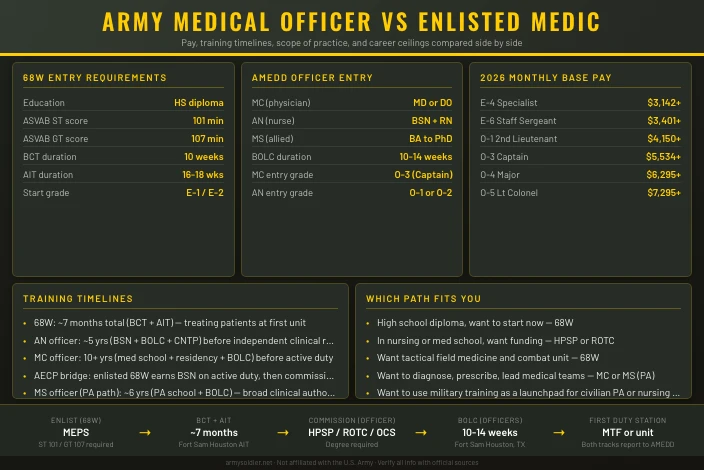
The Core Difference: Scope of Practice vs. Scope of Authority
The clearest way to understand this split is through two separate questions: what can you do clinically, and who do you lead?
| Track | Clinical Authority | Command Authority | Reports To |
|---|---|---|---|
| 68W Combat Medic | Executes standing orders; emergency interventions | NCO chain; no command authority | Medical officer or PA |
| MC Officer (Physician) | Full diagnostic and prescriptive authority | Commands medical units and MTFs | Senior MC officer |
| AN Officer (Nurse) | Independent nursing judgment within licensure | Leads nursing teams | MC officer or MTF commander |
| MS Officer (varies by AOC) | Ranges from full patient care (PA) to none (admin) | Leads clinical or admin sections | Branch-dependent |
A 68W Combat Medic operates under treatment protocols set by medical officers. At a battalion aid station, a medic triages patients, performs emergency interventions, starts IVs, administers certain medications, and manages casualties. But the 68W works within standing orders – a physician or physician assistant establishes the clinical framework, and the medic executes within it.
A Medical Corps (MC) officer – an Army physician – diagnoses, prescribes, performs surgery, and holds medical command authority over the treatment team. An MC captain functioning as a Battalion Surgeon runs the unit’s entire medical program, supervises the 68W medics, and advises the battalion commander on readiness.
Nurse Corps (AN) officers sit between those two positions. An Army nurse leads a nursing team – often supervising 68C Practical Nursing Specialists – and makes independent nursing judgment calls within their licensure. Nurses do not diagnose independently, but they hold significant clinical authority over patient management, procedures, and team coordination.
Medical Service Corps (MS) officers add a third dimension: healthcare administration, behavioral health, laboratory science, and allied health. An MS officer might be a clinical psychologist running a combat stress control unit, a physician assistant with direct patient care authority, or a health services administrator managing a military treatment facility’s patient flow.
Requirements to Enter Each Path
The entry bars are entirely different.
| Requirement | 68W Combat Medic | MC Officer (Physician) | AN Officer (Nurse) | MS Officer |
|---|---|---|---|---|
| Degree | High school diploma | MD or DO degree | BSN minimum | Bachelor’s to Doctorate (varies by AOC) |
| Licensing | None required at entry | State medical license before active duty | NCLEX-RN before active duty | Varies by AOC (PA requires PA-C; OD requires state license) |
| ASVAB | ST: 101 minimum, GT: 107 minimum | No ASVAB (MCAT for med school) | No ASVAB (NCLEX-RN) | GT 110 if OCS-commissioned |
| Age limit | 17-39 (waiver to 42) | Under 42 at commission (waiverable) | Under 47 at commission (varies) | Under 47 (varies by AOC) |
| Commissioning | MEPS and enlistment | HPSP, USUHS, or direct commission | ROTC, direct commission, or AECP | ROTC, OCS, or direct commission |
The 68W path is open to high school graduates who can hit those two ASVAB composites. The officer paths all require either a completed degree or enrollment in an Army-funded education program. Medical Corps officers specifically need a completed MD or DO before they can report to active duty in a clinical role.
One path does bridge the two tracks: the Army Enlisted Commissioning Program (AECP). Active duty enlisted soldiers – including 68Ws – can compete to complete a BSN on full active duty pay and then commission into the Army Nurse Corps. Some 68Ws use this as a deliberate career ladder.
Pay Comparison
Both paths come with full military compensation – base pay, housing allowance, subsistence, and TRICARE. The base pay gap is substantial.
Enlisted pay (68W):
| Rank | Grade | Monthly Base Pay (2026) |
|---|---|---|
| Private First Class | E-3 | $2,837 - $3,198 |
| Specialist | E-4 | $3,142 - $3,816 |
| Sergeant | E-5 | $3,343 - $4,422 |
| Staff Sergeant | E-6 | $3,401 - $5,044 |
Officer pay (AMEDD):
| Rank | Grade | Monthly Base Pay (2026) |
|---|---|---|
| Second Lieutenant | O-1 | $4,150 - $4,320 |
| Captain | O-3 | $5,534 - $9,004 |
| Major | O-4 | $6,295 - $10,510 |
| Lieutenant Colonel | O-5 | $7,295 - $12,395 |
Base pay figures are from DFAS 2026 Military Pay Charts.
The gap widens further for medical officers because AMEDD branches qualify for special pays on top of base pay. Army physicians receive Variable Special Pay ($1,200 to $12,000 per year), Board Certified Pay ($6,000 per year), and Incentive Special Pay that varies by specialty. Nurse Corps officers in shortage specialties like CRNA can earn accession bonuses up to $20,000 and annual retention bonuses in some specialties up to $35,000.
Enlisted medics can earn re-enlistment bonuses when the Army is short of 68Ws, but those are one-time amounts. The structural pay advantage runs with officers throughout a career.
Both tracks receive the same housing and subsistence allowances at equivalent duty stations. An E-4 and O-1 at the same installation receive BAH based on their pay grade, not their specialty – so the total compensation gap at entry is real but not as wide as base pay alone suggests.
Training Pipelines
Getting into the job takes very different amounts of time depending on which track you choose.
68W pipeline:
- 10 weeks – Basic Combat Training (BCT) at Fort Jackson, Fort Moore, or Fort Leonard Wood
- 16-18 weeks – Advanced Individual Training (AIT) at Brooke Army Medical Center, Fort Sam Houston
- Total time from enlistment to first duty station: roughly 7 months
After AIT, a 68W is treating patients and supporting their unit. Advanced skills come through on-the-job experience and additional courses like the Special Operations Combat Medic course or civilian EMT certification.
Medical Corps officer pipeline (HPSP path):
- 4 years – medical school (Army-funded through HPSP or at USUHS)
- 3-7 years – residency (GME program, either Army or civilian)
- 10-14 weeks – AMEDD Basic Officer Leader Course (BOLC) at Fort Sam Houston
- Active duty service obligation: typically 4 years post-residency for HPSP; 7 years for USUHS
A physician who takes the HPSP path goes to medical school on Army scholarship, commissions during school, and completes residency before beginning their active duty obligation. The total investment from starting medical school to reporting as a fully-qualified MC officer can exceed 10 years.
Nurse Corps officer pipeline (direct commission):
- BSN required (4 years of nursing school if starting from high school)
- Direct Commission Course (condensed, a few weeks)
- AMEDD BOLC at Fort Sam Houston: 10-14 weeks
- Clinical Nurse Transition Program (CNTP): 6 months of precepted clinical hours at first duty station
Army nursing compresses the gap somewhat – a new BSN graduate can commission, complete BOLC, and be working as a ward nurse within about a year of graduation.
Day-to-Day Work
The jobs feel very different once you’re past training.
68W in garrison: You run sick call, give injections, manage the unit’s medical records, and treat walk-in patients – anything from sprained ankles to high blood pressure follow-ups. Your scope is set by the Battalion Surgeon’s standing orders. You work under a physician or PA who handles anything outside your protocols.
68W in the field: You move with your unit. You carry both a weapon and a medical bag. During training exercises and deployments, you’re the first person to reach a casualty, and you make real-time treatment decisions with limited support. Communication may be down. Resupply may be hours away. The clinical demands compress fast.
MC officer (Battalion Surgeon): You’re a junior officer first and a doctor second – at least for the first assignment. You run sick call like a medic does, but you make the diagnostic calls, prescribe medications, and sign off on evacuation decisions. You brief the battalion commander on readiness metrics weekly. Your senior medic (typically an E-7 or E-8 68W) runs daily medical operations while you focus on clinical and command duties.
AN officer on a hospital ward: You lead a nursing team – your enlisted 68C soldiers carry out nursing care under your clinical oversight. You set care standards, handle escalations, and own the documentation and quality management for your team. The clinical floor is where you spend most of your company-grade years before moving into department-level leadership.
MS officer (clinical psychologist, PA, or administrator): Scope varies enormously by AOC. A Physician Assistant (65D) has direct patient care authority – diagnosing, prescribing, performing procedures – with broader clinical independence than a nurse but operating in collaboration with physicians. A health services administrator (70B) runs the hospital’s patient flow, staffing, and administrative compliance without any patient care role.
Career Ceilings
Both tracks have genuine long-term potential, but they run on different ladders.
| Track | Typical Ceiling | Top Rank Achievable |
|---|---|---|
| 68W Enlisted | E-9 SGM of medical battalion | E-9 (Command Sergeant Major) |
| MC Officer | MTF Commander (hospital CEO in uniform) | O-7+ (Brigadier General) |
| AN Officer | Department Chief or MTF Deputy Commander | O-6 (Colonel), O-7 possible |
| MS Officer | Department Chief or MTF administrative command | O-6 (Colonel), O-7 possible |
Enlisted medics promote based on time-in-service and competitive boards. An E-9 Sergeant Major of a medical battalion is a senior leadership position with real authority. But command authority in the Army ultimately sits with commissioned officers.
AMEDD officers promote through a standard officer track. O-3 to O-6 progression is time-based and board-selected. O-7 (Brigadier General) opportunities exist within AMEDD, making it one of the few branches where healthcare professionals reach general officer ranks.
The 68W-to-officer pipeline is real. Medics who commission through AECP or a civilian degree plus OCS carry a clinical background that gives them a practical advantage in early officer assignments.
Which Path Fits You
The decision often comes down to where you are in life right now, not just where you want to end up.
The 68W path makes sense if:
- You’re 17-22 with a high school diploma and want to start a medical career without waiting years to finish school
- You want hands-on, field-based trauma care experience early in your career
- You’re interested in using Army medical training and the GI Bill to fund nursing school, PA school, or paramedicine after service
- You want to serve in a combat unit and be the medic that unit relies on
The officer path makes sense if:
- You already have a college degree in a health-related field, or you’re willing to complete one before committing
- You’re in medical school or nursing school and looking at HPSP as a way to fund the degree
- You want clinical command authority – the ability to diagnose, prescribe, and lead medical teams independently
- You’re planning a 20-year career and want to reach senior leadership roles
The honest version: enlisted medics get into the fight faster, build strong tactical medicine skills, and serve in roles that civilian EMTs and paramedics recognize immediately. Officers start later but land at a higher floor, earn more throughout their career, and hold the authority that shapes how Army medicine actually operates.
Neither path is the wrong choice. The right one depends on where you’re starting.
For a broader look at every 68-series specialty and what each one requires, see the Army Medical MOS Jobs: Complete Guide. If you’re weighing an officer commission specifically through direct commission or HPSP, the Army AMEDD Direct Commission Guide covers the commissioning process in detail. Explore all Army medical officer careers to see every AMEDD branch side by side.
This site is not affiliated with the U.S. Army or any government agency. Verify all information with official Army sources before making enlistment or career decisions.