Army National Guard vs Reserve: Key Differences
The Army National Guard and the Army Reserve look almost identical from the outside. Same weekend drill schedule. Same pay tables. Same basic training pipeline. But they are legally and structurally different organizations, and those differences show up in ways that can affect your life – your activation risk, your state-level benefits, and which unit types are even available near you.
If you’re choosing between the two, the details in this post are the ones that actually change your decision.
Who Commands Them
The Reserve and the Guard answer to different bosses, and that distinction runs deeper than an org chart.
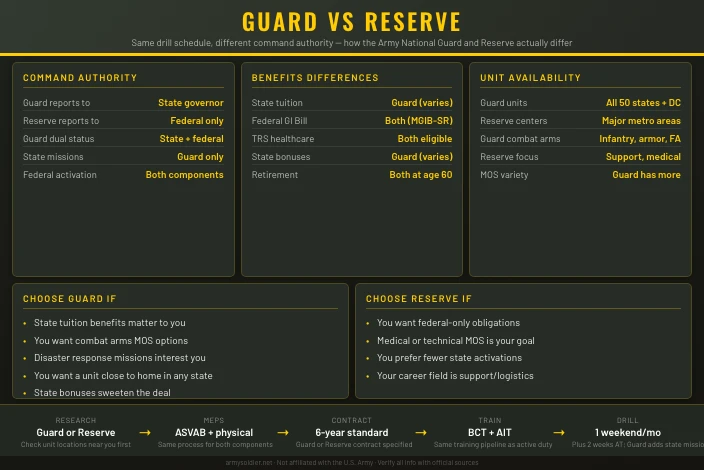
The Army Reserve is a purely federal organization. It falls under U.S. Army Reserve Command (USARC), which reports up through the Department of the Army to the President. There is no state layer. The governor of your state has zero authority over an Army Reserve unit. Reserve soldiers exist solely to support federal military missions.
The Army National Guard operates under dual authority. When not mobilized, each state’s Guard falls under the state Adjutant General, who reports to the governor. The National Guard Bureau coordinates between the states and the federal military. When the Guard is federally mobilized, it shifts to Title 10 status and operates under the same chain of command as Active Duty and Reserve forces.
This dual structure is written into law. Guard soldiers technically hold two concurrent statuses – state employees and federal military members – until one authority supersedes the other through activation orders.
What this means practically:
- Army Reserve units cannot be activated by a governor. Period.
- National Guard units can be called up by the governor without any federal involvement.
- When federally mobilized, Guard soldiers fall under the same rules and chain of command as Reserve soldiers.
- Reserve units are federally funded year-round; Guard units receive a mix of state and federal funding.
When They Get Called Up
Activation authorities are where the Guard and Reserve diverge most sharply.
Both components can be federally mobilized under Title 10 when the President and Congress authorize it. That authority covers overseas deployments, national emergencies, and support to federal law enforcement operations. If you were deployed to Iraq, Afghanistan, or a similar theater, you went under Title 10 orders regardless of whether you were Guard or Reserve.
The Guard has two additional activation authorities that the Reserve does not.
Title 32 lets the governor activate Guard soldiers for domestic missions with federal funding and pay. The soldiers remain under state command but receive federal benefits – including TRICARE coverage and federal pay rates. Natural disaster response, civil disturbance support, and border security missions often run under Title 32.
State Active Duty is the governor calling up Guard soldiers entirely under state authority with state pay and state benefits. Federal benefits like TRICARE do not apply. Pay rates vary by state and are often lower than the equivalent federal rate. USERRA civilian job protections still apply, but the financial picture can look different from a Title 10 or Title 32 activation.
The Reserve has none of these state-level authorities. Reserve soldiers activate under federal orders or not at all.
In practical terms, Guard soldiers face a wider range of activation scenarios. A hurricane season, a wildfire, or a civil emergency can mean a call-up with days of notice under state orders – scenarios that simply do not exist for Reserve soldiers. Whether that feels like more opportunity or more unpredictability depends on you.
| Activation Type | Army Reserve | Army National Guard |
|---|---|---|
| Title 10 (federal, overseas/national) | Yes | Yes |
| Title 32 (state mission, federal pay) | No | Yes |
| State Active Duty (state mission, state pay) | No | Yes |
| Governor can activate without federal approval | No | Yes |
State Benefits Through the Guard
This is the most underappreciated financial difference between the two components, and it only applies to the Guard.
Because National Guard soldiers serve under state authority when not mobilized, many states treat them as state employees for benefit purposes. The specifics vary widely, but common state benefits include:
- Tuition waivers at public state colleges and universities (some states cover full in-state tuition, others offer partial waivers)
- State income tax exemptions on military pay
- State-funded bonuses for enlistment, re-enlistment, or specific MOSs
- State life insurance programs at reduced rates
- Priority hiring preferences for state government jobs
Some states are exceptionally generous. Illinois, New York, and several other states with large Guard forces have historically offered full in-state tuition waivers at public institutions for Guard members in good standing. Others offer nothing beyond the federal benefits that both components share.
The Army Reserve offers none of these state-level benefits. It is a federal entity with no state funding mechanism.
Both components share the same federal benefits:
- Federal Tuition Assistance ($250/semester hour, $4,500/year)
- Montgomery GI Bill – Selected Reserve ($493/month for up to 36 months while drilling)
- Post-9/11 GI Bill eligibility earned through active-duty deployment
- TRICARE Reserve Select ($57.88/month member-only, $286.66/month with family)
- Points-based retirement under the Blended Retirement System
If you live in a state with a strong Guard tuition benefit, the Guard can be meaningfully cheaper for a college education than the Reserve. Contact your state’s Adjutant General office to find out what your specific state offers.
Unit Types and MOS Availability
The Guard and Reserve are not organized identically, and that affects which jobs you can actually get in each component.
The Army Reserve is built around support and sustainment. Reserve units are heavy on medical, transportation, logistics, engineering, signal, finance, and human resources. The logic is straightforward: in a major mobilization, Active Duty combat forces need a large support tail. Reserve units provide it.
The National Guard includes a broader mix of combat arms, aviation, and maneuver forces alongside the support functions. Guard infantry battalions, armor units, artillery batteries, and aviation companies exist in most states because the Guard has a state defense mission that requires combat-capable formations. If your state faces a major civil emergency or is called up to support federal ground operations, it needs units that can do more than logistics.
What this means for your MOS selection:
| MOS Family | Army Reserve | Army National Guard |
|---|---|---|
| Medical (CMF 68) | Widely available | Widely available |
| Transportation/Logistics (CMF 88, 92) | Widely available | Available |
| Signal/Cyber (CMF 25, 17) | Available | Available |
| Engineers (CMF 12) | Available | Available |
| Infantry (CMF 11) | Limited | More prevalent |
| Armor (CMF 19) | Very limited | More prevalent |
| Aviation (CMF 15) | Limited | More prevalent |
| Special Forces (CMF 18) | Not available | Not available (active component only) |
Neither component covers every MOS. Before committing, verify that a unit with your target MOS has openings within commuting distance of where you live. A great MOS with no local unit means a long drive every drill weekend for years.
Which One Should You Choose
The honest answer depends on your state and your priorities, not on one component being objectively superior.
Choose the Army Reserve if:
- Your state offers weak or no Guard tuition benefits, making the state-benefit advantage irrelevant
- You want a purely federal part-time commitment without any state activation exposure
- Your target MOS is a support or sustainment specialty well-represented in Reserve units
- You want predictable activation patterns tied to federal military needs
Choose the Army National Guard if:
- Your state offers a tuition waiver or other meaningful state benefits
- You want the option to respond to local emergencies in your community
- Your target MOS is infantry, armor, or aviation – where Guard units are more common
- You’re comfortable with a slightly broader and less predictable activation footprint
For most people, the practical day-to-day difference is small. Drill weekends look identical. Federal pay and core benefits are the same. The divergence only matters when state benefits are meaningful in your state or when the Guard’s domestic mission changes your activation risk calculation.
The three-way comparison of active duty, Reserve, and Guard covers pay, healthcare, retirement, and deployment frequency in detail if you’re still weighing whether part-time service fits your life at all. Browse Army career options to see which MOSs are available and how they map to civilian careers before you commit to either component.
This site is not affiliated with the U.S. Army or any government agency. Verify all information with official Army sources before making enlistment or career decisions.