Army Officer Bonuses and Incentive Pay
Enlisted soldiers get all the press when it comes to Army bonuses. The $40,000 signing bonus headlines dominate recruiting ads, and most people assume the officer corps runs on prestige alone. That’s not how it works. Army officers qualify for a layered system of incentive pays, accession bonuses, and retention incentives that can add tens of thousands of dollars per year on top of base pay – and in some specialties, the total package rivals what a civilian with similar credentials earns.
The catch is that officer bonuses are less standardized than enlisted bonuses. Amounts shift by specialty, by shortage designation, and by what the Army needs at any given moment. This breakdown covers what’s available, who qualifies, and what the numbers actually look like.
How Officer Pay Differs From Enlisted
Recommended study resource: An officer-focused ASVAB study course with section-specific drills is the fastest way to hit the GT score of 110 required for OCS. Practice tests and adaptive scoring help you identify exactly where to focus.
When you purchase through links on our site, we may receive compensation at no extra cost to you.
Before getting into bonuses, it helps to understand the baseline. Army officers do not receive the same type of signing bonus that enlisted soldiers negotiate at MEPS. There is no standard “MOS bonus” for commissioning. Instead, the officer incentive system works in layers.
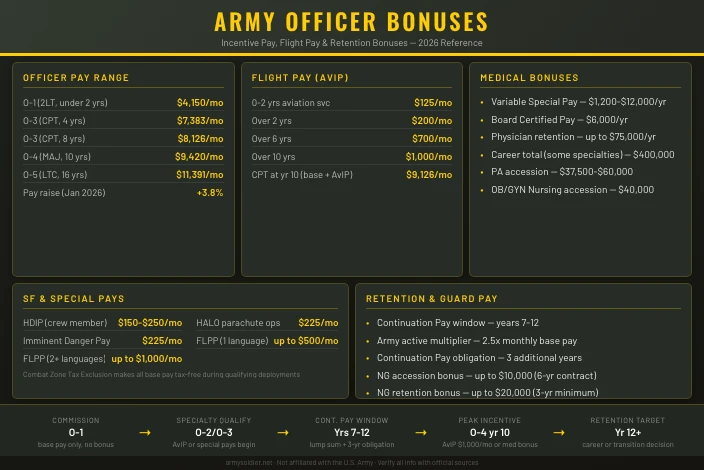
Layer 1 – Base pay: Every officer earns monthly basic pay based on grade (O-1 through O-10) and years of service. The 2026 pay tables reflect a 3.8% raise effective January 1.
| Grade | Title | Under 2 Years | 4 Years | 8 Years | 12 Years |
|---|---|---|---|---|---|
| O-1 | 2LT | $4,150 | $5,222 | – | – |
| O-2 | 1LT | $4,782 | $6,485 | – | – |
| O-3 | CPT | $5,534 | $7,383 | $8,126 | $8,788 |
| O-4 | MAJ | $6,295 | $7,881 | $8,816 | $9,888 |
| O-5 | LTC | $7,295 | $8,894 | $9,461 | $10,272 |
| O-6 | COL | $8,751 | $10,245 | $10,725 | $10,784 |
2026 military pay tables are published by DFAS each January.
Layer 2 – Special and incentive pays: Aviation officers earn flight pay. Medical officers earn physician special pays. SF officers earn hazardous duty pay. These stack on top of base pay.
Layer 3 – Accession and retention bonuses: These are one-time or periodic lump sums tied to committing to a specialty or extending service.
The total compensation picture for a mid-career officer in a shortage specialty looks very different from base pay alone.
Aviation Officers: Flight Pay
Aviation officers earn Aviation Career Incentive Pay (AvIP), commonly called flight pay. It is paid monthly and scales with cumulative years of aviation service – not total military service.
| Years of Aviation Service | Monthly AvIP |
|---|---|
| 2 or fewer | $125 |
| Over 2 | $200 |
| Over 6 | $700 |
| Over 10 | $1,000 |
| Over 22 | $700 |
| Over 24 | $400 |
A captain with 10 years of aviation service earns $8,126 in base pay plus $1,000 in AvIP – $9,126 per month in taxable pay before allowances. That’s before BAH or BAS are added.
General officers are capped at $200-$206 per month regardless of years of aviation service. AvIP begins when Aviation Service Entry Date (ASED) orders are published and ends at 25 years of aviation service.
Aviation officers who separate after the 10-year active duty service obligation (ADSO) carry flight hours that translate directly into competitive airline hiring. The combination of AvIP during service and airline compensation after is one of the strongest financial trajectories available to any officer.
Continuation Pay
Under the Blended Retirement System, aviation officers between years 7 and 12 are eligible for Continuation Pay – a lump sum in exchange for three additional years of active duty service. The Army has paid aviation Continuation Pay at 2.5x monthly basic pay. For a major at 10 years with $9,420 per month in base pay, that works out to roughly $23,550.
Medical Officers: The Highest Bonus Potential
Army physicians earn the largest officer bonuses available. The medical officer incentive system has multiple components that run simultaneously.
Physician Special Pays
These apply to all Medical Corps (MC) officers:
- Variable Special Pay (VSP): $1,200 to $12,000 per year, based on pay grade and years of creditable service
- Board Certified Pay (BCP): $6,000 per year for physicians certified by an American Medical or Osteopathic specialty board
Accession and Retention Bonuses
Accession bonuses and Incentive Special Pay (ISP) amounts vary by specialty and shortage designation and are negotiated annually. Physician retention bonuses can reach $75,000 per year for officers signing a two-, three-, or four-year extension, depending on specialty. Total incentive value across a full career reaches $400,000 in some shortage specialties.
Exact amounts change every fiscal year. The Army Medical Recruiting Brigade can give current figures by specialty.
Non-Physician Medical Officers
Other medical officers – Physician Assistants, pharmacists, psychologists, nurses, and veterinary officers – have their own bonus structures:
| Specialty | Accession Bonus | Annual Incentive Pay |
|---|---|---|
| Physician Assistant | $37,500-$60,000 | $5,000 |
| Pharmacy Officer | $30,000 | – |
| Psychology Officer | Varies by agreement | $5,000 |
| Veterinary Officer | $20,000 | – |
| OB/GYN Nursing | $40,000 | – |
Retention bonuses for these specialties run $10,000 to $40,000 depending on specialty and agreement length.
Special Forces Officers: Hazardous Duty and Language Pay
SF officers do not receive a dedicated accession bonus for branching into Special Forces. Their additional compensation comes through incentive pays tied to what they do.
- Hazardous Duty Incentive Pay (HDIP): Crew member rates range from $150 to $250 per month depending on rank. Officers performing High Altitude Low Opening (HALO) parachute operations receive $225 per month. Non-crew HDIP is $150 per month.
- Foreign Language Proficiency Pay (FLPP): Up to $500 per month for a single designated language, or up to $1,000 per month for certified proficiency in two or more languages. Arabic, Mandarin, and Russian command higher rates.
- Hostile Fire / Imminent Danger Pay: $225 per month during qualifying deployed periods.
- Combat Zone Tax Exclusion (CZTE): All basic pay becomes tax-free during months spent in a designated combat zone. For a major at $9,420 per month, that’s roughly $1,650 in avoided federal tax during each qualifying month.
An SF officer proficient in Arabic who deploys to a combat zone can earn FLPP, HDIP, Imminent Danger Pay, and CZTE simultaneously. The cumulative monthly value adds up quickly against a base pay figure.
SF officers serving under the Blended Retirement System also qualify for Continuation Pay at 2.5x monthly basic pay, the same multiplier as aviation.
Judge Advocate and Chaplain Officers
Judge Advocate General (JAG) officers and chaplains follow the standard officer pay scale without specialty incentive pays equivalent to medical or aviation. JAG officers commissioned through the direct commission path can receive accession bonuses based on Army needs, but exact amounts are not publicly listed and vary by fiscal year.
Chaplain officers have no bonus program beyond standard officer pay and benefits.
Retention Bonuses: What All Officers Can Access
Continuation Pay (BRS)
Any officer enrolled in the Blended Retirement System who reaches the 7-12 year window can receive Continuation Pay. The Army sets the multiplier – it has ranged from 2.5x to 13x monthly basic pay across different career fields and fiscal years. Active component Army officers in critical shortage areas receive higher multipliers.
The payment requires a three-year additional service obligation minimum.
National Guard Officer Accession and Retention
National Guard commissioned officers face different bonus structures:
- Accession bonus: Up to $10,000 for a six-year agreement in an identified skill
- Retention bonus: Up to $20,000 for officers who complete their commissioning obligation and agree to serve a minimum of three additional years
These amounts are lower than active component specialty pays, but they stack on top of civilian income for part-time officers.
What Officers Don’t Get
A few things worth clarifying because they cause confusion:
No standard commissioning bonus. Unlike some enlisted contracts, there is no automatic cash bonus for commissioning as an Army officer. ROTC scholarships cover tuition – that’s a benefit, not a bonus.
HPSP is not a bonus. The Health Professions Scholarship Program pays medical school tuition and a monthly stipend in exchange for a service obligation. It is a scholarship with strings, not discretionary money.
Civilian salary comparison. For most officer specialties, base pay alone falls short of private-sector equivalents at the same career stage. The total compensation picture – BAH, BAS, TRICARE, TSP matching, pension, and any special pays – closes that gap substantially. Officers who calculate total compensation rather than just base pay see a more accurate comparison.
Making Sense of the Numbers
The officer bonus system rewards specialization and commitment, not commissioning itself. Aviation officers who want to maximize compensation should plan to stay through the Continuation Pay window at years 7-12 and accumulate enough flight hours for the airline transition after the ADSO. Medical officers in shortage specialties can reach total bonus packages that rival private-sector compensation when factored over a full service obligation.
For officers in combat arms or support branches without shortage designations, the financial case for service is built on total compensation – the tax-free allowances, the $0-premium healthcare, the TSP matching, and the 20-year pension – rather than on bonuses.
You may also find Army enlistment bonuses explained and the full Army officer career directory helpful for understanding how pay and incentives fit the broader compensation picture.
This site is not affiliated with the U.S. Army or any government agency. Verify all information with official Army sources before making enlistment or career decisions.