Army Officer Selection Tests: SIFT, ASVAB for OCS
Most people know the Army uses the ASVAB. Fewer realize that the path to a commission or a pilot seat runs through a completely different set of tests depending on which officer track you choose. Get the right score on the wrong test and you’re still not going anywhere. This guide breaks down which tests apply to which paths, what scores you actually need, and how each number fits into the board review that decides your fate.
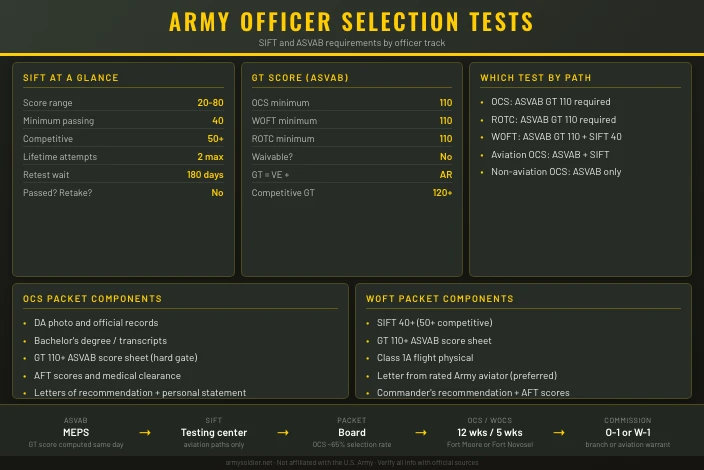
Which Officer Path Requires Which Test
The Army commissions officers through three main pipelines, and testing requirements differ by track.
| Path | ASVAB Required | SIFT Required |
|---|---|---|
| Officer Candidate School (OCS) | Yes – GT 110 minimum | Only if pursuing aviation branch |
| ROTC | Yes – GT 110 minimum | Only if pursuing aviation branch |
| Warrant Officer Flight Training (WOFT) | Yes – GT 110 minimum | Yes – score 40 to qualify |
Every path requires the ASVAB. The SIFT is only mandatory for aviation – either as a commissioned aviation officer or as a warrant officer pilot. The GT score floor of 110 is consistent across all three tracks and is nonwaivable for each one.
OCS and ROTC produce commissioned officers – second lieutenants at O-1. WOFT produces warrant officers at W-1, a separate rank structure built around technical aviation expertise rather than command.
The SIFT: What Aviation Candidates Need to Know
The Selection Instrument for Flight Training is a computer-adaptive test administered at Army testing centers. It produces a single score on a scale of 20 to 80. A 40 is the minimum passing score. Boards treat anything 50 or above as competitive, and candidates with scores in the 60s stand out in a crowded packet.
The test covers seven sections:
| Section | Questions | Time |
|---|---|---|
| Simple Drawings (SD) | 100 | 2 min |
| Hidden Figures (HF) | 50 | 5 min |
| Army Aviation Information Test (AAIT) | 40 | 30 min |
| Spatial Apperception Test (SAT) | 25 | 10 min |
| Reading Comprehension Test (RCT) | 20 | 30 min |
| Math Skills Test (MST) | Adaptive | 40 min |
| Mechanical Comprehension Test (MCT) | Adaptive | 30 min |
Simple Drawings and Hidden Figures are pure speed-and-accuracy events – the kind that respond quickly to focused practice. The Spatial Apperception section requires you to mentally orient an aircraft based on a cockpit view, which is unfamiliar territory for most candidates and rewards dedicated drilling. AAIT tests aviation knowledge you won’t have unless you study for it specifically.
Retesting Rules
The SIFT has strict lifetime attempt limits. Know these before you register.
- Two lifetime attempts maximum. There is no waiver process for exceeding this limit.
- If you pass (score 40 or above): you cannot retake the test. Your score stands permanently.
- If you fail (score below 40): you may retest once, but not until 180 days after your first attempt.
- Second failure: permanent disqualification from Army aviation. No exceptions.
That one-shot rule is what sets the SIFT apart from the ASVAB. You can retake the ASVAB under certain conditions and potentially raise your score. With the SIFT, a 42 is your number for life – which is the strongest possible reason to prepare for your target score, not just a passing score, on the first attempt.
The ASVAB for OCS: GT Score and What It Means
For officer candidates, the relevant ASVAB output is the GT (General Technical) score. GT is a composite of two subtests: Verbal Expression (VE) and Arithmetic Reasoning (AR). VE itself combines Word Knowledge and Paragraph Comprehension. Strong reading and basic math drive GT more than anything else on the test.
The minimum GT score for OCS is 110. The same floor applies to WOFT. Both are nonwaivable.
Most Army MOS jobs require a minimum AFQT (the overall qualifying score), not a GT composite. The table below shows how the officer thresholds compare to standard enlistment:
| Purpose | Score Type | Minimum |
|---|---|---|
| Basic Army enlistment | AFQT | 31 |
| Most MOS qualification | Line score composites | Varies by MOS |
| OCS / ROTC commission | GT composite | 110 |
| WOFT application | GT composite | 110 |
A GT of 110 sits roughly at the 75th percentile among Army applicants. Word Knowledge, Paragraph Comprehension, and Arithmetic Reasoning are the three subtests that drive this composite – put your study time there first.
How Test Scores Fit Into the OCS Selection Board
An OCS application is called a packet. The board reviews the whole thing – test scores are one piece, not the deciding factor.
A complete OCS packet typically includes:
The GT score functions as a screening gate, not a ranking signal. Once a packet clears 110, the board’s attention shifts to academics, leadership record, fitness, and the overall case the packet makes. Roughly 65% of OCS applicants are selected – competitive, but not a long shot for a well-built packet with strong supporting materials.
How Test Scores Fit Into the WOFT Board Packet
Warrant Officer Flight Training runs a separate board from OCS, and the packet reflects that. Technical aptitude carries more weight because aviation performance is the primary job.
The hard minimums for a WOFT packet:
- SIFT: 40 to qualify; 50 or above to be competitive
- GT score: 110, nonwaivable
- Class 1A flight physical: medical qualification for flight duty, including vision standards
The board also weighs letters of recommendation – at least one from a rated Army aviator is strongly preferred. Enlisted applicants need a commander’s recommendation. Physical fitness scores (AFT) apply to all applicants, and some recruiting battalions require a warrant officer board interview.
One age cutoff applies specifically to 153A Rotary Wing Aviator: applicants must not have passed their 33rd birthday at the time of enlistment. It’s a hard cutoff with no waiver. Fixed-wing and other aviation warrant tracks may have different windows, so verify the specific MOS requirements with your recruiting officer.
After selection, WOFT candidates attend Warrant Officer Candidate School (WOCS) at Fort Novosel, Alabama before flight training begins. WOCS runs roughly five weeks of leadership evaluation before any flight instruction starts.
Score Benchmarks and Study Timeline
| Test | Minimum | Competitive | Study Timeline |
|---|---|---|---|
| SIFT | 40 | 50+ | 4-6 weeks focused prep |
| ASVAB GT | 110 | 120+ | 2-4 weeks GT-specific focus |
The four-to-six-week SIFT estimate assumes you’re starting from no aviation background. Spatial Apperception and Simple Drawings respond well to daily drilling – even 20 minutes a day of targeted practice moves the score. Mechanical comprehension and math take longer to improve, so anchor the first two weeks there.
For GT, two to four weeks is realistic if you’re strong in reading but weaker in arithmetic. If both areas need work, add two more weeks. The ASVAB can be retaken under specific wait-period rules, but the SIFT cannot – sequence accordingly. Prepare the SIFT first, take it with full preparation, then refine GT if needed.
You may also find the SIFT test prep guide and ASVAB for OCS prep guide helpful for building out your study plan. For more detail on specific topics, see ASVAB scores for Army officer branches, SIFT vs ASVAB explained, PiCAT vs ASVAB at MEPS, and how to prepare for OCS selection.