Army Officer vs Enlisted Pay Comparison
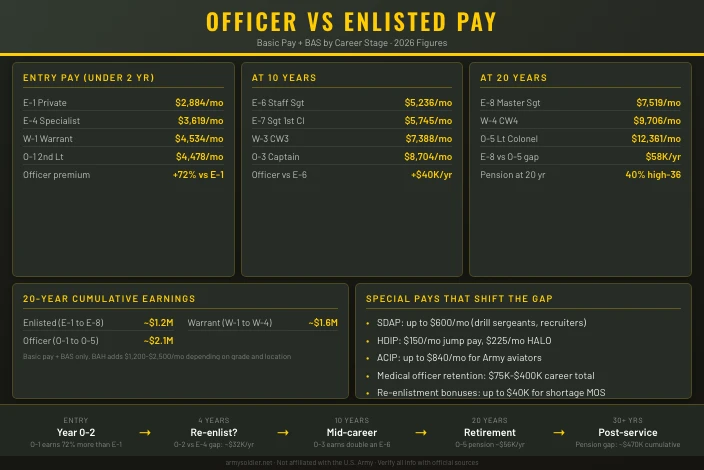
Most people assume officers simply earn more. That’s true – but the gap is wider than most recruits expect, and it doesn’t start the same way for everyone. A new Second Lieutenant and a new Private both enter the Army in the same month, but their paychecks look nothing alike. By the 20-year mark, the difference between an O-5 and an E-8 reaches roughly $58,000 per year in base pay alone, and the retirement pension gap compounds that figure for decades. Here’s what the numbers actually look like at every major career milestone.
How Army Pay Is Structured
Before comparing dollars, it helps to understand what goes into Army compensation. Pay has three layers that apply to everyone.
Basic pay is the taxable foundation. It’s set by your pay grade (rank) and years of service. Everyone in the same grade with the same years of service earns the same basic pay, regardless of MOS or branch.
Basic Allowance for Subsistence (BAS) covers food. Enlisted soldiers receive $476.95 per month in 2026. Officers receive $328.48 per month. The rate is flat – it doesn’t scale with rank or location.
Basic Allowance for Housing (BAH) covers rent or mortgage. It varies by duty station, pay grade, and whether you have dependents. At Fort Sam Houston in San Antonio, an E-4 without dependents receives $1,359/month in 2026; an O-2 without dependents receives $1,827/month. Both are tax-free. The officer rate is higher because BAH scales with pay grade.
On top of those three, some soldiers qualify for special pays based on their duty or MOS. Those are covered in the career-stage comparisons below.
One note on the numbers: BAH varies enough by installation that it can’t be summed cleanly into a single national figure. The tables in this post show basic pay plus BAS. BAH adds another $1,200 to $2,500 per month depending on your location and grade – so actual take-home is higher than the figures here for anyone living off-post.
Pay at Entry: The First Two Years
The gap between officer and enlisted pay is largest at entry, in percentage terms. An E-1 Private fresh out of Basic Combat Training earns $2,407 per month in basic pay. A Second Lieutenant (O-1) commissioned the same week earns $4,150 per month – 72% more – before either receives a dollar in allowances.
That difference exists because officers enter with a college degree and a commission. The Army treats that as a higher starting point on the pay scale, the same way a civilian employer adjusts entry salary for credentials.
| Track | Grade | Basic Pay | BAS | Combined Monthly | Annual |
|---|---|---|---|---|---|
| Enlisted | E-1 | $2,407 | $477 | $2,884 | $34,608 |
| Enlisted (promoted) | E-4 under 2 yr | $3,142 | $477 | $3,619 | $43,428 |
| Warrant Officer | W-1 | $4,057 | $477 | $4,534 | $54,408 |
| Officer | O-1 | $4,150 | $328 | $4,478 | $53,736 |
Most enlisted soldiers reach E-4 Specialist within 24 months through normal promotion timelines, so the practical enlisted entry comparison is closer to $3,619/month than the E-1 floor.
Warrant officers enter as W-1s after completing Warrant Officer Candidate School. Their basic pay at entry tracks almost identically with an O-1 in dollar terms – but they receive the higher enlisted BAS rate, which slightly closes the gap with commissioned officers.
Pay at 4 Years: After the First Enlistment
Four years is a natural checkpoint. Enlisted soldiers face a re-enlistment decision. Officers approach promotion to First Lieutenant (O-2) and begin looking toward Captain. Warrant officers are approaching W-2.
By this point, promotion and within-grade pay steps have pushed everyone’s pay up from their entry figures. An E-4 at 4 years earns $3,659/month in basic pay – about $517 more per month than at entry. An O-2 at 4 years earns $6,485/month – an increase of more than $2,300 per month over an O-1 at entry.
| Track | Grade | Years | Basic Pay | BAS | Combined Monthly | Annual |
|---|---|---|---|---|---|---|
| Enlisted | E-4 | 4 yr | $3,659 | $477 | $4,136 | $49,632 |
| Enlisted (SGT) | E-5 | 4 yr | $3,947 | $477 | $4,424 | $53,088 |
| Warrant Officer | W-1 | 4 yr | $4,859 | $477 | $5,336 | $64,032 |
| Officer | O-2 | 4 yr | $6,485 | $328 | $6,813 | $81,756 |
Enlisted soldiers promoted to Sergeant (E-5) by year four close some of the gap with warrant officers. An E-5 at 4 years earns $4,424/month combined – still $900/month less than a W-1 at the same service point.
The officer-versus-enlisted spread at 4 years is roughly $32,000 annually when comparing an O-2 to an E-4. That spread persists because officer promotions also carry larger pay jumps than enlisted promotions do at the junior grades.
Special pays can narrow the gap for some enlisted soldiers at this career stage. A Ranger-tabbed infantryman collecting $150/month in hazardous duty pay (HDIP) for parachute duty, or a drill sergeant drawing up to $600/month in Special Duty Assignment Pay (SDAP), sees a meaningful addition to base pay. Those pays don’t change the structural gap, but they reward specific assignments.
Pay at 10 Years: Mid-Career
Ten years in, both tracks look very different from entry. Enlisted soldiers are typically Staff Sergeants (E-6) or approaching Sergeant First Class (E-7). Officers are Captains (O-3) aiming for Major. Warrant officers are in the W-2 to W-3 range.
Mid-career is where the officer pay premium becomes most visible in absolute dollars. An O-3 Captain at 10 years earns $8,376/month – more than double the E-6 Staff Sergeant’s $4,759/month at the same career point.
| Track | Grade | Years | Basic Pay | BAS | Combined Monthly | Annual |
|---|---|---|---|---|---|---|
| Enlisted | E-6 | 10 yr | $4,759 | $477 | $5,236 | $62,832 |
| Enlisted | E-7 | 10 yr | $5,268 | $477 | $5,745 | $68,940 |
| Warrant Officer | W-3 | 10 yr | $6,911 | $477 | $7,388 | $88,656 |
| Officer | O-3 | 10 yr | $8,376 | $328 | $8,704 | $104,448 |
Warrant officers at this stage occupy a clear middle position. A CW3 at 10 years earns $88,656 annually in basic pay and BAS – comfortably above an E-7 and substantially below an O-3, but with a compensation trajectory that continues climbing steeply through W-4 and W-5.
Aviation warrant officers collect Aviation Career Incentive Pay (ACIP) on top of their base pay. ACIP rates top out at $840/month for aviators with 14 to 22 years of cumulative aviation service. A CW3 helicopter pilot at 10 years adds roughly $700/month in ACIP, closing the gap with an O-3 by about $8,400 per year before BAH is factored in.
Pay at 20 Years: Retirement Eligibility
Twenty years is the first point a soldier can retire with a pension. The pay differences here inform not just current salary but pension income for the next 30 to 40 years. That’s why the 20-year comparison matters more than any other career stage.
Most enlisted soldiers reaching 20 years hold E-7 or E-8 rank. Officers at 20 years are typically O-5 Lieutenant Colonels. Warrant officers at 20 years hold W-4 rank in most specialties.
| Track | Grade | Years | Basic Pay | BAS | Combined Monthly | Annual |
|---|---|---|---|---|---|---|
| Enlisted | E-7 | 20 yr | $5,537 | $477 | $6,014 | $72,168 |
| Enlisted | E-8 | 20 yr | $7,042 | $477 | $7,519 | $90,228 |
| Warrant Officer | W-4 | 20 yr | $9,229 | $477 | $9,706 | $116,472 |
| Officer | O-5 | 20 yr | $12,033 | $328 | $12,361 | $148,332 |
The E-8 versus O-5 spread: $58,104 per year in basic pay plus BAS. That’s before BAH, which also scales with grade and widens the gap further. The W-4 sits $31,860 above the E-8 and $31,860 below the O-5 – a near-perfect midpoint.
The Retirement Math
The Blended Retirement System (BRS) pension pays 2% per year of service times your high-36 average basic pay. At exactly 20 years, that equals 40% of your average basic pay for your highest 36 months – which in practice means your last three years.
Estimated monthly pension at 20-year retirement:
| Track | Grade | Approx. High-36 Avg | Monthly Pension (40%) | Annual Pension |
|---|---|---|---|---|
| Enlisted | E-8 | ~$6,800 | ~$2,720 | ~$32,640 |
| Warrant Officer | W-4 | ~$9,000 | ~$3,600 | ~$43,200 |
| Officer | O-5 | ~$11,700 | ~$4,680 | ~$56,160 |
These estimates use recent basic pay from the 20-year bracket and the two preceding brackets to approximate the high-36 average. Actual pension depends on your specific pay history.
The pension is inflation-adjusted annually through Cost of Living Adjustments (COLA). Over 20 years of retirement, the cumulative payout difference between an E-8 and O-5 pension approaches $470,000 in nominal dollars – not accounting for COLA increases.
On top of the pension, BRS includes a Thrift Savings Plan (TSP) with government matching of up to 4% of basic pay once the matching window opens (year three onward). Officers contribute more absolute dollars to TSP because their basic pay base is higher, so their TSP balance at retirement is typically larger as well.
Special Pays That Shift the Numbers
Base pay comparisons don’t capture every dollar. Several special pays apply broadly enough to affect the officer-versus-enlisted comparison.
Enlisted special pays:
- SDAP (Special Duty Assignment Pay): Up to $600/month for drill sergeants, recruiters, and other demanding assignments. This runs for the duration of a special duty tour, typically 2-3 years.
- HDIP (Hazardous Duty Incentive Pay): $150/month for jump duty, $225/month for HALO parachute operations. Available to both enlisted and officers in qualifying units.
- Enlistment and re-enlistment bonuses: Lump-sum payments for specific MOS shortages. These can reach $40,000 or more for high-demand specialties. Bonuses are one-time payments, not recurring pay, but they boost total compensation significantly in the years they’re received.
Officer special pays:
- ACIP (Aviation Career Incentive Pay): $125 to $840/month for rated aviators depending on years of aviation service. Applies to both commissioned and warrant officer pilots.
- Special Pay for Medical Officers: Doctors, dentists, and optometrists in the Army Medical Corps receive accession bonuses and multi-year retention incentives that can add $75,000 to $400,000 over a career. These are among the highest special pays in the Army.
- Judge Advocate officers: JAG Corps officers receive accession bonuses and retention pays tied to critical shortage designations.
No single special pay closes the structural officer-enlisted gap over a full career, but ACIP for aviation warrant officers and medical special pays for AMEDD officers can meaningfully change individual outcomes.
Total Career Earnings: The 20-Year Picture
Comparing annual snapshots understates the actual gap because it misses years of compounding pay growth. A rough estimate of cumulative basic pay plus BAS over 20 years – using the stage-by-stage figures above and assuming steady progression through normal promotion timelines:
| Track | Estimated 20-Year Cumulative Basic Pay + BAS |
|---|---|
| Enlisted (E-1 to E-8) | ~$1.2 million |
| Warrant Officer (W-1 to W-4) | ~$1.6 million |
| Officer (O-1 to O-5) | ~$2.1 million |
These are rough estimates based on typical promotion timelines. Officers who promote faster or reach O-6 exceed the O-5 figure significantly. An O-6 Colonel at 20+ years earns up to $15,408/month in basic pay (the FY2026 cap for O-6 and below). Enlisted soldiers who make E-9 Command Sergeant Major approach $8,000-$8,250/month – strong compensation, but still well below field-grade officer pay.
The $900,000 gap between an enlisted career and an officer career over 20 years is the number that puts the college-degree requirement in financial context. Officers invest 4+ years and the cost of a degree to access that additional compensation. The warrant officer track offers a middle path that doesn’t require a four-year degree for most specialties and captures roughly $400,000 more over a career than a typical enlisted track.
What the Numbers Don’t Capture
Pay tables don’t tell the full story. Several factors affect which path actually puts more money in your pocket.
Tax advantages. BAH and BAS are not federally taxed. In a combat zone, basic pay is also tax-exempt. The effective tax rate on total military compensation is lower than it looks on a pay stub – and that advantage applies to all three tracks.
Healthcare. TRICARE Prime for active-duty soldiers costs $0 in enrollment fees, deductibles, and copays. Family members are covered at no cost for in-network care. A civilian equivalent for a family of four runs $15,000 to $20,000 per year in premiums and out-of-pocket costs. That benefit applies equally to an E-1 and an O-6.
Promotion timelines. Officers who don’t promote on schedule face mandatory separation (the “up or out” system). An O-3 who doesn’t make O-4 within a certain window may separate involuntarily. Enlisted soldiers face less pressure from promotion timelines, particularly after the senior NCO ranks thin out promotion opportunities naturally.
Time in service vs. quality of life. Officers generally work longer hours than enlisted soldiers, especially at company and field-grade levels. The pay differential partially compensates for that reality. Warrant officers often describe their track as the best balance: technical seniority, competitive pay, and fewer administrative burdens than commissioned officers.
The full pay chart with all grades and service years is available in the Army pay guide.
You may also find the Army officer vs. enlisted career path comparison and how to become an Army warrant officer helpful for the next steps after reviewing these numbers.
This site is not affiliated with the U.S. Army or any government agency. Verify all information with official Army sources before making enlistment or career decisions.