Army Officer vs Enlisted: Which Path Is Right for You
Most people assume the officer path is automatically better. It pays more, sounds more prestigious, and comes with a commission. But that logic skips a lot: the longer commitment before you see real pay, the leadership weight you carry from day one, and the reality that some of the Army’s most respected careers belong to neither officers nor enlisted Soldiers. This guide breaks down both paths honestly, and covers a third option most people overlook.
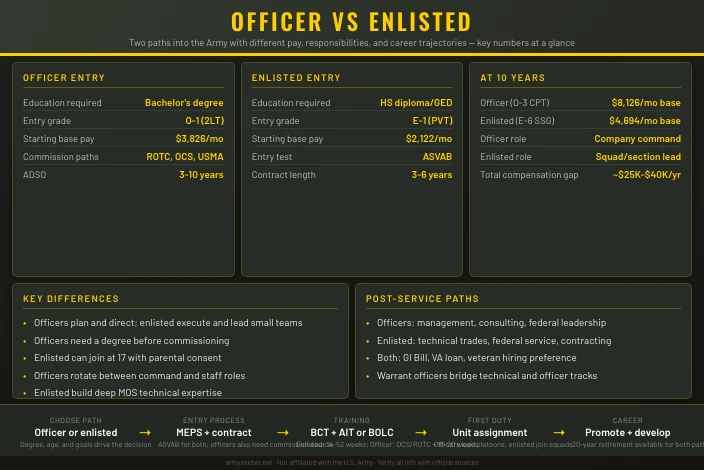
The Three Paths Into the Army
The Army has three distinct entry tracks, and understanding the difference upfront saves a lot of confusion later.
Enlisted Soldiers make up about 83% of the force. They join under a specific Military Occupational Specialty (MOS) and spend most of their career doing hands-on technical and operational work. Advancement is performance-based and relatively fast in the early years.
Commissioned officers lead units and manage resources. They come in at a higher pay grade but carry significant responsibility from the start. The Army commissions officers through four primary programs:
- ROTC (Reserve Officers’ Training Corps): complete a 4-year degree with concurrent military training at a host university. This is the largest commissioning source.
- OCS (Officer Candidate School): a 12-week program at Fort Moore, Georgia for college graduates who did not complete ROTC. Open to civilians and enlisted Soldiers.
- West Point (United States Military Academy): a 4-year federal service academy with a fully funded degree and direct commission upon graduation.
- Direct Commission: for licensed professionals (doctors, lawyers, nurses, chaplains) who receive direct appointment based on their credentials.
Warrant officers are a third track entirely. They are technical specialists, Army aviators, intelligence analysts, cyber operators, and maintenance technicians, who hold authority through a warrant rather than a commission. They outrank all enlisted Soldiers but sit below commissioned officers. Warrant officers are not generalists; they spend entire careers mastering one specialty.
Entry Requirements Side by Side
The biggest practical difference between paths is what you need before you can start.
| Requirement | Enlisted | Warrant Officer | Commissioned Officer |
|---|---|---|---|
| Education | High school diploma or GED | HS diploma + usually E-5 or higher with 5-12 years TIS | Bachelor’s degree required |
| ASVAB (AFQT) | 31 minimum (50 with GED) | GT score of 110+ (no waivers) | No AFQT minimum, but GT score affects branch options |
| Age | 17-34 | Up to 46 (33 for aviation) | Accept commission before age 31 (OCS) |
| Degree | Not required | Not required | Required before commissioning |
| Prior service | Not required | Required for most warrant MOS (exceptions for WOFT) | Not required |
A few notes on these numbers. The enlisted ASVAB minimum of 31 is a floor; competitive MOS jobs require much higher composite scores. The warrant officer GT score of 110 has no waiver, that’s a hard cutoff. For officers, the minimum AFQT isn’t the barrier. Branch competitiveness and physical fitness are.
The Army Warrant Officer Flight Training (WOFT) program is the one significant exception to the prior-service rule. Civilians with no military background can apply directly for WOFT to become Army helicopter pilots.
Pay: What You Actually Earn
All figures below reflect the 2026 pay tables, effective January 1, 2026 (3.8% raise).
Enlisted Pay
A new E-1 earns $2,407 per month in base pay. By the time a Soldier reaches E-5 Sergeant with three years of service, that rises to $3,776 per month. A Staff Sergeant (E-6) at six years earns $4,236 per month.
These numbers don’t tell the full story. Enlisted Soldiers also receive:
- BAS of $476.95 per month (Basic Allowance for Subsistence)
- BAH based on duty location, pay grade, and dependent status (at Fort Sam Houston, an E-4 with dependents receives $1,728 per month)
- Tax-free status for BAS and BAH
Officer Pay
A new O-1 Second Lieutenant starts at $4,150 per month. An O-3 Captain at four years earns $7,383 per month, which is significantly more than an enlisted peer with the same time in service. Officers receive a lower BAS rate of $328.48 per month, but higher BAH rates at most installations.
Warrant Officer Pay
Warrant officers sit between the two. A W-1 with under two years earns $4,057 per month, climbing to $5,786 at ten years. The W-3 Chief Warrant Officer 3 at ten years earns $6,911 per month, which puts a mid-career warrant officer ahead of an O-2 or junior O-3 in base pay.
For a detailed breakdown with bonus data, the Army officer vs enlisted pay comparison covers every grade across a 20-year career.
Training Pipelines
How long before you actually reach your first duty assignment depends entirely on which path you take.
Enlisted Training Timeline
- Basic Combat Training (BCT): 10 weeks at one of several training centers (Fort Jackson, Fort Leonard Wood, Fort Moore, Fort Sill, Fort Knox, Aberdeen Proving Ground)
- Advanced Individual Training (AIT): Varies by MOS, as short as 4 weeks for some administrative roles, up to 52 weeks for certain intelligence or technical specialties
- One Station Unit Training (OSUT): Infantry and Armor candidates complete a combined BCT/AIT at a single installation (22 weeks for Infantry)
Total time from enlistment to first duty assignment ranges from 14 weeks on the short end to well over a year for complex MOS jobs.
Officer Training Timeline
- Commissioning source: ROTC is 4 years concurrent with a bachelor’s degree. OCS is 12 weeks immediately after degree completion. West Point is 4 years.
- Basic Officer Leader Course (BOLC): Branch-specific training following commissioning. Duration varies; Field Artillery BOLC runs approximately 18 weeks, and some technical and medical branches run longer.
Officers reach their first unit later than enlisted Soldiers on a pure calendar basis, but they arrive with a degree and a commission in hand.
Warrant Officer Training Timeline
- Warrant Officer Candidate School (WOCS): 5 weeks at Fort Novosel, Alabama
- Warrant Officer Basic Course (WOBC): MOS-specific technical training at the relevant branch school
Aviation warrant officers have the longest pipeline. After WOCS, they complete flight training at Fort Novosel before assignment. That total process can take 12 to 18 months depending on flight training scheduling and the aircraft type they qualify on.
Daily Life and Responsibilities
The day-to-day difference between an officer and an enlisted Soldier is substantial, and it starts from the first week.
Enlisted Daily Life
Enlisted Soldiers execute tasks. A 68W Combat Medic treats patients and runs aid stations. An 11B Infantryman conducts patrols, maintains equipment, and trains for combat operations. The work is often physical, technically demanding, and mission-focused. The biggest draw for many Soldiers: you develop real, portable skills fast.
Enlisted Soldiers generally work within structured schedules. They receive direction from NCOs (Non-Commissioned Officers) who serve as their direct supervisors, with officers setting the broader mission. Junior enlisted Soldiers have less autonomy than NCOs or officers, but that also means less administrative burden.
Officer Daily Life
Officers manage people, resources, and mission planning. A platoon leader at O-1 is responsible for 16-44 Soldiers, their training readiness, welfare, and operational effectiveness. That responsibility does not wait for experience to accumulate. A 22-year-old Second Lieutenant is in charge on day one.
Officers spend significantly more time on administrative and planning tasks than enlisted Soldiers. Email, briefings, training management, and personnel evaluations are constant. The further up the rank structure, the more administrative and the less tactical the work becomes.
Warrant Officer Daily Life
Warrant officers occupy a distinct lane. They are the Army’s subject-matter experts. An aviation warrant officer (15 series) flies and leads crews. An intelligence warrant (350F) analyzes all-source intelligence and advises commanders directly. They are not expected to be generalists. They are expected to be the best in their specialty, and that focus defines their daily work.
Leadership Responsibility and Career Progression
The clearest structural difference between paths is when and how you lead.
Enlisted Progression
| Grade | Title | Typical Time in Service |
|---|---|---|
| E-1 | Private (PV1) | Entry |
| E-4 | Specialist (SPC) | ~2 years |
| E-5 | Sergeant (SGT) | ~3-4 years |
| E-7 | Sergeant First Class (SFC) | ~10-15 years |
| E-9 | Sergeant Major (SGM) / Command Sergeant Major (CSM) | 20+ years |
NCO leadership is peer leadership. Sergeants lead other Soldiers through technical expertise and direct mentorship. The Sergeant Major is one of the most influential figures in any unit, not because of rank alone, but because of experience, institutional knowledge, and proximity to the enlisted force.
Officer Progression
| Grade | Title | Typical Time in Service |
|---|---|---|
| O-1 | Second Lieutenant (2LT) | Entry |
| O-3 | Captain (CPT) | ~4-6 years |
| O-4 | Major (MAJ) | ~10-12 years |
| O-6 | Colonel (COL) | ~20-22 years |
| O-7+ | General Officer | Competitive selection |
Promotion above O-3 is increasingly competitive. Not every Captain makes Major, and the selection rates tighten further at O-5 and O-6. Officers who don’t advance are typically separated under the “up or out” policy.
Warrant Officer Progression
Warrant officers progress from W-1 through W-5. They are not evaluated on their potential for command; they are evaluated on technical mastery and performance within their specialty. A CW4 or CW5 with 20+ years of aviation experience is among the most respected figures in any unit. Promotion is slower and more deliberate than enlisted, but warrant officers rarely face the same “up or out” pressure as commissioned officers.
The College Question
If you have a degree or are currently working toward one, the officer path is available to you. But having a degree doesn’t automatically make the officer path the right choice.
Some qualified college graduates choose to enlist for specific reasons:
- A specific MOS that doesn’t exist as an officer job (most technical specialties are enlisted)
- Desire for immediate hands-on work rather than management
- Enlistment bonuses that can reach tens of thousands of dollars for in-demand specialties
- Preference to start at a lower rank and earn leadership authority over time
The Should I Go Officer or Enlisted After College post covers this specific decision in detail.
If you’re coming out of ROTC and weighing active duty against a Reserve commitment, that’s a different question. The post on going active duty or Reserve after ROTC covers it directly.
The Warrant Officer Path: When It Makes the Most Sense
Most people researching this decision don’t seriously consider warrant officer as an option. They should.
Warrant officer is the right path when you want to spend a career doing technical work at the highest level, not managing budgets and briefings. If you want to fly Army helicopters, the warrant officer path (specifically WOFT) gets you into the cockpit faster than the commissioned officer route. Strong cyber, intelligence, or electronic warfare skills also map well to warrant MOS jobs in those fields, which offer depth that enlisted and officer paths don’t.
The requirements are narrow. You need a GT score of 110 or higher on the ASVAB, and most warrant MOS require an E-5 or above rank with 5-12 years of time in service before applying. Aviation is the exception; WOFT accepts civilians directly.
For a full breakdown of how to qualify, the how to become an Army warrant officer post walks through every step of the application and selection process.
Post-Service Outcomes
The paths diverge most visibly once a Soldier separates or retires. The officer advantage in civilian credentialing is real, but it’s not the whole picture.
Enlisted Post-Service
Enlisted veterans leave with job-specific technical skills and experience that translate well into trades, healthcare, logistics, law enforcement, federal contracting, and IT. A 68W Combat Medic can sit for EMT or paramedic certifications. A 25U Signal Soldier has a direct path into network operations and IT infrastructure roles.
The Post-9/11 GI Bill covers full in-state tuition at public universities, plus a monthly housing allowance, giving enlisted veterans a strong path to degrees after service. Many use the GI Bill to complete bachelor’s degrees and then pursue graduate school or professional certifications.
Officer Post-Service
Officers typically exit with leadership credentials that translate directly into management and executive roles. A Captain with company command experience is a competitive MBA applicant. Top business schools actively recruit military officers for their leadership background and decision-making experience under pressure.
The Army also offers the Funded Legal Education Program (FLEP), which pays full tuition for eligible officers to attend accredited law schools while remaining on active duty.
Officers who complete 20 years retire with a pension starting at 40% of their high-36 average base pay, plus TSP matching that begins in the third year of service. An O-5 retiring at 20 years with a high-36 of roughly $10,000 per month would receive approximately $4,000 per month in retirement pay, starting immediately.
Warrant Officer Post-Service
Warrant officers often have the most marketable niche skills of all three paths. Army aviators are in high demand at airlines, helicopter operators, and federal agencies. Intelligence and cyber warrant officers exit into defense contracting roles that frequently pay six figures from day one.
Direct Commission: A Special Case
The Army offers direct commissioning for licensed professionals in specific fields: primarily medical, dental, legal, and chaplain. If you’re already a physician, nurse, dentist, attorney, or ordained minister, you can receive an officer commission commensurate with your civilian credentials without completing ROTC or OCS.
Direct commission programs have their own age limits, licensing requirements, and service obligations that differ from standard officer programs. The Army direct commission programs explained post covers the full eligibility requirements and application process.
Choosing Your Path: A Practical Framework
Before signing anything, work through these four questions:
- Do you have a bachelor’s degree, or a concrete plan to get one? If not, enlisted or warrant officer (for those who qualify) is the realistic path today. Officer candidacy requires a degree by commissioning date.
- Do you want to lead from day one, or develop expertise first? Officers lead immediately. Enlisted Soldiers build expertise and earn leadership authority over time.
- Is there a specific technical specialty you want to master? If yes, check whether that specialty exists as a warrant officer MOS before defaulting to enlisted. Warrant officers get more depth, more pay, and more prestige in their specialty than enlisted peers.
- How long are you willing to commit? Enlisted contracts can start at 3 years. Officers typically serve 4 years minimum after commissioning. ROTC scholarship recipients incur an 8-year total service obligation (active plus reserve).
No path is objectively better. Each serves a different type of person with different goals. The Army needs all three.
Explore Army officer career paths and Army enlisted career paths to see the specific jobs available in each track.
This site is not affiliated with the U.S. Army or any government agency. Verify all information with official Army sources before making enlistment or career decisions.