Army Reserve Benefits: What You Actually Get
The Army Reserve pitch sounds almost too good: keep your civilian job, serve one weekend a month, collect a military paycheck, and still get healthcare, education benefits, and a retirement. Some of that is accurate. Some of it requires more context than a recruiter will give you at the first meeting.
Here is what the benefits package actually looks like, with real numbers attached.
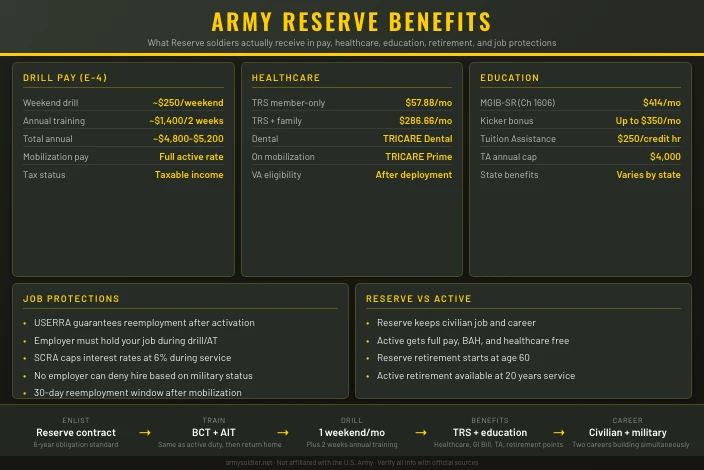
Drill Pay: The Monthly Check
Reserve pay works differently from active duty. You earn money only when you’re in a duty status – drill weekends, annual training, and any additional orders. There’s no base salary.
The formula is straightforward: (monthly base pay ÷ 30) × number of drill periods. A standard drill weekend counts as four Unit Training Assemblies (UTAs), so you’re paid for four periods.
Sample Weekend Drill Pay (4 UTAs, 2026 rates)
| Grade | Years of Service | Weekend Pay |
|---|---|---|
| E-3 | Less than 2 | $378 |
| E-4 | Less than 2 | $419 |
| E-4 | 3 years | $464 |
| E-5 | Less than 2 | $446 |
| E-5 | 3 years | $503 |
| E-6 | 6 years | $565 |
| O-1 | Less than 2 | $553 |
| O-3 | 3 years | $903 |
Beyond drill weekends, you also get two weeks of annual training (AT) per year. AT pay is one day of active-duty base pay for each day on orders, so a two-week AT earns 14 days’ worth. A sergeant (E-5) with under two years logs roughly $1,115 from a standard AT period.
When you mobilize to active duty – whether for a deployment or a special assignment – drill pay disappears entirely and you shift onto full active-duty base pay. The same tables that govern active-duty soldiers govern you. An E-5 on active orders earns $3,343 per month at under two years of service, plus housing and food allowances.
Healthcare: What TRS Covers and What It Costs
Active-duty soldiers pay nothing for healthcare – no premium, no deductible, no copay under TRICARE Prime. The Reserve runs on a different plan called TRICARE Reserve Select (TRS).
TRS is a premium-based plan available to drilling members not on active-duty orders. The 2026 monthly rates:
| Coverage | Monthly Premium |
|---|---|
| Member only | $57.88 |
| Member + family | $286.66 |
That’s not nothing, but compare it to the civilian market. A comparable employer-sponsored family plan often runs $500 to $700 per month in employee premiums, before deductibles. TRS at $286.66 covers medical, mental health, prescriptions, and hospitalization at cost-sharing rates that are far below most civilian plans.
The activation flip: The moment you go on orders over 30 days, TRS ends and full TRICARE Prime kicks in – $0 premiums, $0 copays, full coverage for you and your dependents. It switches back when your orders close.
One thing TRS does not include by default: dental. Dental coverage requires a separate enrollment in the TRICARE Dental Program. Vision coverage is also handled separately through the TRICARE Vision benefit.
Education: Two Paths, Different Triggers
Reserve soldiers have access to two federal education programs, and they work very differently.
Montgomery GI Bill – Selected Reserve (MGIB-SR, Chapter 1606) pays $493 per month for up to 36 months of education. You don’t need to deploy to use it. The requirements are a six-year Selected Reserve obligation, completion of initial entry training, a high school diploma or GED, and staying in good standing with your drilling unit. The catch: the benefit stops the moment you leave drilling status. If you separate before using it all, you lose the remainder.
Post-9/11 GI Bill (Chapter 33) is the more valuable program, but it has a harder trigger. You need at least 90 aggregate days of Title 10 active-duty service after September 10, 2001. Initial entry training – basic and AIT – does not count toward that threshold. Most Reserve soldiers earn Post-9/11 eligibility through deployments.
The benefit scales with cumulative active-duty time:
- 90 days: 40% benefit level
- 6 months: 50%
- 12 months: 60%
- 18 months: 70%
- 24 months: 80%
- 30 months: 90%
- 36+ months: 100%
At 100%, the Post-9/11 GI Bill covers full in-state tuition at public universities with no dollar cap, up to $29,920.95 per year at private schools, a monthly housing allowance pegged to the E-5-with-dependents BAH rate at your school’s ZIP code, and a $1,000 annual book stipend.
Both programs can be stacked against federal Tuition Assistance (TA) while you’re still drilling. TA covers $250 per semester hour, up to $4,500 per year, and it pays before GI Bill benefits apply. Reserve soldiers who use TA first can preserve their GI Bill months for later.
Retirement: Points, Not Years
Reserve retirement looks nothing like active-duty retirement. You don’t collect a pension at 20 years of service. You collect it at age 60, and the amount depends on how many retirement points you accumulated, not how many calendar years you served.
Points accrue from three sources:
- Drill periods: 1 point per UTA (48 per year from standard weekends)
- Active duty: 1 point per day on any orders
- Membership: 15 gratuitous points per year just for being in the unit
A “good year” requires 50 or more retirement points. You need 20 good years to qualify for retirement. A soldier who drills every month, attends annual training, and picks up no additional orders earns roughly 62 points per year (48 drill + 14 AT), comfortably above the 50-point threshold.
The pension formula: 2.5% × equivalent years of service × high-36 average basic pay. Points convert to equivalent years by dividing total points by 360. A soldier with 1,240 total retirement points at 20 good years has the equivalent of 3.44 years of service in the formula – much less than an active-duty soldier’s 20 equivalent years.
Early collection: Each 90 consecutive days of active duty under qualifying mobilization orders reduces the collection age by 90 days, down to a minimum of age 50. A Reserve soldier who deploys twice on 12-month mobilizations could be collecting at 57 instead of 60.
The Thrift Savings Plan (TSP) match is the same as active duty under the Blended Retirement System: 1% automatic government contribution after 60 days, then 100% match on the first 3% you contribute and 50% match on the next 2%, starting in year three. Contributions come out of drill and AT pay, so the dollar amounts are smaller – but the match percentages are identical.
Job Protections: USERRA
Civilian employers sometimes push back when employees need time off for drill or deployment. Federal law covers you here.
USERRA – the Uniformed Services Employment and Reemployment Rights Act – applies to every employer, regardless of size. The key protections:
- Your employer must hold your civilian position for up to five cumulative years of military service
- You cannot be denied a promotion, raise, or benefits because of your military obligations
- Your employer must offer continued health insurance during your absence (up to 24 months at COBRA-equivalent rates)
- You return with the seniority and benefits you would have earned had you not left
USERRA enforcement goes through the Department of Labor’s VETS division. If a complaint doesn’t resolve there, the Department of Justice can take it further. Most employers comply without incident, but knowing the law exists matters before you sign a contract.
The one thing USERRA does not do: it doesn’t require employers to pay you during military leave. Your civilian paycheck stops; your military drill pay starts. Some employers voluntarily make up the difference, especially federal agencies and large defense contractors. That’s a negotiation, not a right.
What the Reserve Doesn’t Provide
A few things that matter and are often misrepresented:
No Basic Allowance for Housing (BAH) while drilling. BAH is an active-duty allowance. Drilling reservists don’t receive it unless on active orders. When you mobilize, BAH kicks in at the rate for your duty location and pay grade – but it disappears when orders end.
No Basic Allowance for Subsistence (BAS) while drilling. Same rule. BAS only applies when on active orders.
No commissary or exchange access by default. Reserve soldiers who have deployed to a combat zone or earned retirement eligibility may have exchange access, but routine drilling status does not automatically confer it at all installations.
Dental and vision are not automatic. Both require separate enrollment through TRICARE programs. They’re available and reasonably priced, but they require action on your part.
The Realistic Picture
For many people, the Reserve package is genuinely competitive – particularly the healthcare costs, education benefits, and retirement contribution from the TSP match. A drilling E-5 with a civilian job paying full benefits already is adding a part-time income stream and building toward retirement points without disrupting their primary career.
The friction points are real too. Drill weekends don’t move around your life. Annual training takes two to three weeks of leave every year. Mobilization can arrive without much warning and last a year or more. The benefits come attached to those obligations.
If you want the deeper comparison between Reserve, Guard, and Active Duty before deciding, Active Duty vs Army Reserve vs National Guard covers all three components side by side. If you’re weighing a specific MOS, Can You Be a 68W in the Army Reserve? shows how benefits and training work for one of the most common Reserve medical roles. The Army benefits guides break down each benefit category in full detail.
This site is not affiliated with the U.S. Army or any government agency. Verify all information with official Army sources before making enlistment or career decisions.