Army Special Forces vs 75th Ranger Regiment
Both units carry serious reputations, and both require you to earn your way in. But Special Forces and the 75th Ranger Regiment are built for fundamentally different missions – and choosing the wrong one wastes years of your life chasing a role that doesn’t fit how you think or what you want to do. One force trains foreign armies and runs long-term unconventional campaigns. The other executes precision direct-action raids and is ready to deploy within 18 hours. Understanding that difference before you enlist is worth more than any recruiter conversation.
Mission: What Each Force Actually Does
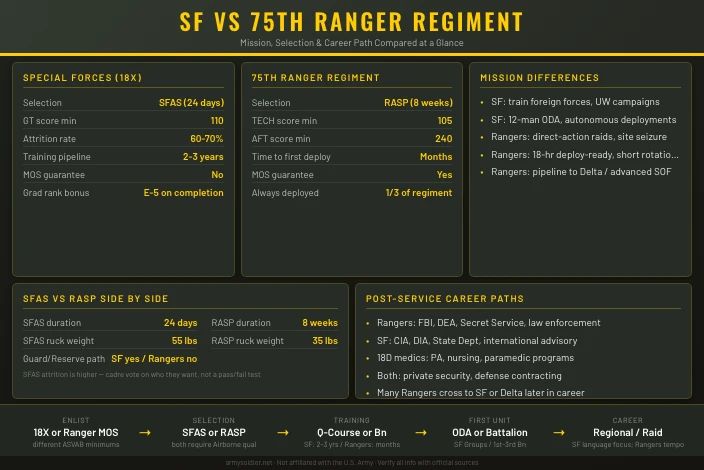
The clearest way to separate these two units is by what they’re asked to accomplish on the ground.
Special Forces – the Green Berets – operate through other people. A 12-man Operational Detachment-Alpha, or ODA, deploys into a country and spends months building the combat capability of a partner nation’s military. The ODA might train a battalion of local soldiers, collect intelligence on extremist networks, or run unconventional warfare campaigns that support indigenous resistance movements. The team is designed to multiply force by working through locals rather than replacing them.
The 75th Ranger Regiment is the Army’s premier raid force. Three battalions train constantly to execute direct-action missions at a moment’s notice – hit a target, seize an airfield, recover a hostage, exploit a site for intelligence. Rangers deploy more frequently and for shorter rotations than most SOF units. At any given time, roughly one-third of the Regiment is deployed. The mission is high-intensity, short-duration, and repeatable.
This split runs through every other difference between the two: selection, training, daily life, and what happens after you leave.
Selection: SFAS vs RASP
Getting into each unit requires passing a dedicated selection program, but they test for different things.
SFAS (Special Forces Assessment and Selection)
SFAS runs 24 days at Camp Mackall, North Carolina. Cadre assess candidates on physical endurance, mental resilience, and – critically – individual judgment under sustained stress. The course includes ruck marches of 12 to 18 miles per day with a 55-pound pack, solo land navigation day and night, and team events explicitly designed to find who quits under pressure.
There’s no formal graduation ceremony. Cadre observe candidates across the full 24 days and vote on who they want in their regiment. Roughly 60-70% of candidates do not pass. Wash out and the Army reassigns your MOS – the 18X contract carries no job guarantee.
Physical minimums to attend SFAS:
- GT composite score: 110 minimum
- CO composite score: 100 minimum
- U.S. citizenship and Secret clearance eligibility
- Age 19-34 at enlistment
- Airborne School qualification
RASP (Ranger Assessment and Selection Program)
RASP is 8 weeks total at Fort Moore, Georgia, split into two phases. Phase 1 covers five weeks of physical and psychological assessment – including a 12-mile ruck march with a 35-pound rucksack, land navigation, and a medical first responder test. Phase 2 covers three weeks of skills training: direct-action tactics, airfield seizure, personnel recovery, marksmanship, and explosives.
RASP 1 is for lower enlisted through sergeant. Senior NCOs, officers, and warrant officers attend the separate 3-week RASP 2, which focuses on leadership assessment.
Minimums to attend RASP:
- ASVAB TECH score: 105 or higher
- Army Fitness Test score of 240+ (80 on each event)
- 15-meter swim in full uniform
- Five-mile run under 40 minutes during selection
- Active-duty status required – no Guard or Reserve path
- U.S. citizenship and Secret clearance eligibility
Side-by-Side Comparison
| Factor | SFAS (SF) | RASP (Rangers) |
|---|---|---|
| Duration | 24 days | 8 weeks |
| Location | Camp Mackall, NC | Fort Moore, GA |
| ASVAB minimum | GT 110 | TECH 105 |
| Attrition rate | 60-70% | High but lower than SFAS |
| MOS guarantee | No (18X) | Yes – enlist into specific MOS |
| Airborne | Required | Required |
| Guard/Reserve path | Yes (19th, 20th SFG) | No (active duty only) |
SFAS is longer by calendar time and carries higher attrition. RASP is harder to dismiss – the physical standards are demanding and the failure consequences still redirect your Army career. But the underlying design is different: SFAS looks for unconventional thinkers who can work alone in ambiguity; RASP looks for disciplined, aggressive soldiers who execute under fire.
Training Pipeline After Selection
Passing selection is only the beginning.
After SFAS, candidates enter the Special Forces Qualification Course (SFQC) – commonly called the Q-Course. The pipeline runs well over a year for most candidates and includes:
- Small unit tactics
- MOS specialty training (weapons, demolitions, medicine, communications, or intelligence)
- Survival, escape, resistance, and evasion (SERE)
- Robin Sage – a culminating 19-day unconventional warfare field exercise in the North Carolina countryside
- Language training, assigned by regional Group
The 18D medical sergeant track runs the longest, adding the Special Forces Medical Sergeant Course. Total pipeline from SFAS to first ODA assignment: 2 to 3 years depending on specialty.
After RASP, Rangers report to one of three battalions and begin working up for deployment. The Regiment maintains one of the highest operational tempos in the Army. New Rangers deploy quickly – often within their first year. Ranger School, the 61-day leadership course, is required for sergeants and above and is typically attended after initial combat deployments, not before.
The Ranger pipeline gets you operational far faster than SF. A new 11B Ranger private can be on a raid force within months of arriving at the Regiment. A new 18X candidate will spend two or more years in training before seeing a Group assignment.
Deployment Tempo and Daily Life
The day-to-day experience in each unit reflects their different purposes.
Rangers live on a perpetual readiness cycle. The Regiment deploys on rotation – one battalion forward while the others train and recover. Deployments are typically shorter (60-120 days is common), but they happen frequently. Between cycles, Rangers spend the bulk of their time on physical training, small-unit tactics, and rehearsing mission sets. There’s less ambiguity in a Ranger’s schedule: you train, you deploy, you come back, you train again.
Green Berets run longer, more autonomous deployments – often 6 to 9 months – in remote locations with minimal conventional support. An ODA in West Africa might go weeks without contact with higher headquarters. The job demands more than physical fitness. Language study, regional expertise, cultural fluency, and the ability to build trust with foreign counterparts are all part of the role. That makes the pace more intellectually demanding but also more varied.
| Factor | Rangers | Special Forces |
|---|---|---|
| Typical deployment | 60-120 days | 6-9 months |
| Deployment frequency | Multiple short rotations per year | 1-2 per year |
| Time at home station | High-tempo training cycle | Language study, area expertise, team prep |
| Autonomy | Low – tight chain of command | High – small teams, minimal oversight |
| Communication with HQ | Constant | Sometimes weeks without contact |
Both assignments are physically taxing. The Ranger Regiment’s intensity is compressed and repetitive. SF’s intensity spreads across a broader skill set over more time.
Career Progression
Promotions and career paths differ significantly between the two.
In Special Forces, enlisted soldiers earn an E-5 promotion upon completing the Q-Course regardless of time-in-service – a meaningful pay and rank bump for anyone who enters as a junior enlisted soldier. Career progression from there runs through team sergeant (E-7 to E-8), then to positions like 18Z Operations Sergeant Major. Officers and warrant officers follow parallel tracks tied to Group and theater command assignments.
In the Ranger Regiment, career progression follows standard Army promotion timelines but is accelerated by the Regiment’s operational reputation. Rangers are competitive candidates for virtually any follow-on assignment in the Army – including Special Forces. A significant portion of 18X candidates who arrive at SFAS come directly from the Ranger Regiment. The Regiment is often described as a steppingstone to SF, DELTA, or other advanced units – but it’s also a full career path for soldiers who want to stay in it.
Key career differences:
- SF: Guaranteed E-5 upon Q-Course completion; language pay; long-term regional specialization
- Rangers: Faster to operational assignment; Ranger Tab earned at Ranger School is permanent and career-enhancing; strong pipeline to advanced SOF units
Physical Standards
Both units demand serious fitness, but the standards reflect their missions.
Special Forces candidates train for sustained output over days and weeks – long ruck marches, sleep deprivation, and repeated high-output events with minimal recovery. The SFAS PT handbook published by USASOC recommends candidates run 5+ miles per day and ruck 3-4 times per week with progressively heavier loads in the months before selection.
Rangers train for explosive power and anaerobic capacity alongside endurance. Pre-RASP standards from the Regiment’s official recruiting page include:
- 41 hand-release push-ups
- 2-minute, 35-second plank
- 6 pull-ups
- 6-mile ruck march (time standard applies)
- Two-mile run
During RASP, candidates must complete a five-mile run under 40 minutes and a 12-mile ruck march with a 35-pound rucksack. PULHES rating of 111221 or better is required – no physical profile waivers.
Neither standard is casual. Both units drop candidates who can’t sustain performance across the full selection event, not just peak performance on a single test day. The biggest training mistake most candidates make is focusing on gym strength while neglecting rucking and land navigation – the two events that eliminate the most people at both SFAS and RASP.
Minimum preparation timelines for serious candidates:
- SFAS: 6-12 months of dedicated training before your ship date, with progressive ruck loads up to 55 lbs
- RASP: 3-6 months of targeted run and ruck training alongside calisthenics and swimming
Post-Service Outcomes
Veterans of both units translate well to civilian careers – but different industries value each background.
Ranger veterans frequently move into law enforcement, federal agencies (FBI, Secret Service, DEA), and private security contracting. The Regiment’s reputation for tactical discipline and physical excellence opens doors at agencies that prioritize direct-action competencies. Emergency services, firefighting, and executive protection are also common destinations.
Green Beret veterans carry a broader skill profile. Language fluency, regional expertise, and years of working with foreign governments make former SF soldiers competitive in intelligence community roles (CIA, DIA, NSA), State Department positions, international consulting, and defense contracting in advisory roles. The 18D medical sergeant track – arguably the most demanding enlisted medical training in the Army – produces veterans who often pursue civilian PA, nursing, or paramedic careers.
Special Forces also opens the door to the Army’s Warrant Officer ranks through re-enlistment and talent management boards. Many 18-series soldiers cross over to warrant officer slots after proving themselves at the team level.
Salary comparisons for common post-service roles:
| Career Path | Former Rangers | Former SF |
|---|---|---|
| Federal law enforcement (FBI, DEA) | $60,000-$95,000 entry | $60,000-$95,000 entry |
| Defense contracting | $75,000-$120,000 | $90,000-$150,000 (advisory roles) |
| Intelligence community | Less common | $80,000-$130,000 (CIA, DIA, NSA) |
| Private security | $80,000-$150,000 | $80,000-$150,000 |
| Medical (18D track) | N/A | PA, nurse, paramedic at $60,000-$120,000 |
The TS/SCI clearance that many SF soldiers carry adds a measurable salary premium in defense and intelligence roles – typically $15,000 to $30,000 above comparable uncleared positions.
Which One Fits You
The honest answer depends less on physical capability – both units require serious fitness – and more on what kind of work you want to do.
Choose Rangers if you want to be on a raid force quickly, prefer a tightly structured operational cycle, and want to prove yourself in direct combat before considering advanced SOF. The Regiment is not a stepping stone for everyone – many soldiers spend full careers there – but it does serve as one of the most respected pipelines in the Army if you want to go further.
Choose Special Forces if you’re drawn to working independently, have aptitude for languages, and want to shape outcomes through advising and unconventional methods rather than through brute force. The pipeline is long and the 18X contract offers no guarantee – but the ODA is one of the most capable small-unit structures the Army fields.
Many of the best SF candidates spent time in the Regiment first. The two paths aren’t mutually exclusive.
Learn more about both career fields in the Army special operations careers overview and review specific entry standards at special operations ASVAB and fitness requirements. For more on the full range of Army special operations enlisted jobs, including 18-series MOS profiles, browse the career directory.
This site is not affiliated with the U.S. Army or any government agency. Verify all information with official Army sources before making enlistment or career decisions.