Army Special Operations Careers: SF, PSYOP, Civil Affairs
Three Army career fields operate under the Special Operations umbrella, and they couldn’t be more different from each other. Special Forces soldiers train partner militaries and run unconventional warfare in denied areas. PSYOP specialists design influence campaigns that shape how foreign populations think and act. Civil Affairs soldiers build relationships with local governments and translate civilian conditions into military intelligence. All three require selection, all three deploy frequently, and all three demand skills the conventional Army doesn’t develop. The question is which one fits you.
What Makes Army Special Operations Different
Conventional Army units operate in large formations with clear chains of command and predictable duty days. Special operations units don’t work that way.
SOF soldiers deploy in small teams, often without conventional support nearby. They operate in politically sensitive environments where mistakes carry strategic consequences. Every assignment is high-stakes and low-supervision – which is exactly why the selection process is so demanding.
The conventional Army trains soldiers to execute orders within a defined task organization. Special operations trains soldiers to think independently, make judgment calls in ambiguous situations, and operate for weeks without guidance from higher headquarters. That distinction shows up at every stage, from selection screening to the way teams plan missions.
The three enlisted career fields covered here are:
- CMF 18 (Special Forces): 12-man Operational Detachment-Alpha teams that train foreign forces, conduct direct action raids, and run unconventional warfare campaigns
- CMF 37 (Psychological Operations): Influence operations specialists who produce targeted messaging to shape foreign audience behavior
- CMF 38 (Civil Affairs): Soldiers who engage civilian governments and populations to support military operations and reduce friction between forces and communities
All three fall under U.S. Army Special Operations Command (USASOC) and are based primarily at Fort Liberty, NC. All three require soldiers to be Airborne-qualified, pass a structured assessment and selection event, and complete a multi-week qualification course before joining an operational unit. The shared baseline is demanding; the specializations diverge significantly from there.
Who should read this: This comparison is written for soldiers deciding which SOF path to pursue and civilians considering a SOCOM-track enlistment. It covers selection requirements, training pipelines, and post-service outcomes for each career field side by side.
Special Forces (CMF 18)
Special Forces is the most physically demanding SOF career path and the longest training pipeline. You don’t enlist into a specific SF specialty – you enlist as 18X (Special Forces Candidate) and earn one of four MOS designations after completing the full pipeline.
What SF Soldiers Do
Each SF team is built around a 12-man Operational Detachment-Alpha (ODA). Every ODA has two officers and ten enlisted soldiers, with two soldiers in each of five specialties: weapons (18B), engineering and demolitions (18C), medicine (18D), communications (18E), and operations/intelligence (18F). The team is built to be self-sufficient for extended periods in austere environments.
ODAs operate across five mission sets: unconventional warfare, foreign internal defense, direct action, special reconnaissance, and counter-terrorism. In practice, most deployments blend several of these. A team in West Africa might spend six months training a partner nation’s infantry battalion while simultaneously collecting intelligence on extremist networks.
The five active-duty Special Forces Groups each focus on a specific region:
| Group | Home Station | Regional Focus |
|---|---|---|
| 1st SFG | Joint Base Lewis-McChord, WA | Indo-Pacific |
| 3rd SFG | Fort Liberty, NC | Africa |
| 5th SFG | Fort Campbell, KY | Middle East |
| 7th SFG | Eglin AFB, FL | Latin America |
| 10th SFG | Fort Carson, CO | Europe |
Your language assignment follows your Group’s regional focus. A soldier assigned to 7th Group will likely study Spanish; 1st Group might send you to Korean or an Indonesian dialect.
SF Entry Requirements
The GT composite minimum is 110. The CO composite minimum is 100. You also need a minimum AFQT of 31 (or 50 with a GED), Secret clearance eligibility, U.S. citizenship, and age between 19 and 34 for new enlistees.
Physical requirements at MEPS include a 50-meter swim in uniform and boots and qualification for Airborne School.
SFAS and the Training Pipeline
The 18X pipeline runs roughly two to three years from enlistment to earning the Green Beret.
| Phase | Location | Duration |
|---|---|---|
| Infantry OSUT | Fort Moore, GA | 22 weeks |
| Airborne School | Fort Moore, GA | 3 weeks |
| Special Forces Prep Course (SFPC) | Fort Liberty, NC | 6 weeks |
| Special Forces Assessment and Selection (SFAS) | Camp Mackall, NC | 24 days |
| SF Qualification Course (SFQC) | Fort Liberty, NC | ~53 weeks |
SFAS is the hardest filter. For 24 days at Camp Mackall, candidates ruck with heavy loads, navigate solo through dense North Carolina woods at night, and complete team events designed to find breaking points. The cadre assess physical endurance, land navigation ability, leadership under pressure, and mental resilience – not speed or raw strength.
The SFQC follows a strict sequence: orientation, small unit tactics, MOS-specific training, language and culture, SERE, and Robin Sage – the final unconventional warfare exercise in the fictional country of Pineland. The MOS training phase varies significantly by specialty: 18B (weapons) is on the shorter end, while 18D (medicine) can run 58 weeks of training alone.
Graduates earn E-5 (Sergeant) upon completing SFQC, regardless of time in service.
SF Career Progression
After earning the Green Beret, a typical career track looks like this:
| Rank | Role | Typical Timeline |
|---|---|---|
| E-5 (SGT) | ODA team member (18B/C/D/E) | SFQC graduation |
| E-6 (SSG) | Senior team member | 2-4 years after tab |
| E-7 (SFC) | Team sergeant candidate (18Z) | 6-10 years after tab |
| E-8 (MSG) | Company operations sergeant | 12-16 years total |
| E-9 (SGM) | Group or command level | 18+ years total |
The 18Z (Special Forces Operations Sergeant) position at E-7 is one of the most respected roles in the Army. The team sergeant runs the enlisted side of an ODA and is usually the most experienced Green Beret on the team.
Psychological Operations (CMF 37)
PSYOP is the least understood of the three career fields – and the one with the most direct impact on information warfare. As a 37F, you don’t carry more firepower than a conventional soldier. You carry analysis, media production skills, and a deep understanding of what motivates a foreign population.
What PSYOP Soldiers Do
A PSYOP specialist plans, produces, and distributes influence products across print, broadcast, digital, and face-to-face channels. That could mean designing leaflets dropped ahead of a military advance, scripting radio broadcasts aimed at enemy combatants, managing social media campaigns targeting hostile audiences, or advising a battalion commander on how cultural dynamics affect his mission.
Deployed teams embed with conventional or SOF units and run real-time influence operations. The analysis side is constant: studying target audiences, reviewing intelligence, and assessing what messages actually change behavior. Garrison time goes toward research, product development, and maintaining language skills.
PSYOP Entry Requirements
The GT composite minimum is 107, plus a Defense Language Aptitude Battery (DLAB) score of 85 or higher. The DLAB tests your ability to learn foreign languages – not your current language knowledge. Every PSYOP soldier will be assigned a language, so this test is mandatory.
You must be a U.S. citizen with Secret clearance eligibility and qualified for Airborne School.
For current soldiers reclassifying into 37F: rank E-2 to E-5 (non-promotable), 18 or more months of service, no more than 10 years of service, and at least 36 months remaining.
POAS and the Training Pipeline
Before the qualification course, new PSYOP candidates go through the PSYOP Assessment and Selection (POAS) – a 10-day evaluation at Fort Liberty that tests physical and psychological fitness. Candidates who clear POAS move into the qualification course.
The PSYOP Qualification Course runs approximately 43 weeks and covers:
- Basic foreign language speaking and listening proficiency
- Military intelligence analysis
- Advanced interpersonal communication
- Cultural analysis and influence theory
- Advanced social media production and marketing
- Airborne School (if not already complete)
Language assignment options include Arabic, Chinese-Mandarin, French, Korean, Persian-Farsi, Russian, Spanish, Tagalog, Thai, and Indonesian-Bahasa. Your assignment depends on Army needs and your DLAB profile.
PSYOP soldiers earn language proficiency pay on top of base pay, plus jump pay for Airborne-qualified personnel.
PSYOP Career Progression
Most 37F graduates enter at E-3 or E-4 after the training pipeline. Promotion follows standard enlisted timelines from there.
Senior PSYOP NCOs move into team leader and staff roles within Tactical PSYOP Detachments, PSYOP battalions, or theater special operations commands. The civilian skill transfer is strong: intelligence community agencies, State Department, and defense contractors actively recruit former PSYOP soldiers for information operations, foreign influence analysis, and communications roles.
Civil Affairs (CMF 38)
Civil Affairs occupies a unique space in the military. Most Army jobs focus on defeating an enemy. A 38B focuses on the population around that enemy – the local mayor, the tribal council, the NGO running a clinic across the street from a checkpoint. Understanding and managing those relationships is a force multiplier no infantry unit can replicate.
What Civil Affairs Soldiers Do
38B specialists conduct civil reconnaissance, assess infrastructure damage and community needs, and build working relationships with local governments and civilian organizations. Their reports feed directly into the intelligence and operations planning cycle.
Common mission types include:
- Civil reconnaissance: mapping governance gaps, infrastructure status, and civilian population dynamics
- Humanitarian assistance coordination: working with NGOs and international organizations during stability operations
- Nation-building support: identifying critical civilian needs like water, power, medical access, and education
- Commander advisory: briefing senior leaders on civil considerations that affect the military mission
Civil Affairs soldiers operate across seven functional specialties: Rule of Law, Economic Stability, Infrastructure, Governance, Public Health and Welfare, Public Education, and Civil Information Management. Senior soldiers typically develop depth in one or two based on their background and assignments.
Civil Affairs Entry Requirements
The GT composite (or TECH score equivalent) minimum is 107 for new enlistees. A DLAB score of 65 or higher is required. Secret clearance eligibility and U.S. citizenship are mandatory. Physical requirements include passing the AFT and meeting height and weight standards.
For reclassifying soldiers: rank E-3 through E-6 with appropriate time in service and grade.
CAAS and the Training Pipeline
Civil Affairs candidates go through the Civil Affairs Assessment and Selection (CAAS) before the qualification course. The selection evaluates candidates on character, courage, commitment, and intellectual capacity.
The full training pipeline runs seven phases:
| Phase | Focus |
|---|---|
| Basic Training + AIT | Combat tactics and reconnaissance (combined) |
| Airborne School | Parachute operations |
| Prep for Assessment and Selection | Physical and mental conditioning |
| CAAS | Character, courage, commitment, and intellect |
| SOF Basic Leaders’ Course | Small team leadership skills |
| Civil Affairs Qualification Course | Army doctrine, conflict operations, field training, foreign language |
| Assignment | 95th Civil Affairs Brigade, Fort Liberty |
The Civil Affairs Qualification Course covers doctrine, conflict operations, field training exercises, and introductory foreign language instruction. Active-duty graduates go to the 95th Civil Affairs Brigade at Fort Liberty.
Civil Affairs Career Progression
CA soldiers build expertise over time through functional specialty depth and regional knowledge. Senior NCOs move into team leader positions, staff roles at Civil Affairs battalions, and senior advisor billets embedded with conventional brigades or SOF task forces.
Post-service opportunities are strong. CA veterans land in USAID, State Department consulting, intelligence agencies, and international development firms at high rates. The combination of language exposure, governance experience, and security clearance opens doors few other Army backgrounds can match.
Comparing the Three Pipelines
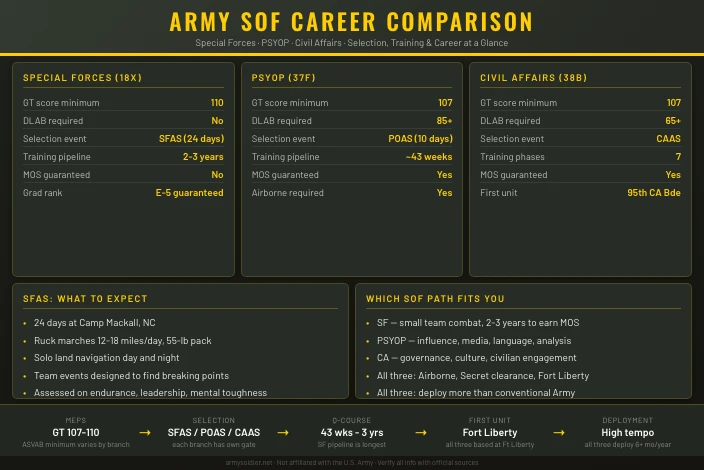
The selection requirements, training timelines, and career experiences differ substantially. Here’s a direct comparison:
| Feature | Special Forces (18X) | PSYOP (37F) | Civil Affairs (38B) |
|---|---|---|---|
| GT Score | 110 | 107 | 107 |
| DLAB Required | No | Yes (85+) | Yes (65+) |
| Selection Event | SFAS (24 days) | POAS (10 days) | CAAS |
| Training Pipeline | ~2-3 years | ~43 weeks post-POAS | 7 phases |
| MOS Guaranteed | No | Yes | Yes |
| Airborne Required | Yes | Yes | Yes |
| Rank at Graduation | E-5 guaranteed | E-3 to E-4 typical | E-3 typical |
| Clearance | Secret (TS common) | Secret | Secret |
| Primary Skill Set | Combat, language, UW | Influence, media, analysis | Governance, culture, assessment |
One critical distinction: the 18X contract does not guarantee you an SF MOS. Wash out of SFAS or the SFQC and the Army reassigns you to a needs-of-the-Army job. PSYOP and Civil Affairs follow more structured pipelines where candidates who meet baseline requirements and clear the assessment course are far more likely to graduate with their intended MOS.
Key takeaways from the comparison:
- Risk tolerance: 18X carries real wash-out risk with no MOS guarantee; 37F and 38B are structured pipeline contracts
- Time investment: SF requires two to three years before you join an operational team; PSYOP and CA pipelines run under a year from POAS/CAAS to unit assignment
- Language requirement: Both PSYOP and Civil Affairs require a DLAB score; SF does not require a qualifying DLAB score for enlistment, though language training is part of SFQC
- Rank upside: SF graduates to E-5 automatically; PSYOP and CA graduates typically enter units at E-3 or E-4 and promote on standard enlisted timelines
Physical Standards Across SOF
All three career fields require Airborne School and regular Army Fitness Test compliance. Combat MOS standards (which apply to all CMF 18 positions) require a minimum AFT total score of 350 out of 500.
PSYOP and Civil Affairs require passing the AFT at standard minimums. But every SOF unit holds its soldiers to a higher bar than the Army floor. Units at Fort Liberty maintain internal physical training standards that exceed Army baseline requirements, and soldiers who can only meet the minimum tend to struggle in unit culture even if they technically pass every official test.
For SFAS specifically, prepare for:
- Ruck marches of 12-18 miles daily carrying a 55-pound pack
- Solo land navigation events, day and night, across multiple consecutive days
- Team events designed to push candidates well past their comfort zones
- 24 days of sustained physical and psychological stress with minimal sleep
- A swim assessment in uniform and boots before enlistment is finalized
How to prepare: Most SFAS candidates who succeed begin structured preparation 6-12 months out, with weekly ruck mileage, loaded carries, and running volume increasing progressively. The SFPC (Special Forces Prep Course) provides pre-SFAS conditioning, but arriving to SFPC already in strong shape significantly improves your outcome.
The strongest predictor of SFAS success is not peak fitness – it’s sustained fitness under weeks of sleep deprivation and physical attrition. Candidates who prepare seriously for 6-12 months before shipping consistently outperform those who ramp up at the last minute. For POAS and CAAS, both evaluations include physical testing components, but neither matches the duration or intensity of SFAS.
Deployment Tempo and Lifestyle
All three SOF career fields deploy more often than conventional Army jobs. Soldiers who choose any of these paths should plan for frequent and extended time away from home station throughout their career, not just in their first assignment.
Special Forces soldiers typically rotate on 3-6 month deployments, with 6-12 months at home station between rotations. Some teams run multiple shorter Joint Combined Exchange Training (JCET) trips to partner nations per year. Annual time away from home routinely exceeds six months. In high-tempo periods, an ODA may complete two or three overseas trips in a single year.
PSYOP teams embed with supported units, so deployment frequency tracks the supported unit’s tempo. A team attached to a SOF task force deploys as often as that task force does. Deployed work runs 12-plus hour days across extended periods. A PSYOP soldier assigned to a conventional brigade will deploy on a different schedule than one supporting a Special Forces Group.
Civil Affairs soldiers operate in the same environments as SF and PSYOP but spend more time in stability and post-conflict phases. Deployments often persist into reconstruction and governance transition periods long after direct combat operations end. This can mean longer individual deployments, sometimes exceeding nine months, in locations where security is fragile but fighting has largely stopped.
All three require significant time away from home, with limited communication during certain mission types. Families at Fort Liberty benefit from well-established SOF community support networks, including unit family readiness groups and access to USASOC-specific family programs. The deployment frequency is a known factor going in – it is not a surprise that emerges after you earn the tab or complete the qualification course.
Which Career Field Fits You
The three SOF paths attract different types of people, and knowing that distinction saves time before you start preparing.
Special Forces fits someone who wants to operate at the edge of ground combat in a small, autonomous team. You need comfort with extreme physical hardship, willingness to spend years in the training pipeline before the job starts, and the ability to operate without a safety net far from conventional support. The 18X contract is also a gamble – no SF MOS is guaranteed.
PSYOP fits someone who thinks analytically, learns languages quickly, and wants to understand what drives human behavior. The work is less physically punishing than SF but requires sustained intellectual effort. If you’re drawn to intelligence analysis, media production, or strategic communication, the 37F pipeline leads to a career where your brain is the primary weapon.
Civil Affairs fits someone with strong interpersonal skills, genuine interest in governance and development, and patience for complex, ambiguous environments. A 38B who builds real trust with a tribal council over weeks of contact can produce intelligence that no surveillance platform can match. Post-service options in international development and government consulting are among the best of any Army MOS.
The Army special operations careers hub has full profiles on every MOS in these three career fields, including detailed pay tables, training timelines, and post-service career data for 18X Special Forces Candidate, 37F PSYOP Specialist, and 38B Civil Affairs Specialist.
You may also find how to get an 18X Special Forces contract, 37F PSYOP vs 38B Civil Affairs, Army Special Forces vs the 75th Ranger Regiment, and special operations ASVAB and fitness requirements helpful.
This site is not affiliated with the U.S. Army or any government agency. Verify all information with official Army sources before making enlistment or career decisions.