Army vs Civilian Pay: The Real Comparison
Most job comparisons stop at base pay. That’s exactly where the Army comparison goes wrong.
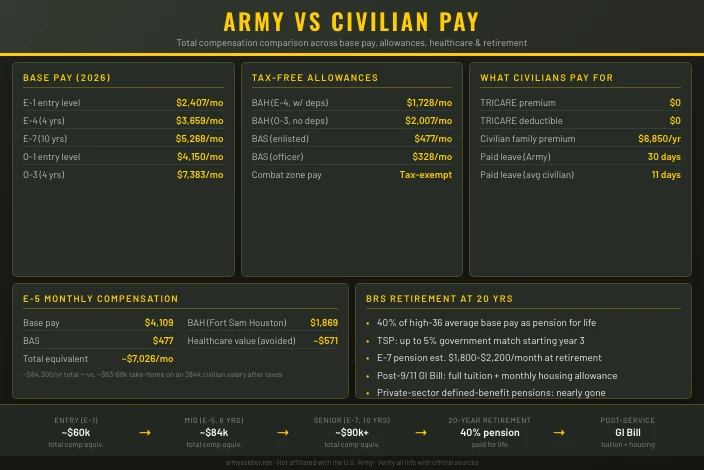
A new E-1 earns $2,407 per month in base pay, roughly $28,900 annually. Stack that against the BLS median annual wage of $49,500 for all U.S. workers and it looks like a bad deal. But that comparison ignores the housing allowance, free healthcare, no payroll taxes on allowances, and a retirement plan that civilian employers stopped offering 30 years ago. When you add it all up, the picture changes significantly.
Base Pay: Where the Army Starts Low
Army base pay scales with rank and years of service. It is not particularly competitive at entry level, and that’s worth being honest about.
An E-1 with under two years earns $2,407/month. An E-4 Specialist at the 4-year mark earns $3,659/month. By E-7 Sergeant First Class at 10 years, base pay reaches $5,268/month, or roughly $63,200 annually.
Officer pay starts higher. A new O-1 earns $4,150/month. An O-3 Captain at four years earns $7,383/month, about $88,600 annually. These figures reflect the 2026 pay table after a 3.8% raise took effect January 1.
| Rank | Years | Monthly Base | Annual Equiv. |
|---|---|---|---|
| E-1 | Under 2 | $2,407 | $28,884 |
| E-4 | 4 years | $3,659 | $43,908 |
| E-7 | 10 years | $5,268 | $63,216 |
| O-1 | Under 2 | $4,150 | $49,800 |
| O-3 | 4 years | $7,383 | $88,596 |
Raw base pay at E-1 through E-4 trails the civilian median. That’s the tradeoff at entry level. The gap closes quickly when you factor in what soldiers don’t pay for.
Housing: The Allowance Most People Ignore
Basic Allowance for Housing (BAH) is paid on top of base pay to soldiers who live off-post. It is tax-free and sized to cover median rental costs in the duty area.
Rates vary by location, rank, and whether you have dependents. As a reference, an E-4 at Fort Sam Houston, Texas receives $1,359/month without dependents or $1,728/month with dependents. An O-3 at the same installation gets $2,007/month without dependents.
That is money that never touches federal income tax. A civilian earning the equivalent amount would need to earn roughly $1,700-$2,500 gross (depending on their bracket) to take home those same dollars after taxes.
Soldiers who live in barracks on-post don’t receive BAH but also pay nothing for housing or utilities. Either way, housing is covered.
BAS: Food Allowance on Top of That
Basic Allowance for Subsistence (BAS) is a flat monthly food allowance, paid regardless of where a soldier eats. It is not subject to federal income tax.
| Category | Monthly BAS |
|---|---|
| Enlisted | $476.95 |
| Officers | $328.48 |
BAS doesn’t cover every grocery bill, but it offsets a real expense that civilian workers pay out of pocket with after-tax dollars.
Healthcare: The Number That Changes Everything
This is the most undervalued part of Army compensation for anyone who has ever paid civilian insurance premiums.
Active-duty soldiers receive TRICARE Prime at no cost: zero enrollment fee, zero deductible, zero copay for in-network care. Coverage extends to medical, dental, vision, mental health, prescriptions, and hospitalization. Family members are covered under the same plan at no premium.
By contrast, civilian employees pay an average of $6,850 per year toward family health insurance premiums, with total family premiums averaging $26,993 annually across all employer plans.
That $6,850 in annual employee premiums is money a soldier simply keeps. Add the deductibles, copays, and out-of-pocket costs civilians absorb, and the healthcare gap between Army and civilian compensation widens further.
Tax Advantages Civilians Never See
BAH and BAS are excluded from federal income tax. That changes the effective value of every dollar.
A soldier receiving $1,700/month in BAH doesn’t count that toward taxable income. For someone in the 22% federal bracket, that’s worth about $4,488 per year in avoided tax. On top of that, any pay earned in a designated combat zone is fully exempt from federal income tax, which can be a substantial benefit during deployment.
Civilian salaries are fully taxable. Every dollar of a $60,000 salary runs through federal, state, and payroll taxes before a worker sees it.
How It Adds Up: Three Career Snapshots
Putting it together at three career points shows the real picture.
Entry level (E-1, Year 1, Fort Sam Houston with dependents):
| Component | Monthly |
|---|---|
| Base pay | $2,407 |
| BAH (E-1 with dependents, est.) | ~$1,500 |
| BAS | $477 |
| Healthcare value (avoided cost) | ~$571 |
| Total monthly equivalent | ~$4,955 |
At $59,460 annually in total compensation, that entry-level soldier is close to the civilian median of $49,500 in raw pay terms, before accounting for the tax-free nature of allowances.
Mid-career (E-5 Sergeant, 6 years, Fort Sam Houston with dependents):
| Component | Monthly |
|---|---|
| Base pay | $4,109 |
| BAH (E-5 with dependents) | $1,869 |
| BAS | $477 |
| Healthcare value | ~$571 |
| Total monthly equivalent | ~$7,026 |
That’s roughly $84,300 annually. A civilian earning $84,300 gross in the same city would see about $63,000-$68,000 after payroll and income taxes, while still paying for housing and insurance.
Officer (O-3 Captain, 4 years, Fort Sam Houston without dependents):
| Component | Monthly |
|---|---|
| Base pay | $7,383 |
| BAH (O-3 without dependents) | $2,007 |
| BAS | $328 |
| Healthcare value | ~$571 |
| Total monthly equivalent | ~$10,289 |
That’s over $123,400 in annual equivalent compensation. For context, the BLS median for management occupations is around $75,000 annually.
Retirement: The Benefit Civilian Jobs No Longer Offer
Private-sector pensions are nearly extinct. The Army still has one.
Under the Blended Retirement System (BRS), soldiers who serve 20 years earn a pension equal to 40% of their average highest-36-month base pay, paid for life starting at retirement. At E-7 with 20 years, that’s roughly $1,800-$2,200 per month in pension income, every month, for the rest of their life.
BRS also includes Thrift Savings Plan (TSP) matching, which works on a schedule:
- 60 days in: government starts contributing 1% automatically
- Year 3+: government matches 100% on your first 3%, then 50% on your next 2%
- Contribute 5%: receive 5% total from the government (max match)
Contribute the full 5% at E-5 pay and you’re capturing roughly $200/month in free money. Few civilian jobs under $80,000 come with a defined-benefit pension and automatic employer matching.
GI Bill: The Post-Service Multiplier
The Post-9/11 GI Bill is not pay, but it functions like deferred compensation. After separation, eligible veterans receive up to 36 months of education benefits. That covers full in-state tuition at public universities with no dollar cap, plus a monthly housing allowance sized to the E-5 with dependents BAH rate at the school’s location.
What the GI Bill pays at a public university:
- Tuition and fees: covered in full (no dollar cap)
- Monthly housing allowance: $1,500-$2,000+ depending on city
- Annual book stipend: $1,000
- Total value over 4 years: can exceed $100,000
No civilian employer matches that as a post-service benefit. Private schools use the Yellow Ribbon program to cover tuition above the $29,920 annual cap.
Leave: 30 Days vs. Civilian PTO
Soldiers accrue 30 days of paid leave per year (2.5 days per month). That number is locked in from day one and doesn’t ramp up with tenure.
Compare that to BLS data on private-sector workers:
- 1 year of service: ~11 days average paid vacation
- 5 years of service: ~15 days average
- 10+ years: ~18-20 days at many employers
Most civilian workers don’t hit 30 days of total PTO until late in their career, if ever. The Army’s leave policy is genuinely competitive on this one.
The Real Downsides
Any honest comparison acknowledges the tradeoffs.
- Base pay is lower than many civilian jobs requiring similar education or technical skills, especially in the first four years.
- No overtime pay. Soldiers work whatever hours the mission demands. There is no time-and-a-half.
- Limited control over location. Assignments are Army-driven. A civilian can turn down a relocation; a soldier generally cannot.
- Deployment. Extended time away from family is a real cost, even if combat zone tax exclusion partially offsets it financially.
- Career field restrictions. Promotion, lateral moves, and specialization are governed by Army needs, not personal preference.
These aren’t deal-breakers for everyone, but they are real constraints worth weighing alongside the compensation advantages.
What the Comparison Actually Tells You
Army pay looks low on paper because most people only look at base pay. Total compensation, including BAH, BAS, tax-free treatment of allowances, zero-cost healthcare, TSP matching, and eventual pension, puts mid-career Army compensation on par with or ahead of many civilian jobs in the $60,000-$90,000 range.
The math is most favorable for enlisted soldiers at the E-5 through E-7 level with dependents at high-BAH duty stations. It is also compelling for junior officers relative to similarly-aged civilian professionals. At entry level, the gap is real but closes faster than the paycheck alone suggests.
For a full breakdown of each component, Army pay and benefits covers BAH lookup tools, retirement calculators, and healthcare enrollment. You can also explore Army enlisted careers and Army officer careers to see how specific roles affect advancement timelines and earning potential. If pay is just one factor in your decision, Is the Army Worth It? weighs the full picture of pros and cons. Day in the Life of an Army Soldier shows what you’re actually doing for those hours between PT and release. The bigger picture of military life is covered in What Army Life Is Really Like.
This site is not affiliated with the U.S. Army or any government agency. Verify all information with official Army sources before making enlistment or career decisions.