ASVAB Line Scores Explained: GT, ST, CL, MM and Every Army Composite
Your AFQT score gets you in the door. Your line scores decide which door you walk through. Most enlistees focus on the percentile number on their score report and miss the ten composite scores underneath it – the ones that actually determine which MOS contracts a recruiter can offer you. Understanding those composites before you test is the difference between a full list of options and a short one.
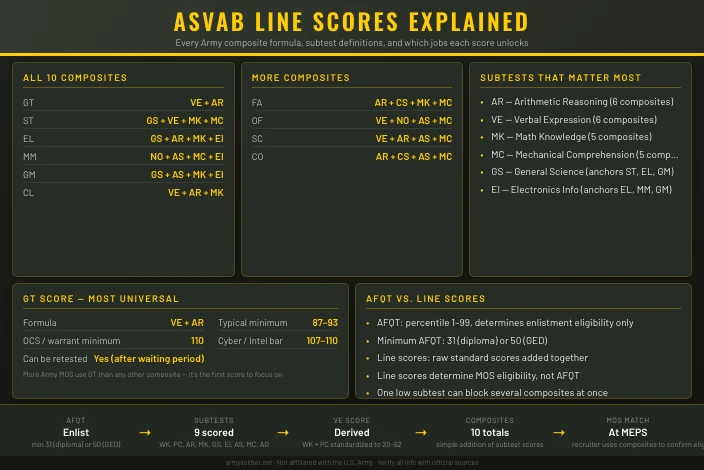
AFQT vs. Line Scores: Two Completely Different Things
The ASVAB produces two types of scores. Recruits mix them up constantly, and it leads to real problems at MEPS.
Want to improve your scores before MEPS? An ASVAB study guide with section-specific practice tests helps you target the exact subtests that feed your goal composite.
When you purchase through links on our site, we may receive compensation at no extra cost to you.
AFQT (Armed Forces Qualification Test) is a percentile score from 1 to 99. The Army uses four subtests to compute it: Arithmetic Reasoning (AR), Math Knowledge (MK), and Verbal Expression (VE, which is itself derived from Word Knowledge and Paragraph Comprehension). The formula is AR + MK + 2×VE, converted to a percentile. The only thing this score controls is whether you can enlist: 31 minimum with a high school diploma, 50 minimum with a GED.
Line scores (also called composite scores) are separate calculations that combine different subtest scores to produce ratings in ten skill areas. These ratings are what actually determine job eligibility. A recruiter cannot offer you an MOS unless your relevant composite meets the published minimum.
The key distinction: AFQT is a percentile. Line scores are raw point totals from adding standard scores together. They operate on completely different scales.
The 10 Army ASVAB Subtests
Before the composite formulas make sense, you need to know what each abbreviation means.
| Abbreviation | Subtest Name | What It Measures |
|---|---|---|
| AR | Arithmetic Reasoning | Word problems, applied math, ratios |
| MK | Mathematics Knowledge | Algebra, geometry, equations |
| WK | Word Knowledge | Vocabulary, synonyms, definitions |
| PC | Paragraph Comprehension | Reading passages, inference, main idea |
| VE | Verbal Expression | Derived score: WK + PC raw scores standardized to a 20-62 scale |
| GS | General Science | Biology, chemistry, physics, earth science |
| EI | Electronics Information | Circuits, current, voltage, electrical theory |
| AS | Auto and Shop Information | Engines, tools, automotive systems, woodworking |
| MC | Mechanical Comprehension | Pulleys, gears, levers, fluid dynamics |
| NO | Numerical Operations | Fast arithmetic, speed-based computation |
| CS | Coding Speed | Pattern matching, letter-number association |
| AO | Assembling Objects | Spatial reasoning, 2D-to-3D assembly |
VE is the only derived score – it doesn’t exist as a standalone subtest. The Army computes it from your WK and PC scores and uses it in six of the ten composites. AO, NO, and CS appear in fewer formulas than the others, but NO and CS still matter for specific MOS clusters.
All 10 Army Composite Formulas
The Army adds standard scores from specific subtests to produce each composite. No weighting, no curves – just addition.
| Composite | Full Name | Formula |
|---|---|---|
| GT | General Technical | VE + AR |
| ST | Skilled Technical | GS + VE + MK + MC |
| EL | Electronics | GS + AR + MK + EI |
| MM | Mechanical Maintenance | NO + AS + MC + EI |
| GM | General Maintenance | GS + AS + MK + EI |
| CL | Clerical | VE + AR + MK |
| FA | Field Artillery | AR + CS + MK + MC |
| OF | Operators and Food | VE + NO + AS + MC |
| SC | Surveillance and Communications | VE + AR + AS + MC |
| CO | Combat | AR + CS + AS + MC |
Each composite is used by a different cluster of MOS. Most Army jobs require a minimum score in one or two composites. A handful of technical specialties require minimums in three.
What Each Composite Covers
The composite names describe roughly which job fields they screen for. Here’s what each one actually signals.
GT (General Technical) screens for general reasoning and verbal ability. It uses only two subtests but appears in more MOS requirements than any other composite. Administrative, intelligence, law enforcement, and many leadership-track roles set a GT minimum. OCS and warrant officer programs also require a GT of at least 110. If you could only improve one composite score, GT has the widest payoff. See the GT score improvement guide for a section-specific study plan.
ST (Skilled Technical) targets science and technical reasoning. Jobs in healthcare, cyber, intelligence analysis, and some engineering specialties use ST. The bar is often 91 or higher. Scores above 107 open the most competitive MOS in intelligence and cyber.
EL (Electronics) screens for electrical theory and applied math. Signal, cyber, and electronic warfare MOS set EL minimums. Jobs like 25S Satellite Communications Operator require EL 117 – one of the highest bars in the Army.
MM (Mechanical Maintenance) uses Numerical Operations, Auto and Shop, Mechanical Comprehension, and Electronics Information. It targets vehicle mechanics and equipment repair. NO and CS are older subtests that some versions of the ASVAB reduced or replaced, but they still appear in Army composite formulas and receive a score.
GM (General Maintenance) is similar to MM but swaps NO for GS, making it slightly more science-oriented. EOD, ordnance, and general equipment maintenance roles commonly use GM.
CL (Clerical) adds Math Knowledge to the GT formula. Finance, HR, and administrative MOS use CL. The math requirement separates it from pure verbal roles.
FA (Field Artillery) combines AR, CS, MK, and MC. This composite screens for the quantitative reasoning needed to operate artillery fire control systems.
OF (Operators and Food) covers a wide range of support roles including truck driving and culinary. The minimum is typically 85 – among the lowest in the Army.
SC (Surveillance and Communications) blends verbal skills with mechanical and shop knowledge. Scouts, certain signal jobs, and some MP roles use SC.
CO (Combat) uses AR, CS, AS, and MC. Infantry, armor, and combat arms branches set CO minimums, usually around 87.
Which Composites Are Most Universal
Not all composites are equal in how many doors they open.
| Composite | Approximate Number of MOS Using It | Key Job Families |
|---|---|---|
| GT | 100+ | Infantry, intel, admin, police, warrant officer |
| ST | 60+ | Medical, cyber, intelligence, engineering |
| EL | 40+ | Signal, cyber, electronic warfare |
| MM | 35+ | Vehicle maintenance, equipment repair |
| GM | 30+ | EOD, ordnance, general maintenance |
| CO | 20+ | Infantry, armor, combat arms |
| CL | 20+ | Finance, HR, administration |
| SC | 15+ | Scout, signal, law enforcement |
| OF | 15+ | Transportation, food service, support |
| FA | 5-10 | Field artillery |
GT is the single most universal composite. Raising your GT score – which means raising VE and AR – expands eligibility across more career families than any other change you can make to your scores.
How to Read Your Army ASVAB Score Report
When you test at MEPS, your score sheet shows several numbers. Here’s what each means.
Your AFQT percentile appears at the top. It’s the big number recruiters reference first. Below it, you’ll see the standard scores for each subtest (usually ranging from about 20 to 62). The Army’s scoring software then adds these standard scores together to produce the ten composite line scores, which appear in a separate section.
The minimum score for any MOS is set against the relevant composite, not the AFQT. A recruiter or career counselor at MEPS will match your composites against the current list of available MOS contracts. Slots for high-demand MOS fill up, so even if you meet the score requirements, availability depends on Army manning needs at the time you ship.
One important note: your score report won’t always show all ten composites explicitly. Some reports display only the composites relevant to Army use. If you’re unclear which composite applies to a specific job, ask the career counselor at MEPS to pull the DA Pam 611-21 requirements for that MOS code.
Score Calculation Example: GT from Subtest Scores
Suppose your ASVAB standard scores are:
- Word Knowledge (WK): 54
- Paragraph Comprehension (PC): 58
- Arithmetic Reasoning (AR): 62
Step 1: Compute VE. VE is derived from WK and PC. The Army standardizes WK + PC to produce VE on a 20-62 scale. For this example, assume VE = 62 (a high score from strong WK and PC).
Step 2: Add VE + AR. GT = 62 + 62 = 124.
A GT of 124 qualifies you for nearly every MOS that uses GT, including OCS and warrant officer programs that require 110. Compare: if WK and PC are weaker and VE comes out at 50, and AR is 45, GT = 95 – still usable for most MOS, but below the threshold for competitive intelligence and cyber jobs.
This is why VE improvements have an outsized effect. Because VE appears in six composites (GT, ST, CL, OF, SC, and CO), every point gained on WK and PC ripples across more than half the Army’s composite framework.
Which MOS Needs Which Composite: A Summary
The table below maps each composite to the types of MOS that use it most, with representative score minimums. Exact requirements vary by MOS – always verify against the current DA Pam 611-21.
| Composite | Representative MOS | Typical Minimum |
|---|---|---|
| GT | 11X Infantry, 31B Military Police, 35F Intel Analyst | 87-110 |
| ST | 68W Combat Medic, 17C Cyber Ops, 35N Signals Intel | 91-112 |
| EL | 25S Satellite Comms, 17E Electronic Warfare, 25U Signal Support | 93-117 |
| MM | 91B Wheeled Vehicle Mechanic, 91H Track Vehicle Repairer | 85-99 |
| GM | 89D EOD Specialist, 91F Small Arms Repairer | 88-105 |
| CL | 36B Financial Management, 42A HR Specialist | 90-100 |
| FA | 13B Cannon Crewmember, 13F Fire Support Specialist | 87-93 |
| SC | 19D Cavalry Scout, 25C Radio Operator-Maintainer | 87-98 |
| OF | 88M Motor Transport Operator, 92G Culinary Specialist | 85-92 |
| CO | 11B Infantryman, 19K Armor Crewmember | 87 |
The highest bars in the Army sit in cyber and intelligence: ST 112, EL 117, and GT 110 combinations. The lowest minimums are in transportation and food service. Most MOS cluster between 87 and 107 on their primary composite.
You may also find ASVAB scores for every Army MOS and the Army ASVAB test prep guide helpful as next steps.