Best Army Engineer MOS for Civilian Construction Jobs
Construction jobs are among the cleanest military-to-civilian skill transfers in the Army. You leave with documented hours on equipment, verified trade training, and credentials the civilian market recognizes. But not every CMF 12 MOS is equal. Some put you on a direct path to a $60,000-plus trade career. Others train you for a combat role first, with construction skills as a secondary benefit. Knowing which is which before you sign a contract is worth real money.
How We Ranked These MOSs
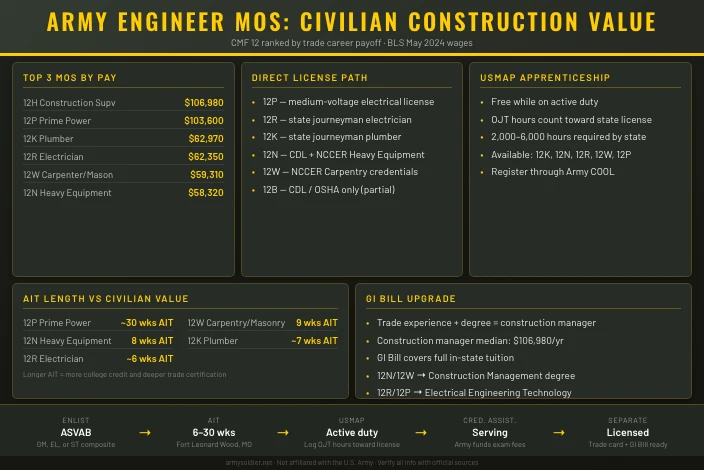
The comparison below scores each engineer MOS on four factors: how directly AIT training maps to a licensable civilian trade, what certifications are available through the Army’s Credentialing Assistance and USMAP apprenticeship programs, what the Bureau of Labor Statistics reports as median wages for that trade, and whether civilian employers can count your Army time toward apprenticeship hour requirements.
A high rank means you can walk into a hiring manager’s office with documented skills, hours, and credentials. A low rank means you need additional civilian training before the Army experience carries much weight.
12T note: The 12T MOS (Topographic Survey Analyst) was redesignated as 12Y (Geospatial Engineer). The civilian career path for 12Y is covered at the end of this article.
Tier 1: Strongest Civilian Translation
12P Prime Power Production Specialist
No other CMF 12 MOS comes close to the civilian earning ceiling of the 12P Prime Power Production Specialist. The AIT at Fort Leonard Wood runs roughly 30 weeks – one of the longest enlisted programs in the Army – and covers electrical theory, power generation systems, medium-voltage distribution, switchgear, and transformers. You graduate with approximately 38 semester hours of college credit.
The civilian numbers are hard to argue with. Power plant operators earn a median of $103,600 per year (BLS, May 2024). Electricians, which many 12P veterans also qualify for through additional training, earn a median of $62,350 with 9% projected job growth through 2034. Defense contractors including AECOM and KBR actively recruit 12P veterans for base camp operations and maintenance contracts, often at wages well above civilian trade medians.
The Army COOL program and Credentialing Assistance funding support medium-voltage electrical licensure, NFPA 70E arc flash certification, and state electrical journeyman credentials. The trade-off is the entry bar: the 12P requires GT 110, EL 107, and ST 107 simultaneously, which is one of the highest collective ASVAB requirements in the Army. A Secret clearance is also required.
Civilian ceiling: Power plant operator ($103,600 median), licensed electrician ($62,350 median)
12R Interior Electrician
The 12R Interior Electrician trains specifically for the work a residential and commercial electrician does every day: wiring, circuit panels, conduit, fixtures, and systems up to 600 volts. The AIT runs about six weeks at Fort Leonard Wood. Short, but focused on exactly the skills a civilian electrical apprenticeship program would teach.
Electricians are in high demand. BLS projects 81,000 openings per year through 2034, driven by data center construction, EV charging infrastructure, and building retrofits. The USMAP apprenticeship program counts your active-duty OJT hours toward state journeyman licensure requirements, which typically require 2,000 to 8,000 hours depending on your state. Many 12R soldiers complete a significant portion of those hours before leaving the Army.
Credentialing Assistance can fund your state journeyman exam fees and preparatory coursework while you’re still on active duty. You don’t need to wait until you separate.
Civilian ceiling: Journeyman electrician ($62,350 median, 9% growth)
12K Plumber
Plumbing has more open jobs than the industry can fill. The 12K Plumber AIT runs about seven weeks at Fort Leonard Wood, covering water supply, drainage, fixtures, blueprints, and field sanitation systems. The skill set maps one-to-one onto civilian plumbing work.
Plumbers, pipefitters, and steamfitters earned a median of $62,970 in May 2024. The USMAP apprenticeship program applies to 12K soldiers, letting active-duty service time count toward the journeyman hours required by most state licensing boards. Credentialing Assistance can fund the apprenticeship registration, exam preparation, and backflow prevention technician certification.
The ASVAB bar is moderate at GM 88, which makes this one of the more accessible Tier 1 MOSs for candidates without strong prior technical backgrounds.
Civilian ceiling: Journeyman plumber ($62,970 median)
Tier 2: Strong Civilian Value with One Extra Step
12W Carpentry and Masonry Specialist
The 12W Carpentry and Masonry Specialist covers framing, concrete, masonry, and structural work in a nine-week AIT at Fort Leonard Wood. You graduate able to frame a building, pour and finish a concrete slab, and lay a masonry wall. Civilian carpenters earn a median of $59,310 per year.
The “one extra step” for 12W is that carpentry and masonry licensing is less standardized across states than electrical or plumbing. Most states require journeyman hours and an exam for plumbing and electrical, but carpentry is often learned through union apprenticeships rather than state licensure. That means 12W veterans typically need to join a union apprenticeship or establish a solid portfolio of documented project experience to maximize their civilian value.
NCCER (National Center for Construction Education and Research) credentials are available through Credentialing Assistance and are recognized by major contractors. Those credentials close the gap between Army training and civilian hiring requirements. The USMAP apprenticeship for carpentry is available and a smart first step.
Civilian ceiling: Carpenter ($59,310 median) or construction superintendent with experience
12N Horizontal Construction Engineer
Four years as a 12N Horizontal Construction Engineer can put you in the cab of a bulldozer, grader, excavator, and scraper with thousands of documented hours. Construction equipment operators earn a median of $58,320 per year, and union operators in metro areas often earn well above that.
The one extra step here is the CDL. Civilian equipment operators typically need a Commercial Driver’s License to haul their own machines between job sites. The Army’s Credentialing Assistance program funds CDL preparation and testing, and OSHA 10 and 30-hour safety credentials are also available. NCCER Heavy Equipment Operations credentials document your Army training in a format civilian employers recognize.
The eight-week AIT is shorter than you might expect for such heavy equipment, but soldiers who stay for four to six years accumulate serious seat time during field exercises and deployments. That real-world experience matters more to contractors than the length of the training course.
Civilian ceiling: Heavy equipment operator ($58,320 median); union operators substantially higher
12H Construction Engineering Supervisor
The 12H is the CMF 12 field’s supervisory track. It requires a GM 93 at reclassification and is not available to direct enlistees – you must first serve in a feeder MOS like 12W, 12K, or 12R. Soldiers typically enter 12H as a Staff Sergeant.
That career path pays off significantly at separation. A soldier leaving as a 12H Staff Sergeant or Sergeant First Class has supervised multi-trade construction projects, managed labor and materials, read critical path schedules, and coordinated electrical, plumbing, and carpentry work simultaneously. That experience maps directly to a construction superintendent or manager role, where the BLS reports a median of $106,980 per year. Construction management is one of the highest civilian payoffs for any Army MOS.
The trade-off is time. Getting to 12H means at least six to eight years of service and a prior enlisted trade background.
Civilian ceiling: Construction supervisor/manager ($106,980 median)
Tier 3: Combat-First MOSs with Limited Direct Transfer
12B Combat Engineer
The 12B Combat Engineer is a combat-focused MOS. The OSUT (combined Basic and AIT) is 22 weeks and covers breaching, demolitions, route clearance, mine detection, and heavy equipment operation. You do operate bulldozers and loaders, but a minority of your training goes there. Most of it is combat tasks.
Civilian employers in construction can’t count your demolitions experience toward a trade license. The equipment hours transfer better than the combat skills, and 12B veterans who pursue Credentialing Assistance for CDL and OSHA credentials can make a decent case to civilian contractors. But a 12N who spent the same years doing construction missions will have more documented hours on civilian-relevant equipment than a 12B who spent most of their time on route clearance.
12B is an excellent MOS for someone who wants to serve in a combat role and treat civilian construction as a bonus path rather than a primary career plan.
Civilian ceiling: Equipment operator ($58,320 median) if hours are there; otherwise an extra year of civilian training is realistic
12Y Geospatial Engineer
The 12Y Geospatial Engineer is the most technically specialized MOS in CMF 12 outside of 12P. You work with GPS, GIS software, and survey equipment to produce terrain analysis and mapping products. The ASVAB requires an ST of 100.
The civilian demand for GIS professionals is real, and the career path exists. The gap is that GIS careers typically require a degree in geography, geospatial science, or a related field, plus proficiency in commercial GIS platforms like Esri’s ArcGIS. The Army trains you on military geospatial systems, which overlap but don’t fully substitute. Veterans who use the GI Bill to complete a GIS-focused degree after service have a strong foundation. Without that degree, direct entry into civilian GIS roles can be difficult.
Civilian ceiling: GIS technician or analyst (median around $58,000-$68,000 depending on specialty), but typically requires a degree alongside Army experience
Certifications and Apprenticeship Credit at a Glance
The USMAP (United States Military Apprenticeship Program) lets active-duty soldiers register their OJT hours as official apprenticeship credit toward state licensure requirements. The program is available at no cost while you serve.
| MOS | USMAP Apprenticeship | Key Credentials Available |
|---|---|---|
| 12P | Available | Medium-voltage electrical license, NFPA 70E, state EL journeyman |
| 12R | Available | State journeyman electrician, OSHA 10/30 |
| 12K | Available | State journeyman plumber, backflow prevention technician |
| 12W | Available | NCCER Carpentry, OSHA 10/30 |
| 12N | Available | CDL Class A, NCCER Heavy Equipment Operations, OSHA 10/30 |
| 12H | Available | PMP (via experience), OSHA 30, state contractor license |
| 12B | Limited | CDL, OSHA 10/30 |
| 12Y | Limited | Esri ArcGIS credentials (self-funded) |
All credentialing through the Army COOL program and Credentialing Assistance is funded by the Army at no cost to the soldier. You can pursue these while still serving.
The GI Bill Factor
The civilian wage ceiling for any CMF 12 veteran rises sharply with a degree. Construction managers earn a median of $106,980 – more than double the median heavy equipment operator wage. A 12N or 12W veteran who uses the Post-9/11 GI Bill to complete a construction management or civil engineering technology degree after four to six years of service is genuinely competitive for project superintendent and project manager roles at major contractors.
The math is straightforward: four years of trade experience plus a GI Bill-funded degree equals a civilian resume that a 22-year-old fresh out of a construction management program can’t match.
Overall Rankings
| Rank | MOS | Trade Category | BLS Median | Direct License Path |
|---|---|---|---|---|
| 1 | 12P | Electrical (medium voltage) | $103,600 | Yes (with effort) |
| 2 | 12H | Construction management | $106,980 | Yes (via experience) |
| 3 | 12K | Plumbing | $62,970 | Yes |
| 4 | 12R | Electrical | $62,350 | Yes |
| 5 | 12W | Carpentry/masonry | $59,310 | Partial (NCCER) |
| 6 | 12N | Heavy equipment | $58,320 | Yes (CDL + NCCER) |
| 7 | 12B | Combat/equipment | $58,320 | Partial |
| 8 | 12Y | Geospatial | ~$60,000+ | Degree required |
12H ranks second overall despite being a reclassification MOS, because the civilian payoff for experienced construction supervisors is the highest in the career field. If you’re already in a CMF 12 trade and approaching E-6, pursuing 12H reclassification before separating can significantly raise your civilian starting salary.
This site is not affiliated with the U.S. Army or any government agency. Verify all information with official Army sources before making enlistment or career decisions.
Explore all CMF 12 profiles at Army engineer careers, see the complete overview of combat and construction roles at Army engineer MOS jobs, and check ASVAB score requirements for every engineer MOS at ASVAB scores for Army engineer MOS.