Best Army Jobs for 2026
Picking an Army MOS isn’t just a career decision. It shapes where you live, what skills you build, how much you earn, and what doors open when you separate. The Army lists more than 150 active enlisted MOS codes, and most of them are just fine. But a handful stand out – because of pay, because of what they teach you, because of what they’re worth on the outside, or because of what they ask of you on the inside.
This guide covers the strongest picks across every major career category. Not every job on this list is right for every person. But each one earns its place based on at least one factor that matters: training depth, enlistment bonuses, civilian salary ceiling, or demand within the Army itself.
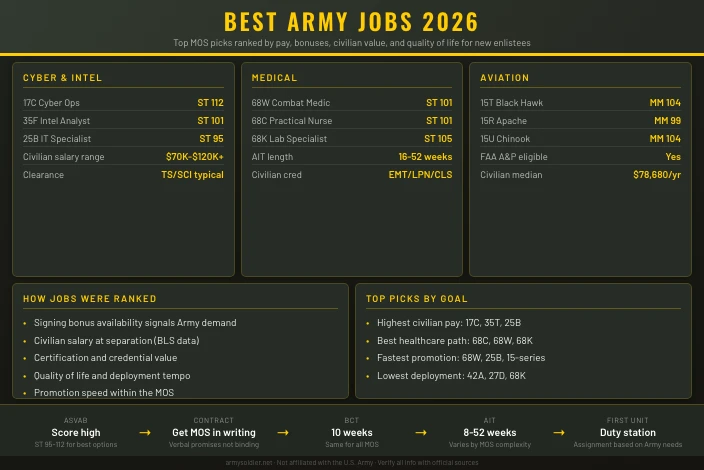
How to Read This List
Before diving in, it helps to know what “best” actually means. The Army doesn’t have a ranked list of MOS jobs. What it has is a wide range of roles, each with a different set of trade-offs.
The jobs covered here were selected based on four factors:
- Pay and bonuses – Does the Army pay a premium to fill this MOS? Signing bonuses signal where the Army has a shortage and where your bargaining power is highest.
- Civilian transferability – Does the training translate to a job after service? A skill that earns $45,000/year in the civilian market is worth less than one that earns $95,000.
- Training quality – Is the Army’s training program genuinely competitive with civilian equivalents? Some Army pipelines are better than what most people could access without military service.
- Job quality – Does the day-to-day work develop you, or does it grind you down? Some MOS assignments produce capable, confident soldiers. Others burn people out in two years.
The AFQT minimum to enlist is a 31 for diploma holders and 50 for GED holders. But the MOS categories below each require specific composite line scores that go higher. Knowing your target score before you take the ASVAB is the single biggest factor in your options.
Cyber and Signal: Highest Civilian Ceiling
The Army’s cyber and signal fields (CMF 17 and CMF 25) sit at the top of the transferability rankings for one reason: the civilian cybersecurity market pays more than almost any other field, and the Army’s training is genuinely competitive with what you’d get in a four-year degree program.
17C Cyber Operations Specialist is the standout. The ASVAB requirement demands a Skilled Technical (ST) score of 112, which is among the highest in the Army. Training runs roughly 52 weeks at Fort Eisenhower, Georgia, covering network penetration testing, computer network exploitation, and offensive cyber operations. The security clearance that comes with it, typically a TS/SCI, adds $20,000 to $40,000 to your civilian starting salary on day one after separation.
25B IT Specialist is the higher-volume option. The bar is lower – a Skilled Technical (ST) score of 95 – and the training is more generalist, covering network administration, help desk operations, and system security. Still, an Army 25B with four years of experience and a Secret clearance can walk into a GS-9 federal position or mid-level IT contractor role without additional credentials.
| MOS | Title | Key Score | Training Length |
|---|---|---|---|
| 17C | Cyber Operations Specialist | ST 112 | ~52 weeks |
| 25B | IT Specialist | ST 95 | ~20 weeks |
| 25U | Signal Support Systems Specialist | ST 102 | ~16 weeks |
| 25S | Satellite Communication Systems Operator | ST 102 | ~27 weeks |
The entire CMF 17/25 field is covered in depth at Army intelligence and cyber MOS jobs.
Medical: Best Training Pipeline in the Army
The 68W Combat Medic Specialist consistently earns the title of best enlisted training value in the Army. The pipeline runs 22 weeks at Fort Sam Houston, Texas, and produces soldiers who are certified as Emergency Medical Technicians (EMT-Basic) at minimum. Many 68Ws pursue National Registry EMT and, in some units, EMT-Advanced certification during their first tour.
The civilian path from 68W is direct. Paramedic programs typically accept AIT credit and require less additional training than starting from scratch. Nursing and physician assistant programs actively recruit veterans with 68W experience. The medical school route is less common but not unheard of – the Army’s Health Professions Scholarship Program (HPSP) is a documented pipeline.
68K Medical Laboratory Specialist requires an ST score of 106 and trains at Fort Sam Houston for about 52 weeks. The credential earned – equivalent to a Medical Laboratory Technician certification – is directly licensable in most states. Starting civilian salary runs $45,000 to $60,000. After a four-year enlistment, a motivated 68K can sit for the ASCP Board of Certification exam and enter the civilian workforce at a meaningful salary floor.
Other 68-series jobs worth considering:
- 68D Operating Room Specialist (ST 101, ~12 weeks) – scrub tech equivalent; civilian credential path is clear
- 68E Dental Specialist (ST 95, ~16 weeks) – dental assistant and X-ray certification included
- 68R Veterinary Food Inspection Specialist (ST 101, ~14 weeks) – unusual but surprisingly strong civilian crossover into food safety and public health inspection
The Army medical career guide covers the full 68-series roster if you’re comparing specific MOS codes.
Intelligence: Best Clearance Value
A Top Secret clearance costs about $5,000 in polygraph exams and background investigation fees to obtain privately. The Army pays for yours. That alone makes CMF 35 worth serious consideration for anyone with a clean record and the ASVAB score to qualify.
35F Intelligence Analyst is the entry point for most MI soldiers. The ASVAB requirement is a Skilled Technical (ST) score of 101 and a General Technical (GT) score of 107. Training runs 16 weeks at Fort Huachuca, Arizona. At most duty stations, the work involves analyzing imagery, signals, and human intelligence reports to support tactical commanders. The skill set transfers directly to federal law enforcement, defense contracting, and private sector threat intelligence roles.
35N Signals Intelligence Analyst requires an ST score of 112. Training runs 25 weeks at Goodfellow Air Force Base, Texas – a joint environment with Air Force and Navy SIGINT students. The technical skills developed here, electronic signals analysis and collection system operation, are highly specific and extremely valuable to defense contractors.
35P Cryptologic Linguist is the highest-ceiling job in the intelligence field. Enlistment bonuses for critical language speakers reach $50,000. Training starts at the Defense Language Institute (DLI) in Monterey, California, and can run up to 64 weeks before AIT even begins. A soldier fluent in Mandarin, Arabic, or Russian with a TS/SCI clearance and four years of operational SIGINT experience commands serious civilian compensation.
Aviation: The Warrant Officer Path
Army aviation is unusual because it offers a direct route from high school to flying Black Hawks, Apaches, and Chinooks without a college degree. That route runs through the Warrant Officer Flight Training (WOFT) program.
Candidates need a GT score of at least 110 on the ASVAB and a minimum score of 40 on the Selection Instrument for Flight Training (SIFT). Physical requirements include Class 1 flight physical clearance. The training pipeline – WOCS followed by IERW at Fort Novosel, Alabama – takes roughly 18 to 24 months depending on the aircraft platform. Upon graduation, you earn your Federal Aviation Administration (FAA) commercial rotorcraft certificate automatically.
The warrant officer path pays at the W-1 grade from day one. At under two years of service, that’s $4,057/month in basic pay (verified 2026 rate). BAH and BAS are on top of that. By W-2 with two years of service, you’re at $5,059/month before allowances.
Enlisted aviation (CMF 15) is equally strong for maintainers. The 15T Black Hawk Repairer and 15R Apache Repairer train on specific airframes and produce mechanics with highly marketable FAA airframe and powerplant (A&P) knowledge. Civilian helicopter maintenance runs $60,000 to $90,000 per year.
Combat Arms: For Those Who Want to Lead
The infantry, armor, and artillery career fields (CMF 11, 19, and 13/14) are not the highest-paying options in the Army. They’re also not the most transferable to civilian employment. What they offer is something different: fast leadership responsibility, elite school access, and a track record that federal agencies, law enforcement, and defense contractors read as evidence of real performance.
11B Infantryman qualifies with a Combat (CO) score of 87. The training is hard – 22 weeks at Fort Moore. The job puts you on the ground carrying the mission. Most infantry soldiers either get out after one term or stay for the career path: Ranger Battalion, Special Forces, or senior NCO leadership. The re-enlistment rate is lower than technical MOS, partly because the job is physically demanding and partly because the civilian value is more indirect.
19D Cavalry Scout (CO 87) and 13B Cannon Crewmember (FA 93) each develop specific, team-based skills. The Cavalry Scout earns a reputation for producing adaptive, resourceful soldiers who perform well in law enforcement and emergency services roles after separation.
One honest comparison on physical standards: all three combat arms families are assessed to the AFT combat specialty standard (minimum 350 points, sex-neutral, age-normed), which is higher than the general standard of 300. This is the Army Fitness Test that replaced the ACFT in June 2025.
The combat arms comparison guide has a full breakdown of all three career families.
Special Operations: The High-Commitment Option
Special operations MOS codes aren’t for everyone, and the Army is honest about that. The selection pipeline exists to filter out candidates who aren’t ready. But for the right person, these jobs offer a career track with no equivalent in the civilian workforce – and transition outcomes that beat most other MOS families.
18X Special Forces Candidate is the direct contract path into Special Forces. You enlist as a Candidate and must pass the Special Forces Assessment and Selection (SFAS) course after completing Basic and Airborne training. The failure rate at SFAS is real – roughly 60 to 70 percent of candidates do not complete selection. Those who do enter the Q-Course, which runs 53 to 95 weeks depending on specialty.
37F PSYOP Specialist and 38B Civil Affairs Specialist are worth knowing about because their training depth is unusual. Both MOS require GT 110 and include targeted instruction in foreign cultural engagement, influence operations, and civilian population support. Veterans from these MOS find ready employment in government affairs, strategic communications, and federal agency roles.
Enlistment bonuses in special operations can reach $40,000 and up for critical language skills paired with a PSYOP or CA contract.
How Bonuses Factor In
Army enlistment bonuses aren’t random. The Army pays premiums where it has shortages. Right now, the highest bonuses cluster in a few places:
- Language-qualified SIGINT and PSYOP roles – bonuses up to $50,000 for critical languages
- Cyber and IT MOS – 17C and 25B bonuses vary by contract length and clearance eligibility
- Medical MOS with civilian-equivalent credentialing – 68W, 68K, and 68D frequently carry bonuses
Bonus amounts change by contract cycle. Your recruiter can show you the current bonus schedule for specific MOS codes available at the time you enlist.
Matching the Job to What You Actually Want
No MOS is universally best. The right job depends on what you’re optimizing for.
| If you want… | Look at… |
|---|---|
| Highest civilian salary ceiling | CMF 17/25 (Cyber/Signal), CMF 35 (Intel with clearance) |
| Best medical training | CMF 68 (Medical), especially 68W, 68K, 68D |
| Flying without a degree | WOFT (Warrant Officer 153A) |
| Fast leadership + elite schools | CMF 11/19/13 (Combat Arms) |
| Special operations track | 18X, 37F, 38B |
| Technical work, less field time | CMF 25 (Signal), CMF 35 (Intel), CMF 91 (Maintenance) |
Several posts in this cluster go deeper on specific scenarios. Best Army jobs for introverts focuses on roles built around independent and technical work. Army jobs that transfer to civilian careers ranks every major career family by how directly the skills convert to civilian employment. If pay is your primary filter, highest-paying Army MOS jobs breaks down base pay, bonus potential, and special duty assignment pay by career field. For candidates who want to serve without direct combat exposure, Army jobs that don’t see combat covers the support and technical MOS fields where deployment is common but direct combat is rare.
Whatever MOS you target, your ASVAB score sets the ceiling on your options. Browse all Army enlisted career families to see which MOS codes align with the fields covered here.
This site is not affiliated with the U.S. Army or any government agency. Verify all information with official Army sources before making enlistment or career decisions.