Best Army Jobs for Introverts
There’s a version of Army life people picture when they think “introvert in the military” – and it involves a lot of shouting, crowded barracks, and forced socializing at 0500. That picture isn’t wrong, exactly. But it leaves out the thousands of soldiers who spend their workdays alone at a classified terminal, analyzing satellite imagery, writing intelligence reports, or defending a network against foreign intrusion.
The Army isn’t built for introverts or extroverts. It’s built for mission. What varies wildly between jobs is how much of your day involves direct interaction with people versus focused, technical work. Some MOS roles are almost entirely social – leading patrols, managing people, conducting interviews. Others are primarily solitary: you and a workstation, a problem to solve, and a deadline. If the second description appeals to you, there are real options worth knowing about.
One honest caveat before the list: every Army job requires some teamwork, formation attendance, and leadership development over time. NCOs mentor junior soldiers. No role is completely isolated. But some MOS fields offer far more heads-down, focused work than others – and those are the jobs covered here.
Intelligence Analysis: Sitting With Hard Problems
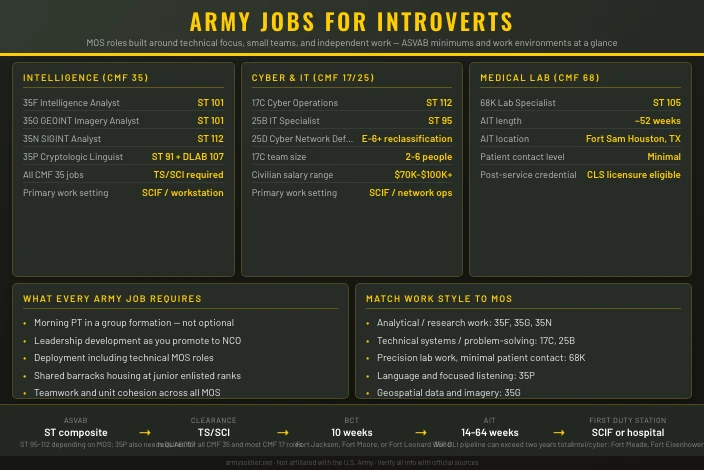
The Military Intelligence branch (CMF 35) is one of the best homes for soldiers who do their best work alone with complex information. The jobs are technical, the output matters, and most of the work happens at a classified workstation rather than in a formation or briefing room.
35F Intelligence Analyst is the most common MI job and a strong starting point. You collect information from multiple sources – imagery, signals, human reporting – and fuse it into a coherent picture of the threat environment. A typical garrison day means several hours of database work, building enemy order-of-battle files, and preparing intelligence products. You do brief commanders, but those briefings are usually prepared the day before. The preparation time is solo.
35G Geospatial Intelligence Imagery Analyst works almost entirely with imagery data. You analyze satellite and aerial photographs, identify what changed, and report the operational significance to commanders. The work is pure spatial reasoning – patterns, measurements, object identification – and most of it happens at a workstation in a SCIF. Human interaction is limited to your immediate team and the occasional written product that goes up the chain.
35N Signals Intelligence Analyst requires an ST score of 112 – near the top of the enlisted range – plus a counterintelligence-scope polygraph. You intercept and analyze foreign communications and electronic signals, maintain technical databases, and write reports that feed national-level intelligence products. The 35N environment is quiet by design. Signals work demands concentration, and most duty positions are in SCIFs where phone use is prohibited.
All three require a TS/SCI security clearance. That means an in-depth background investigation covering your finances, foreign contacts, and personal history. It also means U.S. citizenship is required before you can apply.
| MOS | Core Work Style | Key ASVAB Composite |
|---|---|---|
| 35F | All-source analysis, briefing prep | ST 101 |
| 35G | Imagery interpretation, mapping | ST 101 |
| 35N | Signals intercept, technical reporting | ST 112 |
Cyber and IT: Technical Work Behind the Scenes
CMF 17 and 25 cover cyber operations, network defense, and IT support. These fields attract soldiers who are most productive when debugging a problem or hardening a system – not running a meeting.
17C Cyber Operations Specialist is the Army’s most demanding technical MOS. You defend military networks, conduct authorized offensive operations against adversary systems, and perform digital forensics. Nearly all of it happens inside a SCIF. Most 17C soldiers work in small teams of two to six people, and the day-to-day job is more “analyst at a terminal” than “team leader running a formation.” The pipeline is over a year long and requires a TS/SCI clearance. The ASVAB requirement is a Skilled Technical score of 112.
25B Information Technology Specialist is the Army’s general-purpose IT role. You manage servers, troubleshoot networks, configure hardware, and maintain classified and unclassified systems across a unit. The job has more social interaction than the cyber MOS – you get calls from people whose computers aren’t working – but the actual technical problem-solving is done independently. Many 25B soldiers go on to earn certifications like CompTIA Security+ and Network+, which are funded through Army tuition assistance.
25D Cyber Network Defender is not an entry-level job. It’s a reclassification for experienced NCOs who have already served in CMF 25 roles. If you want a career path that ends in network defense work, 25B is often the starting point. The 25D works in small teams, monitors network traffic for intrusions, and builds the kind of defensive documentation that no one reads until something goes wrong.
These jobs pay off after service. IT and cybersecurity skills earned in CMF 17 and 25 translate directly into civilian roles that routinely start at $70,000–$100,000+, especially with a clearance.
Signals Intelligence: Language and Intercept Work
35P Cryptologic Linguist is built around a skill most Army jobs don’t require: a foreign language. You intercept enemy voice communications, translate them, and produce signals intelligence summaries in near-real time. The work is focused and solitary by nature. You’re listening, transcribing, and analyzing – not managing people or leading operations.
The path to 35P is long. You take the Defense Language Aptitude Battery (DLAB) in addition to the ASVAB. Minimum DLAB score is 107. Then you spend up to 64 weeks at the Defense Language Institute in Monterey, California, before starting the actual MOS training. The total pipeline – Basic Combat Training, DLI, AIT, and clearance processing – can run two years before you reach your first duty station.
That investment pays off. Critical language speakers earn enlistment bonuses that can reach $50,000. Foreign language proficiency pay (FLPP) adds monthly compensation on top of base pay. Federal agencies and defense contractors recruit heavily from the 35P pool.
If you’re the kind of person who could spend two years getting genuinely fluent in Mandarin, Arabic, or Russian without losing your mind, this job is worth a serious look.
Medical Laboratory Work: Precision Over People
Most Army medical jobs involve a lot of direct patient contact. The 68K Medical Laboratory Specialist is the exception. You run the blood work, cultures, urinalysis, and diagnostic panels that tell physicians what’s wrong with a patient. The job requires precision and procedural discipline. It does not require a personality that thrives on constant human interaction.
Lab work happens in a controlled environment – Army community hospitals, combat support hospitals, and forward medical units. You operate analyzers, prepare specimens, and document results. On a typical day, you interact with a small team of lab personnel and occasionally receive samples from clinical staff. The patients themselves are rarely present.
The ASVAB requirement is a Skilled Technical score of 105. AIT runs about 52 weeks at Fort Sam Houston, Texas – one of the longer medical pipelines. That length reflects the depth of clinical training required to operate laboratory equipment and interpret results with accuracy.
After service, 68K graduates often pursue clinical laboratory scientist (CLS) licensure. The Army training counts toward the supervised hours required for state certification in many states.
What to Expect in Any Army Job
No matter which MOS you choose, certain elements are universal and worth knowing about honestly.
- Formation and PT: Every soldier attends unit physical training most mornings. This is a group activity and not optional.
- Mandatory leadership development: The Army expects every NCO to mentor and develop junior soldiers. As you promote, interaction with people increases.
- Deployment: Even technical MOS soldiers deploy. A 35G analyst might spend nine months in a SCIF in Germany or on a forward operating base in the Middle East. The work stays technical; the environment changes.
- Barracks and shared housing: Junior enlisted soldiers typically live in barracks with one or two roommates. Private housing comes with rank and time.
None of this is a reason to avoid the Army if you’re introverted. It is a reason to go in with accurate expectations rather than idealized ones.
Matching Your Personality to a Career Family
Here’s a practical starting point for narrowing down your options based on what kind of work environment matters most to you.
| If you prefer… | Look at… |
|---|---|
| Analytical, research-heavy work | CMF 35 (Intelligence): 35F, 35G, 35N |
| Technical problem-solving, systems | CMF 17/25 (Cyber/Signal): 17C, 25B |
| Precision work, minimal patient contact | CMF 68 (Medical): 68K |
| Language and focused listening work | CMF 35: 35P |
| Working with data and geospatial tools | CMF 35: 35G |
The enlisted careers section has full profiles for each of these MOS, including exact ASVAB score requirements, training pipeline lengths, and post-service career paths.
You may also find Best Army Jobs for 2026 and Army Jobs That Don’t See Combat helpful for rounding out your research before talking to a recruiter.
This site is not affiliated with the U.S. Army or any government agency. Verify all information with official Army sources before making enlistment or career decisions.