Best Army Medical Jobs for Civilian Healthcare Careers
The Army trains more healthcare workers than most people realize. Radiology technologists, clinical lab scientists, pharmacy techs, practical nurses – the military produces all of them, and civilian employers know it. If you’re weighing an Army enlistment and want a healthcare career afterward, picking the right MOS matters more than most recruiters will tell you.
Some Army medical jobs hand you a nationally recognized credential on the way out. Others give you deep clinical experience but leave the licensing paperwork to you. A few are nearly invisible to civilian HR departments. This guide breaks down which MOSs set you up best, what credentials you’ll earn, and what those jobs actually pay once you’re out.
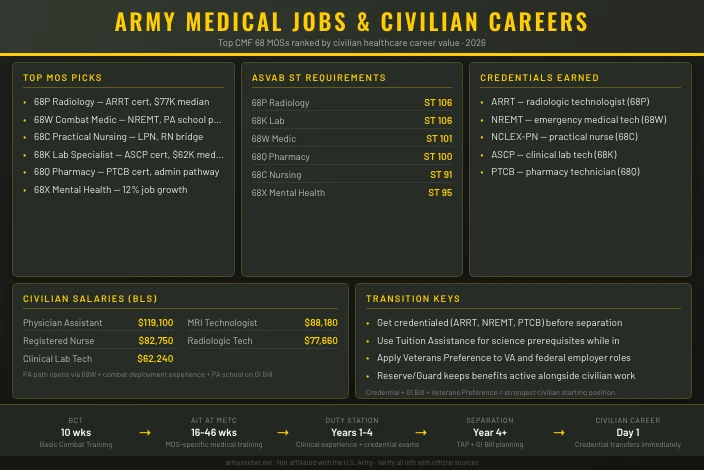
What Makes an Army Medical MOS Valuable After Service
The Army’s medical training campus is the Medical Education and Training Campus (METC) at Fort Sam Houston in San Antonio, Texas. Almost every enlisted medical specialist trains there, and the programs are accredited by the same bodies that govern civilian healthcare schools.
What separates strong civilian-transition MOSs from weak ones comes down to three factors:
- Transferable credential: Do you leave with a nationally recognized license or certification?
- Clinical hours: Does the training count toward civilian licensure requirements?
- Demand: Is the civilian job market actually hiring for this role?
The MOSs below score well on all three.
68P – Radiology Specialist
The 68P is one of the cleanest military-to-civilian transitions in the medical field. You spend 46 weeks in AIT at METC – 24 weeks of classroom and lab work, then 22 weeks of supervised clinical training with real patients. The program is accredited by the Joint Review Committee on Education in Radiologic Technology (JRCERT), which means your training meets the same standard as civilian radiography schools.
At the end, you’re eligible to sit for the American Registry of Radiologic Technologists (ARRT) certification exam. Pass it, and you hold the same credential as any civilian radiologic technologist in the country. The Army even reimburses the exam fee when you pass.
Why civilian employers want you: ARRT-certified technologists are in steady demand. The Bureau of Labor Statistics projects roughly 15,400 annual job openings for radiologic technologists through 2034, with a median salary of $77,660. Specialists who add CT or MRI credentials – both available through Army advanced training – earn around $88,180 at the median. Federal employers like the VA give you Veterans Preference on top of that.
The ASVAB requirement is a 106 Skilled Technical (ST) score. That’s a meaningful threshold, but the career payoff is real.
68C – Practical Nursing Specialist
If your goal is a nursing career, the 68C may be the fastest path in healthcare. The Army trains you to the Licensed Practical Nurse standard, and many soldiers leave with their LPN license already in hand.
The training pipeline qualifies you to sit for the NCLEX-PN exam, which is the national licensure test for practical nurses. Pass it and you’re immediately eligible for civilian LPN positions. The program entry requirement is unique: you need a valid state LPN license before entry, or the Army puts you in a training program to earn one during your enlistment. Either way, you exit with real nursing credentials.
Civilian LPN jobs pay a median of around $48,000, but that’s a floor, not a ceiling. The more important number is what happens next – most former 68Cs use the GI Bill to finish an RN bridge program in under two years. Registered nurses earn a median of $82,750, and job growth is running at 9%.
The 68C is one of the few Army jobs where your military and civilian careers directly reinforce each other. Hospital employers actively recruit former military LPNs, specifically because of the crisis experience and clinical discipline.
ASVAB requirement: Skilled Technical (ST) 91 minimum. The entry bar is lower than 68P, and a Top Secret security clearance is required.
68K – Medical Laboratory Specialist
Clinical lab science is a growth field that most people outside healthcare overlook. The Army trains 68K soldiers in blood draws, urinalysis, cultures, chemistry panels, and immunology – the same diagnostic tests that drive treatment decisions in any hospital or clinic.
Military lab experience counts toward the American Society for Clinical Pathology (ASCP) certification exam. Many 68K soldiers earn that credential before or shortly after separation. ASCP-certified technologists are recognized across the country.
| Civilian Role | Median Salary (2024) |
|---|---|
| Medical Laboratory Technician (MLT) | $38,620 |
| Clinical Laboratory Technologist | $62,240 |
| Hospital Laboratory Manager | $72,000+ |
The jump from technician to technologist usually requires an associate’s or bachelor’s degree. The GI Bill covers that. Veterans with Army lab experience and a science degree are competitive for senior lab positions at hospitals, reference labs, pharmaceutical companies, and federal agencies including the CDC.
ASVAB requirement: Skilled Technical (ST) 106. The 68K is the most STEM-intensive enlisted medical MOS, and the score reflects it.
68W – Combat Medic
The 68W is the Army’s most well-known medical MOS, and the transition path is direct. Training covers emergency medicine, trauma care, IV therapy, pharmacology, and patient assessment. The AIT program is accredited, and graduates are eligible to test for National Registry EMT (NREMT) certification.
Pass the NREMT and you’re a credentialed emergency medical technician on day one of civilian life. Medics with additional training can test for the Paramedic credential. The timeline from Army training to paramedic certification is faster than most civilian routes.
Civilian paths from 68W:
- EMT or Paramedic (direct credential transfer)
- Registered Nurse (2-year bridge program via GI Bill)
- Physician Assistant (competitive PA programs value medic experience heavily)
- Surgical Technologist
- Federal law enforcement or emergency management
The PA school pipeline deserves its own mention. Programs at civilian PA schools consistently report that prior military medic experience – especially combat deployments – is one of the strongest application differentiators. Physician assistants earn a median of $119,100, with a projected job growth rate of 27%.
EMT and paramedic pay is lower on the surface ($41,230 median for EMT/Paramedics), but those roles are frequently paired with fire department careers where total compensation including benefits runs significantly higher.
ASVAB requirement: Skilled Technical (ST) 101, General Technical (GT) 107. You need both.
68Q – Pharmacy Specialist
Pharmacy technician is one of the most portable healthcare credentials in the civilian market – and the Army trains you to exactly that level. The 68Q pipeline covers pharmacology, drug dispensing, controlled substance management, and electronic health record systems.
Many 68Q soldiers earn the Pharmacy Technician Certification Board (PTCB) credential before separation. PTCB-certified pharmacy technicians are qualified for hospital, retail, and specialty pharmacy positions nationwide.
Civilian pharmacy techs earn a median of $37,790, which is on the lower end among medical MOSs. The stronger play is using Army pharmacy training as a foundation for a PharmD program, hospital pharmacy director track, or healthcare administration career. Soldiers with EHR and inventory management experience from 68Q assignments move into healthcare administration roles with median salaries above $104,000.
ASVAB requirement: Skilled Technical (ST) 100.
68X – Mental Health Specialist
Behavioral health is one of the fastest-growing areas in civilian healthcare. The 68X trains soldiers in crisis intervention, behavioral health assessments, and therapeutic communication. That experience directly maps to civilian mental health counselor and substance abuse counselor roles.
| Civilian Role | Median Salary (2024) | 10-Year Outlook |
|---|---|---|
| Mental Health Counselor | $48,520 | +12% |
| Substance Abuse Counselor | $47,660 | +10% |
| School Counselor | $59,430 | +8% |
The civilian licensing path requires a master’s degree for full licensure as a counselor. The GI Bill handles that. What Army service provides is the clinical experience and documented crisis management work that programs require before graduation – and that civilian applicants without military backgrounds often lack.
Veterans who combine 68X experience with a master’s in social work or counseling psychology are competitive for positions at VA facilities, community mental health centers, and hospital systems. The VA in particular actively hires veterans for behavioral health roles.
How to Choose
The right MOS depends on what healthcare career you want to end up in. Use this as a starting point:
| If you want to become… | Start here |
|---|---|
| Radiologic / MRI Technologist | 68P |
| Registered Nurse | 68C (then RN bridge) |
| Physician Assistant | 68W (combat deployment strengthens PA apps) |
| Clinical Lab Scientist | 68K |
| Pharmacy Technician or Administrator | 68Q |
| Mental Health Counselor | 68X (then master’s degree) |
One thing applies across all of them: the ASVAB line scores aren’t suggestions. The ST score especially – if you score below the threshold, the Army won’t give you the MOS regardless of how interested you are. If your current scores are close but not there, a focused study period before testing makes a real difference.
Making the Most of Military Healthcare Training
A few patterns appear consistently among Army medical veterans who land strong civilian careers after service:
Get credentialed before you separate. ARRT, NREMT, PTCB, ASCP – the exam fees are reimbursable, and holding the credential when you leave is far better than studying for it while job hunting.
Use Tuition Assistance while you’re in. Most healthcare careers benefit from science prerequisite courses. Anatomy, microbiology, statistics – take them on Tuition Assistance and arrive at your post-service program with prerequisites done.
Target VA and federal employers first. Veterans Preference in federal hiring puts you ahead of the applicant pool for VA hospital and DoD civilian positions. Those jobs often pay more than comparable civilian roles and include strong retirement benefits.
Don’t sleep on the Reserve or Guard path. A 68C drilling in the Reserve while working as a civilian LPN keeps benefits active, builds retirement points, and keeps your clinical skills current. The same applies to 68P and 68K – the military and civilian schedules are compatible.
The Army’s complete medical career field includes more than 20 enlisted specialties. For a full breakdown of every MOS in CMF 68, the Army medical careers guide covers each one with ASVAB requirements and training details.
This site is not affiliated with the U.S. Army or any government agency. Verify all information with official Army sources before making enlistment or career decisions.
You may also find Best ASVAB Scores for Army Medical MOS Jobs and Army Medical Officer vs. Enlisted Medic helpful for comparing your options.