Best Army Reserve MOS Jobs for Civilian Careers
The Army Reserve’s pitch is straightforward: one weekend a month, two weeks a year, and a paycheck while you do it. What the recruiting brochure doesn’t spell out is that some of those weekends are building skills worth six figures in the civilian market, while others are burning your Saturday for a credential nobody outside the Army recognizes.
The MOS you choose determines which category you land in. This post breaks down the Reserve jobs that deliver the most durable civilian career value, why they transfer so well, and what the civilian salary data actually looks like.
Why MOS Choice Matters More in the Reserve
Active-duty soldiers have time to accumulate experience, rank, and advanced training. A Reserve soldier works with what initial training gives them, plus whatever skills sharpen during monthly drills and annual training. That makes the starting credential – the one you earn at Advanced Individual Training – more important in the Reserve than it is on active duty.
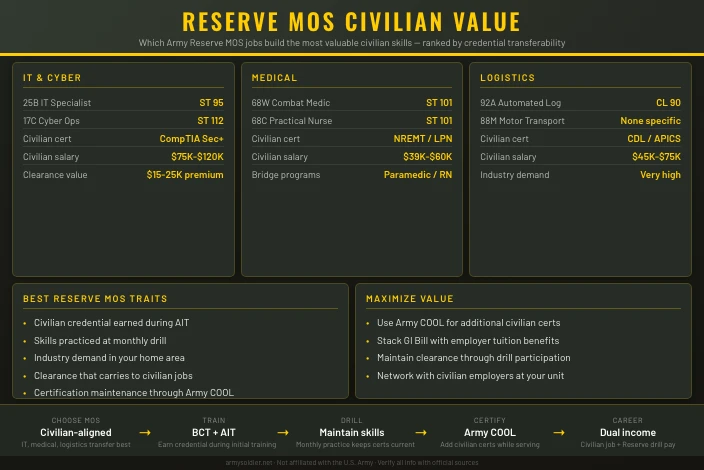
The best Reserve MOS jobs share a few traits:
- Licensed or certified credentials that transfer directly to civilian employers
- Skills with constant civilian demand, so the job exists in every metro area
- A learning curve that drills reinforce, not just a checklist that gets rubber-stamped each month
Jobs that check all three boxes give you something unusual: paid military training that accelerates your civilian career rather than interrupting it. The ones that check none of them are fine for service, but they won’t move the needle on your resume.
25B Information Technology Specialist
Civilian equivalent: Network/systems administrator, IT support analyst
The 25B MOS trains soldiers on hardware troubleshooting, network configuration, operating systems, server maintenance, and IT security fundamentals. It’s one of the most directly transferable jobs in the entire Army.
The civilian demand for these skills is real and documented. Network and computer systems administrators earned a median annual wage of $96,800 as of May 2024. Entry-level IT support roles pay less, but 25B training combined with industry certifications like CompTIA Security+ can move you into mid-tier roles faster than most civilian paths.
The Reserve advantage here is specific: 25B soldiers who pursue certifications between drills compound their value quickly. CompTIA A+, Network+, and Security+ are the standard stack. Many employers in defense contracting treat a 25B MOS plus those certifications as equivalent to two years of civilian experience.
Common first civilian roles:
- IT support analyst ($45,000-$65,000 range to start)
- Systems administrator ($70,000-$85,000 with 2-3 years’ experience)
- Information security analyst (median $124,910 per BLS May 2024, typically requires a few years and a clearance)
The 25B also has a natural upgrade path. Soldiers who cross-train into the 17C Cyber Operations Specialist MOS or pursue the Warrant Officer 255A track can move directly into senior security roles.
68W Combat Medic Specialist
Civilian equivalent: EMT, paramedic, ER technician, LPN bridge program candidate
Every 68W completes the same Advanced Individual Training as their active-duty counterparts – 16 to 18 weeks at Brooke Army Medical Center – and exits with a National Registry EMT (NREMT) credential recognized in all 50 states. That credential is yours the day you earn it. It belongs to you, not to the Army.
The civilian healthcare labor market for EMTs and paramedics shows a median annual wage of $41,340 for EMTs and $58,410 for paramedics as of May 2024. Those aren’t high figures in isolation, but 68W experience is a legitimate bridge to higher-earning healthcare roles.
The Reserve structure suits this MOS well. Civilian healthcare workers who drill as 68Ws keep their emergency medicine skills current in both settings. The two schedules reinforce each other in a way most other MOS jobs don’t replicate.
35F Intelligence Analyst
Civilian equivalent: Intelligence analyst (federal/contractor), data analyst, research analyst
The 35F earns one of the more valuable assets a Reserve soldier can hold: an active security clearance. Most 35F soldiers come out of AIT with a Secret clearance, and sustained service often leads to a Top Secret or TS/SCI.
Security clearances have a documented market premium. Federal contractors routinely pay $15,000-$30,000 more for cleared candidates versus uncleared ones in comparable analytical roles. The clearance requires active maintenance, which the Reserve service provides – drilling keeps your record current in ways that a separation and gap in service would erode.
What the 35F actually does at drill:
- All-source intelligence analysis supporting unit mission planning
- Threat assessment and pattern analysis
- Imagery and signals intelligence interpretation
- Producing written intelligence products for commanders
These skills translate to civilian intelligence agencies, defense contractors, and private sector research roles. The analytical writing and structured assessment methodology 35F soldiers learn also transfer to policy research, market intelligence, and financial analysis with some reframing.
The main limitation: the highest-value 35F positions sit behind a TS/SCI clearance and polygraph. Getting there from a Reserve billet takes longer than the active-duty path. But the baseline Secret clearance still opens doors that most civilian applicants can’t even knock on.
92A Automated Logistical Specialist
Civilian equivalent: Supply chain analyst, inventory manager, logistics coordinator, warehouse operations manager
Supply chain skills are in demand across every industry that moves physical goods. The 92A trains soldiers in property accountability, inventory management, automated logistics systems, and supply operations – all directly applicable to civilian logistics roles.
Logisticians earned a median annual wage of $80,880 as of May 2024, with employment projected to grow 17 percent through 2034. That growth rate is well above the national average, driven by e-commerce expansion and supply chain modernization.
The Reserve advantage for 92A is less about a single credential and more about documented hands-on experience. A soldier who spends four years in a Reserve unit managing equipment worth millions of dollars, processing property transfers, and running digital inventory systems has a verifiable record. That record means something to a hiring manager at a distribution center or logistics firm.
Civilian roles the 92A supports:
| Role | BLS Median Wage (May 2024) |
|---|---|
| Logistician | $80,880 |
| Transportation / distribution manager | $108,650 |
| Purchasing manager | $136,380 |
| Inventory control specialist | $52,000-$65,000 (entry-level) |
The 92A also stacks well with the APICS Certified Supply Chain Professional (CSCP) or the Certified in Production and Inventory Management (CPIM) credential, which civilian employers treat as the industry standard.
68C Practical Nursing Specialist
Civilian equivalent: Licensed Practical Nurse (LPN), clinical care technician
The 68C is one of the longest AIT programs in the Army at 52 weeks, but it exits with a credential that opens a direct civilian career door. Graduates are eligible to sit for the NCLEX-PN exam for LPN licensure. The BLS reported a median annual LPN wage of $59,730 as of May 2024.
More importantly, LPN licensure is a recognized steppingstone to RN programs at most community colleges and state universities. Reserve 68Cs who continue their education while drilling can reach RN-level income without taking on the full cost of a four-year nursing degree as a starting point.
The 52-week AIT commitment is substantial. For a Reserve soldier, that means a year on full-time active orders before transitioning to the part-time drill schedule. The trade-off is a nationally recognized healthcare license with a clear advancement path.
88M Motor Transport Operator
Civilian equivalent: Commercial truck driver, logistics driver, fleet manager
The 88M MOS is the most immediately monetizable Reserve job for candidates who want a civilian career on day one. Training leads directly to a Commercial Driver’s License (CDL), and CDL holders are in short supply across the entire freight and logistics industry.
Civilian CDL drivers earn a median salary around $54,320 (BLS 2024 for heavy and tractor-trailer truck drivers), but experienced over-the-road drivers and specialized haulers regularly earn $70,000-$90,000. Owner-operators earn more, and many veterans use their Army driving experience as the foundation for starting their own operations.
The 88M drills with truck companies, moving equipment and supplies in support of unit operations. That builds verifiable hours and mission experience that civilian employers and CDL programs recognize. The license itself is yours to keep whether you’re driving for a regional freight carrier, a national distributor, or an employer who specifically wants someone with military vehicle experience and a clean record.
What makes this MOS stand out for the Reserve specifically is the speed of return. Unlike IT or intelligence roles that take years to reach the highest salary tiers, an 88M with a CDL can step into a well-paying civilian job the week after AIT ends.
How to Choose Based on Your Civilian Goals
The right Reserve MOS depends on where you want to be in five years, not just what’s available when you talk to a recruiter.
Go 25B if you want a tech career. Use every training gap to stack certifications. The civilian IT market is broad enough that geography doesn’t constrain you, and you can deepen into security or infrastructure as your interests develop.
Healthcare? The 68W gives you speed – an NREMT credential after AIT and a natural bridge to higher-level clinical roles. The 68C takes longer but hands you an LPN license, which is a higher starting point for most nursing programs.
Supply chain and operations favor the 92A. Four years of documented accountability work, combined with a civilian certification like CSCP, positions you for logistics management roles that pay well above the national median.
Federal employment and contracting call for the 35F. The clearance is the asset, and it’s one most civilian employers can’t generate themselves without spending years and significant money on a candidate.
Speed of return is the 88M’s advantage. A CDL from AIT puts you in a well-paying civilian driving job the week you get home.
One honest note: Reserve service adds real career value, but only when you show up consistently, pursue training seriously, and treat the civilian career connection as your own responsibility to build. The MOS gives you the raw material. What you build with it is up to you.
Browse Army enlisted career families to compare MOS options across all specialties before committing to a path. For the broader service component decision, Active Duty vs Army Reserve vs National Guard covers the full three-way trade-offs, and Can You Be a 68W in the Army Reserve? goes deeper on the medical path specifically.
This site is not affiliated with the U.S. Army or any government agency. Verify all information with official Army sources before making enlistment or career decisions.