Best ASVAB Scores for Army Officer Branches
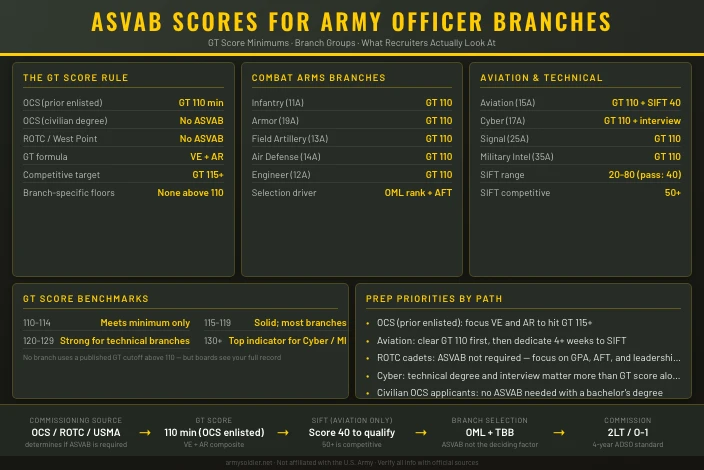
The ASVAB works differently for officer candidates than it does for enlisted soldiers. There are no branch-specific composite thresholds to clear, no ST or EL scores that gate you out of Infantry or Signal. What exists is a single GT score floor of 110 that applies to OCS enlisted-track candidates across every branch in the Army. But that’s the minimum to get in the door, not the score that determines which branches take you seriously.
This post breaks down exactly how the ASVAB fits into officer accessions, which branches are most competitive, and what your scores actually signal to selection boards.
How the ASVAB Actually Works for Officers
Enlisted soldiers qualify for specific MOS jobs based on composite scores like GT, ST, and EL. Officers don’t work that way. You don’t qualify for Infantry because you hit a CO score, or for Signal because your EL cleared a threshold. The ASVAB’s role in officer accessions is narrower and more specific.
Preparing for the ASVAB? An ASVAB prep course covers the Verbal Expression and Arithmetic Reasoning sections that drive your GT score, the two subtests that matter most for officer candidates.
When you purchase through links on our site, we may receive compensation at no extra cost to you.
For OCS candidates with prior enlisted service: The GT score minimum of 110 is required to apply. That’s it – one number, one composite, one gate. The GT score is calculated from Verbal Expression (VE) and Arithmetic Reasoning (AR), and it reflects the reasoning and communication ability officers use daily in any branch.
For civilian OCS candidates with a bachelor’s degree: The ASVAB is not required. Civilians applying directly to OCS qualify through their degree, academic record, and officer board performance.
For ROTC and West Point: Neither path requires the ASVAB for commissioning. Cadets branch through the Order of Merit List (OML) and the Talent-Based Branching (TBB) process, which weighs academic performance, leadership evaluations, physical fitness, and cadet assessments.
That distinction matters. If you’re looking for a branch-by-branch composite chart like the one enlisted soldiers use, that chart doesn’t exist for officer commissioning. Branch selection runs on a different set of criteria entirely.
The GT Score Floor and What It Covers
| Commissioning Path | ASVAB Required | GT Minimum |
|---|---|---|
| OCS (prior enlisted) | Yes | 110 |
| OCS (civilian with degree) | No | N/A |
| ROTC | No | N/A |
| USMA (West Point) | No | N/A |
The GT floor of 110 for OCS enlisted candidates is consistent across every branch: Infantry, Cyber, Aviation, Signal, Finance, and all others. No branch publishes a higher mandatory GT minimum. What varies is selectivity, not score thresholds.
A GT of 110 is achievable but not automatic. It requires solid verbal reasoning and arithmetic skills, and prior-service candidates with older scores sometimes need to retest. A score of 115 or above puts real distance between you and the borderline applicants at the same stage of the process.
Combat Arms Branches
Combat arms officers lead soldiers in close combat and fire support operations. Infantry, Armor, Field Artillery, Air Defense Artillery, and Engineer are among the most sought-after and physically demanding branches in the officer corps.
Branch competition in combat arms runs on OML rank, physical fitness, and leadership evaluations. A GT of 110 qualifies you for the gate. What gets you the branch is finishing near the top of your ROTC class or OCS course.
| Branch | AOC | OCS GT Minimum | SIFT Required | Notes |
|---|---|---|---|---|
| Infantry | 11A | 110 | No | Most requested combat arms branch; OML and AFT performance drive selection |
| Armor | 19A | 110 | No | Competitive; strong physical and leadership record expected |
| Field Artillery | 13A | 110 | No | Technical fire support role; math aptitude matters at BOLC |
| Air Defense Artillery | 14A | 110 | No | Growing importance in multi-domain operations; technical focus |
| Engineer | 12A | 110 | No | Dual-track (combat and construction); STEM background valued |
| Special Forces | 18A | 110 | No | Not a direct commission; requires prior commissioned service first |
Infantry officers and Armor officers consistently rank among the most competed-for branches at ROTC. The TBB process places cadets based on a composite merit score: class standing, leadership evaluation, and AFT results all factor in. A strong ASVAB score can’t substitute for a weak fitness test or a below-average leadership assessment.
Special Forces officers are not branched from ROTC or OCS directly. Candidates commission into another branch first, serve successfully for several years, and then volunteer for Special Forces Assessment and Selection (SFAS). The GT score matters at initial commissioning, not at SFAS.
Aviation Branch
Aviation is the one officer branch that requires a completely separate aptitude test. The SIFT (Selection Instrument for Flight Training) is mandatory for all aviation candidates regardless of commissioning source.
| Test | Minimum | Competitive | Notes |
|---|---|---|---|
| SIFT | 40 | 50+ | Scale of 20-80; two lifetime attempts |
| GT (OCS enlisted) | 110 | 115+ | Standard OCS floor; the SIFT is the harder gate for most candidates |
Passing the SIFT doesn’t guarantee an aviation branch selection. ROTC cadets who want aviation need a passing SIFT score and a current Class 1A flight physical before the branching cycle. OCS candidates must complete both prerequisites before the aviation board reviews their packet.
The ASVAB GT of 110 still applies to prior-service OCS candidates pursuing aviation, but it’s the easier of the two tests to clear. Most candidates who don’t branch aviation wash out because of the SIFT or the flight physical, not the GT score.
Army Aviation Officers (15A) also incur a 10-year Active Duty Service Obligation from the date of their aeronautical rating. That’s the longest training-based obligation in the officer corps, and the clock starts after a 14-to-24-month training pipeline, not at commissioning.
Studying for ASVAB and SIFT? An ASVAB prep course builds the math and reading fundamentals that appear on both tests. Work through it before scheduling your SIFT – the Math Skills and Reading Comprehension sections overlap significantly.
When you purchase through links on our site, we may receive compensation at no extra cost to you.
Technical and Intelligence Branches
Cyber, Signal, Military Intelligence, and Chemical attract candidates with STEM backgrounds. No branch-specific composite gate above GT 110 exists here either. But competitive candidates in these branches tend to score well across all ASVAB subtests, and the Cyber branch runs its own separate accessions process outside the standard TBB system.
| Branch | AOC | OCS GT Minimum | Security Clearance | Technical Background |
|---|---|---|---|---|
| Cyber Warfare | 17A | 110 | TS/SCI required | STEM degree or IT experience strongly preferred |
| Signal | 25A | 110 | Secret (higher for some billets) | IT, networking, or engineering background common |
| Military Intelligence | 35A | 110 | TS/SCI required | Analytical, language, or intelligence background valued |
| Chemical | 74A | 110 | Secret | Science or engineering background helps at BOLC |
The Cyber branch (17A) selects its own officers based on technical aptitude, experience, and an additional interview. A ROTC cadet at the top of the national OML doesn’t automatically get Cyber. A high GT score signals reasoning ability, but the branch looks at the entire academic and professional record.
Military Intelligence officers (35A) value a strong cognitive profile. The GT formula – VE plus AR – measures the verbal and reasoning skills that MI work depends on daily. A GT of 115 or 120 doesn’t guarantee MI, but it aligns with the intellectual profile the branch consistently selects for.
Signal officers (25A) often come from IT and engineering backgrounds. Strong math subtests (MK, AR, GS) give a candidate a more competitive profile for branch selection, even without a published ASVAB requirement above 110.
Support and Functional Branches
Support branches fill essential operational and institutional roles. Logistics, Finance, Adjutant General, Military Police, Civil Affairs, and others offer broad career tracks with consistent command opportunities.
| Branch | AOC | OCS GT Minimum | Notable Entry Requirement |
|---|---|---|---|
| Logistics | 90A | 110 | Large branch; broad assignment options |
| Finance | 36A | 110 | Business or finance background common |
| Adjutant General | 42B | 110 | HR management focus; large enlisted formation leadership |
| Military Police | 31A | 110 | Law enforcement background compatible |
| Civil Affairs | 38A | 110 | SOCOM-aligned; competitive selection from other branches |
| Psychological Operations | 37A | 110 | SOCOM-aligned; competitive volunteer selection |
| Judge Advocate | 27A | 110 | Requires JD and bar admission |
| Chaplain | 56A | 110 | Requires ecclesiastical endorsement |
Civil Affairs officers (38A) and PSYOP officers (37A) are SOCOM-assigned and require volunteer selection after initial commissioning, similar to Special Forces. The GT minimum for initial commissioning is 110, but selection into these branches depends on interview performance, language aptitude in some cases, and an evaluation of the candidate’s civilian background.
Medical officer branches – Medical Corps, Nurse Corps, Medical Service Corps – largely commission through direct commission pathways based on professional credentials. The ASVAB is not a factor for physicians, nurses, or licensed providers commissioning directly. OCS-route medical officer candidates need GT 110, but direct commission applicants are assessed on clinical degrees, licensure, and board results instead.
How GT Score Affects Branch Competition
The GT score does more than check a box. Because it measures the same verbal reasoning and arithmetic ability that officers use across every branch, a score well above 110 sends a real signal – even when no one publicly says they’re looking at it.
| GT Range | What It Communicates |
|---|---|
| 110-114 | Meets minimum; passes the gate; no competitive edge from the score alone |
| 115-119 | Solid; consistent with strong performers across most branches |
| 120-129 | Above average; beneficial for technical branches and competitive selections |
| 130+ | High verbal-analytical aptitude; strong indicator for Cyber, MI, and Signal |
No officer branch publicly uses GT cutoffs above 110 for initial selection. But boards for competitive branches see everything in a candidate’s record, and a stronger score is one more data point that holds up under scrutiny.
ROTC Branch Selection and the ASVAB
ROTC cadets don’t take the ASVAB as part of their commissioning process. Branch selection happens through Talent-Based Branching (TBB), a national process that matches cadets to branch bins based on a composite merit score. That score draws from:
- Academic GPA
- Physical fitness (AFT score)
- Military performance rating at Cadet Summer Training
- Leadership assessment and peer evaluation
- Cadet branch preferences and self-assessments
The ASVAB plays no direct role. A cadet who never took the test can commission into any branch. What matters is OML rank relative to peers competing for the same slots.
That said, the academic and reasoning skills the ASVAB measures are the same skills that drive GPA, AFT performance, and leadership ratings. Strong cognitive ability shows up across all those metrics whether or not an ASVAB score is on file.
What Score to Aim For
If you’re an enlisted soldier building an OCS packet, the GT score should not be the limiting factor. Here’s how to approach it efficiently.
Target at least 115. A score of 110 clears the minimum, but 115 or higher separates you from marginal candidates at the same gate. The difference between a 112 and a 118 is a few focused weeks of preparation, not months.
Focus on VE and AR. The GT composite pulls from Verbal Expression (Word Knowledge + Paragraph Comprehension) and Arithmetic Reasoning. Both sections reward specific preparation. Vocabulary, reading comprehension, and basic algebra are the core areas. Study them directly rather than working through all ten subtests at equal depth.
Plan for the SIFT separately if aviation is your goal. The GT of 110 is the easier of the two tests for aviation candidates. The SIFT’s Spatial Apperception, Army Aviation Information, and Mechanical Comprehension sections require dedicated study that standard ASVAB prep doesn’t cover.
The officer selection process weighs academic record, fitness performance, and demonstrated leadership far more than any ASVAB score alone. But a strong GT removes an obstacle early and signals the reasoning ability every branch values, whether or not they look at the number again after commissioning.
You may also find Army ASVAB test prep and Army officer selection tests: SIFT and ASVAB for OCS helpful.
This site is not affiliated with the U.S. Army or any government agency. Verify all information with official Army sources before making enlistment or career decisions.