Best ASVAB Scores for Artillery & Air Defense MOS
Artillery and air defense MOS are built on five different ASVAB composites. A cannon crewmember needs the Field Artillery score. A HIMARS crewmember needs Operators and Food. A Patriot fire control operator needs Mechanical Maintenance. The highest-scoring MOS in the whole cluster requires two composites at once, both hitting 99. Before you walk into MEPS, you need to know exactly which subtests drive your target job.
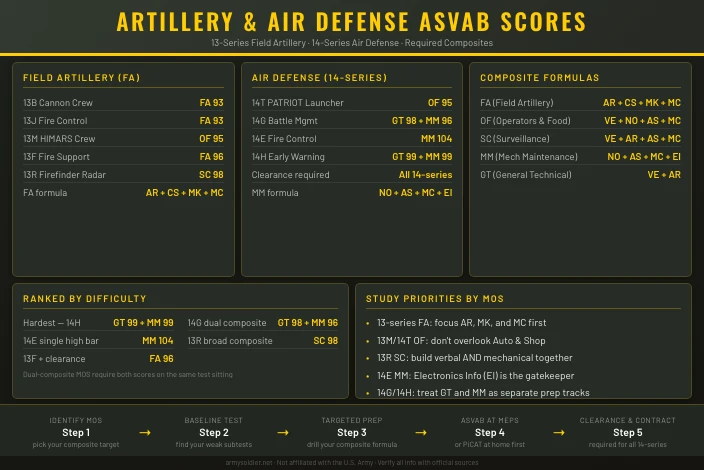
At a Glance: All Artillery & Air Defense ASVAB Requirements
Nine MOS fall inside CMF 13 (Field Artillery) and CMF 14 (Air Defense Artillery). Their score requirements spread across a wide range, from FA 93 for entry-level cannon work to dual composites in the high 90s and above 100 for the most technical air defense jobs. For the full Army-wide picture, the ASVAB scores for every Army MOS guide covers all career fields in one place.
| MOS | Title | Composite | Minimum |
|---|---|---|---|
| 13B | Cannon Crewmember | FA | 93 |
| 13F | Fire Support Specialist | FA | 96 |
| 13J | Fire Control Specialist | FA | 93 |
| 13M | MLRS/HIMARS Crewmember | OF | 95 |
| 13R | Firefinder Radar Operator | SC | 98 |
| 14T | PATRIOT Launching Station Operator | OF | 95 |
| 14E | PATRIOT Fire Control Operator | MM | 104 |
| 14G | Air Defense Battle Management System Operator | GT + MM | 98 + 96 |
| 14H | Air Defense Enhanced Early Warning System Operator | GT + MM | 99 + 99 |
Field Artillery Line Scores (13-Series)
| MOS | Title | Composite | Minimum | Clearance |
|---|---|---|---|---|
| 13B | Cannon Crewmember | FA | 93 | None |
| 13F | Fire Support Specialist | FA | 96 | Secret |
| 13J | Fire Control Specialist | FA | 93 | Secret |
| 13M | MLRS/HIMARS Crewmember | OF | 95 | Secret |
| 13R | Firefinder Radar Operator | SC | 98 | Secret |
The five 13-series MOS share a common theme: they are all combat arms jobs with real physical and tactical demands. But the ASVAB composites vary significantly, and two of the five require a Secret clearance on top of qualifying scores.
13B: Cannon Crewmember
The FA 93 requirement is the entry point for field artillery. FA combines Arithmetic Reasoning (AR), Coding Speed (CS), Mechanical Comprehension (MC), and Mathematics Knowledge (MK). A 93 is achievable with focused math and mechanical prep, but you can’t ignore it. Soldiers who guess through the math sections tend to land just under the threshold.
The job involves loading and firing howitzers, including the M119A3, M777A2, and M109A7 Paladin. Physical demands are heavy. No clearance is required. Soldiers who score FA 93 or higher have the most common entry-level slot in field artillery.
13F: Fire Support Specialist
The FA 96 minimum is three points above 13B, but the job is entirely different. A 13F is a forward observer embedded with infantry and armor units: the soldier who calls in artillery strikes, coordinates air support, and adjusts rounds onto targets. The higher score reflects the math and mechanical reasoning needed to operate targeting systems under fire.
A Secret clearance is required, and vision requirements are strict: normal depth perception, no color blindness, and distant acuity correctable to 20/20. Soldiers who hit FA 96 and pass the clearance investigation can choose this MOS over 13B or 13J if they prefer a forward, infantry-facing role.
13J: Fire Control Specialist
Like 13B, the FA 93 threshold qualifies you for 13J, but the jobs are nothing alike. Where a cannon crewmember is on the gun line in the weather, a 13J works inside a fire direction center operating the Advanced Field Artillery Tactical Data System (AFATDS). You process fire missions, compute firing data, and keep the digital network running.
The 13J requires a Secret clearance and full finger dexterity in both hands. It also demands color vision. You must distinguish red from green. Soldiers who score FA 93 but prefer technical computer work over manual crew tasks should compare 13J and 13B carefully before picking a contract.
13M: MLRS/HIMARS Crewmember
The OF 95 composite shifts the formula entirely. OF stands for Operators and Food, and it combines Verbal Expression (VE), Numerical Operations (NO), Auto and Shop Information (AS), and Mechanical Comprehension (MC). No Coding Speed, no Mathematics Knowledge. Instead, verbal ability and auto/shop knowledge carry more weight.
The 13M operates either the M270A1 MLRS or the M142 HIMARS. These rocket systems can strike targets up to 300 kilometers away with certain munitions. A Secret clearance is required. No red/green color deficiency is permitted. If your scores are stronger on verbal and auto/shop than on pure math, OF 95 may be easier to hit than an FA score in the mid-90s.
13R: Firefinder Radar Operator
The SC 98 is the most demanding single composite in the 13-series. SC (Surveillance and Communications) draws from Verbal Expression (VE), Arithmetic Reasoning (AR), Auto and Shop Information (AS), and Mechanical Comprehension (MC). Hitting 98 requires strength across all four. There is no way to coast on one strong subtest.
A 13R operates the AN/TPQ-36 and AN/TPQ-37 Firefinder radars to locate enemy mortar and artillery fire in real time. The data goes directly to fire direction centers for counter-battery missions. A Secret clearance is required.
Air Defense Artillery Line Scores (14-Series)
| MOS | Title | Composite(s) | Minimum(s) | Clearance |
|---|---|---|---|---|
| 14T | PATRIOT Launching Station Operator | OF | 95 | Secret |
| 14E | PATRIOT Fire Control Operator | MM | 104 | Secret |
| 14G | Air Defense Battle Management System Operator | GT + MM | 98 + 96 | Secret |
| 14H | Air Defense Enhanced Early Warning System Operator | GT + MM | 99 + 99 | Secret |
The 14-series covers the PATRIOT missile system and associated battle management networks. These MOS trend toward higher scores and more technical requirements than their field artillery counterparts. Two of the four require dual composites.
14T: PATRIOT Launching Station Operator
Like the 13M, the OF 95 threshold governs this MOS. The same four subtests apply: VE, NO, AS, and MC. The 14T operates the PATRIOT missile launching station: setting up the launcher, loading missile canisters, running diagnostics, and executing firing procedures when an engagement order comes through.
A Secret clearance is required. Color vision (red/green) must be normal. The OPAT category is Moderate, which is less demanding physically than Heavy-rated artillery MOS. Soldiers with strong verbal and auto/shop scores who prefer a systems-focused role over direct infantry support should look at 14T.
14E: PATRIOT Fire Control Operator
The MM 104 is the highest single-composite requirement in this cluster. MM (Mechanical Maintenance) draws from Numerical Operations (NO), Auto and Shop Information (AS), Mechanical Comprehension (MC), and Electronics Information (EI). Hitting 104 means genuine strength across mechanics, electronics, and math. The Electronics Information subtest separates 14E from most other MOS.
A 14E runs the Engagement Control Station, the command hub of a PATRIOT battery. You track inbound threats, classify them, and manage engagements using the AN/MPQ-65A radar system. This is one of the highest-bonus MOS in the Army, with enlistment incentives historically listed as high as $40,000. A Secret clearance is required.
The EI subtest is where most soldiers need additional preparation for this MOS. Study circuit basics, Ohm’s law, and electronics terminology specifically. Those topics are underrepresented in most generic ASVAB prep books.
14G: Air Defense Battle Management System Operator
The 14G requires two composites simultaneously: GT 98 and MM 96. GT (General Technical) uses VE + AR. MM uses NO + AS + MC + EI. You must hit both on the same test sitting. A high GT score alone does not qualify you, and a strong MM without GT doesn’t either.
As a 14G, you run the battle management networks that connect PATRIOT batteries, Sentinel radars, and joint air defense assets into a single operational picture. The job involves LAN/WAN maintenance, real-time threat processing, and coordination with allied units. A Secret clearance is required.
The dual-composite requirement makes prep strategy different from single-composite MOS. You need to build verbal and math skills (for GT) while also developing electronics and mechanical knowledge (for MM). Identify your weaker composite first and target it directly.
14H: Air Defense Enhanced Early Warning System Operator
The GT 99 and MM 99 dual requirement is the highest ASVAB bar in the entire artillery and air defense cluster. Both must reach 99 on the same test sitting. That means strong performance across six distinct subtests: VE, AR, NO, AS, MC, and EI.
The 14H manages early warning networks that track aerial threats from ground level to space, feeding that data to PATRIOT batteries and battle management units before a threat can get into range. The systems span classified ground sensors to space-based platforms. A Secret clearance is required. The OPAT category is Moderate.
No other enlisted MOS in this career field demands this level of ASVAB performance. Soldiers who hit GT 99 and MM 99 have legitimate pathways into some of the Army’s most technically advanced assignments.
Which MOS Has the Highest Bar
Here is the cluster ranked from most demanding to least, based on the total cognitive load of the composite requirements:
- 14H – GT 99 + MM 99 (dual; highest overall)
- 14G – GT 98 + MM 96 (dual)
- 14E – MM 104 (single, highest mechanical threshold)
- 13R – SC 98 (demands breadth across verbal, math, and mechanical)
- 13F – FA 96 (moderate, plus clearance and vision requirements)
- 13M / 14T – OF 95 (same threshold; different systems)
- 13B / 13J – FA 93 (entry-level field artillery threshold)
The 14H sits at the top because its dual GT/MM requirement forces high performance across the broadest set of subtests. Scoring 99 on GT requires verbal and arithmetic strength. Scoring 99 on MM requires mechanical, electronics, auto/shop, and numerical operations strength. There is no shortcut.
The 14E requires the single highest composite score at MM 104, but it draws from only four subtests. A focused candidate who drills NO, AS, MC, and EI specifically can hit that target without the broad-front preparation that 14H demands.
What to Study: Composites That Matter
Study decisions should flow directly from your target MOS, not from a generic ASVAB study plan.
If your target is 13B, 13F, or 13J (FA composite):
The FA formula is AR + CS + MK + MC. Arithmetic Reasoning and Mathematics Knowledge move your score the most. They also overlap with the GT composite, so improving them helps your overall score as well. Coding Speed is a timed pattern-recognition test; most test-takers improve it quickly with practice. Mechanical Comprehension rewards steady preparation over cramming.
If your target is 13M or 14T (OF composite):
The OF formula is VE + NO + AS + MC. Verbal Expression and Numerical Operations are your primary targets. Auto and Shop Information is the subtest most candidates underestimate. It covers vehicle systems, hand tools, and basic shop math. Review it specifically rather than relying on general knowledge.
If your target is 13R (SC composite):
SC uses VE + AR + AS + MC. Arithmetic Reasoning and Auto/Shop carry significant weight. This composite rewards mechanical aptitude combined with verbal reasoning, an unusual combination that makes unfocused prep less effective.
If your target is 14E, 14G, or 14H (MM composite, with GT for 14G/14H):
Electronics Information is the subtest that determines whether you qualify for these MOS or fall short. Most ASVAB prep materials give it less coverage than AR or MC. Study circuit diagrams, series and parallel circuits, basic electrical formulas, and common component functions. For 14G and 14H, also build GT by improving your verbal reasoning and arithmetic.
You may also find ASVAB scores for Army combat arms MOS and Army ASVAB test prep helpful as you plan your preparation.