Best ASVAB Scores for Army Aviation MOS Jobs
Army aviation runs on more than rotors and turbine fuel. Every 15-series MOS has a minimum ASVAB line score requirement, and the spread is wider than most people expect. A helicopter mechanic and an attack helicopter avionics repairer both work on the same flight line, but one needs MM 104 and the other needs MM 105 plus EL 100 at the same time. Air traffic controllers need a Skilled Technical score above 100. UAS operators use a completely different composite. If aviation is where you want to land, the ASVAB sections you focus on depend entirely on which MOS you’re targeting.
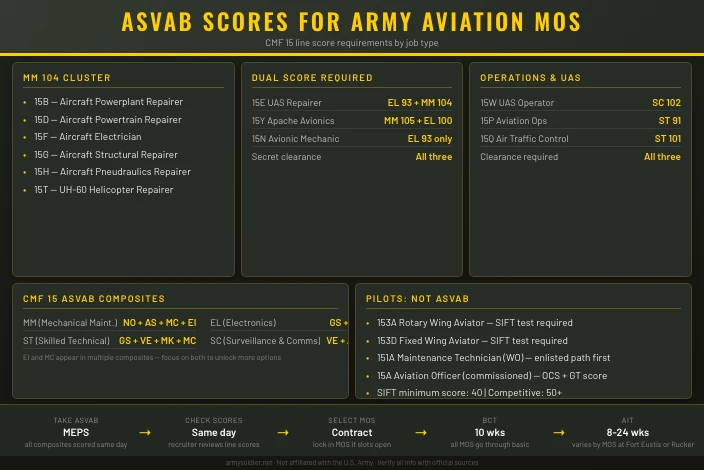
How Army Aviation ASVAB Scores Work
The ASVAB produces ten subtests, and the Army doesn’t use a single score for MOS qualification. Instead, it groups subtests into composite scores called line scores, and each MOS specifies one or more line scores you must hit.
For most 15-series maintenance MOS jobs, the relevant composite is the Mechanical Maintenance (MM) score. MM adds together four subtests: Numerical Operations (NO), Auto and Shop Information (AS), Mechanical Comprehension (MC), and Electronics Information (EI). Strong performance in MC and AS drives this number more than anything else.
A second composite appears frequently in aviation: Electronics (EL). That score pulls from General Science (GS), Arithmetic Reasoning (AR), Mathematics Knowledge (MK), and Electronics Information (EI). It’s the gateway to avionics and electronic systems roles.
Two more composites show up in aviation operations and UAS:
- Skilled Technical (ST): GS + VE + MK + MC. Required for aviation operations and air traffic control roles.
- Surveillance and Communications (SC): VE + AR + AS + MC. The gateway to UAS operator roles.
Every composite overlaps with others on at least one subtest, which means studying certain areas pays off across multiple MOS options at once. MC appears in both MM and ST. EI appears in both MM and EL. Put serious work into MC and EI and your options inside CMF 15 expand.
When you purchase through links on our site, we may receive compensation at no extra cost to you.
Build your ASVAB scores before you visit a recruiter. Our ASVAB prep course walks through every composite used by aviation MOS jobs. If you prefer a book, the ASVAB study guide covers all nine subtests with full practice tests.
Helicopter Maintenance MOS Line Scores
Most of the Army’s helicopter maintenance MOS jobs share the same MM 104 threshold. That consistency exists because they all do fundamentally similar work on flight-critical mechanical systems.
| MOS | Title | Required Score |
|---|---|---|
| 15B | Aircraft Powerplant Repairer | MM: 104 |
| 15D | Aircraft Powertrain Repairer | MM: 104 |
| 15F | Aircraft Electrician | MM: 104 |
| 15G | Aircraft Structural Repairer | MM: 104 |
| 15H | Aircraft Pneudraulics Repairer | MM: 104 |
| 15T | UH-60 Helicopter Repairer | MM: 104 |
| 15U | CH-47 Helicopter Repairer | MM: 104 |
The 15F Aircraft Electrician requires the same MM 104 as the structural and powertrain repairers, even though electrical troubleshooting might seem more electronics-focused. MM’s inclusion of Electronics Information captures enough of the electrical aptitude the Army needs for this role.
The 15R AH-64 Attack Helicopter Repairer sits slightly below the MM 104 cluster. It requires MM 99, which still demands strong mechanical aptitude but is the lowest MM threshold in the CMF 15 maintenance group. If your MM falls between 99 and 104, the 15R Apache Repairer is your broadest maintenance option.
Platform-Specific Notes
The 15T UH-60 Black Hawk Repairer and 15U CH-47 Chinook Repairer both require MM 104. Both are high-demand MOS jobs with slots at aviation units across the Army. If you hit MM 104, you can pursue either without re-testing.
None of these maintenance MOS jobs require a security clearance at enlistment. If a later assignment puts you in a classified unit like the 160th Special Operations Aviation Regiment, you would go through a separate clearance process at that time.
Advanced Technical MOS: Higher Bar, Deeper Specialty
Two aviation MOS jobs stand apart from the standard MM 104 cluster because they require scores in multiple composites.
15E Unmanned Aircraft Systems Repairer requires both EL 93 and MM 104. You need to hit both simultaneously. The dual requirement reflects the nature of the job: UAS maintenance combines mechanical systems work with avionics and electronics troubleshooting. Miss either composite and you cannot contract for this MOS.
15Y AH-64D Armament/Electrical/Avionics Repairer requires MM 105 and EL 100, both at once. This is the highest combined line score requirement in the CMF 15 enlisted career field. The 15Y maintains the Apache’s weapons systems, targeting sensors, and electrical distribution. An MM of 107 means nothing if EL comes in at 98. Both thresholds are hard requirements.
Both the 15E and 15Y require a Secret security clearance. The 15E works with sensitive UAS systems. The 15Y handles classified Apache weapons and sensor capabilities.
| MOS | Title | Required Scores |
|---|---|---|
| 15E | UAS Repairer | EL: 93 and MM: 104 |
| 15Y | AH-64D Armament/Electrical/Avionics Repairer | MM: 105 and EL: 100 |
The 15N Avionic Mechanic uses only EL 93 with no MM requirement. If your EL score is strong but MM falls short, the 15N is the avionics path available to you. It also requires a Secret clearance.
Aviation Operations and Air Traffic Control
The two operations-focused MOS jobs in CMF 15 use different composites entirely.
The 15P Aviation Operations Specialist requires ST 91. This is the Skilled Technical composite, which tests General Science, Verbal Expression, Math Knowledge, and Mechanical Comprehension. The 15P runs the flight operations center, manages crew records, and coordinates with air traffic control and ground units. Strong verbal and organizational skills are what drive this score. A Secret clearance is required.
The 15Q Air Traffic Control Operator requires ST 101. That’s a 10-point jump from 15P on the same composite, reflecting the more demanding cognitive requirements of directing live aircraft. The 15Q also requires normal color vision, clear speech, and correctable-to-20/20 vision. A Secret clearance is mandatory. Of all the enlisted aviation career paths, 15Q offers one of the clearest pipelines to high-paying civilian work: the FAA runs a dedicated hiring track for military controllers and considers them “experienced” applicants.
UAS Operators
15W Unmanned Aircraft Systems Operator requires SC 102. The Surveillance and Communications composite combines Verbal Expression, Arithmetic Reasoning, Auto and Shop Information, and Mechanical Comprehension. It’s a different aptitude profile than the mechanical maintenance composites, which makes sense given the job: you’re piloting aircraft from a ground control station, not turning wrenches on them.
The 15W requires a Secret clearance. AIT runs approximately 23 weeks at Fort Huachuca, Arizona, the longest enlisted training pipeline in CMF 15 outside of the 15Y and 15N courses. The Army is transitioning 15E (UAS Repairer) and 15W into a combined 15X Tactical Unmanned Aircraft Systems Specialist role effective October 2026. New enlistees after that date will train as 15X, which will require EL 93, MM 99, and SC 102.
Complete CMF 15 ASVAB Score Reference
| MOS | Title | Line Score | Clearance |
|---|---|---|---|
| 15B | Aircraft Powerplant Repairer | MM: 104 | None |
| 15D | Aircraft Powertrain Repairer | MM: 104 | None |
| 15E | UAS Repairer | EL: 93, MM: 104 | Secret |
| 15F | Aircraft Electrician | MM: 104 | None |
| 15G | Aircraft Structural Repairer | MM: 104 | None |
| 15H | Aircraft Pneudraulics Repairer | MM: 104 | None |
| 15N | Avionic Mechanic | EL: 93 | Secret |
| 15P | Aviation Operations Specialist | ST: 91 | Secret |
| 15Q | Air Traffic Control Operator | ST: 101 | Secret |
| 15R | AH-64 Attack Helicopter Repairer | MM: 99 | None |
| 15T | UH-60 Helicopter Repairer | MM: 104 | None |
| 15U | CH-47 Helicopter Repairer | MM: 104 | None |
| 15W | UAS Operator | SC: 102 | Secret |
| 15Y | AH-64D Armament/Electrical/Avionics Repairer | MM: 105, EL: 100 | Secret |
Which ASVAB Sections to Focus On
The section that matters most depends on your target MOS cluster.
For helicopter maintenance (15B, 15D, 15F, 15G, 15H, 15T, 15U): Focus on Auto and Shop Information (AS) and Mechanical Comprehension (MC). These two subtests have the biggest effect on MM. Electronics Information (EI) matters too since it appears in MM. Someone who grew up working on engines or has basic auto shop experience tends to find AS familiar. MC requires understanding how gears, pulleys, and levers work under load.
For advanced technical roles (15E, 15N, 15Y): You need EL in addition to MM. EL depends on Arithmetic Reasoning (AR) and Mathematics Knowledge (MK) more heavily than MM does. If math is your weakness, address it before testing. The 15Y’s dual requirement means you can’t afford weakness in either composites direction.
For air traffic control and operations (15P, 15Q): The ST composite rewards verbal reasoning and math knowledge. Work on the Verbal Expression (VE) sections alongside MK and GS. The 15Q’s ST 101 threshold puts it above the median for most test-takers, so deliberate preparation is worth the time.
For UAS operations (15W): The SC composite blends mechanical understanding with verbal and arithmetic skills. The 15W draws a different candidate profile than the maintenance MOS jobs, and preparation should reflect that.
Warrant Officers and Officers Don’t Use ASVAB
This is important context before visiting a recruiter.
Warrant officer pilots (153A Rotary Wing Aviator, 153D Fixed Wing Aviator, and 153M UH-60 Pilot) do not qualify through ASVAB. They must take the Selection Instrument for Flight Training (SIFT), a separate test with a minimum score of 40. The SIFT covers spatial apperception, mechanical comprehension, army aviation information, and basic math. It can only be taken twice in a lifetime, with at least 180 days between attempts.
Similarly, the 151A Aviation Maintenance Technician and 150U UAS Operations Technician warrant officer MOS jobs do not use ASVAB for selection. These are routes for experienced enlisted soldiers who already hold the relevant enlisted MOS.
Commissioned aviation officers (15A, 15FA, and related) access aviation through OCS or ROTC. The Army uses the ASVAB GT score as one input for OCS eligibility, but ASVAB alone doesn’t determine commissioning. Commissioning criteria include degree requirements, medical fitness, and selection board review.
How to Use This Information at MEPS
When you sit down with the MEPS guidance counselor, knowing your line scores in advance gives you more control over the conversation. Counselors present available MOS options based on what you qualified for, but they may not lead with the aviation options unless you ask directly.
If your MM score hits 104, you qualify for the large cluster of helicopter maintenance MOS jobs and should ask about each one specifically. Slots vary by unit need, so some MOS jobs will have open ship dates and others won’t. Knowing your target going in means you can push for the right one rather than taking whatever comes up first.
If your ST score hits 101, ask specifically about 15Q. This MOS has a smaller pipeline than maintenance jobs, and some counselors may not surface it unless you request it.
If you narrowly missed a composite, ask about retesting. The ASVAB can be retested after a one-month wait, with a second retest available a month after that. Subsequent retests require a six-month wait. For a MOS that can define your next decade, the extra month of study is worth it.
You may also find our full ASVAB score breakdown for every Army MOS and Army ASVAB test prep guide helpful as you map out which MOS category is within your range.