Best ASVAB Scores for Combat Arms MOS
Combat arms ASVAB scores work differently than most other Army jobs. Instead of a single GT score, nearly every infantry, armor, and artillery MOS requires a specific composite line score built from a subset of ASVAB subtests. Some jobs only need a moderate score in one composite. Others need two high composites at the same time. Knowing which subtests to target before test day can be the difference between getting the job you want and getting routed into something else entirely.
This post pulls ASVAB requirements directly from each MOS profile on this site. Every number listed here is verified against the source page for that job.
What ASVAB Line Scores Actually Measure
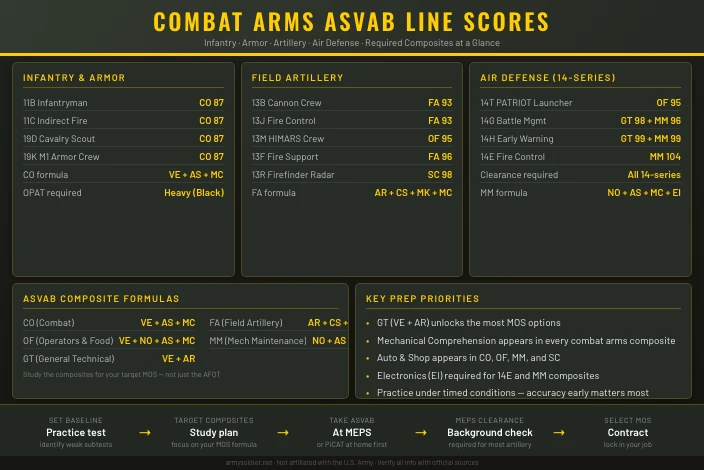
The ASVAB has ten subtests. Army MOS don’t use your raw scores – they combine specific subtests into line score composites, and each MOS has its own required composite. Infantry and armor mostly use the Combat (CO) composite, which measures the reading, mechanical, and general aptitude associated with ground combat roles. Artillery splits across Field Artillery (FA) and Operators and Food (OF) composites that weight math and mechanical understanding more heavily.
Air defense MOS go further, with some jobs requiring two composites simultaneously – both must be met.
| Composite | Subtests Included | What It Measures |
|---|---|---|
| CO (Combat) | VE + AS + MC | Reading, mechanical reasoning, auto/shop |
| FA (Field Artillery) | AR + CS + MK + MC | Math, coding speed, mechanical |
| OF (Operators and Food) | VE + NO + AS + MC | Reading, numerical operations, mechanical |
| MM (Mechanical Maintenance) | NO + AS + MC + EI | Electronics, mechanics, auto/shop |
| GT (General Technical) | VE + AR | Verbal expression, math reasoning |
| SC (Surveillance/Comms) | VE + AR + AS + MC | Verbal, math, mechanical reasoning |
If your target MOS uses the FA composite, you need to study Arithmetic Reasoning, Mathematics Knowledge, and Mechanical Comprehension specifically. If it uses CO, you focus on Word Knowledge, Paragraph Comprehension, Auto & Shop, and Mechanical Comprehension. Study the right subtests for your target job, not just the AFQT.
Get your scores before you talk to a recruiter. Take a timed practice test, identify your weak subtests, and target those specifically. An ASVAB study guide with section-specific practice tests lets you drill each composite independently so you know exactly where you stand.
When you purchase through links on our site, we may receive compensation at no extra cost to you.
Infantry ASVAB Scores
Infantry is the Army’s ground combat force. The 11B Infantryman and 11C Indirect Fire Infantryman both enter under the 11X enlistment option. You state a preference for 11B or 11C at MEPS, but the Army assigns your MOS based on its needs at the time of your training.
Both MOSs use the same score threshold. The combat composite is lower than most other Army jobs – the real filter for infantry is the physical assessment, not the test.
| MOS | Title | Line Score | Minimum | Formula |
|---|---|---|---|---|
| 11B | Infantryman | CO | 87 | VE + AS + MC |
| 11C | Indirect Fire Infantryman | CO | 87 | VE + AS + MC |
| 11X | Infantry Enlistment Option | CO | 87 | Same as above |
11B Infantryman
The 11B closes with and destroys the enemy through fire and maneuver. You operate rifles, machine guns, anti-armor systems, and direct the actions of a fire team at the squad level. A CO score of 87 is among the lower requirements in the Army. Most people who study can hit it.
The bigger challenge is physical. The 11B requires the Heavy (Black) OPAT category: a 160-lb strength deadlift, 43 shuttle runs on the aerobic interval, a standing long jump of at least 160 cm, and a seated power throw of at least 450 cm. That standard is harder to meet than the test score.
11C Indirect Fire Infantryman
The 11C operates 60mm, 81mm, and 120mm mortar systems. You compute firing data, set up mortar positions, and put high-explosive rounds on target from behind cover. The same CO 87 threshold applies, but the job demands both physical toughness and math accuracy – you run ballistic calculations under fire during real missions.
Both MOSs complete 22 weeks of One Station Unit Training (OSUT) at Fort Moore, Georgia.
What CO 87 Means for Your Prep
A CO score of 87 means you need solid performance on the Auto & Shop Information (AS) and Mechanical Comprehension (MC) subtests along with the Verbal Expression (VE) subtests (Word Knowledge + Paragraph Comprehension). Study vocabulary, simple machines, and basic tool mechanics. The score is achievable for most applicants who put in 4 to 6 weeks of focused prep.
Armor ASVAB Scores
Armor MOSs also use the Combat composite. Both 19D Cavalry Scout and 19K M1 Armor Crewmember require the same threshold as infantry.
| MOS | Title | Line Score | Minimum | Formula |
|---|---|---|---|---|
| 19D | Cavalry Scout | CO | 87 | VE + AS + MC |
| 19K | M1 Armor Crewmember | CO | 87 | VE + AS + MC |
19D Cavalry Scout
Scouts move ahead of the main force, find enemy positions, and report battlefield conditions. The 19D operates Bradleys, Strykers, and JLTVs, and employs crew-served weapons including TOW missiles, .50-caliber machine guns, and 25mm chain guns. The CO 87 minimum is the standard, but scouts also need to pass the Heavy OPAT category before shipping to training.
One additional physical limit applies: scouts must be able to operate effectively in armored vehicles. Height and weight standards are checked at MEPS.
19K M1 Armor Crewmember
The 19K crews the M1 Abrams main battle tank as driver, loader, gunner, or tank commander. The job requires a CO score of 87, but also carries a maximum height restriction of 6 feet, 1 inch. The turret and driver’s compartment simply don’t accommodate taller soldiers. If you’re close to that limit, confirm at MEPS before counting on the job.
Normal color vision is required for the 19K because ammunition types use color-coded markings and thermal sight settings require color discrimination.
Armor vs. Infantry: Same Score, Different Jobs
Both families share the CO 87 floor. The difference comes after you qualify. Armor crewmembers spend far more time on vehicle maintenance and gunnery drills. Scouts balance vehicle operations with dismounted reconnaissance. If you want to operate armor platforms rather than conduct foot patrols, the 19-series is a better fit at the same score level. A full breakdown of how the scout and tanker jobs compare on platforms, training, and civilian career paths is in 19D Cavalry Scout vs 19K Tanker.
Artillery and Air Defense ASVAB Scores
Artillery and air defense MOSs require different composites – FA, OF, MM, or SC – and some require two composites at once. The score floors are generally higher than infantry and armor, and several jobs also require a Secret security clearance from day one.
| MOS | Title | Line Score | Minimum | Notes |
|---|---|---|---|---|
| 13B | Cannon Crewmember | FA | 93 | No clearance required |
| 13F | Fire Support Specialist | FA | 96 | Secret clearance required |
| 13J | Fire Control Specialist | FA | 93 | Secret clearance required |
| 13M | MLRS/HIMARS Crewmember | OF | 95 | Secret clearance required |
| 13R | Firefinder Radar Operator | SC | 98 | Secret clearance required |
| 14G | Air Defense Battle Mgmt Operator | GT 98 + MM 96 | Both required | Secret clearance |
| 14T | PATRIOT Launcher Operator | OF | 95 | Secret clearance required |
| 14E | PATRIOT Fire Control Operator | MM | 104 | Secret clearance required |
| 14H | Early Warning System Operator | GT 99 + MM 99 | Both required | Highest ADA requirement |
13B Cannon Crewmember
The 13B loads, aims, and fires howitzers. You operate the M119A3, M777A2, and M109A7 Paladin. A 155mm round weighs 95 pounds, and your crew moves thousands of pounds of ammunition during sustained fire missions. The FA 93 threshold is the lowest in the artillery family. It requires solid Arithmetic Reasoning, Coding Speed, Mechanical Comprehension, and Mathematics Knowledge. Math matters here – you compute firing data manually as a backup to digital systems.
No security clearance is required. This makes 13B the most accessible artillery MOS for applicants with any background concerns.
13F Fire Support Specialist
The 13F is the Army’s forward observer. You embed with infantry or armor units, locate targets, and call for artillery, mortar, and close air support. The FA score rises to 96, and a Secret clearance is required for initial award of the MOS.
The extra three points on the FA composite separate you from 13B and 13J candidates. The 13F is one of the most tactically demanding enlisted jobs – you operate independently at the front edge of the battlefield, often the only artillery-trained soldier in a rifle company.
13J Fire Control Specialist
The 13J runs fire direction centers, operating the Advanced Field Artillery Tactical Data System (AFATDS) to process fire missions and route them to gun lines. The FA composite minimum is 93, same as 13B, but the job is primarily computer-based rather than physical. A Secret clearance is required because AFATDS handles classified targeting data.
If you score 96 or above on FA, you can choose between 13F (forward observer) and 13J (fire control). Below 96, 13J is available. Below 93, neither is.
13M MLRS/HIMARS Crewmember
The 13M operates the HIMARS rocket launcher and MLRS tracked launcher – the systems that can strike targets 300 kilometers away with precision munitions. The requirement shifts to the OF composite at 95. OF measures Verbal Expression, Numerical Operations, Auto & Shop, and Mechanical Comprehension. A Secret clearance is required because these systems use classified munitions and mission data.
13R Firefinder Radar Operator
The 13R tracks incoming enemy fire and locates enemy positions using the AN/TPQ-36 and AN/TPQ-37 radar systems. The SC (Surveillance and Communications) composite of 98 is required – SC combines Verbal Expression, Arithmetic Reasoning, Auto & Shop, and Mechanical Comprehension. That’s a broader set of subtests than most artillery MOS, meaning you need well-rounded scores rather than strength in one area.
A Secret clearance is required. This is one of the more selective artillery jobs from a score standpoint.
Air Defense: The Highest Scores in Combat Arms
Air defense MOSs – the 14-series – have the most demanding ASVAB requirements in the combat arms world. Several jobs require two composites to be met simultaneously, not just one.
The 14T PATRIOT Launching Station Operator requires an OF 95, same as the 13M. The job involves emplacing and maintaining PATRIOT missile launchers and handling interceptor missiles during resupply.
The 14G Air Defense Battle Management System Operator requires both GT 98 and MM 96 simultaneously. Both must be met – a high GT alone doesn’t qualify you. The job runs Sentinel Radar networks and coordinates fires across theater air defense systems.
The 14E PATRIOT Fire Control Operator requires MM 104 – the highest single composite requirement in this family. MM tests No + AS + MC + EI (electronics). If you have strong electronics and mechanical aptitude, 14E is one of the most technically advanced enlisted jobs in the Army.
The 14H Early Warning System Operator requires both MM 99 and GT 99 simultaneously. That is the highest dual-composite requirement among ADA enlisted MOS. You need to be strong across verbal, math, electronics, mechanical, and auto/shop subtests all at once.
All air defense MOS require a Secret security clearance. The clearance process adds 2 to 4 months to the enlistment timeline. A deeper breakdown of every 13-series and 14-series requirement, including composite-specific study strategies, is in ASVAB scores for artillery and air defense MOS.
How to Improve Your Line Scores
Focus on GT First
The GT composite (VE + AR) appears in multiple combat arms requirements, either directly or indirectly through formulas that include VE and AR. A strong GT gives you the most flexibility across MOS options and also matters for warrant officer and officer candidate programs later.
Verbal Expression (VE) is Word Knowledge + Paragraph Comprehension. The most reliable way to raise VE is vocabulary. Study 20 to 30 new words per day using flashcards or a vocab app. Military prep lists cover common ASVAB vocabulary in a compressed format. Reading comprehension improves faster through timed practice than through passive reading.
Arithmetic Reasoning (AR) tests word problems, not equations. Practice translating sentences into math setups. Ratios, percentages, rates, and basic geometry cover most of what appears on the test. Work problems under time pressure because the real test is timed.
Mechanical Comprehension and Auto/Shop
These subtests appear in CO, FA, OF, MM, and SC composites. You cannot avoid them if your target is combat arms. Mechanical Comprehension covers simple machines: pulleys, levers, gears, and inclined planes. Auto & Shop covers basic engine parts, tools, and workshop tasks. Both subtests reward people who have worked on cars or engines, but they can be learned from scratch in 3 to 4 weeks.
Draw diagrams when studying. Visualizing a pulley system or a gear ratio is faster than memorizing rules.
Electronics (EI) for MM Score
If you’re targeting 14E (MM 104) or any MOS with an MM component, Electronics Information needs attention. EI covers circuits, current, voltage, resistance, and basic electronics concepts. It’s one of the subtests people skip most often because it feels distant – but it carries significant weight in the MM composite.
Use basic electronics tutorials online or a prep book chapter, then practice with timed question sets. The concepts are not complex, but the vocabulary is specific. You have to know the terms.
Test Timing
The ASVAB is adaptive in the computerized format. Early questions have more weight. Don’t rush through the first quarter of each section – accuracy there has more impact than speed later. Budget time evenly, skip questions you’re stuck on, and return if time allows.
If you’re a first-time tester, consider taking the PiCAT from home before your MEPS appointment. The PiCAT is an unproctored version of the ASVAB with a short verification test at MEPS. Your PiCAT score can stand in for the full ASVAB if you pass the verification check.
Scores, Security Clearances, and What Happens at MEPS
A qualifying ASVAB score gets you in the door, but several combat arms MOS add requirements that can slow or stop the process.
Security clearances are required for 13F, 13J, 13M, 13R, all 14-series MOS, and others. The investigation covers criminal history, financial records, foreign contacts, and background checks. Significant debt, felony convictions, or foreign citizenship can delay or disqualify. This is the #1 reason qualified applicants miss specific MOS slots. Know your background before you target a clearance-required job.
Physical demands are checked through the OPAT (Occupational Physical Assessment Test) at MEPS. Infantry, armor, and most artillery MOS require Heavy or Moderately Heavy categories. Air defense MOS (14-series) are typically Moderately Heavy or Moderate.
Vision and color vision disqualify more applicants than people expect. The 19K requires normal color vision. The 14E, 14G, 14T, and 14H all require red/green color discrimination. Get a color vision test at your optometrist before your MEPS date if you’re unsure.
This site is not affiliated with the U.S. Army or any government agency. Verify all information with official Army sources before making enlistment or career decisions.
If you are still deciding between infantry, armor, and artillery, Army Combat Arms Jobs: Infantry, Armor, Artillery compares all three families across training, daily life, and civilian career outcomes.
You may also find Best ASVAB Scores for Army Aviation MOS, Best ASVAB Scores for Special Operations MOS, and Best ASVAB Scores for Engineer MOS helpful.