Best ASVAB Scores for Army Cyber and Signal MOS
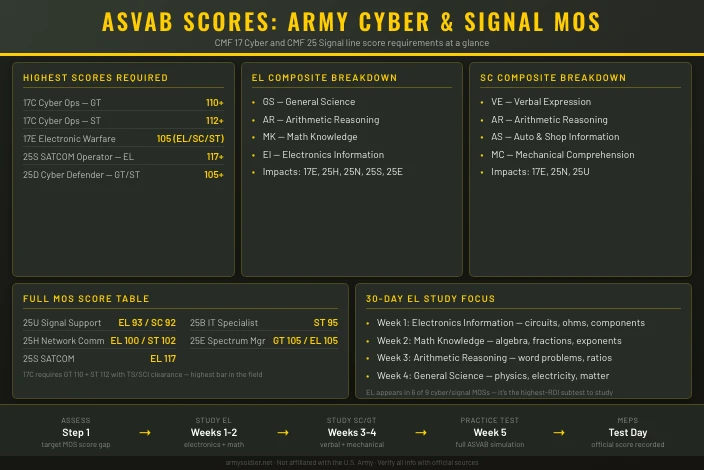
Cyber and signal jobs carry some of the highest ASVAB requirements in the entire Army. A 17C Cyber Operations Specialist needs a General Technical score of 110 and a Skilled Technical score of 112. A 25S SATCOM operator needs an Electronics score of 117, which is higher than what most medical MOSs require. If you want to work in CMF 17 or CMF 25, the test is the first filter, and it’s a serious one.
Why Cyber and Signal Demand High ASVAB Scores
These jobs train you on systems that take years to master. You configure encrypted networks, manage satellite transponders, hunt network intrusions, and manage electromagnetic spectrum for entire brigades. Getting those systems wrong during an operation doesn’t just inconvenience someone. It costs commanders the ability to coordinate fires, move troops, or call for support.
The Army uses ASVAB composites to screen for the cognitive skills that predict success in technical training. Electronics knowledge, math reasoning, and scientific thinking are the core areas. Signal and cyber MOSs draw from the same pool of subtests repeatedly because those subtests actually reflect what the jobs require.
Study resource: An ASVAB prep course with full-length practice tests and section-by-section tutorials will show exactly where your Electronics and Skilled Technical scores need work before you walk into MEPS.
When you purchase through links on our site, we may receive compensation at no extra cost to you.
CMF 25 Signal MOS: Score Requirements
CMF 25 covers every job that installs, operates, and maintains Army communications networks. The ASVAB bar ranges from moderate (25U Signal Support) to genuinely demanding (25S SATCOM). The two most common composites here are Electronics (EL) and Surveillance and Communications (SC).
| MOS | Title | Key Composite(s) | Minimum | Clearance |
|---|---|---|---|---|
| 25U | Signal Support Systems Specialist | EL, SC | EL 93 / SC 92 | Secret |
| 25B | Information Technology Specialist | ST | ST 95 | Secret |
| 25H | Network Communication Systems Specialist | EL, ST | EL 100 / ST 102 | Secret |
| 25N | Nodal Network Systems Operator | EL, SC | EL 102 / SC 105 | Secret |
| 25E | Electromagnetic Spectrum Manager | GT, EL | GT 105 / EL 105 | Secret (TS required to maintain) |
| 25D | Cyber Network Defender | GT, ST | GT 105 / ST 105 | Top Secret |
| 25S | Satellite Communication Systems Operator | EL | EL 117 | Secret |
25U is the most accessible entry point. An EL of 93 and SC of 92 are reachable with focused study. You install and maintain tactical radios and data systems at the battalion level.
25B needs only a Skilled Technical score of 95 to manage Army computer networks and troubleshoot IT systems. It’s the broadest signal job and the most common.
25H replaced three legacy signal MOSs (25L, 25N, 25Q) in 2022. The job covers fiber optic cabling, satellite terminals, and nodal systems in a single 19-week AIT. You need EL 100 and ST 102.
25S has the steepest single composite in the CMF: EL 117. Satellite operations require a deep foundation in radio frequency physics, signal propagation, and electronics. You point multi-ton dish antennas at satellites 22,000 miles out and troubleshoot link degradation in the field.
25D is a reclassification MOS for experienced NCOs (E-6 and above) already serving in signal. You need GT 105 and ST 105, plus four years of IT experience, a battalion commander’s recommendation, and a Top Secret clearance. New enlistees cannot go directly into 25D.
25E is another reclassification specialty, open to soldiers already qualified in select signal MOSs. You manage the Army’s radio frequency assignments across an area of operations, preventing interference between friendly systems. GT 105 and EL 105 are required. Color blindness is disqualifying.
A note on 25N
The 25N MOS was consolidated into 25H in October 2022. Soldiers who held the identifier remain in that specialty. New accessions train under 25H. The 25N scores listed above (EL 102 / SC 105) still apply to existing holders and appear in some recruiting materials.
CMF 17 Cyber MOS: Score Requirements
CMF 17 contains two enlisted MOSs. Both require a Top Secret/SCI security clearance and multiple line scores above 100. They are among the most selective enlisted jobs in the Army.
| MOS | Title | Key Composite(s) | Minimums | Clearance |
|---|---|---|---|---|
| 17C | Cyber Operations Specialist | GT, ST | GT 110 / ST 112 | Top Secret/SCI |
| 17E | Electronic Warfare Specialist | EL, SC, ST | 105 on all three | Top Secret/SCI |
17C is the Army’s offensive and defensive cyber operator. You work inside SCIFs on classified networks, hunt intrusions, and conduct authorized offensive cyber missions against adversary systems. The GT minimum of 110 and ST minimum of 112 are both well above the Army average. A single composite below minimum disqualifies you.
17E requires all three composites to hit 105 simultaneously: Electronics, Surveillance and Communications, and Skilled Technical. That’s a harder qualification than 17C because you need to be strong across a wider range of subtests. Electronic Warfare Specialists control the electromagnetic spectrum, jam enemy communications, and protect friendly systems. The 28-week AIT at Fort Eisenhower is among the longest enlisted programs in the Army. A counterintelligence polygraph may be required by some unit assignments.
Both CMF 17 MOSs carry a 5-year service obligation beyond AIT and require a TS/SCI clearance that can take months to adjudicate. U.S. citizenship is required. No permanent residents.
Clearance level and scores together
For the CMF 17 MOSs, the clearance requirement is as much of a filter as the ASVAB. Past drug use, significant debt, foreign contacts, or a criminal record can slow or stop the process. The ASVAB gets you to the door; a clean background gets you through it.
Study resource: A structured ASVAB study guide that breaks down each composite by subtest is the fastest way to identify which sections of Electronics Information, Math Knowledge, and General Science need the most work.
When you purchase through links on our site, we may receive compensation at no extra cost to you.
Which Composites Matter Most
Every cyber and signal ASVAB requirement traces back to a handful of subtests. Knowing which ones to study, and why, saves you from scattershot preparation.
Electronics (EL) = GS + AR + MK + EI
The EL composite appears in six of the nine MOSs covered here. It measures your ability to reason about circuits, electricity, and math. If you can only focus on one composite, make it EL. General Science and Electronics Information are the subtests candidates most often underestimate. Physics concepts like Ohm’s Law, circuit types, and electromagnetic theory show up directly in the Electronics Information section.
Skilled Technical (ST) = GS + VE + MK + MC
ST appears in 17C, 17E, 25B, 25D, and 25H. It overlaps with EL on General Science and Math Knowledge. The differences are Verbal Expression and Mechanical Comprehension. If you strengthen EL, your ST score typically rises with it.
General Technical (GT) = VE + AR
GT appears as a primary threshold for 17C (110) and 25D (105). It rewards verbal ability and math reasoning. The Verbal Expression score (VE) is derived from Word Knowledge and Paragraph Comprehension. Reading widely and practicing context clues moves VE faster than drilling math.
Surveillance and Communications (SC) = VE + AR + AS + MC
SC shows up in 17E, 25N, and 25U. Auto and Shop Information is the unusual subtest here. Candidates with no mechanical background sometimes find AS difficult to prepare for quickly. Practice AS through sample questions covering tools, engines, and automotive systems.
Composite overlap across MOSs
The table below shows which subtests have the widest influence. Study these first.
| Subtest | Appears In | MOS Composites Affected |
|---|---|---|
| AR (Arithmetic Reasoning) | EL, GT, SC | 17C, 17E, 25B, 25D, 25E, 25H, 25N, 25S, 25U |
| MK (Math Knowledge) | EL, ST | 17C, 17E, 25B, 25D, 25E, 25H, 25N, 25S |
| GS (General Science) | EL, ST | 17C, 17E, 25B, 25D, 25E, 25H, 25N, 25S |
| EI (Electronics Info) | EL | 17E, 25E, 25H, 25N, 25S, 25U |
| VE (Verbal Expression) | GT, SC, ST | 17C, 17E, 25B, 25D, 25E, 25N, 25U |
AR, MK, and GS appear in almost every composite. They are your three highest-impact prep areas.
Civilian Salary Context
The ASVAB scores required for these jobs exist because the skills are genuinely rare and valuable. The same knowledge that gets you into 17C or 25D will pay well the day you leave the Army.
| Civilian Job | Median Annual Salary | 10-Year Outlook |
|---|---|---|
| Information Security Analyst | $124,910 | +29% |
| Computer and Information Systems Manager | $169,510 | +17% |
| Computer Systems Analyst | $103,790 | +9% |
| Network and Computer Systems Administrator | $96,800 | -4% (14,300+ openings/yr) |
| Telecommunications Technician | $64,310 | -3% (stable in defense sector) |
All salary data from the Bureau of Labor Statistics (May 2024). The 29% growth outlook for information security analysts is one of the highest projections across all occupations in the Occupational Outlook Handbook. Veterans who leave 17C or 25D with an active TS/SCI clearance and Security+ certification regularly land offers well above the median from defense contractors.
Cleared cyber professionals in markets like the D.C. metro corridor, San Antonio, and Colorado Springs often earn $90,000 to $130,000 in their first civilian year. That gap between military pay and civilian pay is precisely why the Army has historically offered enlistment bonuses for CMF 17 MOSs.
EL-Focused Study Plan
The Electronics composite is the single highest-return investment for anyone targeting cyber and signal jobs. Here’s a four-week plan built around it.
Week 1: Electronics Information basics
Electronics Information (EI) is the subtest most candidates skip until it’s too late. Cover Ohm’s Law, series and parallel circuits, basic components (resistors, capacitors, diodes, transistors), and units of measurement. You don’t need engineer-level depth. You need pattern recognition across common question types.
Week 2: Math Knowledge and Arithmetic Reasoning
MK covers algebra, ratios, fractions, exponents, and geometry. AR covers word problems that require setting up equations from a situation. Work 20-30 problems per day. Time yourself. The ASVAB is a timed test, and AR is the section where slow readers lose the most points.
Week 3: General Science
GS covers biology, chemistry, and physics. For cyber and signal prep, weight your time toward physics. Wave behavior, electromagnetic spectrum concepts, and basic circuit physics all appear in both GS and EI. Biology and chemistry questions are real but less concentrated in GS than physics for this MOS group.
Week 4: Full practice tests and gap work
Take a full practice ASVAB under timed conditions. Score your EL, ST, and SC composites using the formula for each one. Identify which subtests pulled your composite down and run targeted drills on those sections for the final days before your test.
A practice test matters more than a final week of reading. You can’t study your way to speed without simulating the actual test conditions.
You may also find ASVAB scores for every Army MOS and Army ASVAB test prep helpful for your preparation. If intelligence MOS scores interest you, ASVAB scores for Army intelligence jobs covers the 35-series requirements in the same format.