Best ASVAB Scores for Engineer MOS
Army engineer jobs span a wider range than most career fields. A 12B Combat Engineer needs the same score as an infantryman. A 12P Prime Power Production Specialist needs three separate composites to all clear their minimums at once. If you’re looking at the Army engineer career field and wondering where your scores need to land, this post pulls the verified line score requirements from each MOS profile page on this site.
Every number below comes from a published profile. Nothing here is guessed.
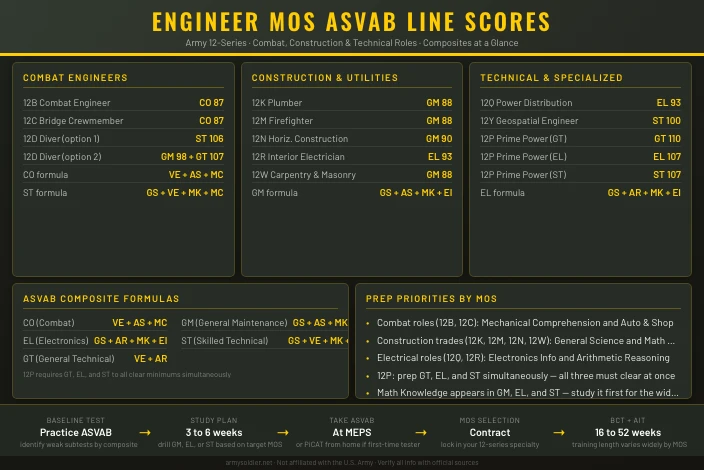
Engineer MOS ASVAB Scores at a Glance
The 12-series uses five composites: CO (Combat), GM (General Maintenance), EL (Electronics), ST (Skilled Technical), and GT (General Technical). The combat and construction jobs cluster around GM and CO. The electrical and technical jobs push into EL and ST territory, which require stronger math and science backgrounds.
| MOS | Job Title | Composite | Minimum Score |
|---|---|---|---|
| 12B | Combat Engineer | CO | 87 |
| 12C | Bridge Crewmember | CO | 87 |
| 12D | Diver | ST or GM+GT | ST: 106, OR GM: 98 + GT: 107 |
| 12K | Plumber | GM | 88 |
| 12M | Firefighter | GM | 88 |
| 12N | Horizontal Construction Engineer | GM | 90 |
| 12P | Prime Power Production Specialist | GT + EL + ST | GT: 110, EL: 107, ST: 107 (all three) |
| 12Q | Power Distribution Specialist | EL | 93 |
| 12R | Interior Electrician | EL | 93 |
| 12W | Carpentry and Masonry Specialist | GM | 88 |
| 12Y | Geospatial Engineer | ST | 100 |
Note: 12H (Construction Engineering Supervisor) is a reclassification-only MOS – you cannot enlist directly into it. It requires a GM score of 93 at the time of reclassification from a feeder MOS such as 12W, 12K, or 12R.
Raise your line scores before you talk to a recruiter. An ASVAB study guide with section-specific practice tests lets you drill GM, EL, and ST composites separately so you know exactly where you stand.
When you purchase through links on our site, we may receive compensation at no extra cost to you.
Combat Engineers: 12B, 12C, 12D
The combat-focused engineer jobs have the broadest range of ASVAB requirements in the field.
12B Combat Engineer
The 12B requires a CO (Combat) composite of 87. That’s the same floor as infantry, which tells you what the Army values most here: physical aptitude and general combat readiness. The CO composite combines Verbal Expression (VE), Auto & Shop Information (AS), and Mechanical Comprehension (MC).
The score requirement is moderate. The real filter for 12B is physical fitness, not the test.
12C Bridge Crewmember
The 12C also requires CO 87. The work is more physically demanding than most engineer jobs – bridge erection in moving water at night is a serious operational task. The ASVAB entry point is the same as 12B, but recruits need to be ready for hard outdoor work in all conditions from day one of AIT.
12D Diver
The 12D has the most complex scoring requirement of any combat engineer MOS. You need either:
- ST (Skilled Technical) of 106 or higher, OR
- GM (General Maintenance) of 98 AND GT (General Technical) of 107 simultaneously
The ST composite draws from General Science, Verbal Expression, Mathematics Knowledge, and Mechanical Comprehension. The dual-composite option requires both GM and GT to clear their floors at the same time. This is one of the harder qualification bars in the engineer career field. Candidates who fall short on ST often find the GM+GT route requires comparable preparation anyway.
Construction and Utilities: 12K, 12M, 12N, 12R, 12W
The construction and trades MOS group around the GM composite. The shared formula – General Science (GS) + Auto & Shop (AS) + Mathematics Knowledge (MK) + Electronics Information (EI) – reflects the mechanical and practical aptitude these jobs need.
12K Plumber
The 12K requires GM 88. It’s the same floor as 12W and 12M. Candidates with construction or shop backgrounds tend to hit this without much difficulty. The Army teaches the specific plumbing skills in AIT – the ASVAB threshold is about confirming general mechanical aptitude, not prior trade experience.
12M Firefighter
The 12M also needs GM 88. This MOS blends emergency response with structural firefighting, aircraft rescue, and hazmat operations at installations and deployed airfields. The moderate GM requirement reflects a job where hands-on mechanical sense matters more than technical engineering depth.
12N Horizontal Construction Engineer
The 12N raises the GM bar to 90. You’ll operate heavy equipment – bulldozers, graders, scrapers – and build roads, airfields, and fighting positions. The slightly higher threshold compared to 12K and 12M reflects the equipment complexity and terrain judgment this MOS demands.
12R Interior Electrician
The 12R shifts to the EL (Electronics) composite and requires a minimum of 93. That’s the same score as the 12Q. EL is calculated from General Science (GS), Arithmetic Reasoning (AR), Mathematics Knowledge (MK), and Electronics Information (EI). Strong math and electronics preparation are the most efficient way to push this composite up.
12W Carpentry and Masonry Specialist
The 12W requires GM 88. Like 12K and 12M, this is a trades-focused job where prior workshop or construction experience helps with the ASVAB but is not required to qualify. AIT at Fort Leonard Wood covers the technical skills from scratch.
Technical and Specialized: 12P, 12Q, 12Y
The electrical and specialized roles in the 12-series require the highest ASVAB composites in the career field. These jobs overlap with STEM skills – electronics, physics, and geospatial math – and the scoring reflects that.
12P Prime Power Production Specialist
The 12P has the most demanding ASVAB requirement of any engineer MOS. You need all three composites to meet minimums at the same time:
- GT 110 (General Technical: Verbal Expression + Arithmetic Reasoning)
- EL 107 (Electronics: GS + AR + MK + EI)
- ST 107 (Skilled Technical: GS + VE + MK + MC)
A strong score in two composites doesn’t compensate for a shortfall in the third. All three have to clear simultaneously. This is one of the highest collective ASVAB requirements across the entire Army. AIT is nearly a year long, and the civilian pay ceiling for prime power electricians is well above six figures.
12Q Power Distribution Specialist
The 12Q requires EL 93. You’ll install and maintain overhead and underground electrical distribution lines, erect utility poles, and work with transformers and switching gear. The EL composite requires solid performance across general science, arithmetic reasoning, math knowledge, and electronics information. Studying electronics fundamentals before the test pays off.
12Y Geospatial Engineer
The 12Y requires ST 100. This MOS uses GPS, GIS software, and survey equipment to produce terrain analysis and geospatial products for mission planning. The Skilled Technical composite reflects the science and math background the job needs. Recruits with coursework in geography, cartography, or STEM fields tend to qualify without extensive ASVAB prep.
How to Study for Engineer Line Scores
The three composites that matter most for 12-series MOS jobs are GM, EL, and ST. Here’s what goes into each one:
GM (General Maintenance): GS + AS + MK + EI
- Focus areas: Auto & Shop Information, General Science, and basic electronics
- Who benefits: Anyone with mechanical, shop, or construction background
- Realistic prep timeline: 3 to 5 weeks of focused study
EL (Electronics): GS + AR + MK + EI
- Focus areas: Electronics Information, Arithmetic Reasoning, Mathematics Knowledge
- Who benefits: Candidates with any electrical, physics, or electronics experience
- Realistic prep timeline: 4 to 6 weeks, with emphasis on circuit concepts and algebra
ST (Skilled Technical): GS + VE + MK + MC
- Focus areas: General Science, Mechanical Comprehension, Mathematics Knowledge
- Who benefits: Candidates with strong science coursework
- Realistic prep timeline: 4 to 6 weeks with priority on science and mechanics
GT (General Technical): VE + AR
- Focus areas: Word Knowledge, Paragraph Comprehension, Arithmetic Reasoning
- Who benefits: Strong readers who brush up on basic math
- Realistic prep timeline: 2 to 3 weeks for most candidates
For the 12P, you need to prepare for GT, EL, and ST simultaneously. Build a study plan that cycles through all three composites weekly so no composite goes cold before test day.
One of the most efficient study methods is taking a timed practice test by section, identifying the two or three subtests where you’re losing the most points, and drilling those specifically. Generic ASVAB prep that reviews every subtest equally is slower. Study the composites your target MOS actually uses.
Prepare smarter, not longer. An ASVAB prep course with full-length practice tests lets you measure your composite scores before your MEPS appointment and target the weak subtests before they cost you your MOS.
When you purchase through links on our site, we may receive compensation at no extra cost to you.
This site is not affiliated with the U.S. Army or any government agency. Verify all information with official Army sources before making enlistment or career decisions.
You may also find ASVAB scores for every Army MOS and Best ASVAB Scores for Combat Arms MOS helpful for planning your score targets, or visit the Army ASVAB test prep guide to start studying. For a full overview of what each MOS actually does day to day, see the Army Engineer MOS Jobs guide.